Thank you for visiting SNEWPapers!
Sign up free
Daily National Intelligencer
Washington, District Of Columbia
What is this article about?
On January 4, the U.S. House of Representatives reported bills on Virginia Military Land Warrants and discharging O. Spellman from imprisonment, both committed. A Treasury report on Thomas Cook's petition was referred. A motion instructed inquiry into a post route from Canandaigua to Sheldon. The House debated a contested election between Rufus Easton and John Scott for Missouri Territory delegate, with speeches from Easton, Betts, Robertson, Wright, and M'Kee.
Clipping
OCR Quality
Full Text
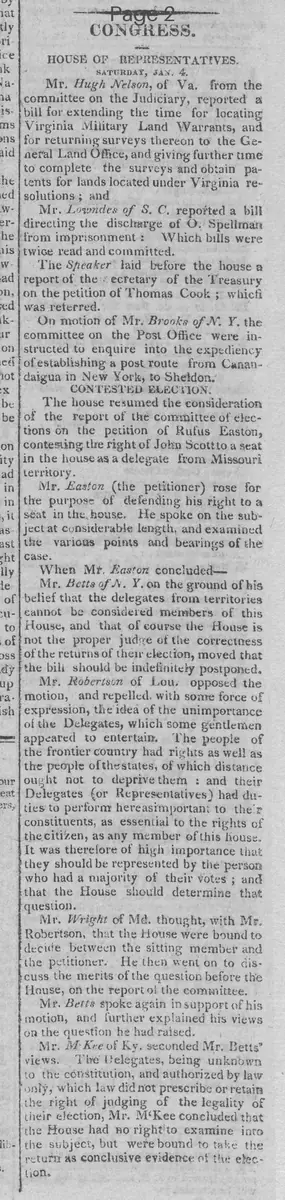
HOUSE OF REPRESENTATIVES.
SATURDAY, JAN. 4.
Mr. Hugh Nelson, of Va. from the committee on the Judiciary, reported a bill for extending the time for locating Virginia Military Land Warrants, and for returning surveys thereon to the General Land Office, and giving further time to complete the surveys and obtain patents for lands located under Virginia resolutions: and
Mr. Lowndes of S. C. reported a bill directing the discharge of O. Spellman from imprisonment: Which bills were twice read and committed.
The Speaker laid before the house a report of the Secretary of the Treasury on the petition of Thomas Cook; which was referred.
On motion of Mr. Brooks of N. Y. the committee on the Post Office were instructed to enquire into the expediency of establishing a post route from Canandaigua in New York, to Sheldon.
CONTESTED ELECTION.
The house resumed the consideration of the report of the committee of elections on the petition of Rufus Easton, contesting the right of John Scott to a seat in the house as a delegate from Missouri territory.
Mr. Easton (the petitioner) rose for the purpose of defending his right to a seat in the house. He spoke on the subject at considerable length, and examined the various points and bearings of the case.
When Mr. Easton concluded Mr. Betts of N. Y. on the ground of his belief that the delegates from territories cannot be considered members of this House, and that of course the House is not the proper judge of the correctness of the returns of their election, moved that the bill should be indefinitely postponed.
Mr. Robertson of Lou. opposed the motion, and repelled, with some force of expression, the idea of the unimportance of the Delegates, which some gentlemen appeared to entertain. The people of the frontier country had rights as well as the people of the states, of which distance ought not to deprive them: and their Delegates (or Representatives) had duties to perform here as important to their constituents, as essential to the rights of the citizen, as any member of this house. It was therefore of high importance that they should be represented by the person who had a majority of their votes; and that the House should determine that question.
Mr. Wright of Md. thought, with Mr. Robertson, that the House were bound to decide between the sitting member and the petitioner. He then went on to discuss the merits of the question before the House, on the report of the committee.
Mr. Betts spoke again in support of his motion, and further explained his views on the question he had raised.
Mr. M'Kee of Ky. seconded Mr. Betts views. The delegates, being unknown to the constitution, and authorized by law only, which law did not prescribe or retain the right of judging of the legality of their election, Mr. M'Kee concluded that the House had no right to examine into the subject, but were bound to take the return as conclusive evidence of the election.
j.'
What sub-type of article is it?
What keywords are associated?
What entities or persons were involved?
Domestic News Details
Event Date
Saturday, Jan. 4.
Key Persons
Outcome
bills on land warrants and spellman's discharge reported and committed; treasury report on cook referred; post route inquiry instructed; contested election debate continued without resolution.
Event Details
House session included reporting and committing bills for extending Virginia Military Land Warrants and discharging O. Spellman; referring a Treasury report on Thomas Cook's petition; instructing post office committee on a route from Canandaigua to Sheldon; resuming debate on Rufus Easton's contest against John Scott's Missouri delegate seat, with speeches by Easton defending his claim, Betts moving indefinite postponement arguing territorial delegates not House members, Robertson opposing and emphasizing delegate importance, Wright supporting decision on merits, Betts elaborating, and M'Kee seconding Betts on constitutional grounds.