Thank you for visiting SNEWPapers!
Sign up free
Imperial Valley Press
El Centro, Imperial County, California
What is this article about?
The U.S. Senate approved an amendment by Sen. Tom Connally to broaden Social Security by matching state old age benefits on a 2-to-1 basis up to $15 monthly, with equal matching above that, passing 43-35 with support from Sen. William Borah.
Clipping
OCR Quality
Full Text
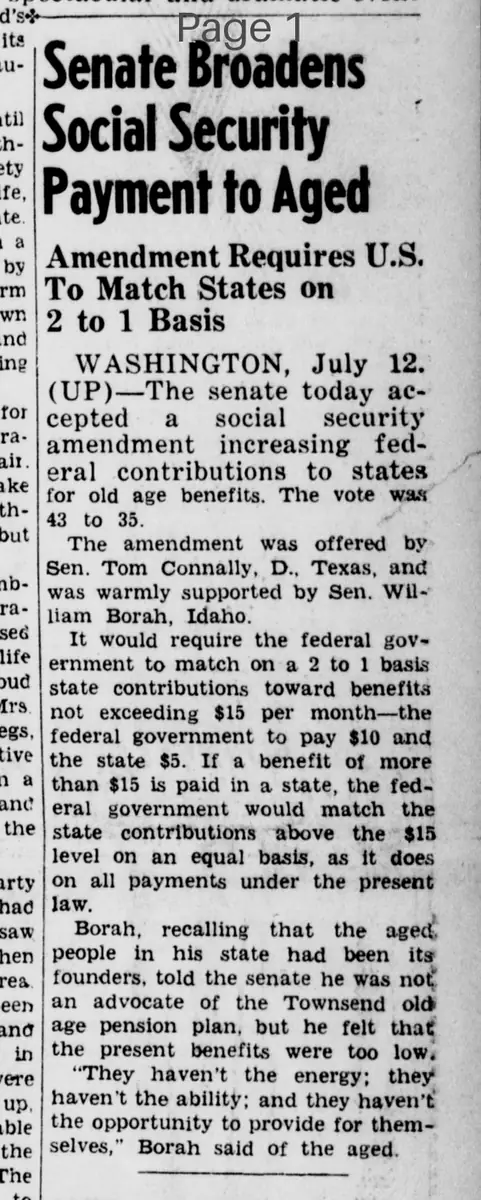
Amendment Requires U.S. To Match States on 2 to 1 Basis
WASHINGTON, July 12. (UP)-The senate today accepted a social security amendment increasing federal contributions to states for old age benefits. The vote was 43 to 35.
The amendment was offered by Sen. Tom Connally, D., Texas, and was warmly supported by Sen. William Borah, Idaho.
It would require the federal government to match on a 2 to 1 basis state contributions toward benefits not exceeding $15 per month-the federal government to pay $10 and the state $5. If a benefit of more than $15 is paid in a state, the federal government would match the state contributions above the $15 level on an equal basis, as it does on all payments under the present law.
Borah, recalling that the aged people in his state had been its founders, told the senate he was not an advocate of the Townsend old age pension plan, but he felt that the present benefits were too low.
"They haven't the energy; they haven't the ability; and they haven't the opportunity to provide for themselves," Borah said of the aged.
What sub-type of article is it?
What keywords are associated?
What entities or persons were involved?
Where did it happen?
Domestic News Details
Primary Location
Washington
Event Date
July 12
Key Persons
Outcome
the vote was 43 to 35.
Event Details
The senate accepted a social security amendment increasing federal contributions to states for old age benefits. The amendment requires the federal government to match on a 2 to 1 basis state contributions toward benefits not exceeding $15 per month-the federal government to pay $10 and the state $5. If a benefit of more than $15 is paid in a state, the federal government would match the state contributions above the $15 level on an equal basis, as it does on all payments under the present law.