Thank you for visiting SNEWPapers!
Sign up free
Editorial
April 17, 1799
Gazette Of The United States, & Philadelphia Daily Advertiser
Philadelphia, Philadelphia County, Pennsylvania
What is this article about?
Extract of a 1799 letter from Philadelphia criticizing Edmund Pendleton's letter for factual errors aimed at influencing Virginia elections against federal measures, including army and navy augmentation and loans, which the author defends as prudent. Discusses British treaty claims and political divisions threatening national unity.
Clipping
OCR Quality
98%
Excellent
Full Text
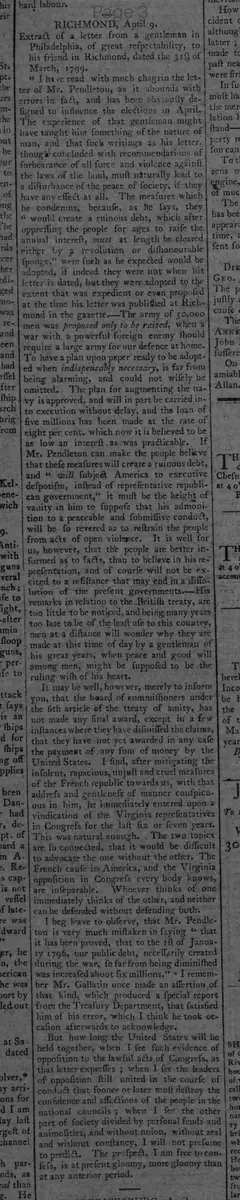
RICHMOND, April 9.
Extract of a letter from a gentleman in Philadelphia, of great respectability, to his friend in Richmond, dated the 31st of March, 1799.
"I have read with much chagrin the letter of Mr. Pendleton, as it abounds with errors in fact, and has been obviously designed to influence the elections in April. The experience of that gentleman might have taught him something of the nature of man, and that such writings as his letter, though concluded with recommendations of forbearance of all force and violence against the laws of the land, must naturally lead to a disturbance of the peace of society, if they have any effect at all. The measures which he condemns, because, as he says, they "would create a ruinous debt, which after oppressing the people for ages to raise the annual interest, must at length be cleared either by a revolution or dishonourable sponge," were such as he expected would be adopted, if indeed they were not when his letter is dated, but they were adopted to the extent that was expedient or even proposed at the time his letter was published at Richmond in the gazette. The army of 20,000 men was proposed only to be raised, when a war with a powerful foreign enemy should require a large army for our defence at home. To have a plan upon paper ready to be adopted when indispensably necessary, is far from being alarming, and could not wisely be omitted. The plan for augmenting the navy is approved, and will in part be carried into execution without delay, and the loan of five millions has been made at the rate of eight per cent. which now it is believed to be as low an interest as was practicable. If Mr. Pendleton can make the people believe that these measures will create a ruinous debt, and "will subject America to executive despotism, instead of representative republican government," it must be the height of vanity in him to suppose that his admonition to a peaceable and submissive conduct, will be so revered as to restrain the people from acts of open violence. It is well for us, however, that the people are better informed as to facts, than to believe in his representation, and of course will not be excited to a resistance that may end in a dissolution of the present governments. His remarks in relation to the British treaty, are too little to be noticed, and being many years too late to be of the least use to this country. Men at a distance will wonder why they are made at this time of day by a gentleman of his great years, when peace and good will among men, might be supposed to be the ruling wish of his heart.
It may be well, however, merely to inform you, that the board of commissioners under the 6th article of the treaty of amity, has not made any final award, except in a few instances where they have denied the claims, that they have not yet awarded in any case the payment of any sum of money by the United States. I find, after mitigating the insolent, rapacious, unjust and cruel measures of the French republic towards us, with that address and gentleness of manner conspicuous in him, he immediately entered upon a vindication of the Virginia representatives in Congress for the last six or even years. This was natural enough. The two topics are so connected, that it would be difficult to advocate the one without the other. The French cause in America, and the Virginia opposition in Congress every body knows, are inseparable. Whoever thinks of one immediately thinks of the other, and neither can be defended without defending both.
I beg leave to observe, that Mr. Pendleton is very much mistaken in saying that it has been proved, that to the 1st of January 1796, our public debt, necessarily created during the war, so far from being diminished was increased about six millions." I remember Mr. Gallatin once made an assertion of that kind, which produced a special report from the Treasury Department, that satisfied him of his error, which I think he took occasion afterwards to acknowledge.
But how long the United States will be held together, when I see such evidence of opposition to the lawful acts of Congress, as that letter expresses; when I see the leaders of opposition still united in the course of conduct that sooner or later must destroy the confidence and affections of the people in the national councils; when I see the other part of society divided by personal feuds and animosities, and without union, without zeal and without constancy, I will not presume to predict. The prospect, I am free to confess, is at present gloomy, more gloomy than at any anterior period."
Extract of a letter from a gentleman in Philadelphia, of great respectability, to his friend in Richmond, dated the 31st of March, 1799.
"I have read with much chagrin the letter of Mr. Pendleton, as it abounds with errors in fact, and has been obviously designed to influence the elections in April. The experience of that gentleman might have taught him something of the nature of man, and that such writings as his letter, though concluded with recommendations of forbearance of all force and violence against the laws of the land, must naturally lead to a disturbance of the peace of society, if they have any effect at all. The measures which he condemns, because, as he says, they "would create a ruinous debt, which after oppressing the people for ages to raise the annual interest, must at length be cleared either by a revolution or dishonourable sponge," were such as he expected would be adopted, if indeed they were not when his letter is dated, but they were adopted to the extent that was expedient or even proposed at the time his letter was published at Richmond in the gazette. The army of 20,000 men was proposed only to be raised, when a war with a powerful foreign enemy should require a large army for our defence at home. To have a plan upon paper ready to be adopted when indispensably necessary, is far from being alarming, and could not wisely be omitted. The plan for augmenting the navy is approved, and will in part be carried into execution without delay, and the loan of five millions has been made at the rate of eight per cent. which now it is believed to be as low an interest as was practicable. If Mr. Pendleton can make the people believe that these measures will create a ruinous debt, and "will subject America to executive despotism, instead of representative republican government," it must be the height of vanity in him to suppose that his admonition to a peaceable and submissive conduct, will be so revered as to restrain the people from acts of open violence. It is well for us, however, that the people are better informed as to facts, than to believe in his representation, and of course will not be excited to a resistance that may end in a dissolution of the present governments. His remarks in relation to the British treaty, are too little to be noticed, and being many years too late to be of the least use to this country. Men at a distance will wonder why they are made at this time of day by a gentleman of his great years, when peace and good will among men, might be supposed to be the ruling wish of his heart.
It may be well, however, merely to inform you, that the board of commissioners under the 6th article of the treaty of amity, has not made any final award, except in a few instances where they have denied the claims, that they have not yet awarded in any case the payment of any sum of money by the United States. I find, after mitigating the insolent, rapacious, unjust and cruel measures of the French republic towards us, with that address and gentleness of manner conspicuous in him, he immediately entered upon a vindication of the Virginia representatives in Congress for the last six or even years. This was natural enough. The two topics are so connected, that it would be difficult to advocate the one without the other. The French cause in America, and the Virginia opposition in Congress every body knows, are inseparable. Whoever thinks of one immediately thinks of the other, and neither can be defended without defending both.
I beg leave to observe, that Mr. Pendleton is very much mistaken in saying that it has been proved, that to the 1st of January 1796, our public debt, necessarily created during the war, so far from being diminished was increased about six millions." I remember Mr. Gallatin once made an assertion of that kind, which produced a special report from the Treasury Department, that satisfied him of his error, which I think he took occasion afterwards to acknowledge.
But how long the United States will be held together, when I see such evidence of opposition to the lawful acts of Congress, as that letter expresses; when I see the leaders of opposition still united in the course of conduct that sooner or later must destroy the confidence and affections of the people in the national councils; when I see the other part of society divided by personal feuds and animosities, and without union, without zeal and without constancy, I will not presume to predict. The prospect, I am free to confess, is at present gloomy, more gloomy than at any anterior period."
What sub-type of article is it?
Partisan Politics
Economic Policy
Foreign Affairs
What keywords are associated?
Pendleton Letter
Federal Debt
Army Augmentation
Navy Expansion
British Treaty
Virginia Opposition
Political Divisions
What entities or persons were involved?
Mr. Pendleton
Virginia Representatives
Congress
French Republic
British Treaty Commissioners
Mr. Gallatin
Editorial Details
Primary Topic
Critique Of Edmund Pendleton's Letter Opposing Federal Measures
Stance / Tone
Defense Of Federal Policies Against Virginia Opposition
Key Figures
Mr. Pendleton
Virginia Representatives
Congress
French Republic
British Treaty Commissioners
Mr. Gallatin
Key Arguments
Pendleton's Letter Contains Factual Errors To Influence Elections
Federal Army And Navy Plans Are Prudent Preparations, Not Alarming
Loan Of Five Millions At Eight Percent Is Practicable
Pendleton's Warnings Risk Inciting Violence Despite Calls For Peace
British Treaty Commissioners Have Not Awarded Payments By Us
Public Debt Was Not Increased As Claimed; Gallatin Acknowledged Error
Virginia Opposition Linked To French Cause, Threatening National Unity