Thank you for visiting SNEWPapers!
Sign up free
Story
December 28, 1893
The Austin Weekly Statesman
Austin, Travis County, Texas
What is this article about?
Scientific experiments by M. d'Arsonval using a myophone reveal that nerves remain excitable for hours after death, producing molecular vibrations rather than muscle contractions, contrary to prior assumptions.
Clipping
OCR Quality
95%
Excellent
Full Text
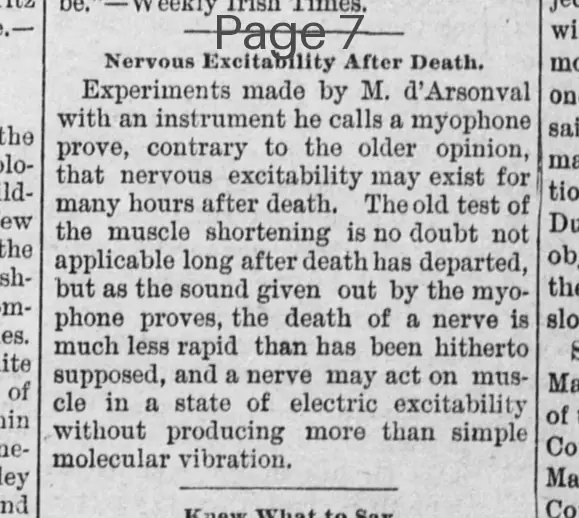
Nervous Excitability After Death.
Experiments made by M. d'Arsonval
with an instrument he calls a myophone
prove, contrary to the older opinion,
that nervous excitability may exist for
many hours after death. The old test of
the muscle shortening is no doubt not
applicable long after death has departed,
but as the sound given out by the myophone proves, the death of a nerve is
much less rapid than has been hitherto
supposed, and a nerve may act on muscle in a state of electric excitability
without producing more than simple
molecular vibration.
Experiments made by M. d'Arsonval
with an instrument he calls a myophone
prove, contrary to the older opinion,
that nervous excitability may exist for
many hours after death. The old test of
the muscle shortening is no doubt not
applicable long after death has departed,
but as the sound given out by the myophone proves, the death of a nerve is
much less rapid than has been hitherto
supposed, and a nerve may act on muscle in a state of electric excitability
without producing more than simple
molecular vibration.
What sub-type of article is it?
Medical Curiosity
Curiosity
What keywords are associated?
Nervous Excitability
Post Death
Myophone
Experiments
D'arsonval
What entities or persons were involved?
M. D'arsonval
Story Details
Key Persons
M. D'arsonval
Story Details
Experiments by M. d'Arsonval with a myophone instrument demonstrate that nervous excitability can persist for many hours after death, challenging older beliefs. The traditional muscle shortening test is not reliable long after death, but the myophone's sound indicates slower nerve death, allowing electric excitability to cause molecular vibration in muscles without contraction.