Thank you for visiting SNEWPapers!
Sign up free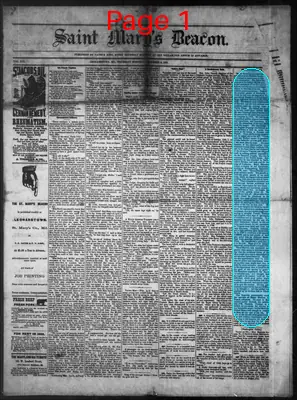
Saint Mary's Beacon
Leonardtown, Lexington Park, Saint Mary's County, Maryland
What is this article about?
Baron Friedrich von Steuben, a Prussian officer trained under Frederick the Great, aided the American Revolution by drilling troops at Valley Forge, commanding in Virginia against Benedict Arnold, and participating in the Yorktown siege. He remained in America, receiving honors including a life annuity and land grants.
Clipping

OCR Quality
Full Text
It was fit and proper that the descendants of the Steuben family be invited to participate in the Yorktown ceremonial. The Baron Steuben was one of the foreign officers who came to the assistance of our Revolutionary fathers, and who remained an American citizen to the close of his life. He was indeed a great acquisition. Trained in the martial school of Frederick the Great he had won his laurels at Prussia and at Rossbach, and had risen to be an Adjutant General on the King's staff. He came to us at a dark period of the war, and his first services were rendered amid the wintery want of Valley Forge. He drilled our troops as he only could have drilled them. He was a thorough disciplinarian, and his manual for the army was approved by Congress in 1779. He was an accomplished soldier, of great knowledge and experience, and sometimes, it is said, the clumsiness of his men sorely tried his temper. His knowledge of the English language was limited, and the tradition is that he swore very freely at the troops in German and French. Once, particularly exasperated, he called out to his aide: "Venez mon ami Walker, sacre de gaucherie of these badauds--je n'en puis plus--I can curse them no more."
He was a member of the court-martial which tried and doomed Major Andre in 1780 and in the same year he had command of the troops in Virginia, and did good work in making matters uncomfortable for Benedict Arnold, who was in command of the British forces. Subsequently he was attached to La Fayette's division, and took part in the siege of Yorktown. Major Ebenezer Denny, a diarist of the Revolution, writing at Williamsburg, September 15, 1781, says: "Baron Steuben is our great military oracle. The guards attend the grand parade at an early hour, where the Baron is always found waiting, with one or two aides on horseback. There the men are exercised and put through various evolutions and military experiments for two hours many officers and spectators present; excellent school this. At length the duty of the parade comes on. The guards are told off; officers take their posts; wheel by platoons to the right; fine corps of music detailed for this duty, which strikes up; the whole march off, saluting the Baron and field officer of the day, as they pass." We can here imagine the Baron in his element, his vigilant eyes watching every movement, and his voluble tongue execrating in mingled French, German and English every sign of ignorance, of indolence and of clumsiness.
In a separate command, he did not win much distinction; indeed, he did not have much chance, for his operations in Virginia were brief, and were not very fortunate. Congress, however, put a high estimate upon his services, for in 1790 it voted him a life annuity of $2500, and he had plenty of land also voted him by different States. New York gave him 16,000 acres near Utica. He transferred a good deal of it to his aides. Some of it he himself improved, and he lived in it until 1794.
When Steuben was appointed Inspector there seems to have been some fear that the undefined duties of his office might give rise to dissatisfaction and occasion embarrassment. Hamilton was apprehensive that "a fondness for power and importance, natural to every man, might lead him to wish for more extensive prerogatives in his department than it would be for the good of the service to grant." Yet Hamilton considered the Baron "a valuable man," and thought that he ought to be treated "with all the deference which good policy might warrant." At times Steuben was very much discontented, and almost resolved to quit the service. He was particularly hampered by Lee and Mifflin, or he thought so; but the matter was patched up by sending him to Rhode Island.
The Republic undoubtedly owed the services of Baron Steuben to French influences. He came to this country partly through the persuasion of St. Germain. Perhaps, as soldier, he was ready for service in any honorable cause; but he liked the United States well enough to remain in them for the rest of his life. He gave us the benefit of his great knowledge and military experience; and it is paying to his memory no doubtful compliment to say that he was precisely the man wanted at the moment when he lent us his sword.
What sub-type of article is it?
What themes does it cover?
What keywords are associated?
What entities or persons were involved?
Where did it happen?
Story Details
Key Persons
Location
Valley Forge, Virginia, Yorktown, Prussia, New York Near Utica, Rhode Island
Event Date
During The American Revolution, 1778 1781
Story Details
Baron Steuben, a Prussian veteran, joined the American Revolution, trained troops at Valley Forge with strict discipline, commanded in Virginia against Arnold, participated in Yorktown siege, faced challenges but was honored with annuity and lands, remaining in America until his death.