Thank you for visiting SNEWPapers!
Sign up free
Editorial
October 19, 1796
Gazette Of The United States, & Philadelphia Daily Advertiser
Philadelphia, Philadelphia County, Pennsylvania
What is this article about?
An editorial signed 'Phocion' mocks Thomas Jefferson's philosophical pretensions, arguing that philosophers are unfit for politics and presidency, citing historical examples like Locke and Condorcet, and contrasting with Washington's success. It accuses Jefferson of ambition masked as humility.
Clipping
OCR Quality
98%
Excellent
Full Text
FOR THE GAZETTE OF THE UNITED STATES.
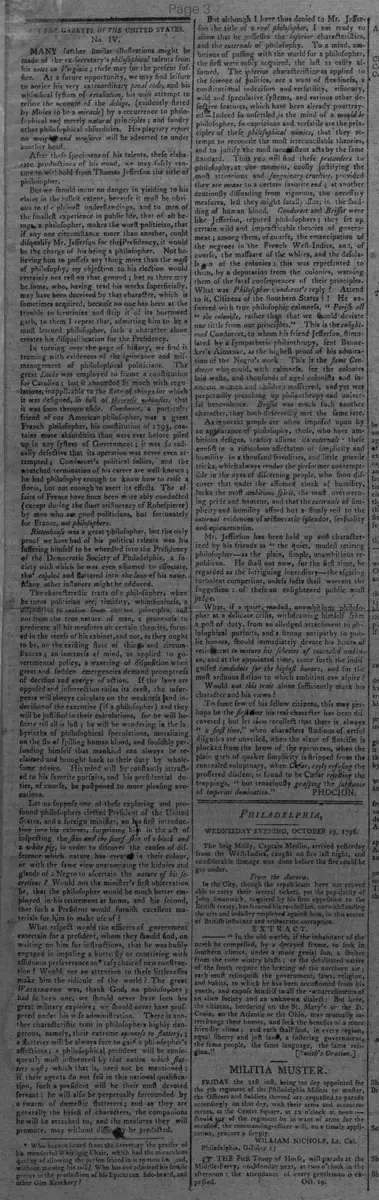
MANY further similar illustrations might be made of the ex-secretary's philosophical talents from his notes on Virginia: these may for the present suffice. At a future opportunity, we may find leisure to notice his very extraordinary penal code, and his whimsical system of retaliation, his wise attempt to refute the account of the deluge, (evidently stated by Moses to be a miracle) by a recurrence to philosophical and merely natural principles; and sundry other philosophical absurdities. His plagiarized report on weights and measures will be adverted to under another head.
After these specimens of his talents, these elaborate productions of his mind, we may safely venture to withhold from Thomas Jefferson the title of philosopher.
But we should incur no danger in yielding to his claim in the fullest extent, because it must be obvious to the plainest understandings, and to men of the smallest experience in public life, that of all beings, a philosopher, makes the worst politician, that if any one circumstance more than another, could disqualify Mr. Jefferson for the Presidency, it would be the charge of his being a philosopher. Not believing him to possess any thing more than the mask of philosophy, my objection to his election would certainly not rest on that ground; but as there may be some, who, having read his works superficially, may have been deceived by that character, which is sometimes acquired, because no one has been at the trouble to scrutinize and strip it of its borrowed garb, to them I repeat that, admitting him to be a most learned philosopher, such a character alone creates his disqualification for the Presidency.
In turning over the page of history, we find it teeming with evidences of the ignorance and mismanagement of philosophical politicians. The great Locke was employed to frame a constitution for Carolina; but it abounded so much with regulations, inapplicable to the state of things for which it was designed, so full of theoretic whims, that it was soon thrown aside. Condorcet, a particular friend of our American philosopher, was a great French philosopher, his constitution of 1793, contains more absurdities than were ever before piled up in any system of Government; it was so radically defective that its operation was never even attempted; Condorcet's political follies, and the wretched termination of his career are well known; he had philosophy enough to know how to raise a storm, but not enough to avert its effects. The affairs of France have since been more ably conducted (except during the short aristocracy of Robespierre) by men who are good politicians, but fortunately for France, not philosophers.
Rittenhouse was a great philosopher, but the only proof we have had of his political talents was his suffering himself to be wheedled into the Presidency of the Democratic Society of Philadelphia, a society with which he was even ashamed to associate, though cajoled and flattered into the loan of his name. Many other instances might be adduced.
The characteristic traits of a philosopher, when he turns politician are, timidity, whimsicalness, a disposition to reason from certain principles, and not from the true nature of man, a proneness to predicate all his measures on certain theories, formed in the recesses of his cabinet, and not, as they ought to be, on the existing state of things and circumstances; an inertness of mind, as applied to governmental policy, a wavering of disposition when great and sudden emergencies demand promptness of decision and energy of action. If the laws are opposed and insurrection raises its crest, the insurgents will always calculate on the weakness and indecision of the executive (if a philosopher) and they will be justified in their calculations, for he will hesitate till all is lost; he will be wandering in the labyrinths of philosophical speculations, moralizing on the sin of spilling human blood, and foolishly persuading himself that mankind can always be reclaimed and brought back to their duty by wholesome advice. His mind will be constantly attracted to his favorite pursuits, and his presidential duties, of course, be postponed to more pleasing avocations.
Let us suppose one of these exploring and profound philosophers elected President of the United States, and a foreign minister, on his first introduction into his cabinet, surprising him in the act of inspecting the skin and the scarf skin of a black and a white pig, in order to discover the causes of difference which nature has created in their colour, or with the same view anatomizing the kidneys and glands of a Negro to ascertain the nature of his secretions? Would not the minister's first observation be, that the philosopher would be much better employed in his retirement at home, and his second, that such a President would furnish excellent materials for him to make use of?
What respect would the officers of government entertain for a president, whom they should find, on waiting on him for instructions, that he was busily engaged in impaling a butterfly or contriving with assiduous perseverance an easy chair of new construction? Would not an attention to these littleness make him the ridicule of the world? The great Washington was, thank God, no philosopher; had he been one, we should never have seen his great military exploits; we should never have prospered under his wise administration. There is another characteristic trait in philosophers highly dangerous, namely, their extreme openness to flattery; a flatterer will be always sure to gain a philosopher's affections: a philosophical president will be consequently most influenced by that nation which flatters most; which that is, need not be mentioned: if their agents do not fail in this national qualification, such a president will be their most devoted servant: he will also be perpetually surrounded by a swarm of domestic flatterers; and as they are generally the basest of characters, the companions he will be attached to, and the measures they will promote, may without difficulty be predicted.
Who has not heard from the Secretary the praises of his wonderful Whirligig Chair, which had the miraculous quality of allowing the person seated in it to turn his head, without moving his tail? Who has not admired his fertile genius in the production of his Epicurean side-board, and other gimcrackery?
But although I have thus denied to Mr. Jefferson the title of a real philosopher, I am ready to allow that he possesses the inferior characteristics, and the externals of philosophy. To a mind, ambitious of passing with the world for a philosopher, the first were easily acquired, the last as easily assumed, The inferior characteristics as applied to the science of politics, are a want of steadiness, a constitutional indecision and versatility, visionary, wild and speculative systems, and various other defective features, which have been already portrayed. Indeed so unsettled is the mind of a would be philosopher, so capricious and versatile are the principles of these philosophical mimics, that they attempt to reconcile the most irreconcilable theories, and to justify the most inconsistent acts by the same standard. Thus you will find these pretenders to philosophy, at one moment, coolly justifying the most atrocious and sanguinary cruelties, provided they are means to a certain favorite end; at another cautiously dissuading from vigorous, tho necessary measures, lest they might fatally issue, in the shedding of human blood. Condorcet and Brissot were like Jefferson, reputed philosophers; they set up certain wild and impracticable theories of government; among them, of course, the emancipation of the negroes in the French West-Indies, and, of course, the massacre of the whites, and the desolation of the colonies: this was represented to them, by a deputation from the colonies, warning them of the fatal consequences of their principles. What was Philosopher Condorcet's reply? Attend to it, Citizens of the Southern States!! He answered with true philosophic calmness, "Perish all the colonies, rather than that we should deviate one tittle from our principles." This is the enlightened Condorcet, to whom his friend Jefferson, stimulated by a sympathetic philanthropy, sent Banneker's Almanac, as the highest proof of his admiration of the Negro's work This is the same Condorcet who could, with calmness, see the colonies laid waste, and thousands of aged colonists and innocent women and children massacred, and yet was perpetually preaching up philanthropy and universal benevolence. Brissot was much such another character, they both deservedly met the same fate.
As ignorant people are often imposed upon by an appearance of philosophy, those, who have ambitious designs, readily assume its externals. These consist in a ridiculous affectation of simplicity and humility in a thousand frivolities, and little puerile tricks, which always render the performer more contemptible in the eyes of discerning people, who soon discover that under the assumed cloak of humility, lurks the most ambitious spirit, the most overweening pride and hauteur, and that the externals of simplicity and humility afford but a limy veil to the internal evidences of aristocratic splendor, sensuality and epicureanism.
Mr. Jefferson has been held up and characterized by his friends as "the quiet, modest retiring philosopher-as the plain, simple, unambitious republican. He shall not now, for the first time, be regarded as the intriguing incendiary-the aspiring turbulent competitor, unless facts shall warrant the suggestion: of these an enlightened public must judge.
What, if a quiet, modest, unambitious philosopher at a delicate crisis, withdrawing himself from a post of duty, from-an alleged attachment to philosophical pursuits, and a strong antipathy to public honors, should immediately devote his hours of retirement to mature his schemes of concealed ambition, and at the appointed time, come forth the dignified candidate for the highest honors, and for the most arduous station to which ambition can aspire? Would not this trait alone sufficiently mark his character and his views?
To some few of his fellow citizens, this may perhaps be the first time his real character has been discovered; but let them recollect that there is always "a first time," when characters studious of artful disguises are unveiled, when the vizor of stoicism is plucked from the brow of the epicurean, when the plain garb of quaker simplicity is stripped from the concealed voluptuary, when Caesar, coyly refusing the proffered diadem, is found to be Caesar rejecting the trappings, "but tenaciously grasping the substance of imperial domination."
PHOCION.
MANY further similar illustrations might be made of the ex-secretary's philosophical talents from his notes on Virginia: these may for the present suffice. At a future opportunity, we may find leisure to notice his very extraordinary penal code, and his whimsical system of retaliation, his wise attempt to refute the account of the deluge, (evidently stated by Moses to be a miracle) by a recurrence to philosophical and merely natural principles; and sundry other philosophical absurdities. His plagiarized report on weights and measures will be adverted to under another head.
After these specimens of his talents, these elaborate productions of his mind, we may safely venture to withhold from Thomas Jefferson the title of philosopher.
But we should incur no danger in yielding to his claim in the fullest extent, because it must be obvious to the plainest understandings, and to men of the smallest experience in public life, that of all beings, a philosopher, makes the worst politician, that if any one circumstance more than another, could disqualify Mr. Jefferson for the Presidency, it would be the charge of his being a philosopher. Not believing him to possess any thing more than the mask of philosophy, my objection to his election would certainly not rest on that ground; but as there may be some, who, having read his works superficially, may have been deceived by that character, which is sometimes acquired, because no one has been at the trouble to scrutinize and strip it of its borrowed garb, to them I repeat that, admitting him to be a most learned philosopher, such a character alone creates his disqualification for the Presidency.
In turning over the page of history, we find it teeming with evidences of the ignorance and mismanagement of philosophical politicians. The great Locke was employed to frame a constitution for Carolina; but it abounded so much with regulations, inapplicable to the state of things for which it was designed, so full of theoretic whims, that it was soon thrown aside. Condorcet, a particular friend of our American philosopher, was a great French philosopher, his constitution of 1793, contains more absurdities than were ever before piled up in any system of Government; it was so radically defective that its operation was never even attempted; Condorcet's political follies, and the wretched termination of his career are well known; he had philosophy enough to know how to raise a storm, but not enough to avert its effects. The affairs of France have since been more ably conducted (except during the short aristocracy of Robespierre) by men who are good politicians, but fortunately for France, not philosophers.
Rittenhouse was a great philosopher, but the only proof we have had of his political talents was his suffering himself to be wheedled into the Presidency of the Democratic Society of Philadelphia, a society with which he was even ashamed to associate, though cajoled and flattered into the loan of his name. Many other instances might be adduced.
The characteristic traits of a philosopher, when he turns politician are, timidity, whimsicalness, a disposition to reason from certain principles, and not from the true nature of man, a proneness to predicate all his measures on certain theories, formed in the recesses of his cabinet, and not, as they ought to be, on the existing state of things and circumstances; an inertness of mind, as applied to governmental policy, a wavering of disposition when great and sudden emergencies demand promptness of decision and energy of action. If the laws are opposed and insurrection raises its crest, the insurgents will always calculate on the weakness and indecision of the executive (if a philosopher) and they will be justified in their calculations, for he will hesitate till all is lost; he will be wandering in the labyrinths of philosophical speculations, moralizing on the sin of spilling human blood, and foolishly persuading himself that mankind can always be reclaimed and brought back to their duty by wholesome advice. His mind will be constantly attracted to his favorite pursuits, and his presidential duties, of course, be postponed to more pleasing avocations.
Let us suppose one of these exploring and profound philosophers elected President of the United States, and a foreign minister, on his first introduction into his cabinet, surprising him in the act of inspecting the skin and the scarf skin of a black and a white pig, in order to discover the causes of difference which nature has created in their colour, or with the same view anatomizing the kidneys and glands of a Negro to ascertain the nature of his secretions? Would not the minister's first observation be, that the philosopher would be much better employed in his retirement at home, and his second, that such a President would furnish excellent materials for him to make use of?
What respect would the officers of government entertain for a president, whom they should find, on waiting on him for instructions, that he was busily engaged in impaling a butterfly or contriving with assiduous perseverance an easy chair of new construction? Would not an attention to these littleness make him the ridicule of the world? The great Washington was, thank God, no philosopher; had he been one, we should never have seen his great military exploits; we should never have prospered under his wise administration. There is another characteristic trait in philosophers highly dangerous, namely, their extreme openness to flattery; a flatterer will be always sure to gain a philosopher's affections: a philosophical president will be consequently most influenced by that nation which flatters most; which that is, need not be mentioned: if their agents do not fail in this national qualification, such a president will be their most devoted servant: he will also be perpetually surrounded by a swarm of domestic flatterers; and as they are generally the basest of characters, the companions he will be attached to, and the measures they will promote, may without difficulty be predicted.
Who has not heard from the Secretary the praises of his wonderful Whirligig Chair, which had the miraculous quality of allowing the person seated in it to turn his head, without moving his tail? Who has not admired his fertile genius in the production of his Epicurean side-board, and other gimcrackery?
But although I have thus denied to Mr. Jefferson the title of a real philosopher, I am ready to allow that he possesses the inferior characteristics, and the externals of philosophy. To a mind, ambitious of passing with the world for a philosopher, the first were easily acquired, the last as easily assumed, The inferior characteristics as applied to the science of politics, are a want of steadiness, a constitutional indecision and versatility, visionary, wild and speculative systems, and various other defective features, which have been already portrayed. Indeed so unsettled is the mind of a would be philosopher, so capricious and versatile are the principles of these philosophical mimics, that they attempt to reconcile the most irreconcilable theories, and to justify the most inconsistent acts by the same standard. Thus you will find these pretenders to philosophy, at one moment, coolly justifying the most atrocious and sanguinary cruelties, provided they are means to a certain favorite end; at another cautiously dissuading from vigorous, tho necessary measures, lest they might fatally issue, in the shedding of human blood. Condorcet and Brissot were like Jefferson, reputed philosophers; they set up certain wild and impracticable theories of government; among them, of course, the emancipation of the negroes in the French West-Indies, and, of course, the massacre of the whites, and the desolation of the colonies: this was represented to them, by a deputation from the colonies, warning them of the fatal consequences of their principles. What was Philosopher Condorcet's reply? Attend to it, Citizens of the Southern States!! He answered with true philosophic calmness, "Perish all the colonies, rather than that we should deviate one tittle from our principles." This is the enlightened Condorcet, to whom his friend Jefferson, stimulated by a sympathetic philanthropy, sent Banneker's Almanac, as the highest proof of his admiration of the Negro's work This is the same Condorcet who could, with calmness, see the colonies laid waste, and thousands of aged colonists and innocent women and children massacred, and yet was perpetually preaching up philanthropy and universal benevolence. Brissot was much such another character, they both deservedly met the same fate.
As ignorant people are often imposed upon by an appearance of philosophy, those, who have ambitious designs, readily assume its externals. These consist in a ridiculous affectation of simplicity and humility in a thousand frivolities, and little puerile tricks, which always render the performer more contemptible in the eyes of discerning people, who soon discover that under the assumed cloak of humility, lurks the most ambitious spirit, the most overweening pride and hauteur, and that the externals of simplicity and humility afford but a limy veil to the internal evidences of aristocratic splendor, sensuality and epicureanism.
Mr. Jefferson has been held up and characterized by his friends as "the quiet, modest retiring philosopher-as the plain, simple, unambitious republican. He shall not now, for the first time, be regarded as the intriguing incendiary-the aspiring turbulent competitor, unless facts shall warrant the suggestion: of these an enlightened public must judge.
What, if a quiet, modest, unambitious philosopher at a delicate crisis, withdrawing himself from a post of duty, from-an alleged attachment to philosophical pursuits, and a strong antipathy to public honors, should immediately devote his hours of retirement to mature his schemes of concealed ambition, and at the appointed time, come forth the dignified candidate for the highest honors, and for the most arduous station to which ambition can aspire? Would not this trait alone sufficiently mark his character and his views?
To some few of his fellow citizens, this may perhaps be the first time his real character has been discovered; but let them recollect that there is always "a first time," when characters studious of artful disguises are unveiled, when the vizor of stoicism is plucked from the brow of the epicurean, when the plain garb of quaker simplicity is stripped from the concealed voluptuary, when Caesar, coyly refusing the proffered diadem, is found to be Caesar rejecting the trappings, "but tenaciously grasping the substance of imperial domination."
PHOCION.
What sub-type of article is it?
Partisan Politics
Satire
What keywords are associated?
Thomas Jefferson
Philosopher Politician
Presidential Disqualification
Political Satire
Jefferson Critique
Philosophical Absurdities
Ambition Mask
What entities or persons were involved?
Thomas Jefferson
George Washington
John Locke
Condorcet
David Rittenhouse
Brissot
Editorial Details
Primary Topic
Disqualification Of Thomas Jefferson For Presidency Due To Philosophical Nature
Stance / Tone
Strongly Anti Jefferson, Satirical Mockery Of Philosophy In Politics
Key Figures
Thomas Jefferson
George Washington
John Locke
Condorcet
David Rittenhouse
Brissot
Key Arguments
Philosophers Make The Worst Politicians Due To Timidity And Indecision
Jefferson's Writings Reveal Philosophical Absurdities
Historical Examples Like Locke's Carolina Constitution And Condorcet's French Efforts Failed Due To Theoretic Whims
Philosophers Are Susceptible To Flattery And Neglect Duties For Pursuits
Jefferson Assumes Externals Of Philosophy To Mask Ambition
Contrast With Washington's Practical Success
Philosophical Pretenders Justify Inconsistencies And Cruelties For Ideals