Thank you for visiting SNEWPapers!
Sign up free
Gazette Of The United States
New York, New York County, New York
What is this article about?
Admiralty court case where Robert Finley Jr. and others libel the French privateer Citizen Genet for capturing the British ship William within U.S. territory, violating neutrality. Mr. Lewis argues for jurisdiction based on law of nations to protect U.S. honor and peace. Judge Peters dismisses the libel as irrelevant.
Clipping
OCR Quality
Full Text
Robert Finley, jun. and others,
Libel filed.
Ship William.
Sketch of the Pleadings in this important case, concluded.
Mr. Lewis on the part of the libellants.
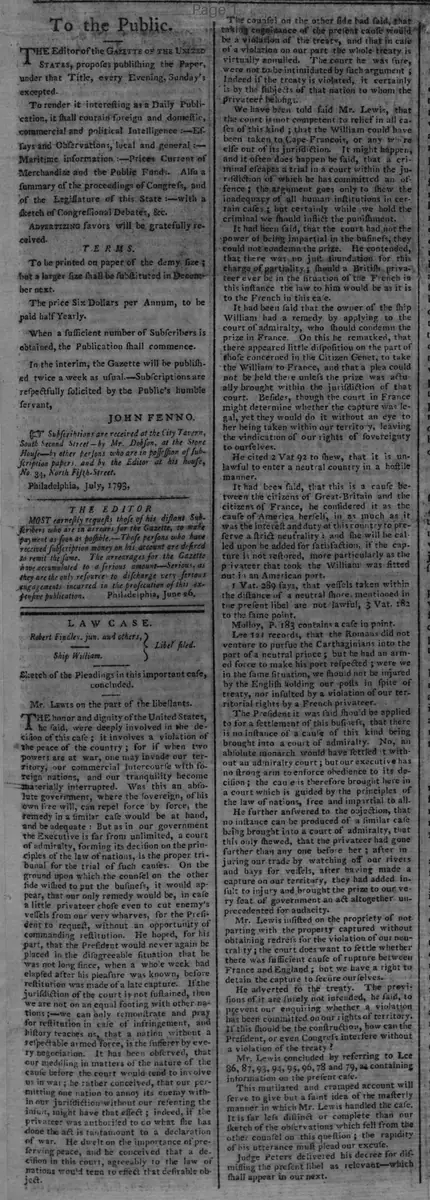
THE honor and dignity of the United States, he said, were deeply involved in the decision of this case; it involves a violation of the peace of the country; for if when two powers are at war, one may invade our territory, our commercial intercourse with foreign nations, and our tranquility become materially interrupted. Was this an absolute government, where the sovereign, of his own free will, can repel force by force, the remedy in a similar case would be at hand, and be adequate: But as in our government the Executive is far from unlimited, a court of admiralty, forming its decision on the principles of the law of nations, is the proper tribunal for the trial of such causes. On the ground upon which the counsel on the other side wished to put the business, it would appear, that our only remedy would be, in case a little privateer chose even to cut enemy's vessels from our very wharves, for the President to request, without an opportunity of commanding restitution. He hoped, for his part, that the President would never again be placed in the disagreeable situation that he was not long since, when a whole week had elapsed after his pleasure was known, before restitution was made of a late capture. If the jurisdiction of the court is not sustained, then we are not on an equal footing with other nations; - we can only remonstrate and pray for restitution in case of infringement, and history teaches us, that a nation without a respectable armed force, is the sufferer by every negotiation. It has been observed, that our meddling in matters of the nature of the cause before the court would tend to involve us in war; he rather conceived, that our permitting one nation to annoy its enemy within our jurisdiction without our resenting the insult, might have that effect; indeed, if the privateer was authorized to do what she has done the act is tantamount to a declaration of war. He dwelt on the importance of preserving peace, and he conceived that a decision in this court, agreeably to the law of nations would tend to effect that desirable object.
The counsel on the other side had said, that taking cognizance of the present cause would be a violation of the treaty, and that in case of a violation on our part the whole treaty is virtually annulled. The court he was sure, were not to be intimidated by such argument; Indeed if the treaty is violated, it certainly is by the subjects of that nation to whom the privateer belongs.
We have been told said Mr. Lewis, that the court is not competent to relief in all cases of this kind; that the William could have been taken to Cape-Francois, or any where else out of its jurisdiction. It might happen, and it often does happen he said, that a criminal escapes a trial in a court within the jurisdiction of which he has committed an offence; the argument goes only to shew the inadequacy of all human institutions in certain cases; but certainly while we hold the criminal we should inflict the punishment.
It had been said, that the court had not the power of being impartial in the business, they could not condemn the prize. He contended, that there was no just foundation for this charge of partiality; should a British privateer ever be in the situation of the French in this instance the law to him would be as it is to the French in this case.
It had been said that the owner of the ship William had a remedy by applying to the court of admiralty, who should condemn the prize in France. On this he remarked, that there appeared little disposition on the part of those concerned in the Citizen Genet, to take the William to France, and that a plea could not be held there unless the prize was actually brought within the jurisdiction of that court. Besides, though the court in France might determine whether the capture was legal, yet they would do it without an eye to her being taken within our territory, leaving the vindication of our rights of sovereignty to ourselves.
He cited 2 Vat 92 to shew, that it is unlawful to enter a neutral country in a hostile manner.
It had been said, that this is a cause between the citizens of Great-Britain and the citizens of France, he considered it as the cause of America herself, in as much as it was the interest and duty of this country to preserve a strict neutrality: and he will be called upon he added for satisfaction, if the capture is not restored, more particularly as the privateer that took the William was fitted out in an American port.
1 Vat. 289 says, that vessels taken within the distance of a neutral shore mentioned in the present libel are not lawful, 3 Vat. 182 to the same point.
Molloy, P. 183 contains a case in point.
Lee 121 records, that the Romans did not venture to pursue the Carthaginians into the port of a neutral prince; but he had an armed force to make his port respected; were we in the same situation, we should not be injured by the English holding our posts in spite of treaty, nor insulted by a violation of our territorial rights by a French privateer.
The President it was said should be applied to for a settlement of this business, that there is no instance of a cause of this kind being brought into a court of admiralty. No, an absolute monarch would have settled it without an admiralty court; but our executive has no strong arm to enforce obedience to its decision; the cause is therefore brought here in a court which is guided by the principles of the law of nations, free and impartial to all.
He further answered to the objection, that no instance can be produced of a similar case being brought into a court of admiralty, that this only shewed, that the privateer had gone further than any one before her; after injuring our trade by watching of our rivers and bays for vessels, after having made a capture on our territory, they had added insult to injury and brought the prize to our very seat of government an act altogether unprecedented for audacity.
Mr. Lewis insisted on the propriety of not parting with the property captured without obtaining redress for the violation of our neutrality; the court does want to settle whether there was sufficient cause of rupture between France and England; but we have a right to detain the capture to secure ourselves.
He adverted to the treaty. The provisions of it are surely not intended, he said, to prevent our enquiring whether a violation has been committed on our rights of territory. If this should be the construction, how can the President, or even Congress interfere without a violation of the treaty?
Mr. Lewis concluded by referring to Lee 86, 87, 93, 94, 95, 96, 78 and 79, as containing information on the present case.
This mutilated and cramped account will serve to give but a faint idea of the masterly manner in which Mr. Lewis handled the case. It is far less distinct or complete than our sketch of the observations which fell from the other counsel on this question; the rapidity of his utterance must plead our excuse.
Judge Peters delivered his decree for dismissing the present libel as irrelevant - which shall appear in our next.
What sub-type of article is it?
What themes does it cover?
What keywords are associated?
What entities or persons were involved?
Where did it happen?
Story Details
Key Persons
Location
United States (Admiralty Court, Seat Of Government)
Story Details
Libellants Robert Finley Jr. and others file libel against the capture of the British ship William by the French privateer Citizen Genet within U.S. territory. Mr. Lewis argues for court jurisdiction under law of nations to uphold U.S. neutrality, sovereignty, and peace, citing authorities and refuting opposing claims. Judge Peters dismisses the libel as irrelevant.