Thank you for visiting SNEWPapers!
Sign up free
Alexandria Daily Advertiser
Alexandria, Virginia
What is this article about?
General Eaton's letter criticizes US naval commodore's decisions in the Barbary War, detailing failed support for Hamet Bashaw's campaign against Tripoli, abandonment after Derne victory, and premature peace negotiations by Consul Lear, resulting in concessions to Yusuf Bashaw.
Merged-components note: Continuation of General Eaton's letter on the Tripolitan affairs across pages 2 and 3, indicated by the text flow and sequential reading order.
Clippings
1 of 2
OCR Quality
Full Text
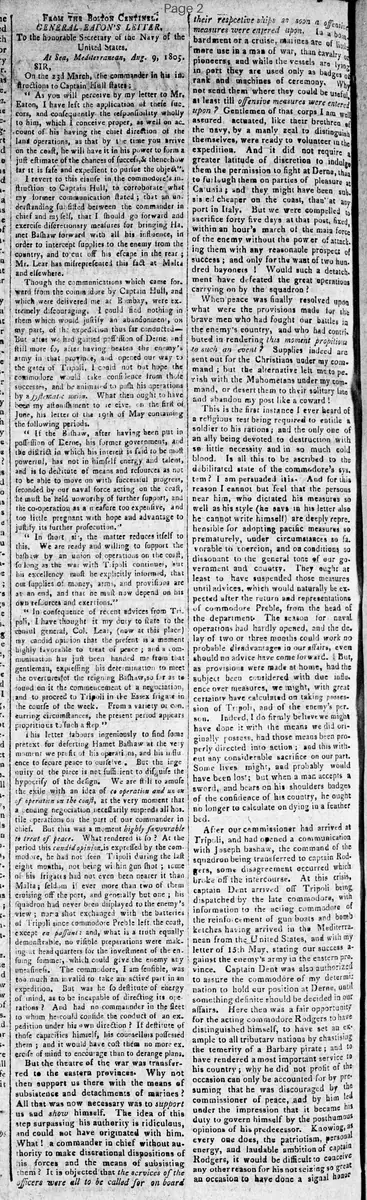
GENERAL EATON'S LETTER
To the honorable Secretary of the Navy of the United States.
At Sea, Mediterranean, Aug. 9, 1805:
SIR,
On the 23d March, the commander in his instructions to Captain Hull states:
"As you will perceive by my letter to Mr. Eaton, I have left the application of these succors, and consequently the responsibility wholly to him, which I conceive proper, as well on account of his having the chief direction of the land operations, as that by the time you arrive on the coast, he will have it in his power to form a just estimate of the chances of success, & thence how far it is safe and expedient to pursue the object".
I revert to this clause in the commodore's instruction to Captain Hull, to corroborate what my former communication stated; that an understanding subsisted between the commander in chief and myself, that I should go forward and exercise discretionary measures for bringing Hamet Bashaw forward with all his influence, in order to intercept supplies to the enemy from the country, and to cut off his escape in the rear; Mr. Lear has misrepresented this fact at Malta and elsewhere.
Though the communications which came forward from the commodore by Captain Hull, and which were delivered me at Bombay, were extremely discouraging. I could find nothing in them which would justify an abandonment, on my part, of the expedition thus far conducted--But after we had gained possession of Derne, and still more, after having beaten the enemy's army in that province, and opened our way to the gates of Tripoli. I could not but hope the commodore would take confidence from those successes, and be animated to push his operations by a systematic union. What then ought to have been my astonishment to receive, on the first of June, his letter of the 19th of May containing the following paragraphs.
"If the Bashaw, after having been put in possession of Derne, his former government, and the district in which his interest is said to be most powerful, has not in himself energy and talent, and is so destitute of means and resources as not to be able to move on with successful progress, seconded by our naval force acting on the coast, he must be held unworthy of further support, and the co-operation as a measure too expensive, and too little pregnant with hope and advantage to justify its further prosecution."
"In short, sir, the matter reduces itself to this. We are ready and willing to support the bashaw by an union of operations on the coast, as long as the war with Tripoli continues, but his excellency must be explicitly informed, that our supplies of money, arms, and provisions are at an end, and that he must now depend on his own resources and exertions."
"In consequence of recent advices from Tripoli, I have thought it my duty to state to the consul general, Col. Lear, (now at this place) my candid opinion that the present is a moment highly favorable to treat of peace; and a communication has just been handed me from that gentleman, expressing his determination to meet the overtures of the reigning Bashaw, so far as to found on it the commencement of a negotiation, and to proceed to Tripoli in the Essex frigate in the course of the week. From a variety of concurring circumstances, the present period appears propitious to such a step."
This letter labours ingeniously to find some pretext for deserting Hamet Bashaw at the very moment we profit of his operations, and his influence to secure peace to ourselves. But the ingenuity of the piece is not sufficient to disguise the hypocrisy of the design. We are still to amuse the exile with an idea of co-operation and union of operation on the coast, at the very moment that a pending negotiation necessarily suspends all hostile operations on the part of our commander in chief. But this was a moment highly favourable to treat of peace. What rendered it so? At the period this candid opinion is expressed by the commodore, he had not seen Tripoli during the last eight months, not being within gun shot; some of his frigates had not even been nearer it than Malta: seldom if ever more than two of them cruising off the port, and generally but one; his squadron had never been displayed to the enemy's view; nor a shot exchanged with the batteries of Tripoli since commodore Preble left the coast, except en passant: and, what is a truth equally demonstrable, no visible preparations were making at head quarters for the movement of the ensuing summer, which could give the enemy any uneasiness. The commodore, I am sensible, was too much an invalid to take an active part in an expedition. But was he so destitute of energy of mind, as to be incapable of directing its operations? And had no commander in the fleet to whom he could confide the conduct of an expedition under his own direction? If destitute of those capacities himself, his counsellors possessed them; and it would have cost them no more exercise of mind to encourage than to derange plans. But the theatre of the war was transferred to the eastern provinces. Why not then support us there with the means of subsistence and detachments of marines? All that was now necessary was to support us and show himself. The idea of this step surpassing his authority is ridiculous, and could not have originated with him. What! a commander in chief without authority to make discretional dispositions of his forces and the means of subsisting them? It is objected that the services of the officers were all to be called for on board their respective ships as soon as offensive measures were entered upon. In a bombardment or a cruise, marines are of little more use in a man of war, than cavalry of pioneers; and while the vessels are lying in port they are used only as badges of rank and machines of ceremony. Why not send them where they could be useful, at least till offensive measures were entered upon? Gentlemen of that corps I am well assured, actuated, like their brethren of the navy, by a manly zeal to distinguish themselves, were ready to volunteer in the expedition. And it did not require a greater latitude of discretion to indulge them the permission to fight at Derne, than to furlough them on parties of pleasure at Catania; and they might have been subsisted cheaper on the coast, than at any port in Italy. But we were compelled to sacrifice forty five days at that post, fixed within an hour's march of the main force of the enemy without the power of attacking them with any reasonable prospect of success; and only for the want of two hundred bayonets! Would such a detachment have defeated the great operations carrying on by the squadron?
When peace was finally resolved upon what were the provisions made for the brave men who had fought our battles in the enemy's country, and who had contributed in rendering this moment propitious to such an event? Supplies indeed are sent out for the Christians under my command; but the alternative left me to perish with the Mahometans under my command, or desert them to their solitary fate and abandon my post like a coward! This is the first instance I ever heard of a religious test being required to entitle a soldier to his rations; and the only one of an ally being devoted to destruction with so little necessity and in so much cold blood. Is all this to be ascribed to the debilitated state of the commodore's system? I am persuaded it is--And for this reason I cannot but feel that the persons near him, who dictated his measures so well as his style (he says in his letter also he cannot write himself) are deeply reprehensible for adopting pacific measures so prematurely, under circumstances so favourable to coercion, and on conditions so dissonant to the general tone of our government and country. They ought at least to have suspended those measures until advices, which would naturally be expected after the return and representations of commodore Preble, from the head of the department. The season for naval operations had hardly opened, and the delay of two or three months could work no probable disadvantage in our affairs, even should no advice have come forward. But, as provisions were made at home, had the subject been considered with due influence over measures, we might, with great certainty have calculated on taking possession of Tripoli, and of the enemy's person.
Indeed, I do firmly believe we might have done it with the means we did originally possess, had those means been properly directed into action; and this without any considerable sacrifice on our part. Some lives might, and probably would have been lost: but when a man accepts a sword, and bears on his shoulders badges of the confidence of his country, he ought no longer to calculate on dying in a feather bed.
After our commissioner had arrived at Tripoli, and had opened a communication with Joseph bashaw, the command of the squadron being transferred to captain Rodgers, some disagreement occurred which broke off the intercourse. At this crisis, captain Dent arrived off Tripoli being dispatched by the late commodore, with information to the acting commodore of the reinforcement of gun boats and bomb ketches having arrived in the Mediterranean from the United States, and with my letter of 15th May, stating our success against the enemy's army in the eastern province. Captain Dent was also authorized to assure the commodore of my determination to hold our position at Derne, until something definite should be decided in our affairs. Here then was a fair opportunity for the acting commodore Rodgers to have distinguished himself, to have set an example to all tributary nations by chastising the temerity of a Barbary pirate; and to have rendered a most important service to his country; why he did not profit of the occasion can only be accounted for by presuming that he was discouraged by the commissioner of peace, and by him led under the impression that it became his duty to govern himself by the posthumous opinions of his predecessor. Knowing, as every one does, the patriotism, personal energy, and laudable ambition of captain Rodgers, it would be difficult to conceive any other reason for his not seizing so great an occasion to have done a signal honor
to his son and to have immortalized himself.
I am, indeed, at a loss for reasons why Mr. Lear abandoned these high grounds after having affected so much eagerness for exemplary measures. But the negotiation was resumed and peace purchased! And on the 6th of June, this commissioner states to me official information of the transaction.
"The bashaw's demands," says he, "were 200,000 dollars for peace and ransom, &c. which terms were at once rejected in toto." And "after some discussion," he adds, "I proposed that a mutual exchange of prisoners should take place, and as he had a balance of more than two hundred in his power, I would give him 60,000 dollars for them; but not a cent for peace, &c."
On these terms peace was definitively concluded, but this statement, adopted in its literal sense, is an imposition on the understanding of the public. It is indeed literally true, that a balance of prisoners of war was in Joseph bashaw's power. But we had in our power, being actually in our possession, the capital of the largest province of his dominions, containing between twelve and fifteen thousand souls. Could not this have been exchanged for two hundred prisoners of war? Was the attempt made? It is manifest the enemy despaired of recovering it by force of arms. And so far from not giving a cent for peace, as asserted by the commissioner, we gave a kingdom for peace. Tripoli was in our power; and with no very extraordinary effort it might have been also in our hands. The enemy felt a conviction of this, and did not hesitate to acknowledge it in the presence of the commissioner; and the latter has since expressed to me his own belief in the feasibility of the enterprize: but he advances at the same time as argument for concluding the peace in the manner he did, and with such prospects before us, that he wished to make peace with a man who would have the ability to keep it. If parricide, fratricide, treason, perfidy to treaty, all ready experienced, and systematic piracy, be characteristic guarantees of good faith, Mr. Lear has chosen the fittest of the two brothers for his man of confidence. Their ability to keep the peace is less essential than ours to maintain it. Undoubtedly nothing but terror would bind either of them, nor any other barbarian chief to a faithful observance of treaty stipulation. Our negotiation ought, however, to have considered that Hamet bashaw's was the popular cause, and this cause is fast gaining ground in Barbary; it was the cause of liberty; of freedom; he ought to have considered that to cede the advantageous position we held, could not but make the desire of peace appear like too much of an object with us, and could not but leave an impression of weakness or want of spirit on our character. It would be hard to suspect our commissioner of intentional fraud on the United States, in his generosity with Joseph bashaw, but it is harder to reconcile his needless concessions and prodigalities to the test of patriotism.
Although Mr. Lear would never admit that our operations in the eastern provinces had any influence on the dispositions of the enemy, and although he made it a condition of his entering upon the negotiation that the commodore should take measures to compel the evacuation of Derne; yet in a paroxysm of candor he expresses himself thus in his letter above quoted:
"I found that the heroic bravery of our few countrymen at Derne, and the idea that we had a large force and immense supplies at that place, had made a deep impression on the bashaw; I kept up that idea, and endeavored from thence to make some arrangements favorable to his brother, who, although not found to be the man whom many had supposed, was yet entitled to some consideration from us. But I found this was impracticable, and, if persisted in would drive him to measures which might prove fatal to our countrymen in his power."
The reasons here assigned for the deep impression made on the bashaw are not strictly true. It was impossible to conceal from the enemy our real force at Derne. The late governor had obtained exact information of it before he escaped from his sanctuary; and the enemy themselves reconnoitered us almost daily. Besides this it was impossible for us totally to prevent communications between the town and the camp. Is it probable that a garrison of 100 christians on the coast, left totally destitute of supplies, could of itself impress such deep apprehensions? For shame, let us not admit this, so much the more humiliating our conditions of peace! No; it was a dread of the revolution, moved by Hamet bashaw, being brought to his capital through our assistance, that made the impression on the enemy...
What sub-type of article is it?
What keywords are associated?
What entities or persons were involved?
Where did it happen?
Foreign News Details
Primary Location
Tripoli
Event Date
March To June 1805, Letter Dated August 9, 1805
Key Persons
Outcome
peace concluded with tripoli on terms including prisoner exchange and $60,000 payment; abandonment of hamet bashaw and derne position; no major us casualties reported in land actions.
Event Details
General Eaton details US support for Hamet Bashaw's campaign against Yusuf Karamanli of Tripoli, capture of Derne, criticisms of Commodore Barron's lack of naval support and premature peace negotiations by Consul Lear, leading to abandonment of allies and concessions despite favorable military position.