Thank you for visiting SNEWPapers!
Sign up free
Alexandria Gazette & Advertiser
Alexandria, Virginia
What is this article about?
Detailed description of Porto Cabello, the last Spanish royalist stronghold in the Republic of Colombia, commanded by Gen. Latorre with a 1000-man garrison. Covers its geography, fortifications, strategic importance, history, and potential post-revolution improvements.
Clipping
OCR Quality
Full Text
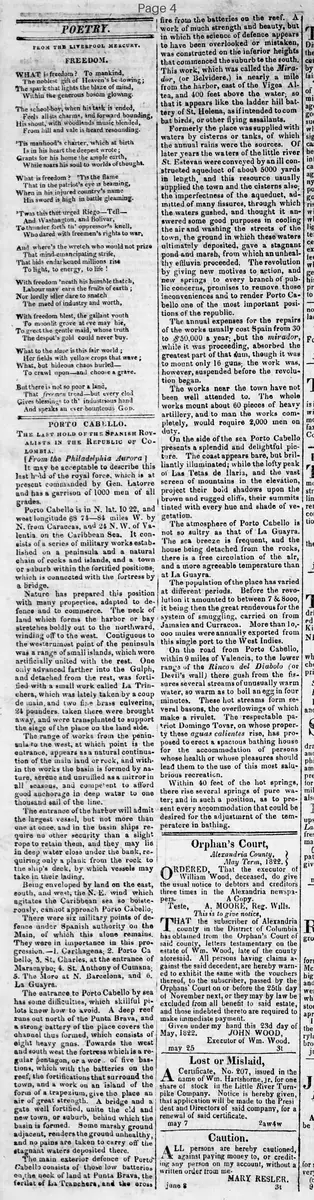
The Last hold of the Spanish Royalists in The Republic of Colombia.
[From the Philadelphia Aurora]
It may be acceptable to describe this last hold of the royal force, which is at present commanded by Gen. Latorre and has a garrison of 1000 men of all grades.
Porto Cabello is in N. lat. 10 22. and west longitude 68 74--84 miles W. by N. from Caracas, and 24 N. W. of Valencia. on the Caribbean Sea. It consists of a series of military works established on a peninsula and a natural chain of rocks and islands, and a town or suburb within the fortified positions: which is connected with the fortress by a bridge.
Nature has prepared this position with many properties, adapted to defence and to commerce. The neck of land which forms the harbor or bay stretches boldly out to the northward. winding off to the west. Contiguous to the westernmost point of the peninsula was a range of small islands, which were artificially united with the rest. One only advanced farther into the Gulph, and detached from the rest, was fortified with a small work called La Trinchera, which was lately taken by a coup de main, and two fine brass culverins, 24 pounders. taken there were brought away, and were transplanted to support the siege of the place on the land side.
The range of works from the peninsula to the west, at which point is the entrance, appears as a natural continuation of the main land or rock. and within the works the basin is formed by nature. serene and unruffled as a mirror in all seasons, and competent to afford good anchorage in deep water to one thousand sail of the line.
The entrance of the harbor will admit the largest vessel, but not more than one at once, and in the basin ships require no other security than a slight rope to retain them, and they may lie in deep water close under the bank, requiring only a plank from the rock to the ship's deck, by which vessels may take in their lading.
Being enveloped by land on the east, south, and west, the N. E. wind which agitates the Caribbean sea so boisterously, cannot approach Porto Cabello: There were six military points of defence under Spanish authority on the Main, of which this alone remains. They were in importance in this progression.--1. Cartagena: 2. Porto Cabello. 3. St. Charles. at the entrance of Maracaybo; 4. St. Anthony of Cumana: 5. The Moro at N. Barcelona, and 6. La Guayra.
The entrance to Porto Cabello by sea has some difficulties, which skillful pilots know how to avoid. A deep reef runs out north of the Punta Brava, and a strong battery of the place covers the channel thus formed, which consists of eight heavy guns. Towards the west and south west the fortress which is a regular pentagon, or a work of five bastions, which with the batteries on the reef, the fortifications that surround the town, and a work on an island of the form of a trapezium, give the place an air of great strength. A bridge and a gate well fortified, unite the old and new town, or suburb, behind which the basin is formed. Some marshy ground adjacent, renders the ground unhealthy, and no pains are taken to carry off the stagnant waters deposited there.
The main exterior defence of Porto Cabello consists of those low batteries on the neck of land at Punta Brava, the fortification of La Trinchera, and the cross fire from the batteries on the reef. A work of much strength and beauty, but in which the science of defence appears to have been overlooked or mistaken. was constructed on the inferior heights that commenced the suburb to the south. This work. which was called the Mirador, (or Belvidere,) is nearly a mile from the harbor, east of the Vigia Alta, and 400 feet above the water: so that it appears like the ladder hill battery of St. Helena, as if intended to combat birds, or other flying assailants.
Formerly the place was supplied with waters by cisterns or tanks, of which the annual rains were the sources. Of later years the waters of the little river St. Estevan were conveyed by an ill constructed aqueduct of about 5000 yards in length, and this resource usually supplied the town and the cisterns also; the imperfectness of the aqueduct, admitted of many fissures, through which the waters gushed, and though it answered some good purposes in cooling the air and washing the streets of the town, the ground in which these waters ultimately deposited, gave a stagnant pond and marsh, from which an unhealthy effluvia proceeded. The revolution by giving new motives to action, and new springs to every branch of public concerns, promises to remove those inconveniences and to render Porto Cabello one of the most important positions of the republic.
The annual expenses for the repairs of the works usually cost Spain from 30 to 50,000 a year; but the mirador, while it was proceeding, absorbed the greatest part of that sum, though it was to mount only 16 guns: the work was, however, suspended before the revolution began.
The works near the town have not been well attended to. The whole works mount about 60 pieces of heavy artillery, and to man the works completely, would require 2,000 men on duty.
On the side of the sea Porto Cabello presents a splendid and delightful picture. The coast appears bare, but brilliantly illuminated; while the lofty peak of Las Tetas de Ilaria, and the vast screen of mountains in the elevation, project their bold shadows upon the brown and rugged cliffs, their summits tinted with every hue and shade of vegetation.
The atmosphere of Porto Cabello is not so sultry as that of La Guayra. The sea breeze is frequent, and the houses being detached from the rocks, there is a free circulation of the air, and a more agreeable temperature than at La Guayra.
The population of the place has varied at different periods. Before the revolution it amounted to between 7 & 8000, it being then the great rendezvous for the system of smuggling, carried on from Jamaica and Curacao. More than 10,000 mules were annually exported from this single port to the West Indies.
On the road from Porto Cabello, within 9 miles of Valencia, to the lower range of the Rincon del Diablo (or Devil's wall) there gush from the fissures several streams of unusually warm water, so warm as to boil an egg in four minutes. These hot streams form several basins, the overflowings of which make a rivulet. The respectable patriot Domingo Tovar, on whose property these aguas calientes rise, has proposed to erect a spacious bathing house for the accommodation of persons whose health or whose pleasures should lead them to the use of this most salubrious recreation.
Within 40 feet of the hot springs, there rise several springs of pure water; and in such a position, as to present every accommodation that could be desired for the adjustment of the temperature in bathing.
What sub-type of article is it?
What keywords are associated?
What entities or persons were involved?
Where did it happen?
Foreign News Details
Primary Location
Porto Cabello
Key Persons
Outcome
la trinchera taken by coup de main; two 24-pounder brass culverins captured and relocated to support siege.
Event Details
Porto Cabello, last Spanish royalist hold in Republic of Colombia, commanded by Gen. Latorre with 1000-man garrison. Detailed description of its strategic peninsula location on Caribbean Sea, natural defenses, harbor basin for 1000 ships, fortifications including pentagon fortress, batteries, and Mirador; historical importance as one of six Spanish defense points; water supply issues and health concerns; pre-revolution smuggling hub with 7000-8000 population; nearby hot springs on Domingo Tovar's property proposed for bathing house. Revolution promises improvements.