Thank you for visiting SNEWPapers!
Sign up free
Waterbury Democrat
Waterbury, New Haven County, Connecticut
What is this article about?
U.S. Department of Agriculture's October 18, 1902, report on global 1902 crop harvests: late in Europe due to wet weather, abundant in Russia, France, Romania, Spain, Argentina, Australia, India; drought affects Hungary maize, low Nile flood impacts Egypt, below-average Japanese rice.
Clipping
OCR Quality
Full Text
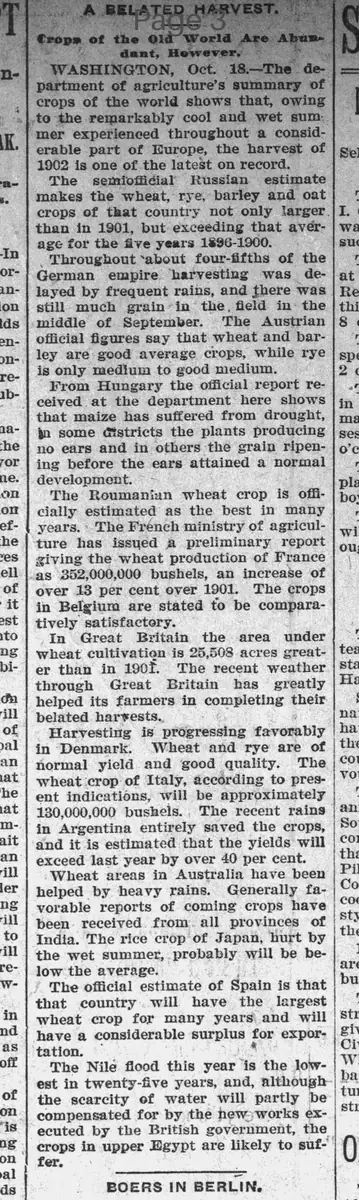
WASHINGTON, Oct. 18.—The department of agriculture's summary of crops of the world shows that, owing to the remarkably cool and wet summer experienced throughout a considerable part of Europe, the harvest of 1902 is one of the latest on record.
The semiofficial Russian estimate makes the wheat, rye, barley and oat crops of that country not only larger than in 1901, but exceeding that average for the five years 1896-1900.
Throughout about four-fifths of the German empire harvesting was delayed by frequent rains, and there was still much grain in the field in the middle of September. The Austrian official figures say that wheat and barley are good average crops, while rye is only medium to good medium.
From Hungary the official report received at the department here shows that maize has suffered from drought, in some districts the plants producing no ears and in others the grain ripening before the ears attained a normal development.
The Roumanian wheat crop is officially estimated as the best in many years. The French ministry of agriculture has issued a preliminary report giving the wheat production of France as 352,000,000 bushels, an increase of over 13 per cent over 1901. The crops in Belgium are stated to be comparatively satisfactory.
In Great Britain the area under wheat cultivation is 25,508 acres greater than in 1901. The recent weather through Great Britain has greatly helped its farmers in completing their belated harvests.
Harvesting is progressing favorably in Denmark. Wheat and rye are of normal yield and good quality. The wheat crop of Italy, according to present indications, will be approximately 130,000,000 bushels. The recent rains in Argentina entirely saved the crops, and it is estimated that the yields will exceed last year by over 40 per cent.
Wheat areas in Australia have been helped by heavy rains. Generally favorable reports of coming crops have been received from all provinces of India. The rice crop of Japan, hurt by the wet summer, probably will be below the average.
The official estimate of Spain is that that country will have the largest wheat crop for many years and will have a considerable surplus for exportation.
The Nile flood this year is the lowest in twenty-five years, and, although the scarcity of water will partly be compensated for by the new works executed by the British government, the crops in upper Egypt are likely to suffer.
What sub-type of article is it?
What themes does it cover?
What keywords are associated?
Where did it happen?
Story Details
Location
Worldwide (Europe, Russia, Germany, Austria, Hungary, Romania, France, Belgium, Great Britain, Denmark, Italy, Argentina, Australia, India, Japan, Spain, Egypt)
Event Date
1902
Story Details
Global crop summary for 1902: Late European harvests due to cool wet summer; abundant Russian grains exceeding recent averages; delayed German harvest; average Austrian wheat/barley, medium rye; Hungarian maize drought-damaged; excellent Romanian wheat; French wheat up 13% to 352M bushels; satisfactory Belgian crops; increased British wheat area, aided by weather; normal Danish wheat/rye; Italian wheat ~130M bushels; Argentine yields up 40%; Australian wheat helped by rains; favorable Indian crops; below-average Japanese rice; large Spanish wheat surplus; low Nile flood threatens upper Egypt crops.