Thank you for visiting SNEWPapers!
Sign up free
The Enquirer
Richmond, Henrico County, Virginia
What is this article about?
In the House of Commons on Aug. 10, Mr. Whitbread urged against proroguing Parliament amid uncertain foreign relations with Turkey, Russia-France treaty, Prussian treaty excluding British ships, a naval expedition affecting West India trade, and delicate US affairs. Mr. Canning responded on Russian mediation communication, US relations, and deferred on Turkey and expedition details.
Merged-components note: Continuation of British Parliament debate on foreign affairs.
Clippings
1 of 2
OCR Quality
Full Text
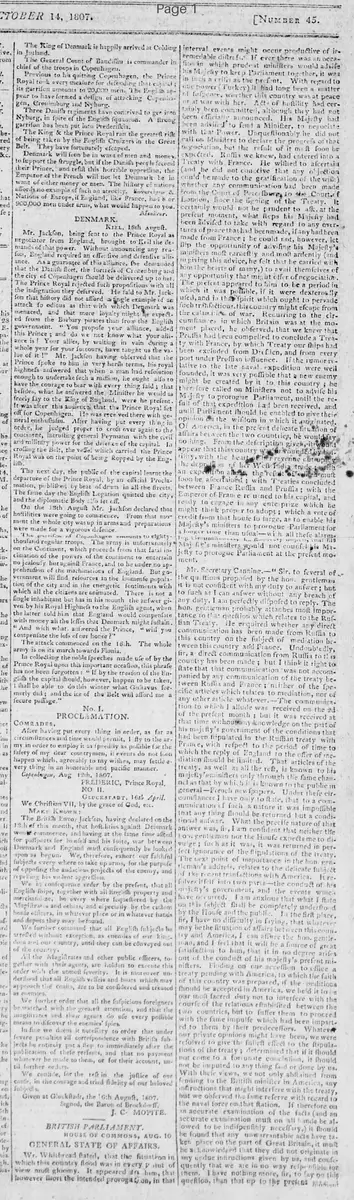
HOUSE OF COMMONS, AUG. 10
GENERAL STATE OF AFFAIRS.
Mr. Whitbread stated, that the situation in which this country stood was in every point of view not gloomy. It appeared so dull, that however short the intended prorogation. in that interval events might occur productive of irremediable distress. If ever there was an occasion in which prudent ministers would advise his Majesty to keep Parliament together, it was in such a crisis as the present. With regard to one power (Turkey) it had long been a matter of suspense, whether this country was at peace or at war with her. Acts of hostility had certainly been committed, although they had not been officially announced. His Majesty had been advised to send a Minister, to negotiate with that Power. Unquestionably he did not call on Ministers to declare the progress of that negotiation, but the result of it must soon be expected. Russia we knew, had entered into a treaty with France. He wished to ascertain (and he did not conceive that any objection could be made to the gratification of the wish) whether any communication had been made from the Court of Petersburgh to the Court of London, since the signing of the Treaty. It certainly would not be prudent to ask, at the present moment, what steps his Majesty had been advised to take with regard to any overtures of peace that had been made, if any had been made from France : he could not, however, let slip the opportunity of advising his Majesty's ministers most earnestly and most ardently (and in giving this advice, he felt that he carried with him the hearts of many,) to avail themselves of any opportunity that might offer of negociation. The present appeared to him to be a period in which it was possible, if it were dexterously used, and in that spirit which ought to pervade such transactions, this country might escape from the calamities of war. Recurring to the circumstances in which Britain was at the moment placed, he observed, that we knew that Prussia had been compelled to conclude a Treaty with France, by which Treaty our ships had been excluded from Dresden, and from every port under Prussian influence. If the rumor relative to the late naval expedition were well founded, it was very possible that a new enemy might be created by it to this country ; he therefore called on Ministers not to advise his Majesty to prorogue Parliament, until the result of that expedition had been received, and until Parliament should be enabled to give their opinion on the wisdom in which it originated. Of America, in the present delicate situation of affairs between the two countries, he would say nothing. From the description given, it would appear that this country was surrounded by hostility, with the heart of her revenue cut open by the deprivation of her West India trade which an expedition affects, the result of which must soon be ascertained ; with Treaties concluded between France Russia and Prussia; with the Emperor of France returned to his capital, and ready to engage in any enterprize which he might think proper to adopt; which a vote of credit from that house so large, as to enable his Majesty's ministers to prorogue Parliament for a longer time than usual--with all these alarming circumstances hanging over us, he thought that his Majesty's ministers would not counsel his Majesty to prorogue Parliament at the present moment.
Mr. Secretary Canning.--" Sir, to several of the questions proposed by the hon. gentleman it is not consistent with my duty to answer; but to such as I can answer without any breach of any duty, I am perfectly disposed to reply. The hon. gentleman probably attaches most importance to that question which relates to the Russian Treaty. He enquired whether any direct communication has been made from Russia to this country on the subject of mediation between this country and France. Undoubtedly, sir, a direct communication from Russia to this country has been made ; but I think it right to state that that communication 'was not accompanied by any communication of the treaty between Russia and France; neither of the specific articles which relates to mediation, nor of any other article whatever.--The communication to which I allude was received on the 2d of the present month ; but it was received at that time without any knowledge on the part of his majesty's government of the conditions that had been stipulated in the Russian treaty with France, with respect to the period of time to which the reply of England to the offer of mediation should be limited. That articles of the treaty, as well as all the rest, is known to his majesty's ministers only through the same channel as that by which it is known to the public in general--French newspapers. Under these circumstances I have only to state, that to a communication of such a nature it was impossible that any thing should be returned but a conditional answer. What the precise nature of that answer was, sir, I am confident that neither the hon. gentleman nor the House expects me to divulge; such as it was, it was returned in perfect ignorance of the stipulations of the treaty. The next point of importance in the hon gentleman's address, relates to the delicate subject of the recent transactions with America. It resolves itself into two parts--the conduct of his majesty's government, and the events which have occurred. I am anxious that what I state on this subject shall be completely understood by the House and the public. In the first place, sir, I have no difficulty in saying, that whatever may be the situation of affairs between this country and America, I can assure the hon. gentleman, and I feel that it will be a source of great satisfaction to him, that it in no degree arises out of the conduct of his majesty's present ministers. Finding on our accession to office a treaty pending with America, to which the faith of this country was pledged, if the conditions should be accepted in America, we held it to be our most sacred duty not to interfere with the course of the relations established between the two countries, but to suffer them to proceed with the same impulse which had been imparted to them by their predecessors. Whatever our private opinions might have been, we were resolved to give the fullest effect to the stipulations of the treaty ; determined that if it should not come to a fortunate conclusion, it should not be imputed to any thing said or done by us. With these views, we not only abstained from sending to the British minister in America, any instructions that might interfere with the treaty, but we observed the same reserve with regard to the naval force on that station. If therefore on an accurate examination of the facts (and an accurate examination must on all hands be allowed to be indispensably necessary,) it should be found that any unwarrantable acts have taken place on the part of Great Britain, it must be acknowledged that they did not originate in any undue instructions given by us, and consequently that we are in no way responsible for them. I have nothing more, sir, to say on this question, than that up to the present moment The British government has not received from the American government, either through the American minister in this country, or through the British minister in America, any representation on the subject.
"No longer ago than this day, in consequence of the Proclamation, purporting to be a Proclamation from the President of the United States, of which Ministers received the first intimation, in common with the rest of the public, from a newspaper, I thought it my duty to ascertain from the American Minister, whether or not he had received any instructions or communications from his government on this point. He replied that he had not received any.
There, sir, are the two questions on which the honorable gentleman must have been so anxious to be satisfied, and I am very glad I have it in my power to satisfy him. With regard to the other two, which relate to the relations between Turkey and Great Britain, and to the objects of the Naval Expedition, I cannot be so explicit. With respect to the former, I can only refer to the expressions of his majesty's speech-- "that he had thought it right to adopt such measures as might best enable him to take advantage of any favorable opportunity of bringing the hostilities in which he was engaged with the Sublime Porte to a conclusion. Consistent with his honour, and the interests of his people."
Sir, it cannot be expected from me, that I should go into the question, how far the changes have recently taken place in Turkey may influence his Majesty's determination with regard to the conditions on which his majesty may be willing to conclude a peace with that power: and with respect to the object of the expedition, it will not, I am sure from the nature of the subject, be expected of me at present to enter into any explanation. And now, sir, as to the subject on which the hon. gen. laid so great a stress, namely, the intended prorogation of parliament, his majesty's ministers will feel it their duty to give to his majesty such advice as may to them seem most expedient.
It is surely a new doctrine to introduce into the theory or practice of the constitution, that so long as any events are pending the result of which may by possibility be soon ascertained, or so long as public information of any kind whatever, may by possibility be speedily received, that so long his majesty shall be advised to abstain from proroguing his parliament, and from giving them that repose which their labours demand, and which the recess naturally affords."
Mr. Whitbread thanked the hon. gen. for the candour with which he had replied to his questions. With respect to the prorogation, he had never insinuated that his Majesty's right to prorogue parliament in any case was doubted; he had merely stated, that in the present emergency of the country, he considered it to be most inconvenient and most dangerous to exert this prerogative to its full extent.
What sub-type of article is it?
What keywords are associated?
What entities or persons were involved?
Foreign News Details
Event Date
Aug. 10
Key Persons
Event Details
Debate in House of Commons where Mr. Whitbread expresses concerns over international situations including uncertainty with Turkey, Russian treaty with France and mediation offer, Prussian treaty excluding British ships, potential new enemy from naval expedition affecting West India trade, and delicate US affairs; urges against proroguing Parliament. Mr. Canning confirms Russian communication on mediation received on 2d of present month without treaty details, assures no responsibility for US issues from current ministers, notes no US representations received, refers to King's speech on Turkey hostilities, and defends prorogation.