Thank you for visiting SNEWPapers!
Sign up free
Gazette Of The United States
New York, New York County, New York
What is this article about?
In Paris, on August 27, French Finance Minister Necker presented a memorial to the National Assembly on failing finances and a proposed new 80 million livre loan at 5% interest. The Assembly supported it, declared public debt inviolable, and praised patriotic tax advances from Touraine province. On August 28, they discussed constitutional monarchy.
Clipping
OCR Quality
Full Text
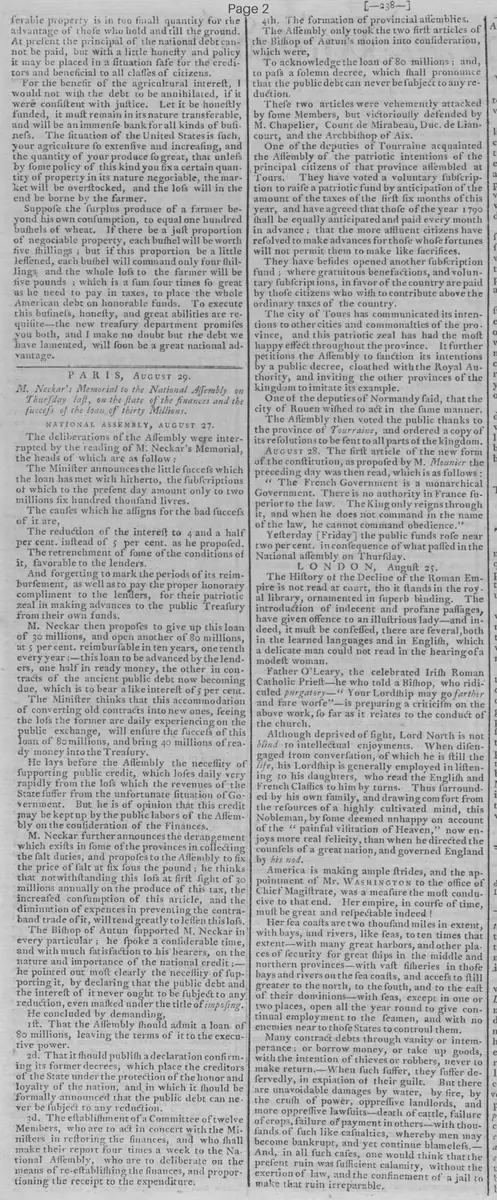
M. Neckar's Memorial to the National Assembly on Thursday last, on the state of the finances and the success of the loan of thirty Millions.
NATIONAL ASSEMBLY, AUGUST 27.
The deliberations of the Assembly were interrupted by the reading of M. Neckar's Memorial, the heads of which are as follow:
The Minister announces the little success which the loan has met with hitherto, the subscriptions of which to the present day amount only to two millions six hundred thousand livres.
The causes which he assigns for the bad success of it are,
The reduction of the interest, to 4 and a half per cent. instead of 5 per cent. as he proposed.
The retrenchment of some of the conditions of it, favorable to the lenders.
And forgetting to mark the periods of its reimbursement, as well as to pay the proper honorary compliment to the lenders, for their patriotic zeal in making advances to the public Treasury from their own funds.
M. Neckar then proposes to give up this loan of 30 millions, and open another of 80 millions, at 5 per cent. reimbursable in ten years, one tenth every year:—this loan to be advanced by the lenders, one half in ready money, the other in contracts of the ancient public debt now becoming due, which is to bear a like interest of 5 per cent.
The Minister thinks that this accommodation of converting old contracts into new ones, seeing the loss the former are daily experiencing on the public exchange, will ensure the success of this loan of 80 millions, and bring 40 millions of ready money into the Treasury.
He lays before the Assembly the necessity of supporting public credit, which loses daily very rapidly from the loss which the revenues of the State suffer from the unfortunate situation of Government. But he is of opinion that this credit may be kept up by the public labors of the Assembly on the consideration of the Finances.
M. Neckar further announces the derangement which exists in some of the provinces in collecting the salt duties, and proposes to the Assembly to fix the price of salt at six sous the pound; he thinks that notwithstanding this loss at first sight of 30 millions annually on the produce of this tax, the increased consumption of this article, and the diminution of expenses in preventing the contraband trade of it, will tend greatly to lessen this loss.
The Bishop of Autun supported M. Neckar in every particular; he spoke a considerable time, and with much satisfaction to his hearers, on the nature and importance of the national credit;—he pointed out most clearly the necessity of supporting it, by declaring that the public debt and the interest of it never ought to be subject to any reduction, even masked under the title of imposing.
He concluded by demanding,
1st. That the Assembly should admit a loan of 80 millions, leaving the terms of it to the executive power.
2d. That it should publish a declaration confirming its former decrees, which place the creditors of the State under the protection of the honor and loyalty of the nation, and in which it should be formally announced that the public debt can never be subject to any reduction.
3d. The establishment of a Committee of twelve Members, who are to act in concert with the Ministers in restoring the finances, and who shall make their report four times a week to the National Assembly, who are to deliberate on the means of re-establishing the finances, and proportioning the receipt to the expenditure:
4th. The formation of provincial assemblies.
The Assembly only took the two first articles of the Bishop of Autun's motion into consideration, which were,
To acknowledge the loan of 80 millions; and,
to pass a solemn decree, which shall pronounce that the public debt can never be subject to any reduction.
These two articles were vehemently attacked by some Members, but victoriously defended by M. Chapelier, Count de Mirabeau, Duc. de Liancourt, and the Archbishop of Aix.
One of the deputies of Tourraine acquainted the Assembly of the patriotic intentions of the principal citizens of that province assembled at Tours. They have voted a voluntary subscription to raise a patriotic fund by anticipation of the amount of the taxes of the first six months of this year, and have agreed that those of the year 1790 shall be equally anticipated and paid every month in advance; that the more affluent citizens have resolved to make advances for those whose fortunes will not permit them to make like sacrifices.
They have besides opened another subscription fund; where gratuitous benefactions, and voluntary subscriptions, in favor of the country are paid by those citizens who wish to contribute above the ordinary taxes of the country.
The city of Tours has communicated its intentions to other cities and commonalties of the province, and this patriotic zeal has had the most happy effect throughout the province. It further petitions the Assembly to sanction its intentions by a public decree, clothed with the Royal Authority, and inviting the other provinces of the kingdom to imitate its example.
One of the deputies of Normandy said, that the city of Rouen wished to act in the same manner.
The Assembly then voted the public thanks to the province of Tourraine, and ordered a copy of its resolutions to be sent to all parts of the kingdom.
August 28. The first article of the new form of the constitution, as proposed by M. Mounier the preceding day was then read, which is as follows:
"The French Government is a monarchical Government. There is no authority in France superior to the law. The King only reigns through it, and when he does not command in the name of the law, he cannot command obedience."
Yesterday [Friday] the public funds rose near two per cent. in consequence of what passed in the National assembly on Thursday.
What sub-type of article is it?
What keywords are associated?
What entities or persons were involved?
Where did it happen?
Foreign News Details
Primary Location
Paris
Event Date
August 27 28
Key Persons
Outcome
acknowledgment of 80 million livre loan; solemn decree protecting public debt from reduction; public thanks to touraine province for voluntary tax subscriptions and patriotic fund.
Event Details
M. Necker's memorial highlighted poor subscription to 30 million livre loan and proposed 80 million livre loan at 5% interest, reimbursable over ten years, using half cash and half old debt contracts. He addressed salt duty issues, suggesting price fix at six sous per pound. Bishop of Autun supported, proposing loan approval, debt protection declaration, finance committee, and provincial assemblies. Assembly approved loan and debt decree, defended by key members. Deputies reported Touraine's advance tax payments and subscriptions, inspiring Normandy; Assembly sent thanks nationwide. On August 28, M. Mounier's constitutional article on monarchical government read; public funds rose 2%.