Thank you for visiting SNEWPapers!
Sign up free
Editorial
November 2, 1805
Alexandria Daily Advertiser
Alexandria, Virginia
What is this article about?
An editorial from the Boston Repertory expresses skepticism about a new anti-French coalition involving Russia, Sweden, Austria, and England, arguing coalitions are unreliable and urging England to rely on its own prolonged war efforts to reduce French power, rather than depending on fleeting alliances.
Clipping
OCR Quality
98%
Excellent
Full Text
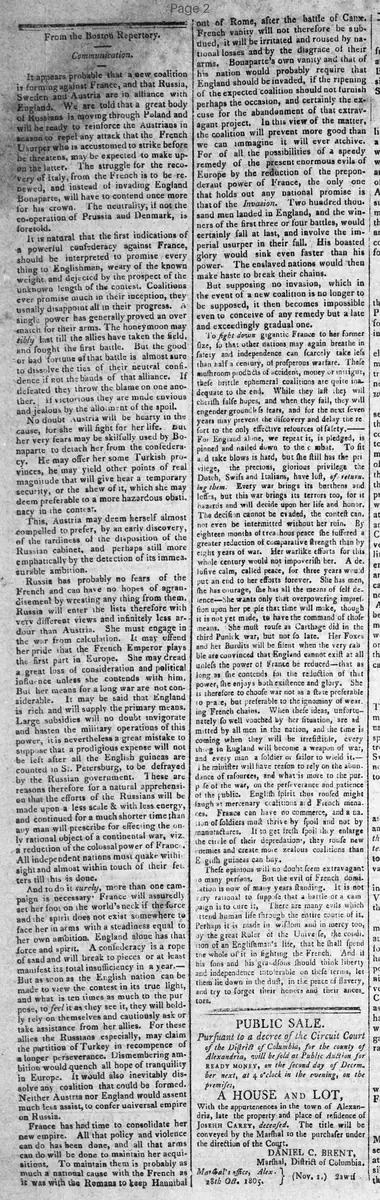
From the Boston Repertory.
Communication.
It appears probable that a new coalition is forming against France, and that Russia, Sweden and Austria are in alliance with England. We are told that a great body of Russians is moving through Poland and will be ready to reinforce the Austrians in season to repel any attack that the French Usurper who is accustomed to strike before he threatens, may be expected to make upon the latter. The struggle for the recovery of Italy from the French is to be renewed, and instead of invading England Bonaparte, will have to contend once more for his crown. The neutrality, if not the co-operation of Prussia and Denmark, is foretold.
It is natural that the first indications of a powerful confederacy against France, should be interpreted to promise every thing to Englishmen, weary of the known weight, and dejected by the prospect of the unknown length of the contest. Coalitions ever promise much in their inception, they usually disappoint all in their progress. A single power has generally proved an over-match for their arms. The honeymoon may possibly last till the allies have taken the field and fought the first battle. But the good or bad fortune of that battle is almost sure to dissolve the ties of that alliance. If defeated they throw the blame on one another. If victorious they are made envious and jealous by the allotment of the spoil.
No doubt Austria will be hearty in the cause, for she will fight for her life; but her very fears may be skilfully used by Bonaparte to detach her from the confederacy. He may offer her some Turkish provinces, he may yield other points of real magnitude that will give her a temporary security, or the shew of it, which she may deem preferable to a more hazardous obstinacy in the contest.
This, Austria may deem herself almost compelled to prefer, by an early discovery of the tardiness of the disposition of the Russian cabinet, and perhaps still more emphatically by the detection of its immeasurable ambition.
Russia has probably no fears of the French and can have no hopes of aggrandizement by wresting any thing from them. Russia will enter the lists therefore with very different views and infinitely less ardour than Austria. She must engage in the war from calculation. It may offend her pride that the French Emperor plays the first part in Europe. She may dread a great loss of consideration and political influence unless she contends with him. But her means for a long war are not considerable. It may be said that England is rich and will supply the primary means. Large subsidies will no doubt invigorate and hasten the military operations of this power, it is nevertheless a great mistake to suppose that a prodigious expense will not be left after all the English guineas are counted in St. Petersburg, to be defrayed by the Russian government. These are reasons therefore for a natural apprehension that the efforts of the Russians will be made upon a less scale & with less energy, and continued for a much shorter time than any rational object of a continental war, viz. a reduction of the colossal power of France. All independent nations must quake within sight and almost within touch of their fetters till this is done. And to do it surely, more than one campaign is necessary France will assuredly set her foot on the world's neck if the force and the spirit does not exist somewhere to face her in arms with a steadiness equal to force and spirit. A confederacy is a rope of sand and will break to pieces or at least manifest its total insufficiency in a year. But as soon as the English nation can be made to view the contest in its true light, to feel it as they see it, they will boldly and what is ten times as much to the purpose, rely on themselves and cautiously ask or take assistance from her allies. For these allies the Russians especially, may claim the partition of Turkey in recompence of a longer perseverance. Dismembering ambition would quench all hope of tranquility in Europe. It would also inevitably dissolve any coalition that could be formed. Neither Austria nor England would assent much less assist, to confer universal empire on Russia.
France has had time to consolidate her new empire. All that policy and violence can do has been done, and all that arms can do will be done to maintain her acquisitions. To maintain them is probably as much a national cause with the French as it was with the Romans to keep Hannibal out of Rome, after the battle of Cannae.
French vanity will not therefore be subdued, it will be irritated and roused by national losses and by the disgrace of their arms. Bonaparte's own vanity and that of his nation would probably require that England should be invaded, if the ripening of the expected coalition should not furnish perhaps the occasion, and certainly the excuse for the abandonment of that extravagant project. In this view of the matter, the coalition will prevent more good than we can imagine it will ever achieve.
For of all the possibilities of a speedy remedy of the present enormous evils of Europe by the reduction of the preponderant power of France, the only one that holds out any rational promise is that of the Invasion. Two hundred thousand men landed in England, and the winners of the first three or four battles, would certainly fall at last, and involve the imperial usurper in their fall. His boasted glory would sink even faster than his power. The enslaved nations would then make haste to break their chains.
But supposing no invasion, which in the event of a new coalition is no longer to be supposed, it then becomes impossible even to conceive of any remedy but a late and exceedingly gradual one. To fight down gigantic France to her former size, so that other nations may again breathe in safety and independence can scarcely take less than half a century, of prosperous warfare. Those mushroom products of accident, money or intrigue, these brittle ephemeral coalitions are quite inadequate to the end. While they last they will cherish false hopes, and when they fail, they will engender groundless fears, and for the next seven years may prevent the discovery and delay the resort to the only effective resources of safety.
For England alone, we repeat it, is pledged, is pinned and nailed down to the combat. To fit and take blows is hard, but she still has the privilege, the precious, glorious privilege the Dutch, Swiss and Italians, have lost, of returning them. Every war brings its burthens and losses, but this war brings its terrors too, for it hazards and will decide upon her life and honor. The decision cannot be evaded, the contest cannot even be intermitted without her ruin. By eighteen months of treacherous peace she suffered a greater reduction of comparative strength than by eight years of war. Her warlike efforts for this whole century would not impoverish her. A deceptive calm, called peace, for three years would put an end to her efforts forever. She has men, she has courage, she has all the means of self defence--She wants only that overpowering impression upon her people that time will make, though it is not yet made, to have the command of those means. She must rouse as Carthage did in the third Punic war, but not too late. Her Foxes and her Burdetts will be silent when the very rabble are convinced that England cannot exist at all unless the power of France be reduced-that as long as she contends for the reduction of that power, she enjoys both existence and glory. She is therefore to choose war not as a state preferable to peace, but preferable to the ignominy of wearing French chains. When these ideas, unfortunately so well vouched by her situation, are admitted by all men in the nation, and the time is coming when they will be irresistible, every thing in England will become a weapon of war, and every man a soldier or sailor to wield it. The minister will have reason to rely on the abundance of resources, and what is more to the purpose of the war, on the perseverance and patience of the public. English spirit thus roused might laugh at mercenary coalitions and French menaces. France can have no commerce, and a nation of soldiers must thrive by spoil and not by manufactures. If to get fresh spoil they enlarge the circle of their depredations, they rouse new enemies and create more zealous coalitions than English guineas can buy.
These opinions will no doubt seem extravagant to many persons. But the evil of French domination is now of many years standing. It is not very rational to suppose that a battle or a campaign is to cure it. There are many evils which attend human life through the entire course of it. Perhaps it is made in wisdom and in mercy too, by the great Ruler of the Universe, the condition of an Englishman's life, that he shall spend the whole of it in fighting the French. And if his sons and his grandsons should think liberty and independence intolerable on these terms, let them lie down in the dust, in the peace of slavery, and try to forget their honors and their ancestors.
Communication.
It appears probable that a new coalition is forming against France, and that Russia, Sweden and Austria are in alliance with England. We are told that a great body of Russians is moving through Poland and will be ready to reinforce the Austrians in season to repel any attack that the French Usurper who is accustomed to strike before he threatens, may be expected to make upon the latter. The struggle for the recovery of Italy from the French is to be renewed, and instead of invading England Bonaparte, will have to contend once more for his crown. The neutrality, if not the co-operation of Prussia and Denmark, is foretold.
It is natural that the first indications of a powerful confederacy against France, should be interpreted to promise every thing to Englishmen, weary of the known weight, and dejected by the prospect of the unknown length of the contest. Coalitions ever promise much in their inception, they usually disappoint all in their progress. A single power has generally proved an over-match for their arms. The honeymoon may possibly last till the allies have taken the field and fought the first battle. But the good or bad fortune of that battle is almost sure to dissolve the ties of that alliance. If defeated they throw the blame on one another. If victorious they are made envious and jealous by the allotment of the spoil.
No doubt Austria will be hearty in the cause, for she will fight for her life; but her very fears may be skilfully used by Bonaparte to detach her from the confederacy. He may offer her some Turkish provinces, he may yield other points of real magnitude that will give her a temporary security, or the shew of it, which she may deem preferable to a more hazardous obstinacy in the contest.
This, Austria may deem herself almost compelled to prefer, by an early discovery of the tardiness of the disposition of the Russian cabinet, and perhaps still more emphatically by the detection of its immeasurable ambition.
Russia has probably no fears of the French and can have no hopes of aggrandizement by wresting any thing from them. Russia will enter the lists therefore with very different views and infinitely less ardour than Austria. She must engage in the war from calculation. It may offend her pride that the French Emperor plays the first part in Europe. She may dread a great loss of consideration and political influence unless she contends with him. But her means for a long war are not considerable. It may be said that England is rich and will supply the primary means. Large subsidies will no doubt invigorate and hasten the military operations of this power, it is nevertheless a great mistake to suppose that a prodigious expense will not be left after all the English guineas are counted in St. Petersburg, to be defrayed by the Russian government. These are reasons therefore for a natural apprehension that the efforts of the Russians will be made upon a less scale & with less energy, and continued for a much shorter time than any rational object of a continental war, viz. a reduction of the colossal power of France. All independent nations must quake within sight and almost within touch of their fetters till this is done. And to do it surely, more than one campaign is necessary France will assuredly set her foot on the world's neck if the force and the spirit does not exist somewhere to face her in arms with a steadiness equal to force and spirit. A confederacy is a rope of sand and will break to pieces or at least manifest its total insufficiency in a year. But as soon as the English nation can be made to view the contest in its true light, to feel it as they see it, they will boldly and what is ten times as much to the purpose, rely on themselves and cautiously ask or take assistance from her allies. For these allies the Russians especially, may claim the partition of Turkey in recompence of a longer perseverance. Dismembering ambition would quench all hope of tranquility in Europe. It would also inevitably dissolve any coalition that could be formed. Neither Austria nor England would assent much less assist, to confer universal empire on Russia.
France has had time to consolidate her new empire. All that policy and violence can do has been done, and all that arms can do will be done to maintain her acquisitions. To maintain them is probably as much a national cause with the French as it was with the Romans to keep Hannibal out of Rome, after the battle of Cannae.
French vanity will not therefore be subdued, it will be irritated and roused by national losses and by the disgrace of their arms. Bonaparte's own vanity and that of his nation would probably require that England should be invaded, if the ripening of the expected coalition should not furnish perhaps the occasion, and certainly the excuse for the abandonment of that extravagant project. In this view of the matter, the coalition will prevent more good than we can imagine it will ever achieve.
For of all the possibilities of a speedy remedy of the present enormous evils of Europe by the reduction of the preponderant power of France, the only one that holds out any rational promise is that of the Invasion. Two hundred thousand men landed in England, and the winners of the first three or four battles, would certainly fall at last, and involve the imperial usurper in their fall. His boasted glory would sink even faster than his power. The enslaved nations would then make haste to break their chains.
But supposing no invasion, which in the event of a new coalition is no longer to be supposed, it then becomes impossible even to conceive of any remedy but a late and exceedingly gradual one. To fight down gigantic France to her former size, so that other nations may again breathe in safety and independence can scarcely take less than half a century, of prosperous warfare. Those mushroom products of accident, money or intrigue, these brittle ephemeral coalitions are quite inadequate to the end. While they last they will cherish false hopes, and when they fail, they will engender groundless fears, and for the next seven years may prevent the discovery and delay the resort to the only effective resources of safety.
For England alone, we repeat it, is pledged, is pinned and nailed down to the combat. To fit and take blows is hard, but she still has the privilege, the precious, glorious privilege the Dutch, Swiss and Italians, have lost, of returning them. Every war brings its burthens and losses, but this war brings its terrors too, for it hazards and will decide upon her life and honor. The decision cannot be evaded, the contest cannot even be intermitted without her ruin. By eighteen months of treacherous peace she suffered a greater reduction of comparative strength than by eight years of war. Her warlike efforts for this whole century would not impoverish her. A deceptive calm, called peace, for three years would put an end to her efforts forever. She has men, she has courage, she has all the means of self defence--She wants only that overpowering impression upon her people that time will make, though it is not yet made, to have the command of those means. She must rouse as Carthage did in the third Punic war, but not too late. Her Foxes and her Burdetts will be silent when the very rabble are convinced that England cannot exist at all unless the power of France be reduced-that as long as she contends for the reduction of that power, she enjoys both existence and glory. She is therefore to choose war not as a state preferable to peace, but preferable to the ignominy of wearing French chains. When these ideas, unfortunately so well vouched by her situation, are admitted by all men in the nation, and the time is coming when they will be irresistible, every thing in England will become a weapon of war, and every man a soldier or sailor to wield it. The minister will have reason to rely on the abundance of resources, and what is more to the purpose of the war, on the perseverance and patience of the public. English spirit thus roused might laugh at mercenary coalitions and French menaces. France can have no commerce, and a nation of soldiers must thrive by spoil and not by manufactures. If to get fresh spoil they enlarge the circle of their depredations, they rouse new enemies and create more zealous coalitions than English guineas can buy.
These opinions will no doubt seem extravagant to many persons. But the evil of French domination is now of many years standing. It is not very rational to suppose that a battle or a campaign is to cure it. There are many evils which attend human life through the entire course of it. Perhaps it is made in wisdom and in mercy too, by the great Ruler of the Universe, the condition of an Englishman's life, that he shall spend the whole of it in fighting the French. And if his sons and his grandsons should think liberty and independence intolerable on these terms, let them lie down in the dust, in the peace of slavery, and try to forget their honors and their ancestors.
What sub-type of article is it?
Foreign Affairs
War Or Peace
What keywords are associated?
Anti French Coalition
Napoleonic Wars
English Resolve
Russian Ambition
Austrian Fears
Bonaparte Invasion
European Balance
Prolonged Warfare
What entities or persons were involved?
France
Bonaparte
Russia
Austria
England
Sweden
Prussia
Denmark
Turkey
Editorial Details
Primary Topic
Skepticism Toward Anti French Coalitions And Call For England's Independent Resolve
Stance / Tone
Critical Of Coalitions, Exhortative For English Self Reliance Against French Domination
Key Figures
France
Bonaparte
Russia
Austria
England
Sweden
Prussia
Denmark
Turkey
Key Arguments
Coalitions Promise Much But Disappoint Due To Internal Rivalries And Quick Dissolution.
Austria Fights For Survival But May Be Tempted By Bonaparte's Offers.
Russia Joins From Calculation, Not Ardor, And Lacks Resources For Prolonged War Despite English Subsidies.
England Must Rely On Itself For A Long Term Reduction Of French Power, As Coalitions Are Unreliable.
A French Invasion Of England Could Lead To Bonaparte's Downfall And Liberation Of Europe.
Without Invasion, Defeating France Requires Decades Of Steady Warfare By England.
Peace Would Weaken England More Than War, And National Conviction Will Mobilize All Resources.
French Empire Is Consolidated; Vanity Will Drive Continued Resistance.
Partition Of Turkey By Allies Would Dissolve Any Coalition.
England's Destiny Is To Fight France For Liberty, Even Across Generations.