Thank you for visiting SNEWPapers!
Sign up free
Literary
May 23, 1789
Gazette Of The United States
New York, New York County, New York
What is this article about?
An essay from 'THE TABLET. NO. XII.' argues that while some party spirit is essential to society, excess factionalism corrupts individuals, using the fictional character Factotius as an example of moral and social downfall due to partisan zeal.
Clipping
OCR Quality
95%
Excellent
Full Text
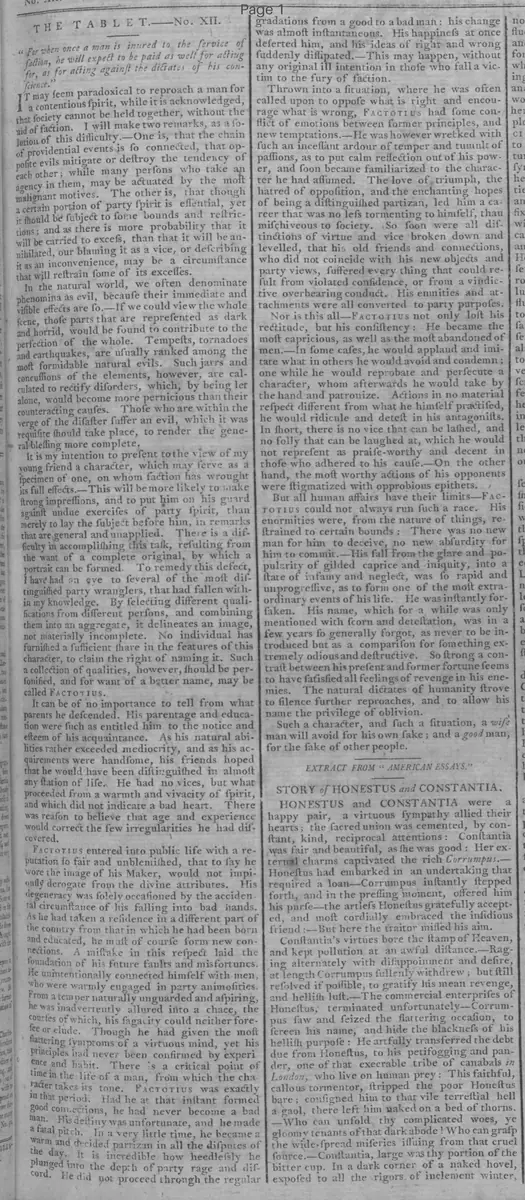
THE TABLET. NO. XII.
"For when once a man is inured to the service of faction, he will expect to be paid as well for acting for, as for acting against the dictates of his conscience."
That society cannot be held together, without the aid of faction. I will make two remarks, as a solution of this difficulty. One is, that the chain of providential events is so connected, that opposite evils mitigate or destroy the tendency of each other; while many persons who take an agency in them, may be actuated by the most malignant motives. The other is, that though a certain portion of party spirit is essential, yet it should be subject to some bounds and restrictions; and as there is more probability that it will be carried to excess, than that it will be annihilated, our blaming it as a vice, or describing it as an inconvenience, may be a circumstance that will restrain some of its excesses.
In the natural world, we often denominate phenomena as evil, because their immediate and visible effects are so. If we could view the whole scene, those parts that are represented as dark and horrid, would be found to contribute to the perfection of the whole. Tempests, tornadoes and earthquakes, are usually ranked among the most formidable natural evils. Such jars and concussions of the elements, however, are calculated to rectify disorders, which, by being let alone, would become more pernicious than their counteracting causes. Those who are within the verge of the disaster suffer an evil, which it was requisite should take place, to render the general blessing more complete.
It is my intention to present to the view of my young friend a character, which may serve as a specimen of one, on whom faction has wrought its full effects.—This will be more likely to make strong impressions, and to put him on his guard against undue exercises of party spirit, than merely to lay the subject before him, in remarks that are general and unapplied. There is a difficulty in accomplishing this task, resulting from the want of a complete original, by which a portrait can be formed. To remedy this defect, I have had an eye to several of the most distinguished party wranglers, that have fallen within my knowledge. By selecting different qualifications from different persons, and combining them into an aggregate, it delineates an image, not materially incomplete. No individual has furnished a sufficient share in the features of this character, to claim the right of naming it. Such a collection of qualities, however, should be personified, and for want of a better name, may be called FACTOTIUS.
It can be of no importance to tell from what parents he descended. His parentage and education were such as entitled him to the notice and esteem of his acquaintance. As his natural abilities rather exceeded mediocrity, and as his acquirements were handsome, his friends hoped that he would have been distinguished in almost any station of life. He had no vices, but what proceeded from a warmth and vivacity of spirit, and which did not indicate a bad heart. There was reason to believe that age and experience would correct the few irregularities he had discovered.
Factotius entered into public life with a reputation so fair and unblemished, that to say he wore the image of his Maker, would not impiously derogate from the divine attributes. His degeneracy was solely occasioned by the accidental circumstance of his falling into bad hands. As he had taken a residence in a different part of the country from that in which he had been born and educated, he must of course form new connections. A mistake in this respect laid the foundation of his future faults and misfortunes. He unintentionally connected himself with men, who were warmly engaged in party animosities. From a temper naturally unguarded and aspiring, he was inadvertently allured into a chase, the courses of which, his sagacity could neither foresee or elude. Though he had given the most flattering symptoms of a virtuous mind, yet his principles had never been confirmed by experience and habit. There is a critical point of time in the life of a man, from which the character takes its tone. Factotius was exactly in that period. Had he at that instant formed good connections, he had never become a bad man. His destiny was unfortunate, and he made a fatal pitch. In a very little time, he became a warm and decided partizan in all the disputes of the day. It is incredible how heedlessly he plunged into the depth of party rage and discord. He did not proceed through the regular gradations from a good to a bad man: his change was almost instantaneous. His happiness at once deserted him, and his ideas of right and wrong suddenly dissipated.—This may happen, without any original ill intention in those who fall a victim to the fury of faction.
Thrown into a situation, where he was often called upon to oppose what is right and encourage what is wrong, Factotius had some conflict of emotions between former principles, and new temptations. He was however wrecked with such an incessant ardour of temper and tumult of passions, as to put calm reflection out of his power, and soon became familiarized to the character he had assumed.
The love of triumph, the hatred of opposition, and the enchanting hopes of being a distinguished partizan, led him a career that was no less tormenting to himself, than mischievous to society. So soon were all distinctions of virtue and vice broken down and levelled, that his old friends and connections, who did not coincide with his new objects and party views, suffered every thing that could result from violated confidence, or from a vindictive overbearing conduct.
His enmities and attachments were all converted to party purposes. Nor is this all—Factorius not only lost his rectitude, but his consistency: He became the most capricious, as well as the most abandoned of men.—In some cases, he would applaud and imitate what in others he would avoid and condemn; one while he would reprobate and persecute a character, whom afterwards he would take by the hand and patronize. Actions in no material respect different from what he himself practised, he would ridicule and detest in his antagonists. In short, there is no vice that can be lashed, and no folly that can be laughed at, which he would not represent as praise-worthy and decent in those who adhered to his cause. On the other hand, the most worthy actions of his opponents were stigmatized with opprobrious epithets.
But all human affairs have their limits—Factotius could not always run such a race. His enormities were, from the nature of things, restrained to certain bounds: There was no new man for him to deceive, no new absurdity for him to commit.—His fall from the glare and popularity of gilded caprice and iniquity, into a state of infamy and neglect, was so rapid and unprogressive, as to form one of the most extraordinary events of his life. He was instantly forsaken. O His name, which for a while was only mentioned with scorn and detestation, was in a few years so generally forgot, as never to be introduced but as a comparison for something extremely odious and destructive. So strong a contrast between his present and former fortune seems to have satisfied all feelings of revenge in his enemies. The natural dictates of humanity drove to silence further reproaches; and to allow his name the privilege of oblivion.
Such a character, and such a situation, a wise man will avoid for his own sake; and a good man, for the sake of other people.
"For when once a man is inured to the service of faction, he will expect to be paid as well for acting for, as for acting against the dictates of his conscience."
That society cannot be held together, without the aid of faction. I will make two remarks, as a solution of this difficulty. One is, that the chain of providential events is so connected, that opposite evils mitigate or destroy the tendency of each other; while many persons who take an agency in them, may be actuated by the most malignant motives. The other is, that though a certain portion of party spirit is essential, yet it should be subject to some bounds and restrictions; and as there is more probability that it will be carried to excess, than that it will be annihilated, our blaming it as a vice, or describing it as an inconvenience, may be a circumstance that will restrain some of its excesses.
In the natural world, we often denominate phenomena as evil, because their immediate and visible effects are so. If we could view the whole scene, those parts that are represented as dark and horrid, would be found to contribute to the perfection of the whole. Tempests, tornadoes and earthquakes, are usually ranked among the most formidable natural evils. Such jars and concussions of the elements, however, are calculated to rectify disorders, which, by being let alone, would become more pernicious than their counteracting causes. Those who are within the verge of the disaster suffer an evil, which it was requisite should take place, to render the general blessing more complete.
It is my intention to present to the view of my young friend a character, which may serve as a specimen of one, on whom faction has wrought its full effects.—This will be more likely to make strong impressions, and to put him on his guard against undue exercises of party spirit, than merely to lay the subject before him, in remarks that are general and unapplied. There is a difficulty in accomplishing this task, resulting from the want of a complete original, by which a portrait can be formed. To remedy this defect, I have had an eye to several of the most distinguished party wranglers, that have fallen within my knowledge. By selecting different qualifications from different persons, and combining them into an aggregate, it delineates an image, not materially incomplete. No individual has furnished a sufficient share in the features of this character, to claim the right of naming it. Such a collection of qualities, however, should be personified, and for want of a better name, may be called FACTOTIUS.
It can be of no importance to tell from what parents he descended. His parentage and education were such as entitled him to the notice and esteem of his acquaintance. As his natural abilities rather exceeded mediocrity, and as his acquirements were handsome, his friends hoped that he would have been distinguished in almost any station of life. He had no vices, but what proceeded from a warmth and vivacity of spirit, and which did not indicate a bad heart. There was reason to believe that age and experience would correct the few irregularities he had discovered.
Factotius entered into public life with a reputation so fair and unblemished, that to say he wore the image of his Maker, would not impiously derogate from the divine attributes. His degeneracy was solely occasioned by the accidental circumstance of his falling into bad hands. As he had taken a residence in a different part of the country from that in which he had been born and educated, he must of course form new connections. A mistake in this respect laid the foundation of his future faults and misfortunes. He unintentionally connected himself with men, who were warmly engaged in party animosities. From a temper naturally unguarded and aspiring, he was inadvertently allured into a chase, the courses of which, his sagacity could neither foresee or elude. Though he had given the most flattering symptoms of a virtuous mind, yet his principles had never been confirmed by experience and habit. There is a critical point of time in the life of a man, from which the character takes its tone. Factotius was exactly in that period. Had he at that instant formed good connections, he had never become a bad man. His destiny was unfortunate, and he made a fatal pitch. In a very little time, he became a warm and decided partizan in all the disputes of the day. It is incredible how heedlessly he plunged into the depth of party rage and discord. He did not proceed through the regular gradations from a good to a bad man: his change was almost instantaneous. His happiness at once deserted him, and his ideas of right and wrong suddenly dissipated.—This may happen, without any original ill intention in those who fall a victim to the fury of faction.
Thrown into a situation, where he was often called upon to oppose what is right and encourage what is wrong, Factotius had some conflict of emotions between former principles, and new temptations. He was however wrecked with such an incessant ardour of temper and tumult of passions, as to put calm reflection out of his power, and soon became familiarized to the character he had assumed.
The love of triumph, the hatred of opposition, and the enchanting hopes of being a distinguished partizan, led him a career that was no less tormenting to himself, than mischievous to society. So soon were all distinctions of virtue and vice broken down and levelled, that his old friends and connections, who did not coincide with his new objects and party views, suffered every thing that could result from violated confidence, or from a vindictive overbearing conduct.
His enmities and attachments were all converted to party purposes. Nor is this all—Factorius not only lost his rectitude, but his consistency: He became the most capricious, as well as the most abandoned of men.—In some cases, he would applaud and imitate what in others he would avoid and condemn; one while he would reprobate and persecute a character, whom afterwards he would take by the hand and patronize. Actions in no material respect different from what he himself practised, he would ridicule and detest in his antagonists. In short, there is no vice that can be lashed, and no folly that can be laughed at, which he would not represent as praise-worthy and decent in those who adhered to his cause. On the other hand, the most worthy actions of his opponents were stigmatized with opprobrious epithets.
But all human affairs have their limits—Factotius could not always run such a race. His enormities were, from the nature of things, restrained to certain bounds: There was no new man for him to deceive, no new absurdity for him to commit.—His fall from the glare and popularity of gilded caprice and iniquity, into a state of infamy and neglect, was so rapid and unprogressive, as to form one of the most extraordinary events of his life. He was instantly forsaken. O His name, which for a while was only mentioned with scorn and detestation, was in a few years so generally forgot, as never to be introduced but as a comparison for something extremely odious and destructive. So strong a contrast between his present and former fortune seems to have satisfied all feelings of revenge in his enemies. The natural dictates of humanity drove to silence further reproaches; and to allow his name the privilege of oblivion.
Such a character, and such a situation, a wise man will avoid for his own sake; and a good man, for the sake of other people.
What sub-type of article is it?
Essay
Satire
What themes does it cover?
Political
Moral Virtue
What keywords are associated?
Faction
Party Spirit
Moral Degeneracy
Political Partisanship
Character Sketch
Satire On Politics
Literary Details
Title
The Tablet. No. Xii.
Subject
On The Effects Of Faction And Party Spirit
Form / Style
Prose Essay With Fictional Character Sketch
Key Lines
"For When Once A Man Is Inured To The Service Of Faction, He Will Expect To Be Paid As Well For Acting For, As For Acting Against The Dictates Of His Conscience."
Such A Collection Of Qualities, However, Should Be Personified, And For Want Of A Better Name, May Be Called Factotius.
His Degeneracy Was Solely Occasioned By The Accidental Circumstance Of His Falling Into Bad Hands.
In Short, There Is No Vice That Can Be Lashed, And No Folly That Can Be Laughed At, Which He Would Not Represent As Praise Worthy And Decent In Those Who Adhered To His Cause.