Thank you for visiting SNEWPapers!
Sign up free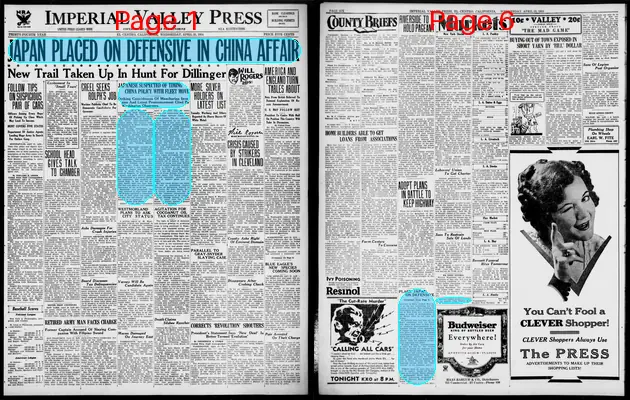
Imperial Valley Press
El Centro, Imperial County, California
What is this article about?
In 1934, U.S. observers suspect Japan timed its assertive China policy announcement with U.S. fleet's Pacific departure, similar to 1931 Manchuria invasion amid British naval mutiny. U.S. and UK demand clarifications from Japan.
Merged-components note: Headline, body, and continuation of the same foreign news story on Japan-China policy across pages 1 and 6.
Clippings
1 of 2
OCR Quality
Full Text
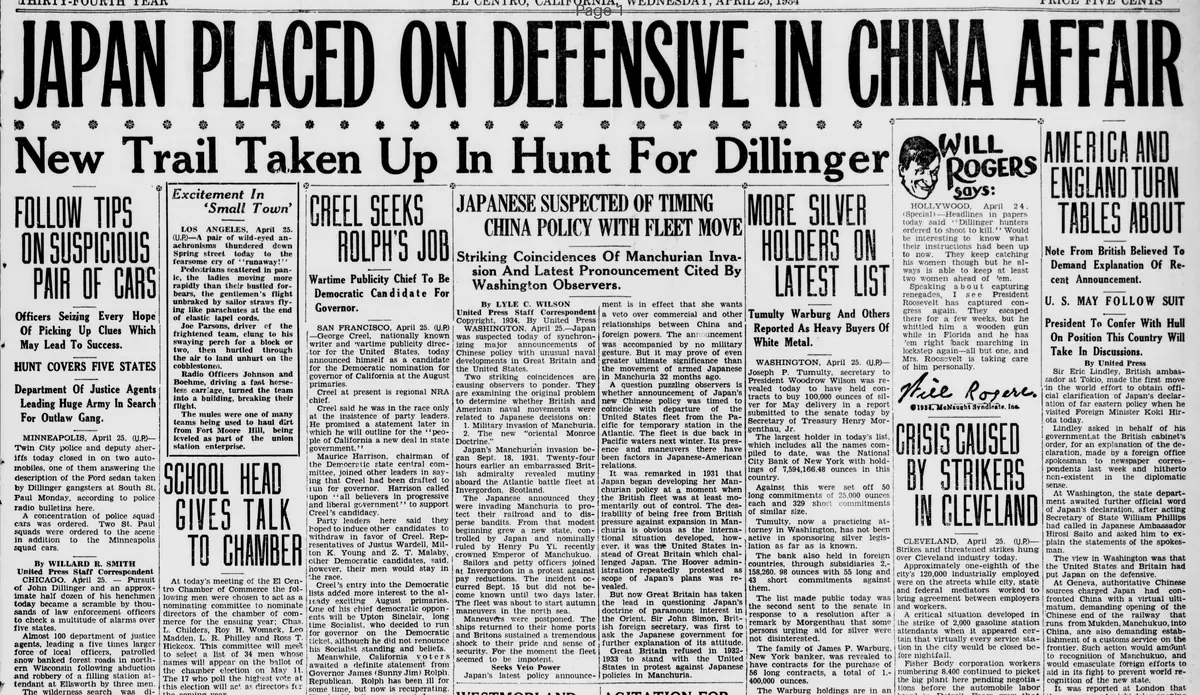
JAPANESE SUSPECTED OF TIMING CHINA POLICY WITH FLEET MOVE
Striking Coincidences Of Manchurian Invasion And Latest Pronouncement Cited By Washington Observers.
By LYLE C. WILSON
United Press Staff Correspondent
Copyright, 1934, By United Press
WASHINGTON. April 25.-Japan was suspected today of synchronizing major announcements of Chinese policy with unusual naval developments in Great Britain and the United States.
Two striking coincidences are causing observers to ponder. They are examining the original problem to determine whether British and American naval movements were related to Japanese decisions on:
1. Military invasion of Manchuria.
2. The new "oriental Monrce Doctrine."
Japan's Manchurian invasion began Sept. 18, 1931. Twenty-four hours earlier an embarrassed British admiralty revealed mutiny aboard the Atlantic battle fleet at Invergordon. Scotland
The Japanese announced they were invading Manchuria to protect their railroad and to disperse bandits. From that modest beginning grew a new state, controlled by Japan and nominally ruled by Henry Pu Yi, recently crowned Emperor of Manchukuo.
Sailors and petty officers joined at Invergordon in a protest against pay reductions. The incident occurred Sept. 15 but did not become known until two days later.
The fleet was about to start autumn maneuvers in the north sea Maneuvers were postponed. The ships returned to their home ports and Britons sustained a tremendous shock to their pride and sense of security. For the moment the fleet seemed to be impotent.
Seeks Veto Power
Japan's latest policy announcement is in effect that she wants a veto over commercial and other relationships between China and foreign powers. The announcement was accompanied by no military gesture. But it may prove of even greater ultimate significance than the movement of armed Japanese in Manchuria 32 months ago.
A question puzzling observers is whether announcement of Japan's new Chinese policy was timed to coincide with departure of the United States fleet from the Pacific for temporary station in the Atlantic. The fleet is due back in Pacific waters next winter. Its presence and maneuvers there have been factors in Japanese-American relations.
It was remarked in 1931 that Japan began developing her Manchurian policy at a moment when the British fleet was at least momentarily out of control. The desirability of being free from British pressure against expansion in Manchuria is obvious as the international situation developed. however. it was the United States instead of Great Britain which challenged Japan. The Hoover administration repeatedly protested as scope of Japan's plans was revealed.
But now Great Britain has taken the lead in questioning Japan's doctrine of paramount interest in the Orient. Sir John Simon, British foreign secretary. was first to ask the Japanese government for further explanation of its attitude.
Great Britain refused in 1932-1933 to stand with the United States in protest against Japanese policies in Manchuria.
PLACE JAPAN
ON DEFENSIVE
(Continued From Page 1)
Secretary of State Cordell Hull later in the day concerning the far eastern situation. Hull returned to Washington last night from a week-end in New York and immediately began a study of developments in the Orient since he left here last Friday.
No definite time had been set for Hull's conference with the President. Since Hull went to New York the unofficial pronouncement by a Japanese foreign office spokesman of Japan's policy toward China has been given official status by almost simultaneous action by the United States and Great Britain in requesting officially more definite "information" from the Japanese government regarding this policy.
William Phillips, undersecretary of state. did this for the United States by calling the Japanese ambassador. Hiroshi Saito, to the state department and asking him for the desired information. Sir John Simon, British secretary for foreign affairs. previously had dispatched a note to Tokio officials asking the Japanese foreign office for "clarification" of the Japanese policy.
TOKIO. April 25. (UP)-The outline of Japan's "hands off China" policy given United States officially by Ambassador Hirosi Saito "explained everything satisfactorily." Foreign Minister Koki Hirota believed today.
For that reason, it was said, Hirota does not expect to receive a note on the subject from Cordell Hull, U. S. secretary of state.
He does not expect to receive a note on the subject from Cordell Hull, U. S. secretary of state.
What sub-type of article is it?
What keywords are associated?
What entities or persons were involved?
Where did it happen?
Foreign News Details
Primary Location
China
Event Date
April 25, 1934
Key Persons
Outcome
japan announces policy seeking veto over china's foreign relationships; united states and great britain request clarification from japan; no military action reported in current announcement.
Event Details
Washington observers suspect Japan timed its new Chinese policy announcement, asserting paramount interest and veto over China's foreign relations, with U.S. fleet movement from Pacific to Atlantic. This echoes 1931 Manchurian invasion coinciding with British fleet mutiny at Invergordon. U.S. Undersecretary William Phillips and British Foreign Secretary Sir John Simon seek explanations from Japanese officials. Japanese Foreign Minister Koki Hirota believes the policy explanation to U.S. Ambassador Hiroshi Saito is satisfactory.