Thank you for visiting SNEWPapers!
Sign up free
The Daily Madisonian
Washington, District Of Columbia
What is this article about?
President John Tyler's letter, read at a Philadelphia Democratic dinner on July 4, 1843, declines an invitation to celebrate Independence Day. He defends his veto of a national bank bill as upholding constitutional limits on federal power, emphasizes a specie-based currency without corporations, and affirms his adherence to Jeffersonian Republican principles amid criticism.
Clipping
OCR Quality
Full Text
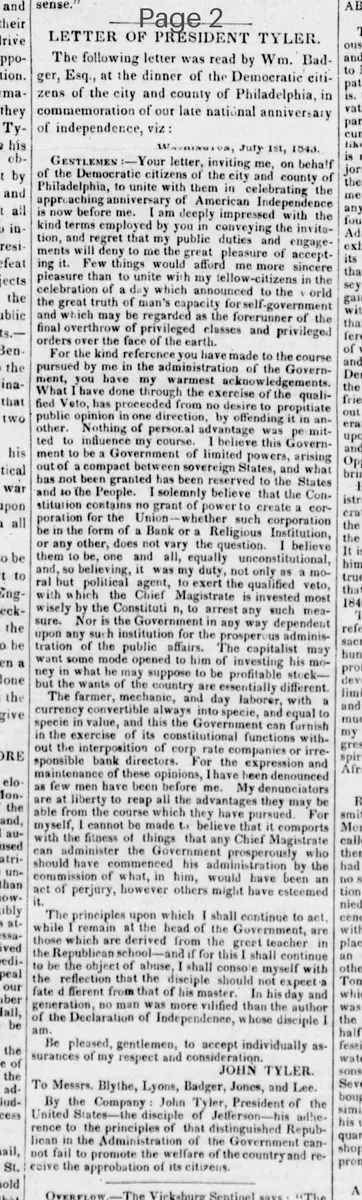
The following letter was read by Wm. Badger, Esq., at the dinner of the Democratic citizens of the city and county of Philadelphia, in commemoration of our late national anniversary of independence, viz:
WASHINGTON, July 1st, 1843.
Gentlemen:—Your letter, inviting me, on behalf of the Democratic citizens of the city and county of Philadelphia, to unite with them in celebrating the approaching anniversary of American Independence is now before me. I am deeply impressed with the kind terms employed by you in conveying the invitation, and regret that my public duties and engagements will deny to me the great pleasure of accepting it. Few things would afford me more sincere pleasure than to unite with my fellow-citizens in the celebration of a day which announced to the world the great truth of man's capacity for self-government and which may be regarded as the forerunner of the final overthrow of privileged classes and privileged orders over the face of the earth.
For the kind reference you have made to the course pursued by me in the administration of the Government, you have my warmest acknowledgements. What I have done through the exercise of the qualified Veto, has proceeded from no desire to propitiate public opinion in one direction, by offending it in another. Nothing of personal advantage was permitted to influence my course. I believe this Government to be a Government of limited powers, arising out of a compact between sovereign States, and what has not been granted has been reserved to the States and to the People. I solemnly believe that the Constitution contains no grant of power to create a corporation for the Union—whether such corporation be in the form of a Bank or a Religious Institution, or any other, does not vary the question. I believe them to be, one and all, equally unconstitutional, and, so believing, it was my duty, not only as a moral but political agent, to exert the qualified veto, with which the Chief Magistrate is invested most wisely by the Constitution, to arrest any such measure. Nor is the Government in any way dependent upon any such institution for the prosperous administration of the public affairs. The capitalist may want some mode opened to him of investing his money in what he may suppose to be profitable stock—but the wants of the country are essentially different. The farmer, mechanic, and day laborer, with a currency convertible always into specie, and equal to specie in value, and this the Government can furnish in the exercise of its constitutional functions without the interposition of corporate companies or irresponsible bank directors. For the expression and maintenance of these opinions, I have been denounced as few men have been before me. My denunciators are at liberty to reap all the advantages they may be able from the course which they have pursued. For myself, I cannot be made to believe that it comports with the fitness of things that any Chief Magistrate can administer the Government prosperously who should have commenced his administration by the commission of what, in him, would have been an act of perjury, however others might have esteemed it.
The principles upon which I shall continue to act, while I remain at the head of the Government, are those which are derived from the great teacher in the Republican school—and if for this I shall continue to be the object of abuse, I shall console myself with the reflection that the disciple should not expect a fate different from that of his master. In his day and generation, no man was more vilified than the author of the Declaration of Independence, whose disciple I am.
Be pleased, gentlemen, to accept individually assurances of my respect and consideration.
JOHN TYLER.
To Messrs. Blythe, Lyons, Badger, Jones, and Lee.
By the Company: John Tyler, President of the United States—the disciple of Jefferson—his adherence to the principles of that distinguished Republican in the Administration of the Government cannot fail to promote the welfare of the country and receive the approbation of its citizens.
What sub-type of article is it?
What themes does it cover?
What keywords are associated?
What entities or persons were involved?
Letter to Editor Details
Author
John Tyler
Recipient
Messrs. Blythe, Lyons, Badger, Jones, And Lee
Main Argument
tyler declines the invitation due to duties but defends his veto of the national bank as a constitutional duty to prevent unauthorized federal corporations, advocating for a specie-based currency without banks, and commits to jeffersonian principles despite criticism.
Notable Details