Thank you for visiting SNEWPapers!
Sign up free
Daily National Intelligencer
Washington, District Of Columbia
What is this article about?
Report from David P. Adams, former chaplain of the USS Essex, detailing the ship's capture by British forces, its sale at Rio de Janeiro, the high costs to Britain, a false rumor of its recapture, and British pursuits in the Pacific.
Clipping
OCR Quality
Full Text
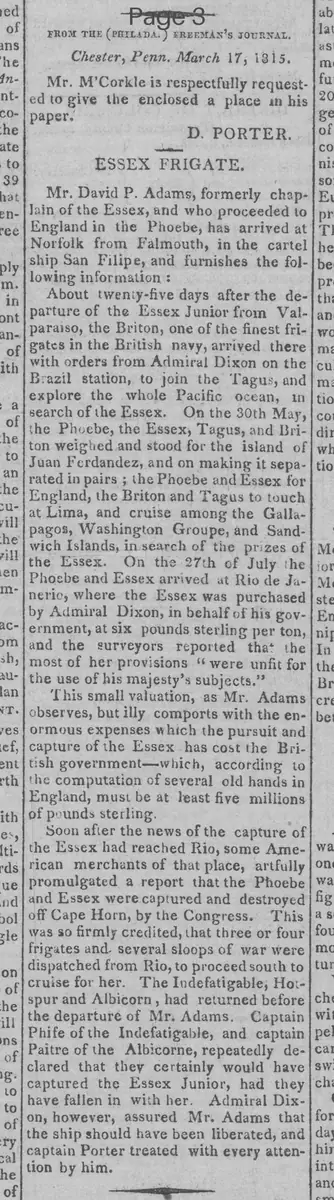
Chester, Penn. March 17, 1815.
Mr. M'Corkle is respectfully requested to give the enclosed a place in his paper.
D. PORTER.
ESSEX FRIGATE.
Mr. David P. Adams, formerly chaplain of the Essex, and who proceeded to England in the Phoebe, has arrived at Norfolk from Falmouth, in the cartel ship San Filipe, and furnishes the following information:
About twenty-five days after the departure of the Essex Junior from Valparaiso, the Briton, one of the finest frigates in the British navy, arrived there with orders from Admiral Dixon on the Brazil station, to join the Tagus, and explore the whole Pacific ocean, in search of the Essex. On the 30th May, the Phoebe, the Essex, Tagus, and Briton weighed and stood for the island of Juan Fernandez, and on making it separated in pairs; the Phoebe and Essex for England, the Briton and Tagus to touch at Lima, and cruise among the Gallapagos, Washington Groupe, and Sandwich Islands, in search of the prizes of the Essex. On the 27th of July the Phoebe and Essex arrived at Rio de Janeiro, where the Essex was purchased by Admiral Dixon, in behalf of his government, at six pounds sterling per ton, and the surveyors reported that the most of her provisions "were unfit for the use of his majesty's subjects."
This small valuation, as Mr. Adams observes, but illy comports with the enormous expenses which the pursuit and capture of the Essex has cost the British government—which, according to the computation of several old hands in England, must be at least five millions of pounds sterling.
Soon after the news of the capture of the Essex had reached Rio, some American merchants of that place, artfully promulgated a report that the Phoebe and Essex were captured and destroyed off Cape Horn, by the Congress. This was so firmly credited, that three or four frigates and several sloops of war were dispatched from Rio, to proceed south to cruise for her. The Indefatigable, Hotspur and Albicore, had returned before the departure of Mr. Adams. Captain Phile of the Indefatigable, and captain Paitre of the Albicore, repeatedly declared that they certainly would have captured the Essex Junior, had they have fallen in with her. Admiral Dixon, however, assured Mr. Adams that the ship should have been liberated, and captain Porter treated with every attention by him.
What sub-type of article is it?
What themes does it cover?
What keywords are associated?
What entities or persons were involved?
Where did it happen?
Story Details
Key Persons
Location
Valparaiso, Pacific Ocean, Juan Fernandez, Rio De Janeiro, Gallapagos, Washington Groupe, Sandwich Islands, Cape Horn
Event Date
March 17, 1815; 30th May; 27th Of July
Story Details
David P. Adams reports on the British pursuit and capture of the USS Essex in the Pacific, its low-value purchase at Rio de Janeiro despite high costs to Britain, a deceptive rumor causing further British deployments, and assurances of fair treatment.