Thank you for visiting SNEWPapers!
Sign up free
Editorial
November 15, 1854
The Lancaster Ledger
Lancaster, Lancaster County, South Carolina
What is this article about?
This editorial critiques the fanaticism in the temperance movement, arguing that total abstinence alone is insufficient and promotes hypocrisy. It discusses historical stimulant use, advocates for American wine production to reduce spirit consumption, and considers prohibitory laws like the Maine Law as a potential solution to intemperance.
Clipping
OCR Quality
95%
Excellent
Full Text
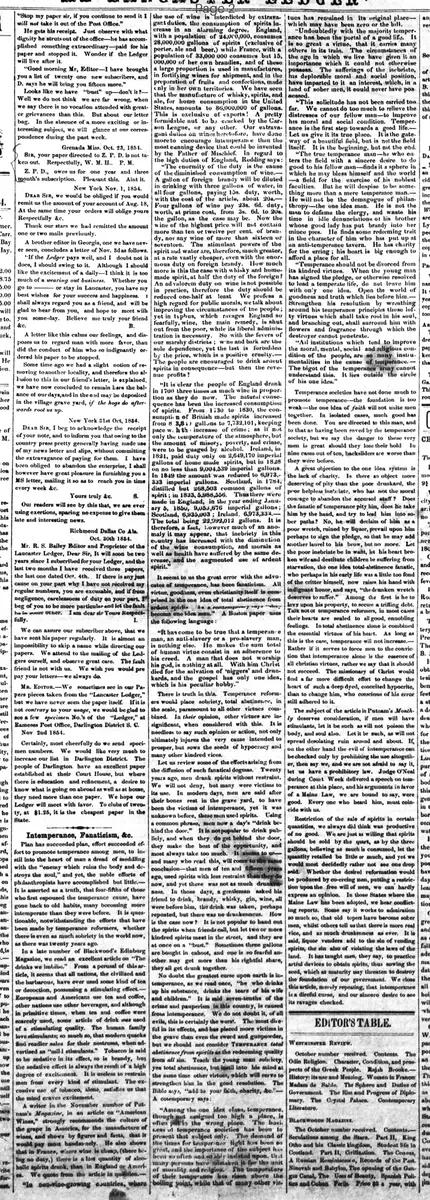
Intemperance, Fanaticism, &c.
Plan has succeeded plan, effort succeeded effort to promote temperance among men, to instil into the heart of man a dread of meddling with the "enemy which ruins the body and destroys the soul," and yet, the noble efforts of philanthropists have accomplished but little.
It is asserted as a truth, that four-fifths of those who first espoused the temperance cause, have gone back to old habits, many becoming more intemperate than they were before. It is questionable, notwithstanding the efforts that have been made by temperance reformers, whether there is even as much sobriety in the world now, as there was twenty years ago.
In a late number of Blackwood's Edinburgh Magazine, we read an excellent article on "The drinks we imbibe." From a perusal of this article, it seems that all nations, the civilized and the barbarous, have ever used some kind of tea or decoction, possessing a stimulating effect.
Europeans and Americans use tea and coffee, other nations use other beverages, and although in primitive times, when tea and coffee were scarcely used, some article of drink was used of a stimulating quality. The human family love stimulants; so much so, that modern quacks find readier sales for their nostrums, when advertised as "mild stimulants." Tobacco is said to be sedative in its effect, so is brandy, but the sedative effect is always the result of a high degree of excitement. It is useless to restrain men from every kind of stimulant. The excessive use of tobacco, alone, satisfies us that the mind craves excitement.
A writer in the November number of Putnam's Magazine, in an article on "American Wines," strongly recommends the culture of the grape in America, for the manufacture of wines, and shows by figures and facts, that it would pay most handsomely. He also shows that in France, where wine is cheap, (there being no duty,) there is a less quantity of alcoholic spirits drank, than in England or America. We quote from the article in question.
"Where the use of wine is interdicted by extravagant duties, the consumption of spirits increases in an alarming degree. England, with a population of 24,000,000, consumes 28,000,000 gallons of spirits (exclusive of porter, ale and beer,) while France, with a population of 33,000,000 consumes but 15,000,000 of her own brandies, and of these a large proportion is used in manufactures, in fortifying wines for shipment, and in the preparation of fruits and confections, made only in her own territories. We have seen that the manufacture of whisky, spirits, and ale, for home consumption in the United States, amounts to 86,000,000 of gallons.
This is exclusive of exports! A pretty formidable nut to be cracked by the Carson League, or any other. Our extravagant duties on wines heretofore, have done more to encourage intemperance than the most cunning device that could be invented by the Father of Mischief. In regard to the high duties of England, Redding says:
"The enormity of the duty is the cause of the diminished consumption of wine.—A gallon of foreign brandy will be diluted in drinking with three gallons of water, in all four gallons, paying 15s. duty, worth, with the cost of the article, about 20s.—Four gallons of wine pay 23s. 6d. duty, worth, at prime cost, from 3s. 6d. to 20s. the gallon, as the case may be. Now the wine of the highest price will not contain more than ten or twelve per cent. of brandy, nor any wine of more than sixteen or seventeen. The stimulant powers of the spirit and water are, therefore, much greater, at a rate vastly cheaper, even with the enormous duty on foreign brandy. How much more is this the case with whisky and home-made spirit, at half the duty of the foreign? An ad valorem duty on wine is not possible in practice, therefore the duty should be reduced one-half at least. We profess a high regard for public morals, we talk about improving the circumstances of the people; yet in typhus, which ravages England so fearfully, wine, the main remedy, is shut out from the poor, while its liberal administration is necessary. So with the fevers of our marshy districts; wine and bark are the sole dependence, yet the last is forbidden by the price, which is a positive cruelty.—The people are encouraged to drink ardent spirits in consequence—but then the revenue profits?
"It is clear the people of England drank in 1700 three times as much wine in proportion as they do now. The natural consequence has been the increased consumption of spirits. From 1730 to 1830, the consumption of British made spirits increased from 3,810 gallons to 7,732,101, keeping pace with the increase of crime; as if not only the temperature of the atmosphere, but the amount of misery, poverty, and crime, were to be gauged by alcohol." Ireland, in 1821, paid duty only on 2,649,170 imperial gallons of home made spirits, but in 1828 on no less than 9,004,539 imperial gallons. In 1849 the amount was reduced to 6,973,333 imperial gallons. Scotland, in 1784, distilled but 268,503 common gallons of spirit; in 1833, 5,988,556. Thus there were made in England, in the year ending January 5, 1850, 9,053,676 imperial gallons; Scotland, 6,935,003; Ireland, 6,973,333. The total being 22,992,012 gallons. It is therefore, a fact, however much of an anomaly it may appear, that inebriety in this Country has increased with the diminution of the wine consumption, and morals as well as health have suffered by the same decrease, and the augmented use of ardent spirit.
It seems to us the great error with the advocates of temperance, has been fanaticism. All virtue, goodness, even christianity itself is comprised in the one idea of total abstinence from ardent spirits and a contemptuous who she become one idea men.
A Boston paper uses the following language:
"It has come to be true that a temperance man, an anti-slavery or a pro-slavery man, is nothing else. He makes the sum total of human virtue consist in an adherence to his creed. A man that does not worship his god, is nothing at all. With him Christ died for the salvation of 'niggers' and drunkards, and the gospel has only one idea, which is his peculiar hobby."
There is truth in this. Temperance reformers would place sobriety, total abstinence, in the scale, paramount to all other virtues combined. In their opinion, other virtues are insignificant, when considered with this. It is needless to say such opinion or action, not only ultimately injures the very cause intended to prosper, but sows the seeds of hypocrisy and many other kindred vices.
Let us review some of the effects arising from the diffusion of such fanatical dogmas. Twenty years ago, men drank spirits without restraint. We will not deny, but many were victims to its use. In modern days, men are said after their bones rest in the grave yard, to have been the victims of intemperance, yet it was unknown before, these men used spirits. Being a common phrase, men now a day's "drink behind the door." It is not popular to drink publicly, and when they do get behind the door, they make the best of the opportunity, and most always take too much. It seems to us—and many who read this, will come to the same conclusion—that men of ten and fifteen years ago, used spirits with less restraint than they do now, and yet there was not as much drunkenness. In those days, a gentleman asked his friend to drink, 'brandy, whisky, gin, wine, all were before him, the drink was taken, perhaps repeated, but there was no drunkenness. How is the case now? It is not popular to hand out the spirits when friends call, but let two or more kindred spirits meet in the street, and they are at once on a "bust." Sometimes three gallons are bought in cahoot, and one is so fearful another may get more than his rightful share, they all get drunk together.
No doubt the greatest curse upon earth is intemperance, as we read once, "he who drinks up his substance, drinks the tears of his wife and children." It is said seven-tenths of the crime and pauperism in this country, is caused from intemperance. We do not doubt it, of all evils, this is certainly the worst. The most direful in its effects, and has placed more victims in the grave than even the sword and gunpowder, but we should not consider TEMPERANCE total abstinence from spirits as the redeeming quality from all sin. Teach the young man sobriety, yea total abstinence, but instil into his mind at the same time other virtues, which will serve to strengthen him in the good resolution. The Bible says, "add to your faith, charity, &c."
A contemporary says
"Among the one idea class, temperance, though not assigned too high a place, is often put in the wrong place. The business of temperance societies has been to present that subject only. The demand of the times for temperance light has been so great, and the importance of the subject has been so often and so ably insisted upon, that many persons have mistaken it for the unit of morality and religion. The temperature of their temperance has risen above the boiling point, while that of many other virtues has remained in its original place—which may have been zero or the ball.
Undoubtedly with the majority temperance has been the portal of a good life. It is so great a virtue, that it carries many others in its train. The circumstances of the age in which we live have given it an importance which it could not otherwise possess. The sufferings of the inebriate, his deplorable moral and social position, have imparted to it an interest, which, in a land of sober men, it could never have possessed.
"This solicitude has not been carried too far. We cannot do too much to relieve the distresses of our fellow man—to improve his moral and social condition. Temperance is the first step towards a good life.—Let us give it its true place. It is the gateway of a beautiful field, but is not the field itself. It is the beginning, but not the end.
"The true temperance man—he who enters the field with a sincere desire to do good to his fellow man—finds it a sphere in which he may bless himself and the world—a field for the exercise of his noblest faculties. But he will despise to be something more than a mere temperance man.—He will not be the demagogue of philanthropy—the one idea man. He is not the man to defame the clergy, and waste his time in idle denunciations of his brother whose good lady has put brandy into her mince pies. He finds some redeeming trait in the character of him who has put up at an anti-temperance tavern. He has charity for the erring; his heart is big enough to afford a place for all.
"Temperance should not be divorced from its kindred virtues. When the young man has signed the pledge, or otherwise resolved to lead a temperate life, do not leave him with only one idea. Open the world of goodness and truth which lies before him.—Strengthen his resolution by wreathing around his temperance principles those lofty virtues which shall take root in his soul, and branching out, shall surround him with flowers and fragrance through which the destroyer cannot penetrate.
"All institutions which tend to improve the moral, mental, social and religious condition of the people, are so many instrumentalities in the cause of temperance.—The bigot of the temperance army cannot understand this. It lies outside the circle of his one idea."
Temperance societies have not done much to promote temperance—the foundation is too weak—the one idea of faith will not unite men together. In isolated cases, much good has been done. You are directed to this man, and to that as having been saved by the temperance society, but we say the danger to these very men is great should they lose their hold. In nine cases out of ten, backsliders are worse than they were before.
A great objection to the one idea system is the lack of charity. Is there an object more deserving of pity than the poor drunkard, the poor helpless inebriate, who has not the moral courage to abandon the accursed stuff? Does the fanatic of temperance pity him, does he take him by the hand, and try to lead him into sober paths? No, he will declaim of him as a poor wretch, ruined by liquor, prevail upon him perhaps to sign the pledge, so that he may add another laurel to his brow, but no more. Let the poor inebriate be in want, let his broken wife and destitute children be suffering from starvation, the one idea total-abstinence fanatic, who perhaps in his early life was a little too fond of the critter himself, now raises his hand with indignant horror, and says, "the drunken wretch deserves to suffer." Among the first is he to levy upon his property, to secure a trifling debt.
Talk not of temperance reformers, in most cases their hearts are sealed to all good, ennobling feelings. In total abstinence alone is combined the essential virtues of his heart. As long as this is the case, temperance will not increase.—Rather if it serves to force men to the conviction that intemperance alone is the essence of all christian virtues, rather we say that it should not succeed. The missionary of Christ would find a far more difficult effort to change the heart of such a deep dyed, conceited hypocrite, than to change him, who conscious of his error still adhered to it.
The subject of the article in Putnam's Monthly deserves consideration, if men will have stimulants, let it be such as will not poison the body, and soul also. Let it be such, as will not spread desolating ruin around and about. If on the other hand the evil of intemperance can be checked only by prohibiting the use altogether, then say we, and we are not afraid to say it, let us have a prohibitory law. Judge O'Neal during Court Week delivered a speech on temperance at this place, and his arguments in favor of a Maine Law, we are bound to say, were good. Every one who heard him, must coincide with us.
Restriction of the sale of spirits in certain quantities, we always did think was productive of no good. We are just as willing that spirit should be sold by the quart, as by the three gallons, believing as much is consumed, let the quantity retailed be little or much, and yet we would most decidedly rather not see one drop sold. Whether the desired reformation would be produced by coercing men, putting a restriction upon the free will of men, we can hardly express an opinion. In those States where the Maine Law has been adopted, we hear conflicting reports. Some say it works to admiration so much so, that old topers have become sober men, whilst others tell us that there is more real vice, and as much drunkenness as ever. It is said, liquor venders add to the sin of vending spirits, the sin also of violating the laws of the land. It has taught men, they say, to practice artful devices to obtain spirits, thus sowing the seed, which at maturity may threaten to destroy the foundation of our government. We close this article, merely repeating, that intemperance is a direful curse, and our sincere desire to see its ravages checked.
Plan has succeeded plan, effort succeeded effort to promote temperance among men, to instil into the heart of man a dread of meddling with the "enemy which ruins the body and destroys the soul," and yet, the noble efforts of philanthropists have accomplished but little.
It is asserted as a truth, that four-fifths of those who first espoused the temperance cause, have gone back to old habits, many becoming more intemperate than they were before. It is questionable, notwithstanding the efforts that have been made by temperance reformers, whether there is even as much sobriety in the world now, as there was twenty years ago.
In a late number of Blackwood's Edinburgh Magazine, we read an excellent article on "The drinks we imbibe." From a perusal of this article, it seems that all nations, the civilized and the barbarous, have ever used some kind of tea or decoction, possessing a stimulating effect.
Europeans and Americans use tea and coffee, other nations use other beverages, and although in primitive times, when tea and coffee were scarcely used, some article of drink was used of a stimulating quality. The human family love stimulants; so much so, that modern quacks find readier sales for their nostrums, when advertised as "mild stimulants." Tobacco is said to be sedative in its effect, so is brandy, but the sedative effect is always the result of a high degree of excitement. It is useless to restrain men from every kind of stimulant. The excessive use of tobacco, alone, satisfies us that the mind craves excitement.
A writer in the November number of Putnam's Magazine, in an article on "American Wines," strongly recommends the culture of the grape in America, for the manufacture of wines, and shows by figures and facts, that it would pay most handsomely. He also shows that in France, where wine is cheap, (there being no duty,) there is a less quantity of alcoholic spirits drank, than in England or America. We quote from the article in question.
"Where the use of wine is interdicted by extravagant duties, the consumption of spirits increases in an alarming degree. England, with a population of 24,000,000, consumes 28,000,000 gallons of spirits (exclusive of porter, ale and beer,) while France, with a population of 33,000,000 consumes but 15,000,000 of her own brandies, and of these a large proportion is used in manufactures, in fortifying wines for shipment, and in the preparation of fruits and confections, made only in her own territories. We have seen that the manufacture of whisky, spirits, and ale, for home consumption in the United States, amounts to 86,000,000 of gallons.
This is exclusive of exports! A pretty formidable nut to be cracked by the Carson League, or any other. Our extravagant duties on wines heretofore, have done more to encourage intemperance than the most cunning device that could be invented by the Father of Mischief. In regard to the high duties of England, Redding says:
"The enormity of the duty is the cause of the diminished consumption of wine.—A gallon of foreign brandy will be diluted in drinking with three gallons of water, in all four gallons, paying 15s. duty, worth, with the cost of the article, about 20s.—Four gallons of wine pay 23s. 6d. duty, worth, at prime cost, from 3s. 6d. to 20s. the gallon, as the case may be. Now the wine of the highest price will not contain more than ten or twelve per cent. of brandy, nor any wine of more than sixteen or seventeen. The stimulant powers of the spirit and water are, therefore, much greater, at a rate vastly cheaper, even with the enormous duty on foreign brandy. How much more is this the case with whisky and home-made spirit, at half the duty of the foreign? An ad valorem duty on wine is not possible in practice, therefore the duty should be reduced one-half at least. We profess a high regard for public morals, we talk about improving the circumstances of the people; yet in typhus, which ravages England so fearfully, wine, the main remedy, is shut out from the poor, while its liberal administration is necessary. So with the fevers of our marshy districts; wine and bark are the sole dependence, yet the last is forbidden by the price, which is a positive cruelty.—The people are encouraged to drink ardent spirits in consequence—but then the revenue profits?
"It is clear the people of England drank in 1700 three times as much wine in proportion as they do now. The natural consequence has been the increased consumption of spirits. From 1730 to 1830, the consumption of British made spirits increased from 3,810 gallons to 7,732,101, keeping pace with the increase of crime; as if not only the temperature of the atmosphere, but the amount of misery, poverty, and crime, were to be gauged by alcohol." Ireland, in 1821, paid duty only on 2,649,170 imperial gallons of home made spirits, but in 1828 on no less than 9,004,539 imperial gallons. In 1849 the amount was reduced to 6,973,333 imperial gallons. Scotland, in 1784, distilled but 268,503 common gallons of spirit; in 1833, 5,988,556. Thus there were made in England, in the year ending January 5, 1850, 9,053,676 imperial gallons; Scotland, 6,935,003; Ireland, 6,973,333. The total being 22,992,012 gallons. It is therefore, a fact, however much of an anomaly it may appear, that inebriety in this Country has increased with the diminution of the wine consumption, and morals as well as health have suffered by the same decrease, and the augmented use of ardent spirit.
It seems to us the great error with the advocates of temperance, has been fanaticism. All virtue, goodness, even christianity itself is comprised in the one idea of total abstinence from ardent spirits and a contemptuous who she become one idea men.
A Boston paper uses the following language:
"It has come to be true that a temperance man, an anti-slavery or a pro-slavery man, is nothing else. He makes the sum total of human virtue consist in an adherence to his creed. A man that does not worship his god, is nothing at all. With him Christ died for the salvation of 'niggers' and drunkards, and the gospel has only one idea, which is his peculiar hobby."
There is truth in this. Temperance reformers would place sobriety, total abstinence, in the scale, paramount to all other virtues combined. In their opinion, other virtues are insignificant, when considered with this. It is needless to say such opinion or action, not only ultimately injures the very cause intended to prosper, but sows the seeds of hypocrisy and many other kindred vices.
Let us review some of the effects arising from the diffusion of such fanatical dogmas. Twenty years ago, men drank spirits without restraint. We will not deny, but many were victims to its use. In modern days, men are said after their bones rest in the grave yard, to have been the victims of intemperance, yet it was unknown before, these men used spirits. Being a common phrase, men now a day's "drink behind the door." It is not popular to drink publicly, and when they do get behind the door, they make the best of the opportunity, and most always take too much. It seems to us—and many who read this, will come to the same conclusion—that men of ten and fifteen years ago, used spirits with less restraint than they do now, and yet there was not as much drunkenness. In those days, a gentleman asked his friend to drink, 'brandy, whisky, gin, wine, all were before him, the drink was taken, perhaps repeated, but there was no drunkenness. How is the case now? It is not popular to hand out the spirits when friends call, but let two or more kindred spirits meet in the street, and they are at once on a "bust." Sometimes three gallons are bought in cahoot, and one is so fearful another may get more than his rightful share, they all get drunk together.
No doubt the greatest curse upon earth is intemperance, as we read once, "he who drinks up his substance, drinks the tears of his wife and children." It is said seven-tenths of the crime and pauperism in this country, is caused from intemperance. We do not doubt it, of all evils, this is certainly the worst. The most direful in its effects, and has placed more victims in the grave than even the sword and gunpowder, but we should not consider TEMPERANCE total abstinence from spirits as the redeeming quality from all sin. Teach the young man sobriety, yea total abstinence, but instil into his mind at the same time other virtues, which will serve to strengthen him in the good resolution. The Bible says, "add to your faith, charity, &c."
A contemporary says
"Among the one idea class, temperance, though not assigned too high a place, is often put in the wrong place. The business of temperance societies has been to present that subject only. The demand of the times for temperance light has been so great, and the importance of the subject has been so often and so ably insisted upon, that many persons have mistaken it for the unit of morality and religion. The temperature of their temperance has risen above the boiling point, while that of many other virtues has remained in its original place—which may have been zero or the ball.
Undoubtedly with the majority temperance has been the portal of a good life. It is so great a virtue, that it carries many others in its train. The circumstances of the age in which we live have given it an importance which it could not otherwise possess. The sufferings of the inebriate, his deplorable moral and social position, have imparted to it an interest, which, in a land of sober men, it could never have possessed.
"This solicitude has not been carried too far. We cannot do too much to relieve the distresses of our fellow man—to improve his moral and social condition. Temperance is the first step towards a good life.—Let us give it its true place. It is the gateway of a beautiful field, but is not the field itself. It is the beginning, but not the end.
"The true temperance man—he who enters the field with a sincere desire to do good to his fellow man—finds it a sphere in which he may bless himself and the world—a field for the exercise of his noblest faculties. But he will despise to be something more than a mere temperance man.—He will not be the demagogue of philanthropy—the one idea man. He is not the man to defame the clergy, and waste his time in idle denunciations of his brother whose good lady has put brandy into her mince pies. He finds some redeeming trait in the character of him who has put up at an anti-temperance tavern. He has charity for the erring; his heart is big enough to afford a place for all.
"Temperance should not be divorced from its kindred virtues. When the young man has signed the pledge, or otherwise resolved to lead a temperate life, do not leave him with only one idea. Open the world of goodness and truth which lies before him.—Strengthen his resolution by wreathing around his temperance principles those lofty virtues which shall take root in his soul, and branching out, shall surround him with flowers and fragrance through which the destroyer cannot penetrate.
"All institutions which tend to improve the moral, mental, social and religious condition of the people, are so many instrumentalities in the cause of temperance.—The bigot of the temperance army cannot understand this. It lies outside the circle of his one idea."
Temperance societies have not done much to promote temperance—the foundation is too weak—the one idea of faith will not unite men together. In isolated cases, much good has been done. You are directed to this man, and to that as having been saved by the temperance society, but we say the danger to these very men is great should they lose their hold. In nine cases out of ten, backsliders are worse than they were before.
A great objection to the one idea system is the lack of charity. Is there an object more deserving of pity than the poor drunkard, the poor helpless inebriate, who has not the moral courage to abandon the accursed stuff? Does the fanatic of temperance pity him, does he take him by the hand, and try to lead him into sober paths? No, he will declaim of him as a poor wretch, ruined by liquor, prevail upon him perhaps to sign the pledge, so that he may add another laurel to his brow, but no more. Let the poor inebriate be in want, let his broken wife and destitute children be suffering from starvation, the one idea total-abstinence fanatic, who perhaps in his early life was a little too fond of the critter himself, now raises his hand with indignant horror, and says, "the drunken wretch deserves to suffer." Among the first is he to levy upon his property, to secure a trifling debt.
Talk not of temperance reformers, in most cases their hearts are sealed to all good, ennobling feelings. In total abstinence alone is combined the essential virtues of his heart. As long as this is the case, temperance will not increase.—Rather if it serves to force men to the conviction that intemperance alone is the essence of all christian virtues, rather we say that it should not succeed. The missionary of Christ would find a far more difficult effort to change the heart of such a deep dyed, conceited hypocrite, than to change him, who conscious of his error still adhered to it.
The subject of the article in Putnam's Monthly deserves consideration, if men will have stimulants, let it be such as will not poison the body, and soul also. Let it be such, as will not spread desolating ruin around and about. If on the other hand the evil of intemperance can be checked only by prohibiting the use altogether, then say we, and we are not afraid to say it, let us have a prohibitory law. Judge O'Neal during Court Week delivered a speech on temperance at this place, and his arguments in favor of a Maine Law, we are bound to say, were good. Every one who heard him, must coincide with us.
Restriction of the sale of spirits in certain quantities, we always did think was productive of no good. We are just as willing that spirit should be sold by the quart, as by the three gallons, believing as much is consumed, let the quantity retailed be little or much, and yet we would most decidedly rather not see one drop sold. Whether the desired reformation would be produced by coercing men, putting a restriction upon the free will of men, we can hardly express an opinion. In those States where the Maine Law has been adopted, we hear conflicting reports. Some say it works to admiration so much so, that old topers have become sober men, whilst others tell us that there is more real vice, and as much drunkenness as ever. It is said, liquor venders add to the sin of vending spirits, the sin also of violating the laws of the land. It has taught men, they say, to practice artful devices to obtain spirits, thus sowing the seed, which at maturity may threaten to destroy the foundation of our government. We close this article, merely repeating, that intemperance is a direful curse, and our sincere desire to see its ravages checked.
What sub-type of article is it?
Temperance
Moral Or Religious
Social Reform
What keywords are associated?
Temperance Movement
Intemperance
Fanaticism
Stimulants
American Wines
Prohibitory Law
Maine Law
Total Abstinence
What entities or persons were involved?
Blackwood's Edinburgh Magazine
Putnam's Magazine
Carson League
Judge O'neal
Maine Law
Editorial Details
Primary Topic
Critique Of Temperance Fanaticism And Promotion Of Moderate Alternatives
Stance / Tone
Critical Of One Idea Temperance Advocates, Supportive Of Broader Moral Education And Wine Over Spirits
Key Figures
Blackwood's Edinburgh Magazine
Putnam's Magazine
Carson League
Judge O'neal
Maine Law
Key Arguments
Efforts To Promote Total Abstinence Have Largely Failed, With Many Relapsing Worse Than Before.
All Nations Have Used Stimulants Historically, Making Total Restraint Impractical.
High Duties On Wine Encourage Spirit Consumption, As Seen In England Vs. France.
Temperance Fanaticism Elevates Abstinence Above Other Virtues, Fostering Hypocrisy And Lack Of Charity.
Promoting American Wine Production Could Reduce Intemperance By Providing Milder Alternatives.
Prohibitory Laws Like The Maine Law May Be Necessary If Moderation Fails, Though Results Are Mixed.
True Reform Requires Integrating Temperance With Other Virtues Like Charity And Faith.