Thank you for visiting SNEWPapers!
Sign up free
The Dispatch News
Lexington, Lexington County, South Carolina
What is this article about?
Jerba, a Tunisian island famed in Homer's Odyssey as the home of the lotus-eaters, features rich history including Roman ruins, a pirate massacre site, and a Jewish pilgrimage spot. Recently, an ancient Greek treasure galley was discovered there. The island thrives on agriculture, fisheries, and trade despite scant rainfall, relying on underground water.
Clipping
OCR Quality
Full Text
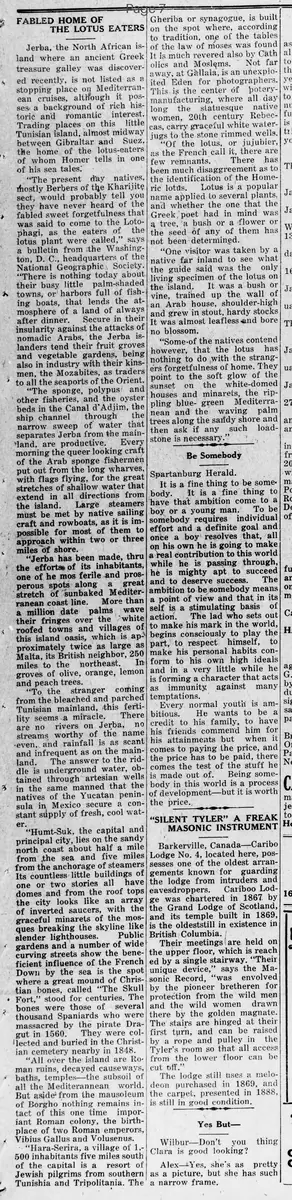
Jerba, the North African island where an ancient Greek treasure galley was discovered recently, is not listed as a stopping place on Mediterranean cruises, although it possesses a background of rich historic and romantic interest.
Trading places on this little Tunisian island, almost midway between Gibraltar and Suez, the home of the lotus-eaters of whom Homer tells in one of his sea tales:
"The present day natives, mostly Berbers of the Kharijite sect, would probably tell you they have never heard of the fabled sweet forgetfulness that was said to come to the Lotophagi, as the eaters of the lotus plant were called," says a bulletin from the Washington, D. C., headquarters of the National Geographic Society.
"There is nothing today about their busy little palm-shaded towns, or harbors full of fishing boats, that lends the atmosphere of a land of always after dinner. Secure in their insularity against the attacks of nomadic Arabs, the Jerba islanders tend their fruit groves and vegetable gardens, being also in industry with their kinsmen, the Mozabites, as traders to all the seaports of the Orient.
"The sponge, polypus and other fisheries, and the oyster beds in the Canal d'Adjim, the ship channel through the narrow sweep of water that separates Jerba from the mainland, are productive. Every morning the queer looking craft of the Arab sponge fishermen put out from the long wharves, with flags flying, for the great stretches of shallow water that extend in all directions from the island. Large steamers must be met by native sailing craft and rowboats, as it is impossible for most of them to approach within two or three miles of shore.
"Jerba has been made, thru the efforts of its inhabitants, one of the most fertile and prosperous spots along a great stretch of sunbaked Mediterranean coast line. More than a million date palms wave their fringes over the white roofed towns and villages of this island oasis, which is approximately twice as large as Malta, its British neighbor, 250 miles to the northeast. In groves of olive, orange, lemon and peach trees.
"To the stranger coming from the bleached and parched Tunisian mainland, this fertility seems a miracle. There are no rivers on Jerba, no streams worthy of the name even, and rainfall is as scant and infrequent as on the mainland. The answer to the riddle is underground water, obtained through artesian wells in the same manner that the natives of the Yucatan peninsula in Mexico secure a constant supply of fresh, cool water.
"Humt-Suk, the capital and principal city, lies on the sandy north coast about half a mile from the sea and five miles from the anchorage of steamers. Its countless little buildings of one or two stories all have domes and from the roof tops the city looks like an array of inverted saucers, with the graceful minarets of the mosques breaking the skyline like slender lighthouses.
Public gardens and a number of wide curving streets show the beneficent influence of the French. Down by the sea is the spot where a great mound of Christian bones, called "The Skull Fort," stood for centuries. The bones were those of several thousand Spaniards who were massacred by the pirate Dragut in 1560. They were collected and buried in the Christian cemetery nearby in 1848.
"All over the island are Roman ruins, decayed causeways, baths, temples--the subsoil of all the Mediterranean world. But aside from the mausoleum of Borgho nothing remains intact of this one time important Roman colony, the birthplace of two Roman emperors, Vibius Gallus and Volusenus.
"Hara-Serira, a village of 1,500 inhabitants five miles south of the capital is a resort of Jewish pilgrims from southern Tunisia and Tripolitania. The Gheriba or synagogue, is built on the spot where, according to tradition, one of the tables of the law of Moses was found. It is much revered also by Catholics and Moslems. "Not far away, at Gallala, is an unexploited Eden for photographers. This is the center of pottery-manufacturing, where all day long the statuesque native women, 20th century Rebeccas, carry graceful white water-jugs to the stone rimmed wells,
"Of the lotus, or jujubier, as the French call it, there are few remnants. There has been much disagreement as to the identification of the Homeric lotus. Lotus is a popular name applied to several plants, and whether the one that the Greek poet had in mind was a tree, a bush or a flower or the seed of any of them has not been determined.
"One visitor was taken by a native far inland to see what the guide said was the only living specimen of the lotus on the island. It was a bush or vine, trained up the wall of an Arab house, shoulder-high and grew in stout, hardy stocks. It was almost leafless and bore no blossom.
"Some of the natives contend however, that the lotus has nothing to do with the strangers forgetfulness of home. They point to the soft glow of the sunset on the white-domed houses and minarets, the rippling blue-green Mediterranean and the waving palm trees along the sandy shore and then ask if any such loadstone is necessary."
What sub-type of article is it?
What keywords are associated?
What entities or persons were involved?
Where did it happen?
Foreign News Details
Primary Location
Jerba, Tunisia
Event Date
Recently
Key Persons
Outcome
several thousand spaniards massacred by the pirate dragut in 1560
Event Details
Jerba island, home of the lotus-eaters from Homer's tales, features Berber natives, productive fisheries, fertile groves sustained by artesian wells, Roman ruins, a synagogue revered for Mosaic tradition, and a recent discovery of an ancient Greek treasure galley. The capital Humt-Suk shows French influence, and historical sites include the Skull Fort massacre site.