Thank you for visiting SNEWPapers!
Sign up free
The Virginia Gazette
Williamsburg, Virginia
What is this article about?
A 1775 letter to printer Mr. Purdie from James River critiques British court favoritism toward tyrannical governors, citing cases in Massachusetts, Ireland, and Minorca's Fabrigas trial. It argues this policy discourages colonial subjects from seeking royal redress, promoting despair or self-redress among the oppressed.
Merged-components note: The text in the second component directly continues the letter to the editor from the first component, discussing the Mostyn trial and related political grievances, forming a single coherent letter.
Clippings
1 of 2
OCR Quality
Full Text
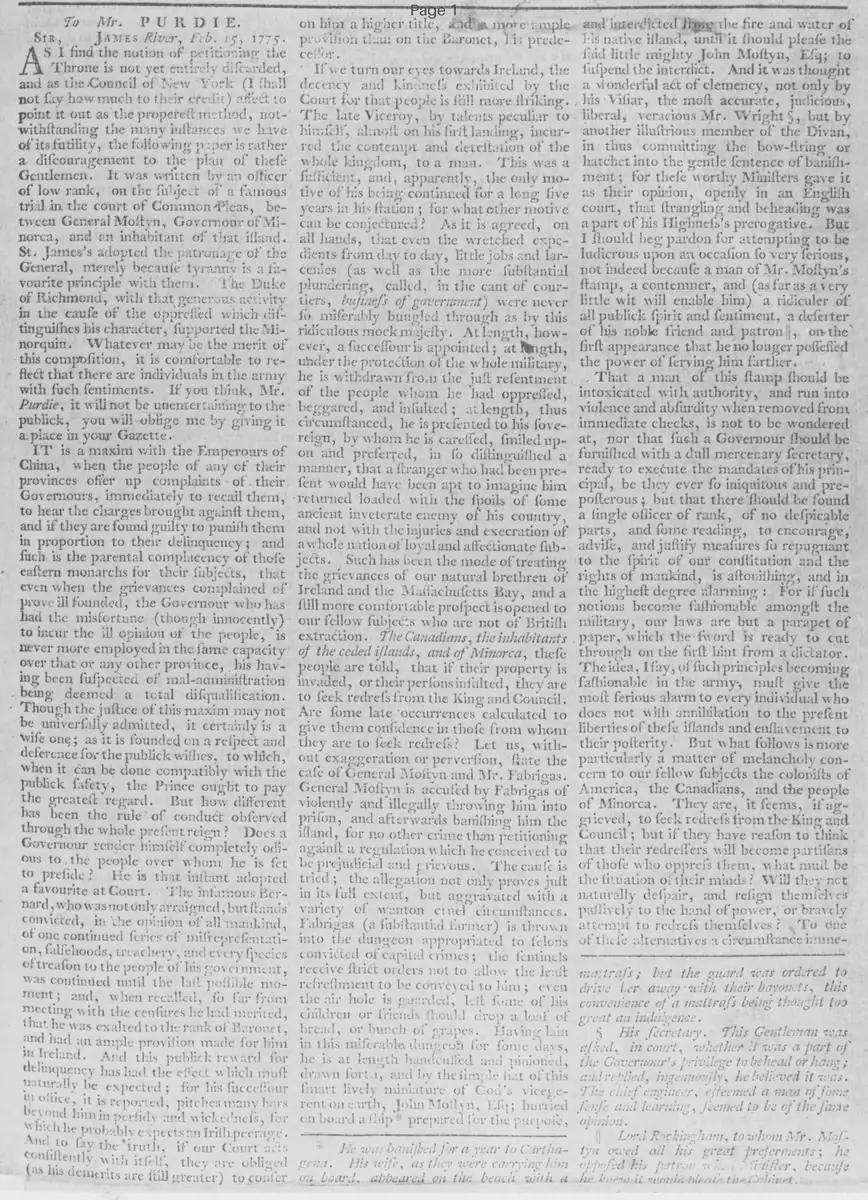
SIR, James River, Feb. 15, 1775.
As I have not yet really despaired and as the Council of New York (I shall not say how much to their credit) affect to point it out as the properest method, notwithstanding the many instances we have of its futility, the following occurs to me as rather a discouragement to the plan of these Gentlemen. It was written by an officer of low rank, on the subject of a famous trial in the court of Common Pleas, between General Mostyn, Governor of Minorca, and an inhabitant of that island. St. James's adopted the patronage of the General, merely because tyranny is a favourite principle with them. The Duke of Richmond, with that generous activity in the cause of the oppressed which distinguishes his character, supported the Minorquin. Whatever may be the merit of this composition, it is comfortable to reflect that there are individuals in the army with such sentiments. If you think, Mr. Purdie, it will not be unentertaining to the publick, you will oblige me by giving it a place in your Gazette.
It is a maxim with the Emperours of China, when the people of any of their provinces offer up complaints - of their Governours, immediately to recall them, to hear the charges brought against them, and if they are found guilty to punish them in proportion to their delinquency; and such is the parental complacency of those eastern monarchs for their subjects, that even when the grievances complained of prove ill founded, the Governour who has had the misfortune (though innocently) to incur the ill opinion of the people, is never more employed in the same capacity over that or any other province, his having been suspected of mal-administration being deemed a total disqualification.
Though the justice of this maxim may not be universally admitted, it certainly is a wise one; as it is founded on a respect and deference for the publick wills, to which, when it can be done compatibly with the publick safety, the Prince ought to pay the greatest regard. But how different has been the rule of conduct observed through the whole present reign? Does a Governour render himself completely odious to the people over whom he is set to preside? He is that instant adopted a favourite at Court. The infamous Bernard, who was not only arraigned, but stands convicted, in the opinion of all mankind, of one continued series of misrepresentations, falsehoods, treachery, and every species of treason to the people of his government, was continued until the last possible moment; and, when recalled, so far from meeting with the censures he had merited, that he was exalted to the rank of Baronet, and had an ample provision made for him in Ireland. And this publick reward for delinquency has had the effect which must naturally be expected; for his successor in office, it is reported, pitches many bars beyond him in perfidy and wickedness, for which he probably expects an Irish peerage. And to say the truth, if our Court acts consistently with itself, they are obliged (as his demerits are still greater) to confer on him a higher title, and a more ample provision than on the Baronet, his predecessor.
If we turn our eyes towards Ireland, the decency and kindness exhibited by the Court for that people is still more striking. The late Viceroy, by talents peculiar to himself, almost on his first landing, incurred the contempt and detestation of the whole kingdom, to a man. This was a sufficient, and, apparently, the only motive of his being continued for a long five years in his station; for what other motive can be conjectured? As it is agreed, on all hands, that even the wretched expedients from day to day, little jobs and larcenies (as well as the more substantial plundering, called, in the cant of courtiers, business of government) were never so miserably bungled through as by this ridiculous mock majesty. At length, however, a successor is appointed; at length, under the protection of the whole military, he is withdrawn from the just resentment of the people whom he had oppressed, beggared, and insulted; at length, thus circumstanced, he is presented to his sovereign, by whom he is caressed, smiled upon and preferred, in so distinguished a manner, that a stranger who had been present would have been apt to imagine him returned loaded with the spoils of some ancient inveterate enemy of his country, and not with the injuries and execration of a whole nation of loyal and affectionate subjects. Such has been the mode of treating the grievances of our natural brethren of Ireland and the Massachusetts Bay, and a still more comfortable prospect is opened to our fellow subjects who are not of British extraction. The Canadians, the inhabitants of the ceded islands, and of Minorca, these people are told, that if their property is invaded, or their persons insulted, they are to seek redress from the King and Council. Are some late occurrences calculated to give them confidence in those from whom they are to seek redress? Let us, without exaggeration or perversion, state the case of General Mostyn and Mr. Fabrigas.
General Mostyn is accused by Fabrigas of violently and illegally throwing him into prison, and afterwards banishing him the island, for no other crime than petitioning against a regulation which he conceived to be prejudicial and grievous. The cause is tried; the allegation not only proves just in its full extent, but aggravated with a variety of wanton cruel circumstances. Fabrigas (a substantial farmer) is thrown into the dungeon appropriated to felons convicted of capital crimes; the sentinels receive strict orders not to allow the least refreshment to be conveyed to him; even the air hole is guarded, lest some of his children or friends should drop a loaf of bread, or bunch of grapes. Having lain in this miserable dungeon for some days, he is at length handcuffed and pinioned, drawn forth, and by the simple fiat of this smart lively miniature of God's vicegerent on earth, John Mostyn, Esq: hurried on board a ship* prepared for the purpose, and interdicted from the fire and water of His native island, until it should please the said little mighty John Mostyn, Esq; to suspend the interdict. And it was thought a wonderful act of clemency, not only by his Vizier, the most accurate, judicious, liberal, veracious Mr. Wright§, but by another illustrious member of the Divan, in thus committing the bow-string or hatchet into the gentler sentence of banishment; for these worthy Ministers gave it as their opinion, openly in an English court, that strangling and beheading was a part of his Highness's prerogative. But I should beg pardon for attempting to be ludicrous upon an occasion so very serious, not indeed because a man of Mr. Mostyn's stamp, a contemner, and (as far as a very little wit will enable him) a ridiculer of all publick spirit and sentiment, a deserter of his noble friend and patron, on the first appearance that he no longer possessed the power of serving him farther.
That a man of this stamp should be intoxicated with authority, and run into violence and absurdity when removed from immediate checks, is not to be wondered at, nor that such a Governour should be furnished with a dull mercenary secretary, ready to execute the mandates of his principal, be they ever so iniquitous and preposterous; but that there should be found a single officer of rank, of no despicable parts, and some reading, to encourage, advise, and justify measures so repugnant to the spirit of our constitution and the rights of mankind, is astonishing, and in the highest degree alarming: For if such notions become fashionable amongst the military, our laws are but a parapet of paper, which the sword is ready to cut through on the first hint from a dictator. The idea, I say, of such principles becoming fashionable in the army, must give the most serious alarm to every individual who does not wish annihilation to the present liberties of these islands and enslavement to their posterity. But what follows is more particularly a matter of melancholy concern to our fellow subjects the colonists of America, the Canadians, and the people of Minorca. They are, it seems, if aggrieved, to seek redress from the King and Council; but if they have reason to think that their redressers will become partisans of those who oppress them, what must be the situation of their minds? Will they not naturally despair, and resign themselves passively to the hand of power, or bravely attempt to redress themselves? To one of these alternatives a circumstance immediately following will, I fear, incline them. Reeking with the infamy of being convicted by an honest jury of his country, he dared to present himself at the levee of her first magistrate. Where he, who is the head, and in fact creates and uncreates this court from which redress and equity are to flow, he, who should consider himself as the corrector of abuses, and avenger of wrongs, could attempt to be facetious on the occasion. Well, General, says the King, so you have been cast; and who were the counsel employed by your doughty adversary? The General, a veteran courtier, long accustomed to Royal waggery smartly replied, the learned Serjeant Glynn, and the profound Duke of Richmond. This was so prodigiously witty, that the whole circle, Lords of the Bedchamber, Maids of Honour, and Privy Council, all burst into a loud laugh*.
This may be a very excellent joke at St. James's: but I can assure St. James's, that in other places it savours but of shallow wit, and that it only serves as a proof (for which there was no occasion) of the weakness of the heads, and corruption of the hearts, within those walls. And I can farther assure them, that did such noblemen, and such lawyers, as the Duke of Richmond, and Serjeant Glynn, form the circle of the Drawing Room, it would be more for the honour of his Majesty, and the satisfaction and safety of the nation, than one composed of the Graftons, Sandwiches, Nortons, and Wedderburns.
* Lord Rockingham, to whom Mr. Mostyn owed all his great preferments; he opposed his patron as Minister, because he knew it would please the Cabinet.
§ His Secretary. This Gentleman was asked, in court, whether it was a part of the Governour's privilege to behead or hang; and replied, ingenuously, he believed it was. The chief engineer, esteemed a man of some sense and learning, seemed to be of the same opinion.
*It is to be observed, that the Treasury paid General Mostyn's damages.
but the guard was ordered to drive her away with their bayonets, this convenience of a mistress being thought too great an indulgence.
What sub-type of article is it?
What themes does it cover?
What keywords are associated?
What entities or persons were involved?
Letter to Editor Details
Recipient
Mr. Purdie
Main Argument
the british court rewards tyrannical governors who oppress their subjects rather than punishing them, as seen in cases like governor bernard and general mostyn, discouraging colonial and other subjects from seeking redress from the king and council and potentially leading to despair or self-redress.
Notable Details