Thank you for visiting SNEWPapers!
Sign up free
Mexico Missouri Message
Mexico, Audrain County, Missouri
What is this article about?
In the early 1890s, printer Tom Eagan hires detective Frank Peyser to photograph a forger of race betting tickets using a hidden camera, stopping the fraud. Peyser's background includes avoiding East Side crooks, Pinkerton racetrack work, and 13 years at Wanamaker store before starting his own bureau. (248 characters)
Clipping
OCR Quality
Full Text
Stopped Printing Forged Pool Room Tickets on the Horse Races.
USED A MINIATURE CAMERA
Early Acquaintance With Crooks and His Knowledge of Human Nature Have Helped Him to Success and to the Establishment of a Big Business.
By OSBORN MARSHALL.
(Copyright, McClure Newspaper Syndicate.)
It was in the good old days of the early nineties when horse racing flourished under a kindlier law in New York than it does today that Tom Eagan had the distinction of being official stationer and printer to the bookmakers and poolrooms of the city. He supplied them with pencils and pads, blank books, ink and record books and did whatever printing their business called for. He it was who printed the colored tickets issued to those who bet on the races in the poolrooms or on the track. These tickets, which were filled in at the time of the betting, served as a record of the transaction, and in case the bettor was lucky he received his winnings on presentation of the ticket.
Tom's business with the poolrooms and bookmakers had thriven and it seemed that the neat little profit from printing the tickets would continue so long as Tom Eagan continued to run his printing presses.
One day, however, Mr. Eagan got word that there were counterfeiters at work. Fake tickets were being printed and filled out to duplicate Eagan's tickets, and every once in a while winnings went to a holder of the fake ticket instead of to the real winner.
So between Mr. Eagan and the poolroom operators a new system had to be devised. Thereafter tickets were printed in several colors, according to the number of the ticket. That is, all tickets numbering between one and a hundred should be pink, all between one and two hundred should be green, and so on throughout the list. Each day a different color was used for a different set of numbers, and as this code was communicated secretly to the poolroom men it was hoped that in this way they could detect the fraudulent tickets.
Still the trouble continued. Apparently the dishonest printer printed his slips on every color of cardboard every day. Then when the races were over the man who manipulated the fraudulent tickets would manage to see over the shoulder of the holder of the winning ticket, note the number and the color, select a ticket of the right denomination and color from his own collection, fill it in and, on presenting it to the bookmaker or poolroom operator before the lawful winner arrived, he would get the winnings.
Called in Frank Peyser.
Something had to be done and it was clearly up to Eagan to think what it should be.
"I know who the crook printer is," he told the poolroom men, "but I haven't evidence enough to convict him. However, I think I can stop the issue of the fake tickets." Then Eagan sent for Frank Peyser, known to be one of the sharpest young race-track detectives.
"I have spotted the man who does the fake printing," he told Peyser "but I can't prove it, and I don't know as it would do much good if I could. What we want to do is to get a photograph of him and have it sent to every poolroom and every bookmaker in this part of the country. Then they will know him and can steer clear of him.
Now, what I want you to do is to get the photograph. He runs a printing shop down on Broadway and Twenty-seventh street."
Eagan told Peyser the name of the suspected printer and Peyser said he would get the photo graph if anyone could.
First he went to see the printer on the pretext of wanting to do some business with him, taking care not to arouse his suspicions. Then, when he had secured his confidence, he went to a nearby photographer.
"There is a fellow around here," he told the photographer, "whose picture I've got to have. He isn't anxious to be photographed, either. What I want you to do is to hang out on Twenty-seventh street and Broadway and wait till you see me. I'll come out about noon with my friend and when you see us you can level the camera and take the picture."
This agreed upon, Peyser went to see the printer, with whom he had already arranged to have luncheon. At noon they rounded the corner of Twenty-seventh street and Broadway. Peyser talking eagerly to the printer as they walked along. The photographer was seated on a bootblack stand, having his shoes polished, camera in hand, on the opposite corner. He leveled the camera at the dishonest printer and Peyser continued to talk vigorously.
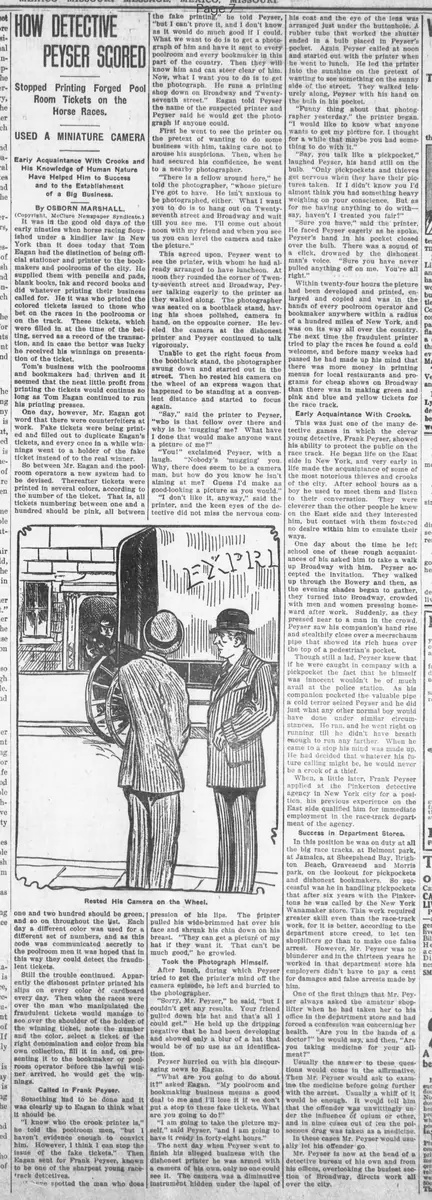
Unable to get the right focus from the bootblack stand, the photographer swung down and started out in the street. Then he rested his camera on the wheel of an express wagon that happened to be standing at a convenient distance and started to focus again.
"Say," said the printer to Peyser, "who is that fellow over there and why is he 'mugging' me? What have I done that would make anyone want a picture of me?"
"You!" exclaimed Peyser, with a laugh. "Nobody's 'mugging' you. Why, there does seem to be a camera man, but how do you know he isn't aiming at me? Guess I'd make as good-looking a picture as you would."
"I don't like it, anyway," said the printer, and the keen eyes of the detective did not miss the nervous compression of his lips.
The printer pulled his wide-brimmed hat over his face and shrunk his chin down on his breast. "They can get a picture of my hat if they want it. That can't be much good," he growled.
Took the Photograph Himself.
After lunch, during which Peyser tried to get the printer's mind off the camera episode, he left and hurried to the photographer.
"Sorry, Mr. Peyser," he said. "but I couldn't get any results. Your friend pulled down his hat and that's all I could get." He held up the dripping negative that he had been developing and showed only a blur of a hat that would be of no use as an identification.
Peyser hurried on with his discouraging news to Eagan.
"What are you going to do about it?" asked Eagan. "My poolroom and bookmaking business means a good deal to me and I'll lose it if we don't put a stop to these fake tickets. What are you going to do?"
"I am going to take the picture myself," said Peyser, "and I am going to have it ready in forty-eight hours."
The next day when Peyser went to finish his alleged business with the dishonest printer he was armed with a camera of his own, only no one could see it. The camera was a diminutive instrument hidden under the lapel of his coat and the eye of the lens was arranged just under the buttonhole. A rubber tube that worked the shutter ended in a bulb placed in Peyser's pocket. Again Peyser called at noon and started out with the printer when he went to lunch. He led the printer into the sunshine on the pretext of wanting to see something on the sunny side of the street. They walked leisurely along. Peyser with his hand on the bulb in his pocket.
"Funny thing about that photographer yesterday," the printer began. "I would like to know what anyone wants to get my picture for. I thought for a while that maybe you had something to do with it."
"Say, you talk like a pickpocket," laughed Peyser, his hand still on the bulb. "Only pickpockets and thieves get nervous when they have their pictures taken. If I didn't know you I'd almost think you had something heavy weighing on your conscience. But as for me having anything to do with—say, haven't I treated you fair?"
"Sure you have," said the printer He faced Peyser eagerly as he spoke. Peyser's hand in his pocket closed over the bulb. There was a sound of a click, drowned by the dishonest man's voice. "Sure you have never pulled anything off on me. You're all right."
Within twenty-four hours the picture had been developed and printed, enlarged and copied and was in the hands of every poolroom operator and bookmaker anywhere within a radius of a hundred miles of New York, and was on its way all over the country.
The next time the fraudulent printer tried to play the races he found a cold welcome, and before many weeks had passed he had made up his mind that there was more money in printing menus for local restaurants and programs for cheap shows on Broadway than there was in making green and pink and blue and yellow tickets for the race track.
Early Acquaintance With Crooks.
This was just one of the many detective games in which the clever young detective, Frank Peyser, showed his ability to protect the public on the race track. He began life on the East side in New York, and very early in life made the acquaintance of some of the most notorious thieves and crooks of the city. After school hours as a boy he used to meet them and listen to their conversation. They were cleverer than the other people he knew on the East side and they interested him, but contact with them fostered no desire within him to emulate their ways.
One day about the time he left school one of these rough acquaintances of his asked him to take a walk up Broadway with him. Peyser accepted the invitation. They walked up through the Bowery and then, as the evening shades began to gather, they turned into Broadway, crowded with men and women pressing homeward after work. Suddenly, as they pressed near to a man in the crowd, Peyser saw his companion's hand rise and stealthily close over a meerschaum pipe that showed its rich hues over the top of a pedestrian's pocket.
Though still a lad, Peyser knew that if he were caught in company with a pickpocket the fact that he himself was innocent wouldn't be of much avail at the police station. As his companion pocketed the valuable pipe a cold terror seized Peyser and he did just what any other normal boy would have done under similar circumstances. He ran, and he went right on running till he didn't have breath enough to run any farther. When he came to a stop his mind was made up. He had decided that whatever his future calling might be, he would never be a crook or a thief.
When, a little later, Frank Peyser applied at the Pinkerton detective agency in New York city for a position, his previous experience on the East side qualified him for immediate employment in the race-track department of the agency.
Success in Department Stores.
In this position he was on duty at all the big race tracks, at Belmont park, at Jamaica, at Sheepshead Bay, Brighton Beach, Gravesend and Morris park, on the lookout for pickpockets and dishonest bookmakers. So successful was he in handling pickpockets that after six years with the Pinkertons he was called by the New York Wanamaker store. This work required greater skill even than the race-track work, for it is better, according to the department store creed, to let ten shoplifters go than to make one false arrest. However, Mr. Peyser was no blunderer and in the thirteen years he worked in that department store his employers didn't have to pay a cent for damages and false arrests made by him.
One of the first things that Mr. Peyser always asked the amateur shop-lifter when he had taken her to his office in the department store and had forced a confession was concerning her health. "Are you in the hands of a doctor?" he would say, and then, "Are you taking medicine for your ailment?"
Usually the answer to these questions would come in the affirmative. Then Mr. Peyser would ask to examine the medicine before going further with the arrest. Usually a whiff of it would be enough. It would tell him that the offender was unwittingly under the influence of opium or ether, and in nine cases out of ten the poisonous drug was taken as a medicine.
In these cases Mr. Peyser would usually let his offender go.
Mr. Peyser is now at the head of a detective bureau of his own and from his offices, overlooking the busiest section of Broadway, directs work all over the city.
Rested His Camera on the Wheel.
What sub-type of article is it?
What themes does it cover?
What keywords are associated?
What entities or persons were involved?
Where did it happen?
Story Details
Key Persons
Location
New York City, Broadway And Twenty Seventh Street, Race Tracks Including Belmont Park, Jamaica, Sheepshead Bay, Brighton Beach, Gravesend, Morris Park
Event Date
Early Nineties
Story Details
Detective Frank Peyser uses a hidden miniature camera to photograph a printer forging race betting tickets, distributing the image to poolrooms and bookmakers to stop the fraud. The article also covers Peyser's early life avoiding crime, his work with Pinkerton at racetracks, success in department stores handling shoplifters, and his own detective bureau.