Thank you for visiting SNEWPapers!
Sign up free
Domestic News
March 7, 1795
Gazette Of The United States And Daily Evening Advertiser
Philadelphia, Philadelphia County, Pennsylvania
What is this article about?
Satirical letter from London mocks Virginia's legal system, particularly land exemptions from debt, portraying it as favoring dishonest lawyers and politicians; encourages more attorneys to emigrate.
Clipping
OCR Quality
95%
Excellent
Full Text
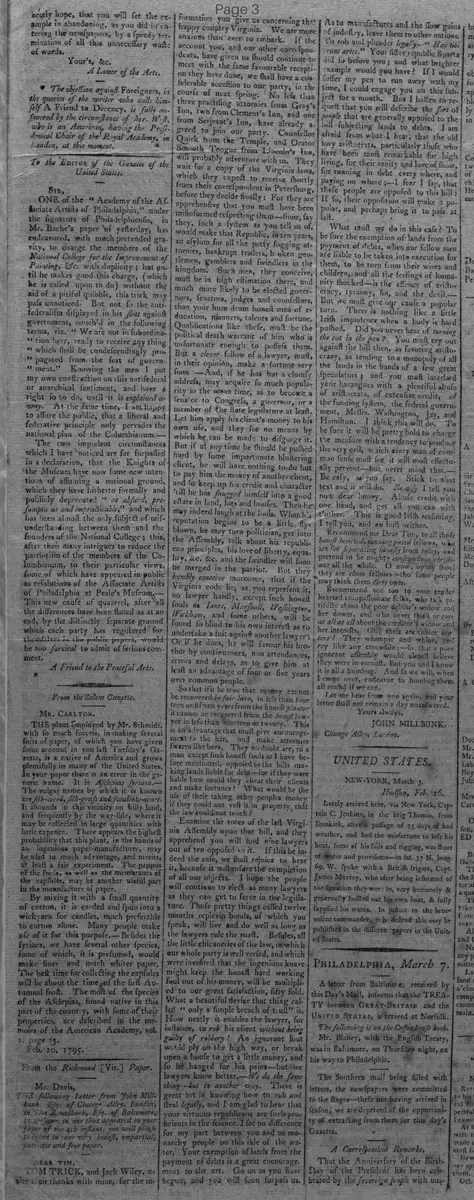
From the Richmond [Vir.] Paper.
Mr. Davis,
THE following Letter from John Millbunk, Esq. of Change Alley, London, to Tim Broadback, Esq. of Baltimore, in answer to one that appeared in your paper of the 4th instant, you will please to insert in your very honest, impartial, patriotic and free paper.
DEAR TIM,
TOM TRICK, and Jack Wiley, unite their thanks with mine, for the information you give us concerning the happy country Virginia. We are more anxious than ever to embark. If the account you, and our other correspondents, have given us should continue to meet with the same favourable reception they have done, we shall have a considerable accession to our party, in the course of next spring. No less than three practicing attorneys from Gray's Inn, two from Clement's Inn, and one from Serjeant's Inn, have already agreed to join our party. Counsellor Quirk from the Temple, and Orator Smooth Tongue from Lincoln's Inn, will probably adventure with us. They wait for a copy of the Virginia laws, which they expect to receive shortly from their correspondent in Petersburg, before they decide finally: For they are apprehensive that you must have been misinformed respecting them—since, say they, such a system as you tell us of, would make that Republic, in ten years, an asylum for all the petty fogging attorneys, bankrupt traders, broken gentlemen, gamblers and swindlers in the kingdom. Such men, they conceive, must be in high estimation there, and much more likely to be elected governors, senators, judges and counsellors, than your hum drum honest men of education, manners, talents and fortune.
Qualifications like these, must be the political death warrant of him who is unfortunate enough to possess them.
But a clever fellow of a lawyer, must, in their opinion, make a fortune very soon :—And, if he has but a clumsy address, may acquire so much popularity in the mean time, as to become a senator to Congress, a governor, or a member of the state legislature at least.
Let him apply his client's money to his own use, and they see no means by which he can be made to disgorge it.
But if at any time he should be pushed hard by some importunate blustering client, he will have nothing to do but to pay him the money of another client, and so keep up his credit and character 'till he has snuggered himself into a good estate in land, lots and houses. Then—he may indeed laugh at the fools. When his reputation begins to be a little fly-blown, he may turn politician, get into the Assembly, talk about his republican principles, his love of liberty, equality, &c. &c. and the swindler will soon be merged in the patriot. But they bumbly conceive moreover, that if the Virginia code be, as you represent it, no lawyer hardly, except such honest souls as Innes, Marshall, Washington, Wickham, and some others, will be found so blind to his own interest as to undertake a suit against another lawyer :
Or if he does, he will favour his brother by continuances, non attendances, errors and delays, as to give him at least an advantage of four or five years over common people.
So that if it be true that money cannot be recovered by fair law, in less than fourteen or fifteen years from the honest planter it cannot be recovered from the honest lawyer in less than nineteen or twenty. This is an advantage that must give encouragement to the bar, and make attorneys swarm like bees. They no doubt are, to a man except such honest fools as I have before mentioned, opposed to the bills making lands liable for debt—for if they were liable how could they cheat their clients and make fortunes? What would be the use of their taking other peoples money if they could not vest it in property_ that the law could not touch?
Examine the votes of the last Virginia Assembly upon that bill, and they apprehend you will find nine lawyers out of ten opposed to it. If this be indeed the case, we shall rejoice to hear it, because it will ensure the completion of all our objects. I hope the people will continue to elect as many lawyers as they can get to serve in the legislature. Those pretty things called twelve months replevin bonds, of which you speak, will live and do well as long as the lawyers rule the roost. Besides, all the little chicaneries of the law, in which our whole party is well versed, and which were invented that the ingenious knave might keep the honest hard working fool out of his money, will be multiplied to our great satisfaction, fifty fold.
What a beautiful device that thing called "only a simple breach of trust" is.
How neatly it enables the lawyer, for instance, to rob his client without being guilty of robbery! An ignorant lout would ply on the high way, or break open a house to get a little money, and so be hanged for his pains—but we lawyers know better.—He do the same thing—but in another way. . There is great art in knowing how to rob and steal legally, and I am glad to hear that your virtuous republicans are such proficients in the science. I see no difference for my part between you and us monarchy people on this side of the water.
Your exemption of lands from the payment of debts is a great encouragement to the art. Go on as you have begun, and you will soon surpass us.
As to manufactures and the low gains of industry, leave them to other nations.
To rob and plunder legally—"Hec tibi crunt artes." Your sister republic Sparta did so before you; and what brighter example would you have? If I would suffer my pen to run away with my time, I could engage you on this subject for a month. But I hasten to request that you will describe the sort of people that are generally opposed to the bill subjecting lands to debts. I am afraid from what I hear, that the old tory aristocrats, particularly those who have been most remarkable for high living, for their vanity and love of show, for running in debt every where, and paying no where ;—I fear I say, that these people are opposed to this bill :
If so, their opposition will make it popular, and perhaps bring it to pass at last.
What must we do in this case? To be sure the exemption of lands from the payment of debts, when our fellow men are liable to be taken into execution for them, to be torn from their wives and children, and all the feelings of humanity shocked—is the essence of aristocracy, tyranny, sin, and the devil.—
But we must give our cause a popular turn. There is nothing like a little Irish impudence when a body is hard pushed. Did you never hear of turning the cat in the pan? You must cry out against the bill then, as favoring aristocracy, as tending to a monopoly of all the lands in the hands of a few great speculators ; and you must interlard your harangues with a plentiful abuse of aristocrats, of extensive credit, of the funding system, the federal government, Mess. Washington, Jay, and Hamilton. I think this will do. To be sure it will be pretty bold to charge the measure with a tendency to produce the very evil, which every man of common sense must see it will most effectually prevent—but never mind that.—
Be easy, as you say. Stick to that text and it will do. Be easy I tell you now dear honey. Abuse credit with one hand, and get all you can with t'other. This is good Irish reasoning, I tell you, and no bull neither.
Recommend me Dear Tim, to all those honest hearted, cunning peted fellows, who are separating honesty from policy, and pretend to be mighty conscientious christians all the while. O now, by my soul they are clean fellows—tho' some people may think them dirty ones.
Recommend me too to your tender hearted compassionate folks, who talk pitifully about the poor debtor's widow and her dower, and who never think or care at all at all about the creditor's widow and her interests. Ob! these are choice characters! They whimper and whine, and cry like any crocodile;—o that a poor ignorant assembly would almost believe they were in earnest. But you and I know it is all a humbug. And so we will, when I come over, endeavor to humbug them all round if we can.
Let me hear from you again, and your letter shall not remain a day unanswered.
Yours always,
JOHN MILLBUNK.
Change Alley, London.
Mr. Davis,
THE following Letter from John Millbunk, Esq. of Change Alley, London, to Tim Broadback, Esq. of Baltimore, in answer to one that appeared in your paper of the 4th instant, you will please to insert in your very honest, impartial, patriotic and free paper.
DEAR TIM,
TOM TRICK, and Jack Wiley, unite their thanks with mine, for the information you give us concerning the happy country Virginia. We are more anxious than ever to embark. If the account you, and our other correspondents, have given us should continue to meet with the same favourable reception they have done, we shall have a considerable accession to our party, in the course of next spring. No less than three practicing attorneys from Gray's Inn, two from Clement's Inn, and one from Serjeant's Inn, have already agreed to join our party. Counsellor Quirk from the Temple, and Orator Smooth Tongue from Lincoln's Inn, will probably adventure with us. They wait for a copy of the Virginia laws, which they expect to receive shortly from their correspondent in Petersburg, before they decide finally: For they are apprehensive that you must have been misinformed respecting them—since, say they, such a system as you tell us of, would make that Republic, in ten years, an asylum for all the petty fogging attorneys, bankrupt traders, broken gentlemen, gamblers and swindlers in the kingdom. Such men, they conceive, must be in high estimation there, and much more likely to be elected governors, senators, judges and counsellors, than your hum drum honest men of education, manners, talents and fortune.
Qualifications like these, must be the political death warrant of him who is unfortunate enough to possess them.
But a clever fellow of a lawyer, must, in their opinion, make a fortune very soon :—And, if he has but a clumsy address, may acquire so much popularity in the mean time, as to become a senator to Congress, a governor, or a member of the state legislature at least.
Let him apply his client's money to his own use, and they see no means by which he can be made to disgorge it.
But if at any time he should be pushed hard by some importunate blustering client, he will have nothing to do but to pay him the money of another client, and so keep up his credit and character 'till he has snuggered himself into a good estate in land, lots and houses. Then—he may indeed laugh at the fools. When his reputation begins to be a little fly-blown, he may turn politician, get into the Assembly, talk about his republican principles, his love of liberty, equality, &c. &c. and the swindler will soon be merged in the patriot. But they bumbly conceive moreover, that if the Virginia code be, as you represent it, no lawyer hardly, except such honest souls as Innes, Marshall, Washington, Wickham, and some others, will be found so blind to his own interest as to undertake a suit against another lawyer :
Or if he does, he will favour his brother by continuances, non attendances, errors and delays, as to give him at least an advantage of four or five years over common people.
So that if it be true that money cannot be recovered by fair law, in less than fourteen or fifteen years from the honest planter it cannot be recovered from the honest lawyer in less than nineteen or twenty. This is an advantage that must give encouragement to the bar, and make attorneys swarm like bees. They no doubt are, to a man except such honest fools as I have before mentioned, opposed to the bills making lands liable for debt—for if they were liable how could they cheat their clients and make fortunes? What would be the use of their taking other peoples money if they could not vest it in property_ that the law could not touch?
Examine the votes of the last Virginia Assembly upon that bill, and they apprehend you will find nine lawyers out of ten opposed to it. If this be indeed the case, we shall rejoice to hear it, because it will ensure the completion of all our objects. I hope the people will continue to elect as many lawyers as they can get to serve in the legislature. Those pretty things called twelve months replevin bonds, of which you speak, will live and do well as long as the lawyers rule the roost. Besides, all the little chicaneries of the law, in which our whole party is well versed, and which were invented that the ingenious knave might keep the honest hard working fool out of his money, will be multiplied to our great satisfaction, fifty fold.
What a beautiful device that thing called "only a simple breach of trust" is.
How neatly it enables the lawyer, for instance, to rob his client without being guilty of robbery! An ignorant lout would ply on the high way, or break open a house to get a little money, and so be hanged for his pains—but we lawyers know better.—He do the same thing—but in another way. . There is great art in knowing how to rob and steal legally, and I am glad to hear that your virtuous republicans are such proficients in the science. I see no difference for my part between you and us monarchy people on this side of the water.
Your exemption of lands from the payment of debts is a great encouragement to the art. Go on as you have begun, and you will soon surpass us.
As to manufactures and the low gains of industry, leave them to other nations.
To rob and plunder legally—"Hec tibi crunt artes." Your sister republic Sparta did so before you; and what brighter example would you have? If I would suffer my pen to run away with my time, I could engage you on this subject for a month. But I hasten to request that you will describe the sort of people that are generally opposed to the bill subjecting lands to debts. I am afraid from what I hear, that the old tory aristocrats, particularly those who have been most remarkable for high living, for their vanity and love of show, for running in debt every where, and paying no where ;—I fear I say, that these people are opposed to this bill :
If so, their opposition will make it popular, and perhaps bring it to pass at last.
What must we do in this case? To be sure the exemption of lands from the payment of debts, when our fellow men are liable to be taken into execution for them, to be torn from their wives and children, and all the feelings of humanity shocked—is the essence of aristocracy, tyranny, sin, and the devil.—
But we must give our cause a popular turn. There is nothing like a little Irish impudence when a body is hard pushed. Did you never hear of turning the cat in the pan? You must cry out against the bill then, as favoring aristocracy, as tending to a monopoly of all the lands in the hands of a few great speculators ; and you must interlard your harangues with a plentiful abuse of aristocrats, of extensive credit, of the funding system, the federal government, Mess. Washington, Jay, and Hamilton. I think this will do. To be sure it will be pretty bold to charge the measure with a tendency to produce the very evil, which every man of common sense must see it will most effectually prevent—but never mind that.—
Be easy, as you say. Stick to that text and it will do. Be easy I tell you now dear honey. Abuse credit with one hand, and get all you can with t'other. This is good Irish reasoning, I tell you, and no bull neither.
Recommend me Dear Tim, to all those honest hearted, cunning peted fellows, who are separating honesty from policy, and pretend to be mighty conscientious christians all the while. O now, by my soul they are clean fellows—tho' some people may think them dirty ones.
Recommend me too to your tender hearted compassionate folks, who talk pitifully about the poor debtor's widow and her dower, and who never think or care at all at all about the creditor's widow and her interests. Ob! these are choice characters! They whimper and whine, and cry like any crocodile;—o that a poor ignorant assembly would almost believe they were in earnest. But you and I know it is all a humbug. And so we will, when I come over, endeavor to humbug them all round if we can.
Let me hear from you again, and your letter shall not remain a day unanswered.
Yours always,
JOHN MILLBUNK.
Change Alley, London.
What sub-type of article is it?
Politics
Legal Or Court
What keywords are associated?
Virginia Laws
Debt Exemption
Lawyers
Politics
Satire
Assembly Bills
Legal Chicanery
What entities or persons were involved?
John Millbunk
Tim Broadback
Tom Trick
Jack Wiley
Counsellor Quirk
Orator Smooth Tongue
Innes
Marshall
Washington
Wickham
Where did it happen?
Virginia
Domestic News Details
Primary Location
Virginia
Key Persons
John Millbunk
Tim Broadback
Tom Trick
Jack Wiley
Counsellor Quirk
Orator Smooth Tongue
Innes
Marshall
Washington
Wickham
Event Details
Satirical letter criticizing Virginia's laws exempting lands from debt payment, portraying them as enabling dishonest lawyers to thrive and dominate politics; mocks opposition to bills making lands liable for debts and suggests strategies to oppose such reforms.