Thank you for visiting SNEWPapers!
Sign up free
The Liberator
Boston, Suffolk County, Massachusetts
What is this article about?
In a heated U.S. House debate on December 13, members clashed over a bill to compensate for a slave taken during the War of 1812, arguing slaves' status as property under the Constitution and referencing Supreme Court rulings and the Treaty of Ghent. The session adjourned without resolution.
Merged-components note: Sequential reading order and text continuity of Congressional debate; relabeled from 'story' to 'domestic_news' for political reporting.
Clipping
OCR Quality
Full Text
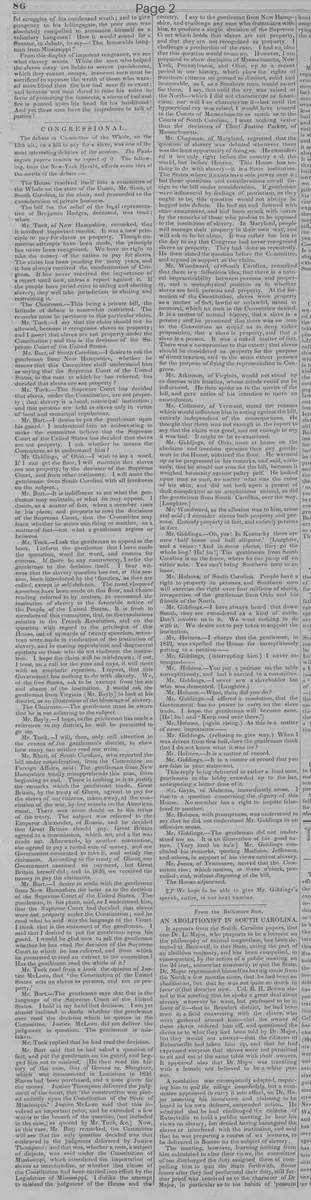
The debate in Committee of the Whole, on the 13th ult., on a bill to pay for a slave, was one of the most interesting debates of the session. The Washington papers contain no report of it. The following, from the New-York Herald, affords some idea of the merits of the debate:—
The House resolved itself into a committee of the Whole on the state of the Union, Mr. Sims, of South Carolina, in the chair, and proceeded to the consideration of private business. The bill for the relief of the legal representative of Benjamin Hodges, deceased, was read; when Mr. Tuck, of New Hampshire, remarked, that it involved important results. It was a new principle to pay for slaves as property. Though numerous attempts have been made, the principle has never been recognised. We have no right to take the money of the nation to pay for slaves. The claim has been pending for many years, and it has always received the condemnation of Congress. It has never received the importance of a report until now, unless a report against it. If the people have jurisdiction in aiding and abetting slavery, they will take jurisdiction in abating and restraining it.
The Chairman.—This being a private bill, the latitude of debate is somewhat restricted. The remarks must be pertinent to this particular claim.
Mr. Tuck.—I say that the claim should not be allowed, because it recognises slaves as property; and I assert that slaves are not property under the Constitution; and this is the decision of the Supreme Court of the United States.
Mr. Burt, of South Carolina.—I desire to ask the gentleman from New Hampshire, whether he means that this Committee shall understand him as saying that the Supreme Court of the United States, in the case to which he has referred, has decided that slaves are not property?
Mr. Tuck.—The Supreme Court has decided that slaves, under the Constitution, are not property; that slavery is a local, municipal institution; and that persons are held as slaves only in virtue of local and municipal regulations.
Mr. Burt.—I desire to put the gentleman upon his guard. I understood him as endeavoring to make the committee believe that the Supreme Court of the United States has decided that slaves are not property. I ask whether he means the Committee so to understand him?
Mr. Giddings, of Ohio.—I wish to say a word. If I can get the floor, I will maintain that slaves are not property, by the decision of the Supreme Court, and from other testimony. I will meet the gentleman from South Carolina with all frankness on the subject.
Mr. Burt.—It is indifferent to me what the gentleman may maintain, or what he may oppose. I desire, as a matter of fact, when a member rises in his place, and purports to read the decisions of the Supreme Court, that the Committee may learn whether he states one thing or another, as a matter of fact—not what a gentleman argues or believes.
Mr. Tuck.—I ask the gentleman to appeal to the book. I inform the gentleman that I have made the quotation, word for word, and comma for comma. If there be any controversy, I refer the gentleman to the decision itself. I bear witness that the slavery question has not, at this session, been introduced by the 'fanatics,' as they are called, except in self-defence. The most eloquent speeches have been made on this floor, and choice reading referred to by orators, to commend the institution of slavery to the favorable notice of the People of the United States. It is fresh to members of this committee, that, on the resolutions relative to the French Revolution, and on the question with regard to the privileges of this House, out of upwards of twenty speeches, seventeen were made in vindication of the institution of slavery, and in casting opprobrium and disgraceful epithets on those who do not vindicate the institution. I hope the claim will be withdrawn; if not, I trust, on a call for the yeas and nays, it will meet with an emphatic rejection. I repeat, that this Government has nothing to do with slavery. We, of the free States, ask to be exempt from the sin and shame of the institution. I would ask the gentleman from Virginia [Mr. Bayly] to look at his district, as an illustration of the blessings of slavery.
The Chairman.—The gentleman must be aware that he is not adhering to the subject.
Mr. Bayly.—I hope, as the gentleman has made a reference to my district, he will be permitted to go on.
Mr. Tuck.—I will, then, only call attention to the census of the gentleman's district, to show how many can neither read nor write.
Mr. Rhett, of South Carolina, who reported the bill under consideration, from the Committee on Foreign Affairs, said: The gentleman from New Hampshire totally misapprehends this case, from beginning to end. There is nothing in it to justify the remarks which the gentleman made. Great Britain, by the treaty of Ghent, agreed to pay for the slaves of our citizens, taken away, at the conclusion of the war, by her vessels on the American coast. There was some doubt as to the terms of the treaty. The subject was referred to the Emperor Alexander, of Russia, and he decided that Great Britain should pay. Great Britain agreed to a commission, which sat, and a list was made out. Afterwards, by another convention, she agreed to pay a round sum of money, and our Government consented to take it, and satisfy the claimants. According to the treaty of Ghent, our Government assumed no payment, but Great Britain herself did; and in 1826, we received the money to pay the claimants.
Mr. Burt.—I desire to settle with the gentleman from New Hampshire the issue as to the decision of the Supreme Court of the United States. The gentleman, in his place, said, as I understood him, that the Supreme Court had decided that slaves were not property under the Constitution; and he read what he said was the language of the Court. I think that is the statement of the gentleman. I said that I desired to put the gentleman upon his guard. I would be glad now to ask the gentleman whether he has read the decision of the Supreme Court to which he has referred, and from which he presumed to read an extract to the committee? Has the gentleman read the whole of it?
Mr. Tuck read from a book the opinion of Justice McLean, that 'the Constitution of the United States acts on slaves as persons, and not as property.'
Mr. Burt.—The gentleman says that that is the language of the Supreme Court of the United States. I hold in my hand that decision. I am yet almost inclined to doubt whether the gentleman ever read the decision which he quotes to the Committee. Justice McLean did not deliver the judgment in question. The gentleman is mistaken.
Mr. Tuck replied that he had read the decision.
Mr. Burt said that he had asked a question of fact, and put the gentleman on his guard, and begged him not to mislead. [He then read the history of the case, that of Groves vs. Slaughter, which was commenced in Louisiana in 1838. Slaves had been purchased, and a note given for the money. Justice Thompson delivered the judgment of the court, that 'the construction was placed entirely upon the Constitution of the State of Mississippi.' 'Justice McLean said that this involved an important point, and he extended a few words to the branch of the question, (not included in the case,) as quoted by Mr. Tuck, &c.] Now, in this case, Mr. Burt remarked, the Committee will see that the only question decided was that embraced in the judgment delivered by Justice Thompson; and that was, whether a note, a subject of dispute, was void under the Constitution of Mississippi, which interdicted the importation of slaves as merchandise, or whether that clause of the Constitution had been carried into effect by the Legislature of Mississippi. I dislike the attempt to mislead the judgment of the House and the country.
country. I say to the gentleman from New Hampshire, and challenge any man who fraternizes with him, to produce a single decision of the Supreme Court which holds that slaves are not property, and that they are not recognized as property. I challenge a production of the case. I had no idea that this question would come up. However, I am prepared to show decisions of Massachusetts, New York, Pennsylvania, and Ohio, up to a recent period in our history, which place the rights of Southern citizens on ground as distinct, solid and immovable, as I, as a Southern man, would assert for them. I say, that until the cry was raised at the North—which I did not characterize as fanaticism, nor will I so characterize it—but until the hypocritical cry was raised, I would have trusted to the Courts of Massachusetts as much as to the Courts of South Carolina. I want nothing better than the decisions of Chief Justice Parker, of Massachusetts.
Mr. Chapman, of Maryland, regretted that the question of slavery was debated whenever there was the least opportunity of doing so. He considered it not only right before the country and the world, but before Heaven. This House has nothing to do with slavery—it is a State institution. The States where it exists have sole power over it; but these questions and considerations are all foreign to the bill under consideration. If gentlemen were influenced by feelings of patriotism, as they ought to be, this question would not always be lugged into debate. He had sat and listened with utter amazement, and had been struck with horror by the remarks of those who profess to be opposed to the institution of slavery. In Maryland, people will manage their property in their own way, and will ask to be let alone. It was rather too late in the day to say that Congress had never recognised slaves as property. They had done so repeatedly. He then stated the question before the Committee, and argued in support of the claim.
Mr. Woodward, of South Carolina, remarked that there is a fallacious idea, that there is a natural impracticability between persons and property, and a metaphysical position as to whether slaves are both persons and property. At the formation of the Constitution, slaves were property as a matter of fact, lawful or unlawful, moral or immoral, which no man in the Convention denied. It is a matter of natural history, that a slave is a person; and he presumed that there was no man in the Convention so stupid as to deny either proposition, that a slave is property, and that a slave is a person. It was a naked matter of fact. There was a compromise to this extent; that slaves should be considered as property for the purpose of direct taxation, and to the same extent persons for the purpose of fixing the representation in Congress.
Mr. Atkinson, of Virginia, would not stand up to discuss with fanatics, whose minds could not be influenced. He then spoke as to the merits of the bill, and gave notice of his intention to move an amendment.
Mr. Collamer, of Vermont, stated the reasons which would influence him in voting against the bill, entirely independent of the consequences. He thought that there was not enough in the report to say that the claim was good, and not enough to say it was bad. It ought to be re-examined.
Mr. Giddings, of Ohio, more at home on the abolition and freedom question than any gentleman in the House, obtained the floor. He warmed up as he progressed in his remarks, and said, earnestly, that he would not vote for the bill, because it weighed humanity against paltry pelf. He looked upon man as man, no matter what was the color of his skin, and did not look upon a person of dark complexion as an amphibious animal, as did the gentleman from South Carolina, over the way. [Laughter.]
Mr. Woodward, as the allusion was to him, arose and said: I consider slaves both property and persons. Entirely property in fact, and entirely persons in fact.
Mr. Giddings.—Oh, yes! In Kentucky there are men 'half horse and half alligator.' [Laughter and a voice: 'And in some places, they go the whole hog.?' Ha! ha!] The gentleman from South Carolina is on the fence, where he can jump off on either side. You can't bring Southern men to an issue.
Mr. Holmes, of South Carolina. People have a right to property in persons, and Southern men will exercise the right over four millions of slaves, irrespective of the gentleman from Ohio and his friends of the North.
Mr. Giddings.—I have always heard that down South, they are considered as a kind of cattle. Don't involve us in it. We want nothing to do with it. We desire not to pay taxes to support the institution.
Mr. Holmes.—I charge that the gentleman, in 1842, was expelled the House for surreptitiously putting in a petition.
Mr. Giddings, (interrupting him.) I never attempted.
Mr. Holmes.—You put a petition on the table surreptitiously, and had it carried to a committee.
Mr. Giddings.—I never saw a slaveholder but who was demented. [Laughter.]
Mr. Holmes.—What, then, did you do?
Mr. Giddings.—I offered a resolution, that the Government has no power to carry on the slave trade. I hope the gentleman will become sane. [Ha! ha! and 'Keep cool over there.']
Mr. Holmes, (again rising.) As this is a matter of some importance.
Mr. Giddings. (refusing to give way.) When I was driven from this hall, does the gentleman think that I do not know what it was for?
Mr. Holmes.—It is a matter of record.
Mr. Giddings.—It is a matter of record that you are false in your statement.
This reply being delivered in rather a loud tone, gentlemen in the lobby crowded up to the bar, anticipating a hotter time of it.
Mr. Gayle, of Alabama, immediately arose. I rise to a question concerning the dignity of this House. No member has a right to impute falsehood to another.
Mr. Holmes, with promptness, was understood to say that he did not understand Mr. Giddings in an offensive sense.
Mr. Giddings.—The gentleman did not understand me so. It is an illustration of his good nature. [Very loud ha ha's.] Mr. Giddings concluded his remarks, quoting Madison, Jefferson, and others, in support of his views against slavery.
Mr. Jones, of Tennessee, moved that the Committee rise; which motion, at three o'clock, prevailed; and, without disposing of the bill, The House adjourned.
We hope to be able to give Mr. Giddings's speech, entire, in our next number.
What sub-type of article is it?
What keywords are associated?
What entities or persons were involved?
Where did it happen?
Domestic News Details
Primary Location
Washington
Event Date
13th Ult.
Key Persons
Outcome
the committee rose without disposing of the bill, and the house adjourned.
Event Details
Debate in Committee of the Whole on a bill for the relief of the legal representative of Benjamin Hodges, deceased, to pay for a slave taken during the war. Discussion centered on whether slaves are property under the Constitution, referencing Supreme Court decisions, the treaty of Ghent, and broader arguments on slavery as a local institution. Heated exchanges occurred between Northern and Southern members, with interruptions and near confrontations.