Thank you for visiting SNEWPapers!
Sign up free
The Salt Lake Herald
Salt Lake City, Salt Lake County, Utah
What is this article about?
Idaho Supreme Court upholds the 1891 test oath law targeting Mormons involved in polygamy, denying writ to Joseph R. Sheppard and barring about 2500 Mormons from voting. Decision by Justice Huston, concurred by Sullivan and Morgan.
Clipping
OCR Quality
Full Text
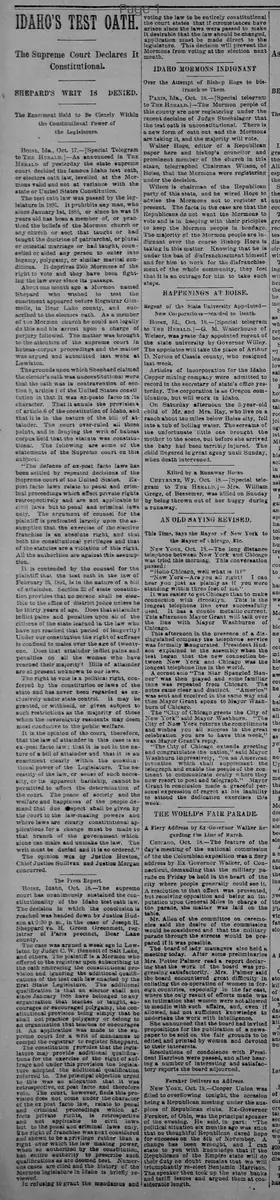
The Supreme Court Declares It
Constitutional.
SHEPARD'S
WRIT
IS
DENIED.
The Enactment Held to Be Clearly Within
the Constitutional Power of
the Legislature.
Boise, Ida., Oct. 17.—Special Telegram to The Herald.—As announced in The Herald of yesterday the state supreme court decided the famous Idaho test oath, or electors oath law, levelled at the Mormons valid and not at variance with the state or United States Constitution.
The test oath law was passed by the legislature in 1891. It prohibits any man, who since January 1st, 1889, or since he was 18 years old has been a member of, or practiced the beliefs of the Mormon church or any church or sect that taught or had taught the doctrine of patriarchal, or plural or celestial marriage or had taught, counselled or aided any person to enter into bigamy, polygamy, or similar marital conditions. It deprives 2500 Mormons of the right to vote and they have been fighting the law ever since its passage.
About one month ago a Mormon named Shepard who wished to test the enactment appeared before Registrar Gimmelle, in Bear Lake county, and subscribed to the electors oath. As a member of the Mormon church he could not legally do this and his arrest upon a charge of perjury followed. The matter was brought to the attention of the supreme court in habeas-corpus proceedings and the matter was argued and submitted last week at Lewiston.
The grounds upon which Shepard claimed the elector's oath was unconstitutional were that the oath was in contravention of section 9, article 1 of the United States constitution in that it was ex-post facto in its character. That it annuls the provisions of article 6 of the constitution of Idaho, and that it is in the nature of the bill of attainder. The court over-ruled all these points, and in denying the writ of habeas corpus held that the statute was constitutional. The following are some of the statements of the Supreme court on this subject:
The defense of ex-post facto laws has been settled by repeated decisions of the Supreme court of the United States. Ex-post facto laws relate to penal and criminal proceedings which affect private rights retrospectively and are not applicable to civil laws but to penal and criminal laws only. The argument of counsel for the plaintiff is predicated largely upon the assumption that the exercise of the elective franchise is an absolute right, and that both the constitutional privileges and that of the statutes are a violation of this right. All the authorities are against this assumption.
It is contended by the counsel for the plaintiff that the test oath in the law of February 25, 1891, is in the nature of a bill of attainder. Section 23 of state constitution provides that no person shall be eligible to the office of district judge unless he be thirty years of age. Does that attainder inflict pains and penalties upon all of the citizens of the state learned in the law who have not reached that period of longevity?
Under our constitution the right of suffrage is confined to males over the age of twenty-one. Does that attainder inflict pains and penalties on all the women who have reached their majority? Bills of attainder are at present unknown to our laws.
The right to vote is a political right, conferred by the constitution or laws of the state and has never been regarded as exclusively under state control. It may be granted, or withheld, or given subject to such restrictions as the majority of those whom the sovereignty resides may deem most conducive to the public welfare.
It is the opinion of the court, therefore, that the law of attainder in this case is an ex-post facto law; that it is not in the nature of a bill of attainder and that it is an enactment clearly within the constitutional power of the Legislature. The necessity of the law, or sense of such necessity, or its apparent hardship, cannot be permitted to affect the determination of the court. The peace of society and the welfare and happiness of the people demand that due respect shall be given by the court to the law-making powers and where laws are clearly constitutional applications for a change must be made to that branch of the government which alone can make and unmake the law. The writ must be denied and it is so ordered."
The opinion was by Justice Huston, Chief Justice Sullivan and Justice Morgan concurred.
The Press Report.
Boise, Idaho, Oct. 18.—The supreme court has unanimously sustained the constitutionality of the Idaho test oath law. The decision in which the conclusion in reached was handed down by Justice Hudson at 2:30 p. m., in the case of Joseph R. Sheppard vs. H. Green Greenmett, registrar of Paris precinct, Bear Lake county.
The case was argued a week ago in Lewiston by Judge C. W. Bennett of Salt Lake, and others. The plaintiff is a Mormon who offered to the registrar upon subscribing to the oath embracing the constitutional provision and ignoring the additional qualifications of the test oath law enacted by the first State Legislature. The additional qualification is that an elector shall not since January 1889 have belonged to any organization that teaches or taught, encourages or encouraged polygamy, the constitutional provision being simply that he shall not practice polygamy or belong to an organization that teaches or encourages it. An application was made to the supreme court for a writ of mandamus to compel the registrar to register Sheppard.
The constitution provides that the legislature may provide additional qualifications for the exercise of the right of suffrage and under this provision the legislature adopted the additional qualification referred to. The principal objection urged this retrospective, ex post facto and therefore void. The court, however, finds this provision does not come under the character of the ex post facto law, relate to penal and criminal proceedings which affects private rights, is retrospective and not applicable to civil laws but to the penal and criminal laws only.
The right of franchise was next considered and shown to be a privilege rather than a right over which the law making power, when so authorized by the constitution, has entire authority to prescribe such qualifications as are deemed best. Numerous cases are cited and the history of the Mormon legislature in Idaho is briefly reviewed.
In refusing to grant the mandamus and voting the law to be entirely constitutional the court states that if circumstances have arisen since the laws were passed to make it desirable that the law should be changed, application must be made direct to the legislature. This decision will prevent the Mormons from voting at the election next month.
What sub-type of article is it?
What keywords are associated?
What entities or persons were involved?
Where did it happen?
Domestic News Details
Primary Location
Boise, Idaho
Event Date
Oct. 17
Key Persons
Outcome
writ denied; test oath law upheld as constitutional; prevents 2500 mormons from voting in upcoming election.
Event Details
Idaho Supreme Court rules the 1891 test oath law, prohibiting Mormons involved in polygamy from voting, is constitutional. Case brought by Mormon Shepard/Sheppard via habeas corpus and mandamus after arrest for perjury; court rejects ex post facto and bill of attainder claims, affirming legislature's power to set suffrage qualifications.