Thank you for visiting SNEWPapers!
Sign up free
The Daily Advertiser
New York, New York County, New York
What is this article about?
A satirical critique in the Daily Advertiser addressed to 'Rough-Hewer,' a former New York Loan-Officer, mocking his demand for exorbitant compensation (over 3,500 specie dollars) for handling depreciated Continental currency, contrasting it with his prior advocacy for public frugality, debt reduction, and anti-federalist views on government power and credit.
Clipping
OCR Quality
Full Text
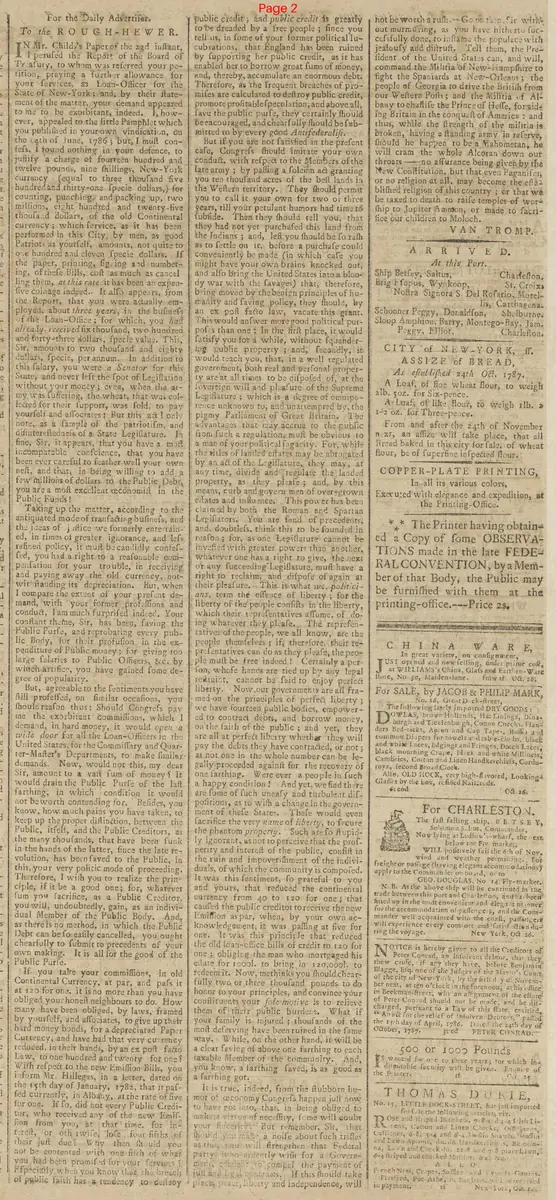
To the ROUGH-HEWER.
In Mr. Childs's Paper of the 23d instant, I perused the Report of the Board of Treasury, to whom was referred your petition, praying a further allowance for your services, as Loan-Officer for the State of New-York; and, by their statement of the matter, your demand appeared to me to be exorbitant, indeed. I, however, appealed to the little Pamphlet which you published in your own vindication, on the 14th of June, 1786; but, I must confess, I found nothing in your defence, to justify a charge of fourteen hundred and twelve pounds, nine shillings, New-York currency (equal to three thousand five hundred and thirty-one specie dollars,) for counting, punching, and packing up, two millions, eight hundred and twenty-five thousand dollars, of the old Continental currency; which service, as it has been performed in this City, by men, as good Patriots as yourself, amounts, not quite to one hundred and eleven specie dollars. If the paper, printing, signing and numbering, of these Bills, cost as much as cancelling them, at this rate, it has been an expensive coinage indeed. It also appears, from the Report, that you were actually employed, about three years, in the business of the Loan-Office; for which, you had already received six thousand, two hundred and forty-three dollars, specie value. This, Sir, amounts to two thousand and eighty dollars, specie, per annum. In addition to this salary, you were a Senator for this State, and never left the post of Legislation without your money; even, when the army was suffering, the wheat, that was collected for their support, was sold, to pay yourself and associates: But this fact I only note, as a sample of the patriotism, and disinterestedness of a State Legislature. In fine, Sir, it appears, that you have a most incomparable conscience, that you have been ever careful to feather well your own nest, and that, in being willing to add a few millions of dollars to the Public Debt, you are a most excellent economist in the Public Funds!
Taking up the matter, according to the antiquated mode of transacting business, and the ideas of justice we formerly entertained, in times of greater ignorance, and less refined policy, it must be candidly confessed, you had a right to a reasonable compensation for your trouble, in receiving and paying away the old currency, notwithstanding its depreciation. But, when I compare the extent of your present demand, with your former professions and conduct, I am much surprised indeed. Your constant theme, Sir, has been, saving the Public Purse, and reprobating every public Body, for their profusion in the expenditure of Public money; for giving too large salaries to Public Officers, &c. by which artifice, you have gained some degree of popularity.
But, agreeable to the sentiments you have still professed, on similar occasions, you should reason thus: Should Congress pay me the exorbitant Commissions, which I demand, in hard money, it would open a wide door for all the Loan-Officers in the United States, for the Commissary and Quarter-Master's Departments, to make similar demands. Now, would not this, my dear Sir, amount to a vast sum of money? It would drain the Public Purse of the last farthing, in which condition it would not be worth contending for. Besides, you know, how much pains you have taken, to keep up the proper distinction, between the Public, itself, and the Public Creditors, as the many thousands, that have been sunk in the hands of the latter, since the late revolution, has been saved to the Public, in this, your very politic mode of proceeding. Therefore, I wish you to realize the principle, if it be a good one; for, whatever sum you sacrifice, as a Public Creditor, you will, undoubtedly, gain, as an individual Member of the Public Body. And, as there is no method, in which the Public Debt can be so easily cancelled, you ought cheerfully to submit to precedents of your own making. It is all for the good of the Public Purse.
If you take your commissions, in old Continental Currency, at par, and pass it at 120 for one, it is no more than you have obliged your honest neighbours to do. How many have been obliged, by laws, framed by yourself, and associates, to give up their hard money bonds, for a depreciated Paper Currency, and have had that very currency reduced, in their hands, by an ex post facto Law, to one hundred and twenty for one?
With respect to the new Emission Bills, you inform Mr. Hillegas, in a letter, dated on the 15th day of January, 1782, that it passed currently, in Albany, at the rate of five for one. If so, did not every Public Creditor, who received any of the new Emission from you, at that time, for interest, or otherwise, lose four fifths of their just due: Why then should you not be contented with one fifth of what you had been promised for your services? Especially when you know that the breach of public faith has a tendency to destroy public credit; and public credit is greatly to be dreaded by a free people; since you tell us, in some of your former political lucubrations, that England has been ruined by supporting her public credit, as it has enabled her to borrow great sums of money, and, thereby, accumulate an enormous debt. Therefore, as the frequent breaches of promises are calculated to destroy public credit, promote profitable speculation, and above all, save the public purse, they certainly should be encouraged, and cheerfully should be submitted to by every good Antifederalist.
But if you are not satisfied in the present case, Congress should imitate your own conduct, with respect to the Members of the late army; by passing a solemn act granting you ten thousand acres of the best lands in the Western territory. They should permit you to call it your own for two or three years, till your petulant humors had time to subside. Then they should tell you, that they had not yet purchased this land from the Indians; and, lest you should be so rash as to settle on it, before a purchase could conveniently be made (in which case you might have your own brains knocked out, and also bring the United States into a bloody war with the savages) that, therefore, being moved by the benign principles of humanity and saving policy, they should, by an ex post facto law, vacate this grant.
This would answer more good political purposes than one: In the first place, it would satisfy you for a while, without squandering public property; and, secondly, it would teach you, that, in a well regulated government, both real and personal property are at all times to be disposed of, at the sovereign will and pleasure of the Supreme Legislature; which is a degree of omnipotence unknown to, and unattempted by, the pigmy Parliament of Great Britain. The advantages that may accrue to the public from such a regulation, must be obvious to a man of your political sagacity. For, while the titles of landed estates may be abrogated by an act of the Legislature, they may, at any time, divide and regulate the landed property, as they please; and, by this means, curb and govern men of over-grown estates and influence. This power has been claimed by both the Roman and Spartan Legislators. You are fond of precedents, and, doubtless, think this to be founded in reason; for, as one Legislature cannot be invested with greater powers than another, whatever one has a right to give, the next or any succeeding Legislature, must have a right to reclaim, and dispose of again at their pleasure. This is what we, politicians, term the essence of liberty; for the liberty of the people consists in the liberty, which their representatives assume, of doing whatever they please. The representatives of the people, we all know, are the people themselves; if, therefore, their representatives can do as they please, the people must be free indeed! Certainly a person, whose hands are tied up by any legal restraint, cannot be said to enjoy perfect liberty. Now, our governments are all framed on the principles of perfect liberty; we have fourteen public bodies, empowered to contract debts, and borrow money, on the faith of the public; and yet, they are all at perfect liberty whether they will pay the debts they have contracted, or not; as not one in the whole number can be legally proceeded against for the recovery of one farthing. Were ever a people in such a happy condition! And yet, we find there are some of such uneasy and turbulent dispositions, as to wish a change in the government of these States. These would even sacrifice the very name of liberty, to secure the phantom property. Such are so stupidly ignorant, as not to perceive that the prosperity and interest of the public, consists in the ruin and impoverishment of the individuals, of which the community is composed.
It was this sentiment, so grateful to you and yours, that reduced the continental currency from 40 to 120 for one; that caused the public creditor to receive the new Emission as par, when, by your own acknowledgement, it was passing at five for one. It was this principle that reduced the old loan-office bills of credit to 120 for one; obliging the man who mortgaged his estate for 1000l. to bring in 120,000l. to redeem it. Now, methinks you should cheerfully throw or three thousand pounds to do honor to your principles, and convince your constituents your sole motive is to relieve them of their public burdens. What if your family is injured; thousands of the most deserving have been ruined in the same way. While, on the other hand, it will be a clear saving of above one farthing to each taxable Member of the community. And, you know, a farthing saved, is as good as a farthing got.
It is true, indeed, from the stubborn humor of oeconomy Congress happen just now to have got into, that, in being obliged to make a virtue of necessity, some will doubt your sincerity: But remember, Sir, that though you make a noise about such trifles as these, you will strengthen that Federal party, who ardently wish for a Government, efficient to compel the payment of just and legal contracts. If this should take place, peace, liberty and independence, will not be worth a rush. - Go on then, Sir, without murmuring, as you have hitherto successfully done, to inflame the populace with jealousy and distrust. Tell them, the President of the United States can, and will, command the Militia of New-Hampshire to fight the Spaniards at New-Orleans; the people of Georgia to drive the British from our Western Posts; and the Militia of Albany to chastise the Prince of Hesse, for aiding Britain in the conquest of America: and thus, while the strength of the militia is broken, having a standing army in reserve, should he happen to be a Mahometan, he will cram the whole Alcoran down our throats - no assurance being given by the New Constitution, but that even Paganism, or no religion at all, may become the established religion of this country; or that we be taxed to death to raise temples of worship to Jupiter Ammon, or made to sacrifice our children to Moloch.
VAN TROMP.
What sub-type of article is it?
What themes does it cover?
What keywords are associated?
What entities or persons were involved?
Letter to Editor Details
Author
Van Tromp.
Recipient
To The Rough Hewer.
Main Argument
the writer sarcastically condemns rough-hewer for hypocritically demanding exorbitant compensation for his loan-officer services amid depreciated currency, contrasting it with his past calls for public frugality, debt cancellation benefiting the public purse, and anti-federalist fears of strong government enforcing contracts.
Notable Details