Thank you for visiting SNEWPapers!
Sign up free
Daily National Intelligencer
Washington, District Of Columbia
What is this article about?
French Minister Caulincourt reports to Napoleon on April 12, 1815, detailing diplomatic efforts for peace post his return, but highlighting alarming military preparations by European powers like England, Austria, Prussia, and others, suggesting potential war against France.
Clipping
OCR Quality
Full Text
Translated for the Commercial Advertiser from French papers by the Boxer.
REPORT TO THE EMPEROR.
PARIS, APRIL 12. 1815.
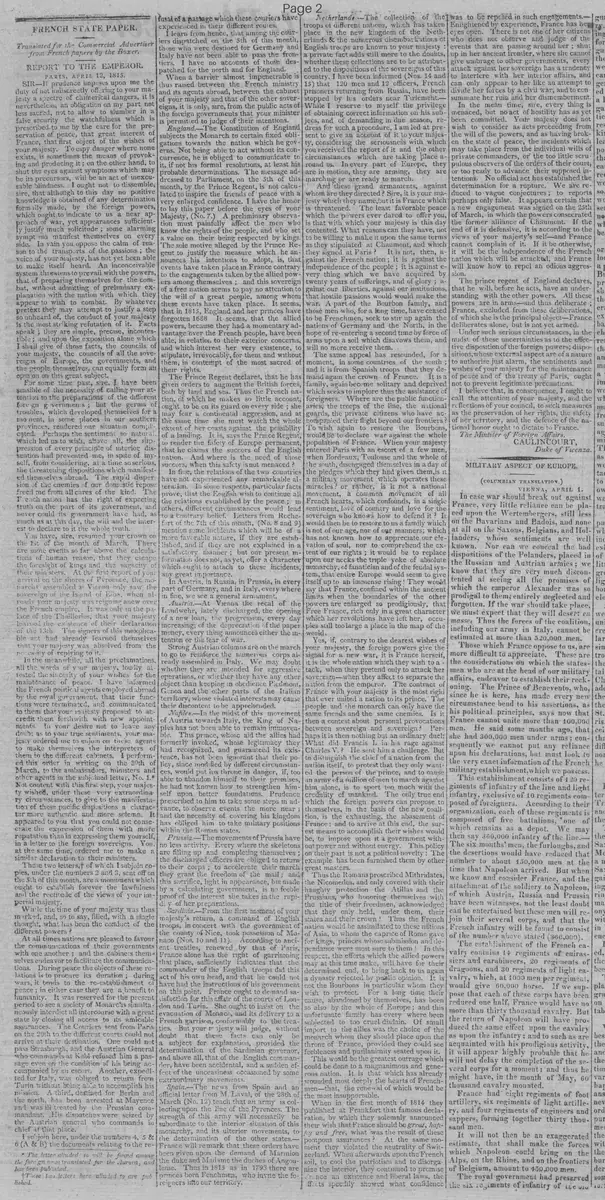
SIR—If prudence imposes upon me the duty of not indiscreetly offering to your majesty a spectre of chimerical dangers, it is nevertheless, an obligation on my part not less sacred, not to allow to slumber in a false security the watchfulness which is prescribed to me by the care for the preservation of peace, that great interest of France, that first object of the wishes of your majesty. To espy danger where none exists, is sometimes the means of provoking and producing it; on the other hand, to shut the eyes against symptoms which may be its precursors, will be an act of inexcusable blindness. I ought not to dissemble, sire, that although to this day no positive knowledge is obtained of any determination formally made, by the foreign powers, which ought to indicate to us a near approach of war, yet appearances sufficiently justify much solicitude; some alarming symptoms manifest themselves on every side. In vain you oppose the calm of reason to the transports of the passions; the voice of your majesty, has not yet been able to make itself heard. An inconceivable system threatens to prevail with the powers, that of preparing themselves for the combat, without admitting of preliminary explanation with the nation with which they appear to wish to combat. By whatever pretext they may attempt to justify a step so unheard of, the conduct of your majesty is the most striking refutation of it. Facts speak; they are simple, precise, incontestable: and upon the exposition alone which I shall give of those facts, the councils of your majesty, the councils of all the sovereigns of Europe, the governments, and the people themselves, can equally form an opinion on this great subject.
For some time past, sire, I have been sensible of the necessity of calling your attention to the preparations of the different foreign governments; but the germs of troubles, which developed themselves for a moment, in some places in our southern provinces, rendered our situation complicated. Perhaps the sentiment so natural which led us to wish, above all, the suppression of every principle of interior dissension had prevented me, in spite of myself, from considering, at a time so serious, the threatening dispositions which manifested themselves abroad. The rapid dispersion of the enemies of our domestic repose freed me from all cares of the kind: The French nation has the right of expecting truth on the part of its government, and never could its government have had, as much as at this day, the will and the interest to declare to it the whole truth.
You have, sire, resumed your crown on the 1st of the month of March. There are some events so far above the calculations of human reason, that they escape the foresight of kings and the sagacity of their ministers. At the first report of your arrival on the shores of Provence, the monarchs assembled at Vienna only saw the sovereign of the Island of Elba, when already your majesty was reigning anew over the French empire. It was only in the palace of the Thuilleries, that your majesty learned the existence of their declaration of the 13th. The signers of this inexplicable act had already learned themselves that your majesty was absolved from the necessity of replying to it.
In the mean while, all the proclamations, all the words of your majesty, loudly attested the sincerity of your wishes for the maintenance of peace. I have informed the French political agents employed abroad by the royal government, that their functions were terminated, and communicated to them that your majesty proposed to accredit them forthwith with new appointments. In your desire not to leave any doubt as to your true sentiments, your majesty ordered me to enjoin on these agents to make themselves the interpreters of them to the different cabinets. I performed this order in writing on the 30th of March, to the ambassadors, ministers and other agents in the subjoined letter. No. 1.*
Not content with this first step, your majesty wished, under these very extraordinary circumstances, to give to the manifestation of those pacific dispositions a character more authentic and more solemn. It appeared to you that you could not consecrate the expression of them with more reputation than in expressing them yourself, in a letter to the foreign sovereigns. You, at the same time, ordered me to make a similar declaration to their ministers. These two letters† of which I subjoin copies, under the numbers 2 and 3, sent off on the 5th of this month, are a monument which ought to establish forever the lawfulness and the rectitude of the views of your imperial majesty.
While the time of your majesty was thus marked, and, so to say, filled, with a single thought, what has been the conduct of the different powers?
At all times nations are pleased to favour the communications of their governments with one another: and the cabinets themselves endeavor to facilitate the communications. During peace the objects of these relations is to procure its duration; during wars, it tends to the re-establishment of peace; in either case they are a benefit to humanity. It was reserved for the present period to see a society of Monarchs simultaneously interdict all intercourse with a great state by closing all access to its amicable assurances. The Couriers sent from Paris on the 20th to the different courts could not arrive at their destination. One could not pass Strasburgh, and the Austrian General who commands at Kehl refused him a passage even on the condition of his being accompanied by an escort. Another, expedited for Italy, was obliged to return from Turin without being able to accomplish his mission. A third, destined for Berlin and the north, has been arrested at Mayence and was ill treated by the Prussian commandant. His dispatches were seized by the Austrian general who commands in chief at that place.
I subjoin here, under the numbers 4, 5 & 6 (A & B) the documents relating to the refusal of a passage which these couriers have experienced in their different routes.
I learn from hence, that among the couriers dispatched on the 5th of this month, those who were destined for Germany and Italy have not been able to pass the frontiers. I have no accounts of those dispatched for the north and for England.
When a barrier almost impenetrable is thus raised between the French ministry and its agents abroad, between the cabinet of your majesty and that of the other sovereigns, it is only, sire, from the public acts of the foreign governments that your minister is permitted to judge of their intentions.
England. The Constitution of England subjects the Monarch to certain fixed obligations towards the nation which he governs. Not being able to act without its concurrence, he is obliged to communicate to it, if not his formal resolutions, at least his probable determinations. The message addressed to Parliament, on the 5th of this month, by the Prince Regent, is not calculated to inspire the friends of peace with a very enlarged confidence. I have the honor to lay this paper before the eyes of your Majesty, (No. 7.) A preliminary observation must painfully affect the men who know the rights of the people, and who set a value on their being respected by kings. The sole motive alleged by the Prince Regent to justify the measure which he announces his intentions to adopt, is, that events have taken place in France contrary to the engagements taken by the allied powers among themselves; and this sovereign of a free nation seems to pay no attention to the will of a great people, among whom these events have taken place. It seems, that in 1815, England and her princes have forgotten 1688. It seems, that the allied powers, because they had a momentary advantage over the French people, have been able, in relation to their exterior concerns, and which interest her very existence, to stipulate, irrevocably, for them and without them, in contempt of the most sacred of their rights.
The Prince Regent declares, that he has given orders to augment the British force both by land and sea. Thus the French nation, of which he makes so little account, ought to be on its guard on every side; she may fear a continental aggression, and at the same time she must watch the whole extent of her coasts against the possibility of a landing. It is, says the Prince Regent, to render the safety of Europe permanent, that he claims the succors of the English nation. And where is the need of those succors, when this safety is not menaced?
In fine, the relations of the two countries have not experienced any remarkable alteration. In some respects, particular facts prove, that the English wish to continue all the relations established by the peace; in others, different circumstances would lead to a contrary belief. Letters from Rochefort of the 7th of this month, (No. 8 and 9) mention some incidents which will be of a more favorable nature, if they are established, and if they are not explained in a satisfactory manner; but our present information does not, as yet, offer a character which ought to attach to these incidents, any great importance.
In Austria, in Russia, in Prussia, in every part of Germany, and in Italy, every where in fine, we see a general armament.
Austria.—At Vienna the recall of the Landwehr, lately discharged, the opening of a new loan, the progression, every day increasing, of the depreciation of the paper money, every thing announces either the intention or the fear of war.
Strong Austrian columns are on the march to go to reinforce the numerous corps already assembled in Italy. We may doubt whether they are intended for aggressive operations, or whether they have any other object than keeping in obedience Piedmont, Genoa and the other parts of the Italian territory, whose violated interests may cause their discontent to be apprehended.
Naples.—In the midst of this movement of Austria towards Italy, the King of Naples has not been able to remain immoveable. This prince, whose aid the allies had formerly invoked, whose legitimacy they had recognized, and guaranteed its existence, has not been ignorant that their policy, since modified by different circumstances, would put his throne in danger, if, too able to abandon himself to their promises, he had not known how to strengthen himself upon better foundations. Prudence prescribed to him to take some steps in advance, to observe events the more near; and the necessity of covering his kingdom has obliged him to take military positions within the Roman states.
Prussia.—The movements of Prussia have no less activity. Every where the skeletons are filling up and completing themselves; the discharged officers are obliged to return to their corps; to accelerate their march they grant the freedom of the mail: and this sacrifice, high in appearance, but made by a calculating government, is no feeble proof of the interest she takes in the rapidity of her preparations.
Sardinia. From the first moment of your majesty's return, a command of English troops, in concert with the government of the county of Nice, took possession of Monaco (Nos. 10 and 11). According to ancient treaties, renewed by that of Paris, France alone has the right of garrisoning that place, sufficiently indicates that the commander of the English troops did this act of his own head, and that he could not have had the instructions of his government on this point. France ought to demand satisfaction for this affair of the courts of London and Turin. She ought to insist on the evacuation of Monaco, and its delivery to a French garrison, conformably to the treaties. But your majesty will judge, without doubt that these facts can only be a subject for explanation, provided the determination of the Sardinian governor, and above all, that of the English commander, have been accidental, and a sudden effect of the uneasiness occasioned by some extraordinary movements.
Spain.—The news from Spain and an official letter from M. Laval, of the 28th of March (No. 12) teach that an army is collecting upon the line of the Pyrenees. The strength of this army will necessarily be subordinate to the interior situation of this monarchy, and its ulterior movements, to the determination of the other states.—France will remark that these orders have been given upon the demand of Marmont the duke and Madame the duchess of Angouleme. Thus in 1815 as in 1793 there are princes born Frenchmen, who invite the foreigners into our territory.
Netherland—The collection of the troops of different nations, which has taken place in the new kingdom of the Netherlands & the numerous disembarkations of English troops are known to your majesty: a private fact adds still more to the doubts, whether these collections are to be attributed to the dispositions of the sovereigns of this country. I have been informed (Nos. 14 and 15) that 120 men and 12 officers, French prisoners returning from Russia, have been stopped by his orders near Tirlemont.—
While I reserve to myself the privilege of obtaining correct information on his subjects, and of demanding in due season, redress for such a procedure, I am led at present to give an account of it to your majesty, considering the seriousness with which you received the report of it and the other circumstances which are taking place around us. In every part of Europe, they are in motion, they are arming, they are marching or are ready to march.
And these grand armaments, against whom are they directed? Sire, it is your majesty which they name, but it is France which is threatened. The least favorable peace which the powers ever dared to offer you, is that with which your majesty is this day contented. What reasons can they have, not to be willing to make it upon the same terms as they stipulated at Chaumont, and which they signed at Paris? It is not, then, against the French nation; it is against the independence of the people; it is against every thing which we have acquired by twenty years of sufferings, and of glory; against our liberties, against our institutions, that hostile passions would make the war. A part of the Bourbon family, and those men who, for a long time, have ceased to be Frenchmen, seek to stir up again the nations of Germany and the North, in the hope of re-entering a second time by force of arms upon a soil which disavows them, and will no more receive them.
The same appeal has resounded, for a moment, in some countries of the south; and it is from Spanish troops that they demand again the crown of France. It is a family, again become solitary and deprived which seeks to implore thus the assistance of foreigners. Where are the public functionaries, the troops of the line, the national guards, the private citizens who have accompanied their flight beyond our frontiers?
To wish again to restore the Bourbons would be to declare war against the whole population of France. When your majesty entered Paris with an escort of a few men, when Bordeaux, Toulouse and the whole of the south, disengaged themselves in a day of the pledges which they had given them, is it a military movement which operates these miracles? or rather, is it not a national movement, a common movement of all French hearts, which confounds, in a single sentiment, love of country and love for the sovereign who knows how to defend it? It would then be to restore to us a family which is not of our age, nor of our manners; which has not known how to appreciate our elevation of soul, nor to comprehend the extent of our rights; it would be to replace upon our necks the triple yoke of absolute monarchy, of fanaticism and of the feudal system, that entire Europe would seem to give itself up to an immense rising! They would say that France, confined within the ancient limits when the boundaries of the other powers are enlarged so prodigiously, that Free France, rich only in a great character which her revolutions have left her, occupies still too large a place in the map of the world.
Yes, if, contrary to the dearest wishes of your majesty, the foreign powers give the signal for a new war, it is France herself, it is the whole nation which they wish to attack, when they pretend only to attack her sovereign—when they affect to separate the nation from the emperor. The contract of France with your majesty is the most rigid that ever united a nation to its prince. The people and the monarch can only have the same friends and the same enemies. Is it then a contest about personal provocations between sovereign and sovereign? Perhaps it is then nothing but an ordinary duel: What did Francis I. in his rage against Charles V.? He sent him a challenge. But to distinguish the chief of a nation from the nation itself, to protest that they only wanted the person of the prince, and to cause an army of a million of men to march against him alone, is to sport too much with the credulity of mankind. The only true end which the foreign powers can propose to themselves, in the basis of the new coalition, is the exhausting, the abasement of France: and to arrive at this end, the surest means to accomplish their wishes would be, to impose upon it a government without power and without energy. This policy on their part is not a political novelty: The example has been furnished them by other great masters.
Thus the Romans proscribed Mithridates, the Nicomedes, and only covered with their haughty protection the Attilas and the Prussians, who honoring themselves with the title of their freedmen, acknowledged that they only held, under them, their states and their crown! Thus the French nation would be assimilated to these nations of Asia, to whom the caprice of Rome gave for kings, princes whose submission and dependence were most sure to them! In this respect, the efforts which the allied powers may at this time make, will have for their determined end, to bring back to us again a dynasty rejected by public opinion. It is not the Bourbons in particular whom they wish to protect. For a long time their cause, abandoned by themselves, has been so also by the whole of Europe; and this unfortunate family has every where been subjected to too cruel disdain. Of small import to the allies was the choice of the monarch whom they should place upon the throne of France, provided they could see feebleness and pusillanimity seated upon it.
This would be the greatest outrage which could be done to a magnanimous and generous nation. It is that which has already wounded most deeply the hearts of Frenchmen—that, the renewal of which would be the most insupportable.
When in the first month of 1814 they published at Frankfort that famous declaration, by which they solemnly announced their wish that France should be great, happy and free, what was the result of these pompous assurances? At the same moment they violated the neutrality of Switzerland. When afterwards upon the French soil, to cool the patriotism and to disorganize the interior, they continued to promise France an existence and liberal laws, the effects speedily showed what confidence was to be reposed in such engagements.—
Enlightened by experience, France has her eyes open. There is not one of her citizens who does not observe and judge of the events that are passing around her; shut up in her ancient frontier, where she cannot give umbrage to other governments, every attack against her sovereign has a tendency to interfere with her interior affairs, and can only appear to her like an attempt to divide her forces by a civil war, and to consummate her ruin and her dismemberment.
In the mean time, sire, every thing is menaced, but no act of hostility has as yet been committed. Your majesty does not wish to consider as acts proceeding from the will of the powers, and as having broken the state of peace, the incidents which may take place from the individual wills of private commanders, or the too little scrupulous observers of the orders of their court, or too ready to advance their supposed intentions. No official act has established the determination for a rupture. We are reduced to vague conjectures; to reports perhaps only false. It appears certain that a new engagement was signed on the 25th of March, in which the powers consecrated the former alliance of Chaumont. If the end of it is defensive, it is according to the views of your majesty's self—and France cannot complain of it. If it be otherwise, it will be the independence of the French nation which will be attacked, and France will know how to repel an odious aggression.
The prince regent of England declares, that he will, before he acts, have an understanding with the other powers. All these powers are in arms—and thus deliberate; France, excluded from these deliberations, of which she is the principal object—France deliberates alone, but is not yet armed.
Under such serious circumstances, in the midst of these uncertainties as to the effective disposition of the foreign powers; dispositions, whose external aspect are of a nature to authorise just alarm, the sentiments and wishes of your majesty for the maintenance of peace and of the treaty of Paris, ought not to prevent legitimate precautions.
I believe that, in consequence, I ought to call the attention of your majesty, and the reflections of your council, to such measures as the preservation of her rights, the safety of her territory, and the defence of the national honor ought to dictate to France.
The Minister of Foreign Affairs.
CAULINCOURT,
Duke of Vicenza.
What sub-type of article is it?
What keywords are associated?
What entities or persons were involved?
Where did it happen?
Foreign News Details
Primary Location
Europe
Event Date
April 12, 1815
Key Persons
Outcome
no acts of hostility committed; french diplomatic overtures blocked by foreign powers; widespread military preparations across europe indicating potential coalition against france.
Event Details
French Foreign Minister Caulincourt reports to Napoleon on diplomatic efforts for peace following his return on March 1, 1815, including letters to foreign sovereigns. However, couriers are blocked, and powers like England, Austria, Prussia, Spain, and others are arming, renewing alliances, and taking positions suggesting preparation for war against France to restore the Bourbons or weaken the nation.