Thank you for visiting SNEWPapers!
Sign up free
Story
October 31, 1884
The Times
Owosso, Shiawassee County, Michigan
What is this article about?
An opinion piece narrated through a U.S. farmer's daily life, illustrating how protectionist tariffs benefit American agriculture and industry by creating home markets and cheap goods, contrasting with free trade's harms in Canada. References 1860 Morrill tariff and 1870 censuses.
Clipping
OCR Quality
95%
Excellent
Full Text
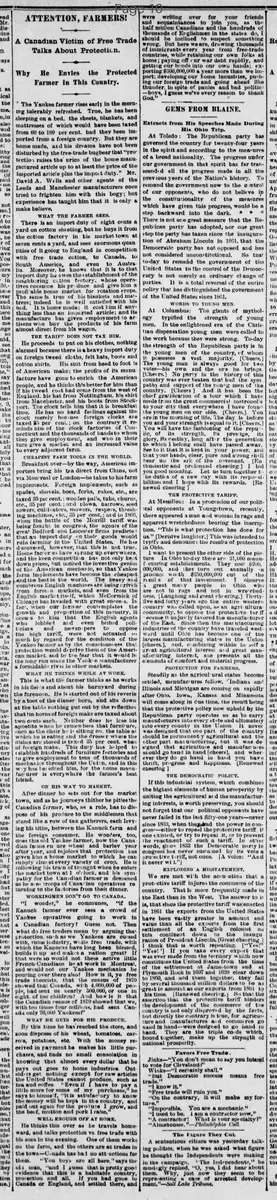
ATTENTION. FARMERS!
A Canadian Victim of Free Trade Talks About Protection.
Why He Envies the Protected Farmer in This Country.
The Yankee farmer rises early in the morning tolerably refreshed. True, he has been sleeping on a bed, the sheets, blankets, and mattresses of which would have been taxed from 60 to 180 per cent. had they been imported from a foreign country. But they are home made, and his dreams have not been disturbed by the free-trade bugbear that "protection raises the price of the home manufactured article up to at least the price of the imported article plus the import duty." Mr. David A. Wells and other agents of the Leeds and Manchester manufacturers once tried to frighten him with this bogy; but experience has taught him that it is only a make believe.
WHAT THE FARMER SEES.
There is an import duty of eight cents a yard on cotton sheeting, but he buys it from the cotton factory in his market town at seven cents a yard, and sees enormous quantities of it going to England in competition with free trade cotton, to Canada, to South America, and even to Australia. Moreover, he knows that it is to that import duty he owes the establishment of the neighboring cotton factory, whose operatives consume his produce and give him a profitable home market for rotation crops.
The same is true of his blankets and mattress; indeed he is well satisfied with his bed. It is home made; it cost him if anything less than an imported article; and its manufacture has given employment to artisans who buy the products of his farm almost direct from his wagon.
THE TARIFF DOES NOT TAX HIM.
He proceeds to put on his clothes, nothing alarmed because there is a heavy import duty on foreign tweed cloths, felt hats, boots and cotton shirts.
His suit from head to foot is of American make; the profits of its manufacture have gone to enrich the American people, and he thinks this better for him than if his tweed coat had come from the west of England, his hat from Nottingham, his shirt from Manchester, and his boots from Stockport. The clock tells him that it is breakfast time. He has no hard feelings against the clock merely because foreign clocks are taxed 85 per cent.; on the contrary it reminds him of the clock factories of Connecticut and the thousands of hands to whom they give employment, and who in their turn give a market and an increased value to every adjacent farm.
CHEAPEST FARM TOOLS IN THE WORLD.
Breakfast over-by the way, American importers bring his tea direct from China, not via Montreal or London-he takes to his farm implements. Foreign implements, such as spades, shovels, hoes, forks, rakes, etc., are taxed 35 per cent.; wooden pails, tubs, churns etc., 35 per cent.; and plows, harrows, seed sowers, cultivators, mowers, reapers, threshing machines, etc., 35 per cent.; and in 1860, when the battle of the Morrill tariff was being fought in congress, the agents of the great Bedford and Leicester firms predicted that an import duty on their goods would ruin farming in the United States. He has discovered, however, that this is not true. Home factories have sprung up everywhere, and the keen competition has not only kept down prices, but incited the inventive genius of the American mechanic, so that Yankee farm implements have become the cheapest and the best in the world. The heavy and cumbrous English machines are being driven from foreign markets, and even from the English market itself, which McCormick of Chicago has invaded with great success. In fact, when our farmer contemplates the growth and proportion of this industry, it occurs to him that the English agents who lobbied and even bribed politicians and newspapers to oppose the high tariff, were not actuated so much by regard for the condition of the Yankee farmer as by the consciousness that protection would deprive them of the American market, and by the fear that it would in the long run make the Yankee manufacturer a formidable rival in other markets.
WHAT HE THINKS WHILE AT WORK.
This is what the farmer thinks as he works in his fields and about his barnyard during the forenoon. He is started out of his reverie by a toot of the dinner horn, and sits down at the table nothing put out by the reflection that tin horns of foreign make are taxed about two cents each. Neither does he lose his appetite when he remembers that furniture, such as the chair he is sitting on, the table at which he is eating and the dresser where the dishes are stored is taxed 35 per cent. when of foreign make. This duty has helped to establish hundreds of furniture factories and to give employment to tens of thousands of mechanics throughout the Union, and in this way has benefited him, for the home manufacturer is everywhere the farmer's best friend.
ON HIS WAY TO MARKET.
After dinner he sets out for the market town, and as he journeys thither he pities the Canadian farmer, who, as a rule, has to dispose of his produce to the middlemen that stand like a row of tax gatherers, each levying his tithe, between the Kanuck farm and the foreign consumer. He wonders, too, does this old Yankee farmer, how the Canadian farms endure wheat and barley year after year, and rejoices that protection has given him a home market to which he can supply almost every variety of crop. He is following his train of thought when he enters the market town at 1 o'clock, and his sympathy for the Canadian farmer is deepened as he sees troops of Canadian operatives returning to the factories from their dinner.
WORKINGMEN DON'T GO TO CANADA.
"I wonder," he communes, "if the Kanuck farmer ever sees a crowd of Yankee operatives going to work in a Canadian factory? Guess not. Then what do free traders mean by arguing that protection, such as we Yankees are cursed with, ruins industry, while free trade, with which the Kanucks have long been blessed, builds it up and makes a nation great? If that were so would not these active little French-Canadians be at work in Montreal, and would not our Yankee mechanics be pouring over there also? How is it, ye free trade theorists, that the census of 1870 showed that Canada, with 4,000,000 of people, had sent us nearly 500,000, or one in eight, of her children? And how is it that the Canadian census of 1870 showed that we, with ten times four millions, had sent Canada only 70,000 Yankees?"
WHAT HE GETS FOR HIS PRODUCE.
By this time he has reached the store, and soon disposes of his wheat, tomatoes, carrots, potatoes, etc. With the money received in payment he makes his little purchases, and finds no small consolation in knowing that almost every dollar that he pays out goes to home industries. Outsiders get nothing except for raw articles the United States cannot produce, such as tea and coffee. Even if I have to pay a little more for some of my purchases," he says to himself, "it is satisfactory to know the money will be kept in the country, and paid out again for the produce I grow, and the beef, mutton and pork I raise.
WELL ENOUGH OFF AT HOME.
He thinks this over as he travels homeward, and talks protection vs. free trade with his sons in the evening. One of them works on the farm, and the others are at trades in the town-Canada has had no attractions for them.
"You boys are all here," says the old man, "and I guess that is pretty good evidence that this is a habitable country, protection and all. If you had gone to Canada or England, and settled there, and were writing over for your friends and acquaintances to join you, as the half million Canadians and the hundreds of thousands of Englishmen in the states do, I should be inclined to suspect something wrong. But here we are, drawing thousands of immigrants every year from free-trade countries, while retaining our own folks at home; paying off our war debt rapidly, and getting our bonds into our own hands; exporting $300,000,000 a year more than we import; developing our home industries, pushing our foreign trade and going ahead like thunder, in spite of panics and bad politics—boys, I guess we've every reason to thank God."
A Canadian Victim of Free Trade Talks About Protection.
Why He Envies the Protected Farmer in This Country.
The Yankee farmer rises early in the morning tolerably refreshed. True, he has been sleeping on a bed, the sheets, blankets, and mattresses of which would have been taxed from 60 to 180 per cent. had they been imported from a foreign country. But they are home made, and his dreams have not been disturbed by the free-trade bugbear that "protection raises the price of the home manufactured article up to at least the price of the imported article plus the import duty." Mr. David A. Wells and other agents of the Leeds and Manchester manufacturers once tried to frighten him with this bogy; but experience has taught him that it is only a make believe.
WHAT THE FARMER SEES.
There is an import duty of eight cents a yard on cotton sheeting, but he buys it from the cotton factory in his market town at seven cents a yard, and sees enormous quantities of it going to England in competition with free trade cotton, to Canada, to South America, and even to Australia. Moreover, he knows that it is to that import duty he owes the establishment of the neighboring cotton factory, whose operatives consume his produce and give him a profitable home market for rotation crops.
The same is true of his blankets and mattress; indeed he is well satisfied with his bed. It is home made; it cost him if anything less than an imported article; and its manufacture has given employment to artisans who buy the products of his farm almost direct from his wagon.
THE TARIFF DOES NOT TAX HIM.
He proceeds to put on his clothes, nothing alarmed because there is a heavy import duty on foreign tweed cloths, felt hats, boots and cotton shirts.
His suit from head to foot is of American make; the profits of its manufacture have gone to enrich the American people, and he thinks this better for him than if his tweed coat had come from the west of England, his hat from Nottingham, his shirt from Manchester, and his boots from Stockport. The clock tells him that it is breakfast time. He has no hard feelings against the clock merely because foreign clocks are taxed 85 per cent.; on the contrary it reminds him of the clock factories of Connecticut and the thousands of hands to whom they give employment, and who in their turn give a market and an increased value to every adjacent farm.
CHEAPEST FARM TOOLS IN THE WORLD.
Breakfast over-by the way, American importers bring his tea direct from China, not via Montreal or London-he takes to his farm implements. Foreign implements, such as spades, shovels, hoes, forks, rakes, etc., are taxed 35 per cent.; wooden pails, tubs, churns etc., 35 per cent.; and plows, harrows, seed sowers, cultivators, mowers, reapers, threshing machines, etc., 35 per cent.; and in 1860, when the battle of the Morrill tariff was being fought in congress, the agents of the great Bedford and Leicester firms predicted that an import duty on their goods would ruin farming in the United States. He has discovered, however, that this is not true. Home factories have sprung up everywhere, and the keen competition has not only kept down prices, but incited the inventive genius of the American mechanic, so that Yankee farm implements have become the cheapest and the best in the world. The heavy and cumbrous English machines are being driven from foreign markets, and even from the English market itself, which McCormick of Chicago has invaded with great success. In fact, when our farmer contemplates the growth and proportion of this industry, it occurs to him that the English agents who lobbied and even bribed politicians and newspapers to oppose the high tariff, were not actuated so much by regard for the condition of the Yankee farmer as by the consciousness that protection would deprive them of the American market, and by the fear that it would in the long run make the Yankee manufacturer a formidable rival in other markets.
WHAT HE THINKS WHILE AT WORK.
This is what the farmer thinks as he works in his fields and about his barnyard during the forenoon. He is started out of his reverie by a toot of the dinner horn, and sits down at the table nothing put out by the reflection that tin horns of foreign make are taxed about two cents each. Neither does he lose his appetite when he remembers that furniture, such as the chair he is sitting on, the table at which he is eating and the dresser where the dishes are stored is taxed 35 per cent. when of foreign make. This duty has helped to establish hundreds of furniture factories and to give employment to tens of thousands of mechanics throughout the Union, and in this way has benefited him, for the home manufacturer is everywhere the farmer's best friend.
ON HIS WAY TO MARKET.
After dinner he sets out for the market town, and as he journeys thither he pities the Canadian farmer, who, as a rule, has to dispose of his produce to the middlemen that stand like a row of tax gatherers, each levying his tithe, between the Kanuck farm and the foreign consumer. He wonders, too, does this old Yankee farmer, how the Canadian farms endure wheat and barley year after year, and rejoices that protection has given him a home market to which he can supply almost every variety of crop. He is following his train of thought when he enters the market town at 1 o'clock, and his sympathy for the Canadian farmer is deepened as he sees troops of Canadian operatives returning to the factories from their dinner.
WORKINGMEN DON'T GO TO CANADA.
"I wonder," he communes, "if the Kanuck farmer ever sees a crowd of Yankee operatives going to work in a Canadian factory? Guess not. Then what do free traders mean by arguing that protection, such as we Yankees are cursed with, ruins industry, while free trade, with which the Kanucks have long been blessed, builds it up and makes a nation great? If that were so would not these active little French-Canadians be at work in Montreal, and would not our Yankee mechanics be pouring over there also? How is it, ye free trade theorists, that the census of 1870 showed that Canada, with 4,000,000 of people, had sent us nearly 500,000, or one in eight, of her children? And how is it that the Canadian census of 1870 showed that we, with ten times four millions, had sent Canada only 70,000 Yankees?"
WHAT HE GETS FOR HIS PRODUCE.
By this time he has reached the store, and soon disposes of his wheat, tomatoes, carrots, potatoes, etc. With the money received in payment he makes his little purchases, and finds no small consolation in knowing that almost every dollar that he pays out goes to home industries. Outsiders get nothing except for raw articles the United States cannot produce, such as tea and coffee. Even if I have to pay a little more for some of my purchases," he says to himself, "it is satisfactory to know the money will be kept in the country, and paid out again for the produce I grow, and the beef, mutton and pork I raise.
WELL ENOUGH OFF AT HOME.
He thinks this over as he travels homeward, and talks protection vs. free trade with his sons in the evening. One of them works on the farm, and the others are at trades in the town-Canada has had no attractions for them.
"You boys are all here," says the old man, "and I guess that is pretty good evidence that this is a habitable country, protection and all. If you had gone to Canada or England, and settled there, and were writing over for your friends and acquaintances to join you, as the half million Canadians and the hundreds of thousands of Englishmen in the states do, I should be inclined to suspect something wrong. But here we are, drawing thousands of immigrants every year from free-trade countries, while retaining our own folks at home; paying off our war debt rapidly, and getting our bonds into our own hands; exporting $300,000,000 a year more than we import; developing our home industries, pushing our foreign trade and going ahead like thunder, in spite of panics and bad politics—boys, I guess we've every reason to thank God."
What sub-type of article is it?
Biography
Curiosity
What themes does it cover?
Triumph
Moral Virtue
What keywords are associated?
Protectionism
Free Trade
Tariff Benefits
Yankee Farmer
Canadian Farmer
Morrill Tariff
What entities or persons were involved?
Yankee Farmer
David A. Wells
Mccormick
Where did it happen?
United States, Canada
Story Details
Key Persons
Yankee Farmer
David A. Wells
Mccormick
Location
United States, Canada
Event Date
1870s
Story Details
A Yankee farmer reflects on the benefits of protectionist tariffs throughout his daily routine, from bedding and clothing to tools and market, envying the Canadian farmer under free trade and arguing that protection fosters home industries and markets.