Thank you for visiting SNEWPapers!
Sign up free
Story
June 22, 1863
Canton Weekly Register
Canton, Fulton County, Illinois
What is this article about?
In 1793 Boston, exiled French noblewoman Comtesse de la Tourdu-Pin, formerly of Louis XVI's court, encounters Talleyrand in the market while selling vegetables. Having fled the Revolution, she adapts to humble life, becoming a skilled homemaker and farmer's wife to support her family, showcasing her fortitude and virtue.
Clipping
OCR Quality
95%
Excellent
Full Text
Miscellaneous.
THE FAITHFUL WIFE.
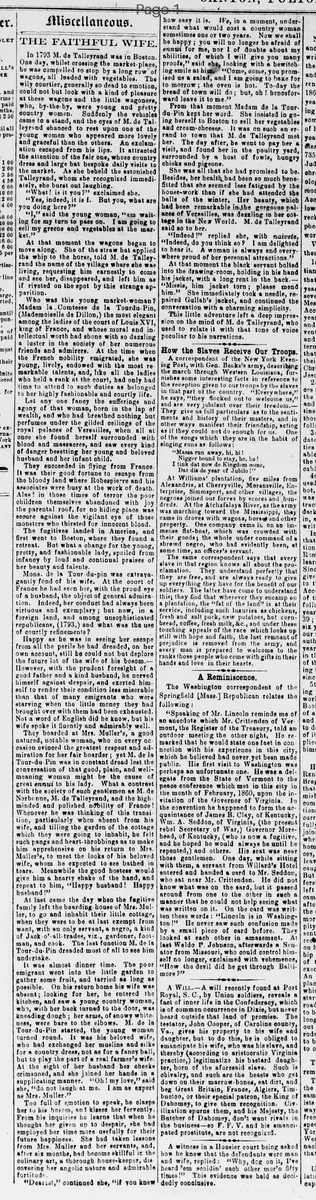
In 1793 M. de Talleyrand was in Boston. One day, while crossing the market-place, he was compelled to stop by a long row of wagons, all loaded with vegetables. The wily courtier, generally so dead to emotion, could not but look with a kind of pleasure at these wagons and the little wagoners, who, by-the-by, were young and pretty country women. Suddenly the vehicles came to a stand, and the eyes of M. de Talleyrand advanced to rest upon one of the young women who appeared more lovely and graceful than the others. An exclamation escaped from his lips. It attracted the attention of the fair one, whose country dress and large hat bespoke daily visits to the market. As she beheld the astonished Talleyrand, whom she recognized immediately, she burst out laughing.
"What! is it you?" exclaimed she.
"Yes, indeed, it is I. But you, what are you doing here?"
"I," said the young woman, "am waiting for my turn to pass on. I am going to sell my greens and vegetables at the market."
At that moment the wagons began to move along. She of the straw hat applied the whip to the horse, told M. de Talleyrand the name of the village where she was living, requesting him earnestly to come and see her, disappeared, and left him as if riveted on the spot by this strange apparition.
Who was this young market-woman? Madam la Comtesse de la Tourdu-Pin, (Mademoiselle de Dillon,) the most elegant among the ladies of the court of Louis XVI, king of France, and whose moral and intellectual worth had shone with so dazzling a luster in the society of her numerous friends and admirers. At the time when the French nobility emigrated, she was young, lively, endowed with the most remarkable talents, and, like all the ladies who held a rank at the court, had only had time to attend to such duties as belonged to her highly fashionable and courtly life.
Let any one fancy the sufferings and agony of that woman, born in the lap of wealth, and who had breathed nothing but perfumes under the gilded ceilings of the royal palaces of Versailles, when all at once she found herself surrounded with blood and massacres, and saw every kind of danger besetting her young and beloved husband and her infant child.
They succeeded in flying from France. It was their good fortune to escape from the bloody land where Robespierre and his associates were busy at the work of death. Alas! in those times of terror the poor children themselves abandoned with joy the parental roof, for no hiding place was secure against the vigilant eye of those monsters who thirsted for innocent blood.
The fugitives landed in America, and first went to Boston, where they found a retreat. But what a change for the young, pretty, and fashionable lady, spoiled from infancy by loud and continual praises of her beauty and talents.
Mons. de la Tour-du-Pin was extravagantly fond of his wife. At the court of France he had seen her, with the proud eye of a husband, the object of general admiration. Indeed, her conduct had always been virtuous and exemplary; but now, in a foreign land, and among unsophisticated republicans, (1793,) and what was the use of courtly refinements?
Happy as he was in seeing her escape from all the perils he had dreaded, on her own account, still he could not but deplore the future lot of the wife of his bosom. However, with the prudent foresight of a good father and a kind husband, he preserved himself against despair, and exerted himself to render their condition less miserable than that of many emigrants who were starving when the little money they had brought over with them had been exhausted.
Not a word of English did he know, but his wife spoke it fluently and admirably well. They boarded at Mrs. Muller's, a good natured, notable woman, who on every occasion evinced the greatest respect and admiration for her fair boarder; yet M. de la Tour-du-Pin was in constant dread lest the conversation of that good, plain, and well-meaning woman might be the cause of great ennui to his lady. What a contrast with the society of such gentlemen as M. de Norbonne, M. de Talleyrand, and the high-minded and polished nobility of France!
Whenever he was thinking of this transition, particularly when absent from his wife, and tilling the garden of the cottage which they were going to inhabit, he felt such pangs and heart-throbbings as to make him apprehensive on his return to Mrs. Muller's, to meet the looks of his beloved wife, whom he expected to see bathed in tears. Meanwhile the good hostess would give him a hearty shake of the hand, and repeat to him, "Happy husband! Happy husband!"
At last came the day when the fugitive family left the boarding-house of Mrs. Muller, to go and inhabit their little cottage, when they were to be at last exempt from want, with an only servant, a negro, a kind of Jack.o'-all-trades, viz., gardener, foot-man, and cook. The last function M. de la Tour-du-Pin dreaded most of all to see him undertake.
It was almost dinner time. The poor emigrant went into the little garden to gather some fruit, and tarried as long as possible. On his return home his wife was absent; looking for her, he entered the kitchen, and saw a young country woman, who, with her back turned to the door, was kneading dough; her arms, of snowy whiteness, were bare to the elbows. M. de la Tour-du-Pin started, the young woman turned round. It was his beloved wife, who had exchanged her muslins and silks for a country dress, not as for a fancy ball but to play the part of a real farmer's wife.
At the sight of her husband her cheeks crimsoned, and she joined her hands in a supplicating manner. "Oh! my love," said she, "do not laugh at me. I am as expert as Mrs. Muller."
Too full of emotion to speak, he clasped her to his bosom, and kisses her fervently.
From his inquiries he learned that when he thought her given up to despair, she had employed her time more usefully for their future happiness. She had taken lessons from Mrs. Muller and her servants, and after six months, had become skillful in the culinary art, a thorough house-keeper, discovering her angelic nature and admirable fortitude.
"Dearest," continued she, "if you knew how easy it is. We, in a moment, understand what would cost a country woman sometimes one or two years. Now we shall be happy; you will no longer be afraid of ennui for me, nor I of doubts about my abilities, of which I will give you many proofs," said she, looking with a bewitching smile at him. "Come, come, you promised us a salad, and I am going to bake for to-morrow; the oven is hot. To-day the bread of town will do; but, oh! henceforth leave it to me."
From that moment Madam de la Tour-du-Pin kept her word. She insisted in going herself to Boston to sell her vegetables and cream-cheeses. It was on such an errand to town that M. de Talleyrand met her. The day after, he went to pay her a visit, and found her in the poultry yard, surrounded by a host of fowls, hungry chicks and pigeons.
She was all that she had promised to be. Besides, her health had been so much benefited that she seemed less fatigued by the house-work than if she had attended the balls of the winter. Her beauty, which had been remarkable in the gorgeous palaces of Versailles, was dazzling in her cottage in the New World. M. de Talleyrand said so to her.
"Indeed!" replied she, with naivete, "Indeed, do you think so? I am delighted to hear it. A woman is always and everywhere proud of her personal attractions."
At that moment the black servant bolted into the drawing-room, holding in his hand his jacket, with a long rent in the back.
"Massa, him jacket torn; please mend him." She immediately took a needle, repaired Gullah's jacket, and continued the conversation with a charming simplicity.
This little adventure left a deep impression on the mind of M. de Talleyrand, who used to relate it with that tone of voice peculiar to his narrations.
THE FAITHFUL WIFE.
In 1793 M. de Talleyrand was in Boston. One day, while crossing the market-place, he was compelled to stop by a long row of wagons, all loaded with vegetables. The wily courtier, generally so dead to emotion, could not but look with a kind of pleasure at these wagons and the little wagoners, who, by-the-by, were young and pretty country women. Suddenly the vehicles came to a stand, and the eyes of M. de Talleyrand advanced to rest upon one of the young women who appeared more lovely and graceful than the others. An exclamation escaped from his lips. It attracted the attention of the fair one, whose country dress and large hat bespoke daily visits to the market. As she beheld the astonished Talleyrand, whom she recognized immediately, she burst out laughing.
"What! is it you?" exclaimed she.
"Yes, indeed, it is I. But you, what are you doing here?"
"I," said the young woman, "am waiting for my turn to pass on. I am going to sell my greens and vegetables at the market."
At that moment the wagons began to move along. She of the straw hat applied the whip to the horse, told M. de Talleyrand the name of the village where she was living, requesting him earnestly to come and see her, disappeared, and left him as if riveted on the spot by this strange apparition.
Who was this young market-woman? Madam la Comtesse de la Tourdu-Pin, (Mademoiselle de Dillon,) the most elegant among the ladies of the court of Louis XVI, king of France, and whose moral and intellectual worth had shone with so dazzling a luster in the society of her numerous friends and admirers. At the time when the French nobility emigrated, she was young, lively, endowed with the most remarkable talents, and, like all the ladies who held a rank at the court, had only had time to attend to such duties as belonged to her highly fashionable and courtly life.
Let any one fancy the sufferings and agony of that woman, born in the lap of wealth, and who had breathed nothing but perfumes under the gilded ceilings of the royal palaces of Versailles, when all at once she found herself surrounded with blood and massacres, and saw every kind of danger besetting her young and beloved husband and her infant child.
They succeeded in flying from France. It was their good fortune to escape from the bloody land where Robespierre and his associates were busy at the work of death. Alas! in those times of terror the poor children themselves abandoned with joy the parental roof, for no hiding place was secure against the vigilant eye of those monsters who thirsted for innocent blood.
The fugitives landed in America, and first went to Boston, where they found a retreat. But what a change for the young, pretty, and fashionable lady, spoiled from infancy by loud and continual praises of her beauty and talents.
Mons. de la Tour-du-Pin was extravagantly fond of his wife. At the court of France he had seen her, with the proud eye of a husband, the object of general admiration. Indeed, her conduct had always been virtuous and exemplary; but now, in a foreign land, and among unsophisticated republicans, (1793,) and what was the use of courtly refinements?
Happy as he was in seeing her escape from all the perils he had dreaded, on her own account, still he could not but deplore the future lot of the wife of his bosom. However, with the prudent foresight of a good father and a kind husband, he preserved himself against despair, and exerted himself to render their condition less miserable than that of many emigrants who were starving when the little money they had brought over with them had been exhausted.
Not a word of English did he know, but his wife spoke it fluently and admirably well. They boarded at Mrs. Muller's, a good natured, notable woman, who on every occasion evinced the greatest respect and admiration for her fair boarder; yet M. de la Tour-du-Pin was in constant dread lest the conversation of that good, plain, and well-meaning woman might be the cause of great ennui to his lady. What a contrast with the society of such gentlemen as M. de Norbonne, M. de Talleyrand, and the high-minded and polished nobility of France!
Whenever he was thinking of this transition, particularly when absent from his wife, and tilling the garden of the cottage which they were going to inhabit, he felt such pangs and heart-throbbings as to make him apprehensive on his return to Mrs. Muller's, to meet the looks of his beloved wife, whom he expected to see bathed in tears. Meanwhile the good hostess would give him a hearty shake of the hand, and repeat to him, "Happy husband! Happy husband!"
At last came the day when the fugitive family left the boarding-house of Mrs. Muller, to go and inhabit their little cottage, when they were to be at last exempt from want, with an only servant, a negro, a kind of Jack.o'-all-trades, viz., gardener, foot-man, and cook. The last function M. de la Tour-du-Pin dreaded most of all to see him undertake.
It was almost dinner time. The poor emigrant went into the little garden to gather some fruit, and tarried as long as possible. On his return home his wife was absent; looking for her, he entered the kitchen, and saw a young country woman, who, with her back turned to the door, was kneading dough; her arms, of snowy whiteness, were bare to the elbows. M. de la Tour-du-Pin started, the young woman turned round. It was his beloved wife, who had exchanged her muslins and silks for a country dress, not as for a fancy ball but to play the part of a real farmer's wife.
At the sight of her husband her cheeks crimsoned, and she joined her hands in a supplicating manner. "Oh! my love," said she, "do not laugh at me. I am as expert as Mrs. Muller."
Too full of emotion to speak, he clasped her to his bosom, and kisses her fervently.
From his inquiries he learned that when he thought her given up to despair, she had employed her time more usefully for their future happiness. She had taken lessons from Mrs. Muller and her servants, and after six months, had become skillful in the culinary art, a thorough house-keeper, discovering her angelic nature and admirable fortitude.
"Dearest," continued she, "if you knew how easy it is. We, in a moment, understand what would cost a country woman sometimes one or two years. Now we shall be happy; you will no longer be afraid of ennui for me, nor I of doubts about my abilities, of which I will give you many proofs," said she, looking with a bewitching smile at him. "Come, come, you promised us a salad, and I am going to bake for to-morrow; the oven is hot. To-day the bread of town will do; but, oh! henceforth leave it to me."
From that moment Madam de la Tour-du-Pin kept her word. She insisted in going herself to Boston to sell her vegetables and cream-cheeses. It was on such an errand to town that M. de Talleyrand met her. The day after, he went to pay her a visit, and found her in the poultry yard, surrounded by a host of fowls, hungry chicks and pigeons.
She was all that she had promised to be. Besides, her health had been so much benefited that she seemed less fatigued by the house-work than if she had attended the balls of the winter. Her beauty, which had been remarkable in the gorgeous palaces of Versailles, was dazzling in her cottage in the New World. M. de Talleyrand said so to her.
"Indeed!" replied she, with naivete, "Indeed, do you think so? I am delighted to hear it. A woman is always and everywhere proud of her personal attractions."
At that moment the black servant bolted into the drawing-room, holding in his hand his jacket, with a long rent in the back.
"Massa, him jacket torn; please mend him." She immediately took a needle, repaired Gullah's jacket, and continued the conversation with a charming simplicity.
This little adventure left a deep impression on the mind of M. de Talleyrand, who used to relate it with that tone of voice peculiar to his narrations.
What sub-type of article is it?
Biography
Personal Triumph
Historical Event
What themes does it cover?
Fortune Reversal
Survival
Moral Virtue
What keywords are associated?
French Emigration
Exile Adaptation
Talleyrand Encounter
Faithful Wife
Boston Market
Noblewoman Labor
What entities or persons were involved?
M. De Talleyrand
Madam La Comtesse De La Tourdu Pin
M. De La Tour Du Pin
Mrs. Muller
Where did it happen?
Boston, America
Story Details
Key Persons
M. De Talleyrand
Madam La Comtesse De La Tourdu Pin
M. De La Tour Du Pin
Mrs. Muller
Location
Boston, America
Event Date
1793
Story Details
Exiled French noblewoman Comtesse de la Tourdu-Pin flees the Revolution with her family to Boston in 1793, adapting from courtly luxury to rural labor as a market seller and homemaker, impressing Talleyrand with her resilience and virtue.