Thank you for visiting SNEWPapers!
Sign up free
The Republic
Washington, District Of Columbia
What is this article about?
Governor Crittenden's message to Kentucky's Legislature affirms strong Union loyalty, critiques agitators against President Taylor, and stresses the Union's vital role for state prosperity and national unity amid congressional tensions.
Clipping
OCR Quality
Full Text
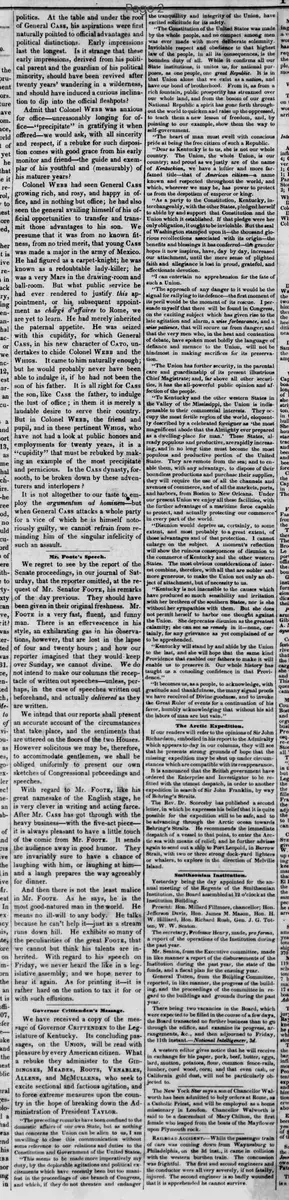
We have received a copy of the message of Governor Crittenden to the Legislature of Kentucky. Its concluding passages, on the Union, will be read with pleasure by every American citizen. What a rebuke they administer to the Giddingses, Meades, Roots, Vennables, Allens, and McMullens, who seek to excite sectional and factious agitation, and to force extreme measures upon the country in the hope of breaking down the Administration of President Taylor.
"The preceding remarks have been confined to the domestic affairs of our own State, but as nothing that concerns the Union can be alien to us, I am unwilling to close this communication without some reference to our relations and duties to the Constitution and Government of the United States.
"This seems to be made more imperatively my duty, by the deplorable agitations and political excitements which have recently been but too manifest in the proceedings of one branch of Congress, and which, if they do not threaten and endanger the tranquillity and integrity of the Union, have excited solicitude for its safety.
"The Constitution of the United States was made by the whole people, and no compact among men was ever made with more deliberate solemnity. Inviolable respect and obedience to that highest law of the people, in all its consequences, is the bounden duty of all. While it confirms all our State institutions, it unites us, for national purposes, as one people, one great Republic. It is in that Union alone that we exist as a nation, and have our bond of brotherhood. From it, as from a rich fountain, public prosperity has streamed over our whole land, and from the bosom of our great National Republic a spirit has gone forth throughout the world to quicken and raise up the oppressed, to teach them a new lesson of freedom, and, by pointing to our example, show them the way to self-government.
"The heart of man must swell with conscious pride at being the free citizen of such a Republic.
"Dear as Kentucky is to us, she is not our whole country. The Union, the whole Union, is our country; and proud as we justly are of the name of Kentuckian, we have a loftier and more far-famed title—that of American citizen—a name known and respected throughout the world; and which, wherever we may be, has power to protect us from the despotism of emperor or king.
"As a party to the Constitution, Kentucky, interchangeably, with the other States, pledged herself to abide by and support that Constitution and the Union which it established. If that pledge were her only obligation, it ought to be inviolable. But the seal of Washington stamped upon it—the thousand glorious recollections associated with its origin—the benefits and blessings it has conferred—the grander hopes it now inspires, have, day by day, increased our attachment, until the mere sense of plighted faith and allegiance is lost in proud, grateful, and affectionate devotion.
"I can entertain no apprehension for the fate of such a Union.
"The approach of any danger to it would be the signal for rallying to its defence—the first moment of its peril would be the moment of its rescue. I persuade myself that there will be found in Congress, on the exciting subject which has given rise to the late agitation and alarm, a wise forbearance, and a wise patience, that will secure us from danger; and that the very men who, in the heat and contention of debate, have spoken most boldly the language of defiance and menace to the Union, will not be hindmost in making sacrifices for its preservation.
"The Union has further security, in the parental care and guardianship of its present illustrious Chief Magistrate; and, far above all other securities, it has the all-powerful public opinion and affection of the people.
"To Kentucky and the other western States in the Valley of the Mississippi, the Union is indispensable to their commercial interests. They occupy the most fertile region of the world, eloquently described by a celebrated foreigner as 'the most magnificent abode that the Almighty ever prepared as a dwelling-place for man.' These States, already populous and productive, are rapidly increasing, and in no long time must become the most populous and productive portion of the United States. They are remote from the sea; and to enable them, with any advantage, to dispose of their boundless productions and purchase their supplies, they will require the use of all the channels and avenues of commerce, and of all the markets, ports, and harbors, from Boston to New Orleans. Under our present Union we enjoy all these facilities, with the further advantage of a maritime force capable to protect, and actually protecting our commerce in every part of the world.
"Disunion would deprive us, certainly, to some extent, and most probably to a great extent, of those advantages and of that protection. I cannot enlarge on the subject. A moment's reflection will show the ruinous consequences of disunion to the commerce of Kentucky and the other western States. The most obvious considerations of interest combine, therefore, with all that are nobler and more generous, to make the Union not only an object of attachment, but of necessity to us.
"Kentucky is not insensible to the causes which have produced so much sensibility and irritation with her brethren of the southern States, nor is she without her sympathies with them. But she does not permit herself to harbor one thought against the Union. She deprecates disunion as the greatest calamity; she can see no remedy in it—none, certainly, for any grievance as yet complained of or to be apprehended.
"Kentucky will stand by and abide by the Union to the last, and she will hope that the same kind Providence that enabled our fathers to make it will enable us to preserve it. Our whole history has taught us a consoling confidence in that Providence."
"It becomes us, as a people, to acknowledge, with gratitude and thankfulness, the many signal proofs we have received of Divine goodness, and to invoke the Great Ruler of events for a continuation of his favor, humbly acknowledging that without his aid the labors of man are but vain."
What sub-type of article is it?
What keywords are associated?
What entities or persons were involved?
Where did it happen?
Domestic News Details
Primary Location
Kentucky
Key Persons
Event Details
Governor Crittenden delivered a message to the Kentucky Legislature focusing on domestic state affairs before addressing the importance of the Union. He rebuked sectional agitators like Giddings, Meade, Root, Venable, Allen, and McMullen for seeking to undermine President Taylor's administration. Crittenden expressed confidence in the Union's durability, praised the Constitution, highlighted its benefits to Kentucky and western states, sympathized with southern grievances but rejected disunion, and invoked divine providence for its preservation.