Thank you for visiting SNEWPapers!
Sign up free
New York Dispatch
New York, New York County, New York
What is this article about?
Debate on Catholic Church's historical opposition to secret societies like Freemasonry, arguing monks unlikely to practice Masonic rites due to public doctrine, countered by view that early clergy were Masons and opposition stems from promoting education and free thought over church dogma.
Clipping
OCR Quality
Full Text
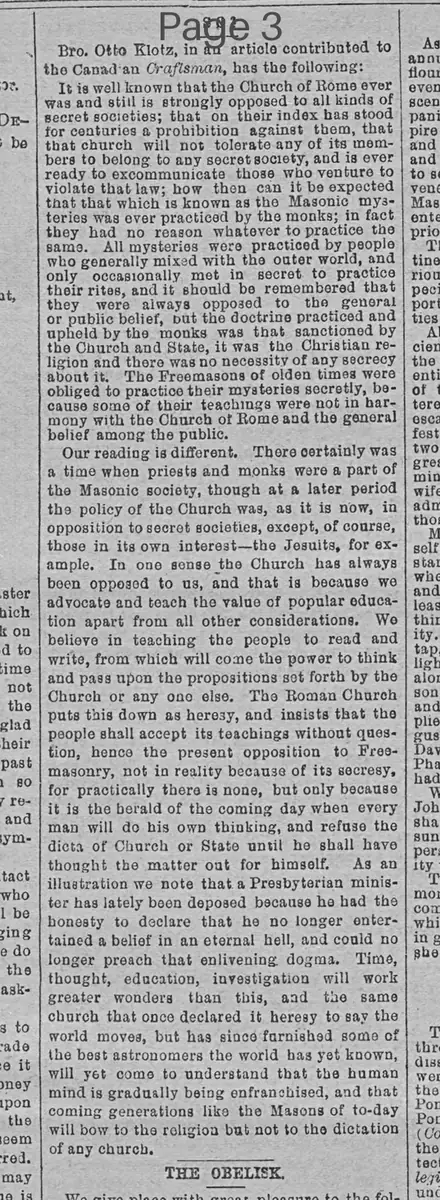
It is well known that the Church of Rome ever was and still is strongly opposed to all kinds of secret societies; that on their index has stood for centuries a prohibition against them, that that church will not tolerate any of its members to belong to any secret society, and is ever ready to excommunicate those who venture to violate that law; how then can it be expected that that which is known as the Masonic mysteries was ever practiced by the monks; in fact they had no reason whatever to practice the same. All mysteries were practiced by people who generally mixed with the outer world, and only occasionally met in secret to practice their rites, and it should be remembered that they were always opposed to the general or public belief, but the doctrine practiced and upheld by the monks was that sanctioned by the Church and State, it was the Christian religion and there was no necessity of any secrecy about it. The Freemasons of olden times were obliged to practice their mysteries secretly, because some of their teachings were not in harmony with the Church of Rome and the general belief among the public.
Our reading is different. There certainly was a time when priests and monks were a part of the Masonic society, though at a later period the policy of the Church was, as it is now, in opposition to secret societies, except, of course, those in its own interest-the Jesuits, for example. In one sense the Church has always been opposed to us, and that is because we advocate and teach the value of popular education apart from all other considerations. We believe in teaching the people to read and write, from which will come the power to think and pass upon the propositions set forth by the Church or any one else. The Roman Church puts this down as heresy, and insists that the people shall accept its teachings without question, hence the present opposition to Freemasonry, not in reality because of its secrecy, for practically there is none, but only because it is the herald of the coming day when every man will do his own thinking, and refuse the dicta of Church or State until he shall have thought the matter out for himself. As an illustration we note that a Presbyterian minister has lately been deposed because he had the honesty to declare that he no longer entertained a belief in an eternal hell, and could no longer preach that enlivening dogma. Time, thought, education, investigation will work greater wonders than this, and the same church that once declared it heresy to say the world moves, but has since furnished some of the best astronomers the world has yet known, will yet come to understand that the human mind is gradually being enfranchised, and that coming generations like the Masons of to-day will bow to the religion but not to the dictation of any church.
What sub-type of article is it?
What themes does it cover?
What keywords are associated?
What entities or persons were involved?
Story Details
Key Persons
Story Details
Otto Klotz argues the Catholic Church opposes secret societies, making it unlikely monks practiced Masonic mysteries, as their doctrine was public Christian religion. The response counters that early priests and monks were Masons, but the Church later opposed them due to advocacy for popular education and independent thinking, seen as heresy; illustrates with a deposed Presbyterian minister for rejecting eternal hell belief.