Thank you for visiting SNEWPapers!
Sign up free
Literary
December 16, 1785
Fowle's New Hampshire Gazette And General Advertiser
Portsmouth, Rockingham County, New Hampshire
What is this article about?
Mr. Varlo recounts 1764 experiments testing wheat sowing densities, observing that thinner sowing (10 lbs/acre) produced better stooling roots with 20-30 ears, higher yields (up to 1500-fold in good soil), and convinced skeptics, despite sabotage and late harvest. Compares soil types, varieties, and barley trials.
Clipping
OCR Quality
95%
Excellent
Full Text
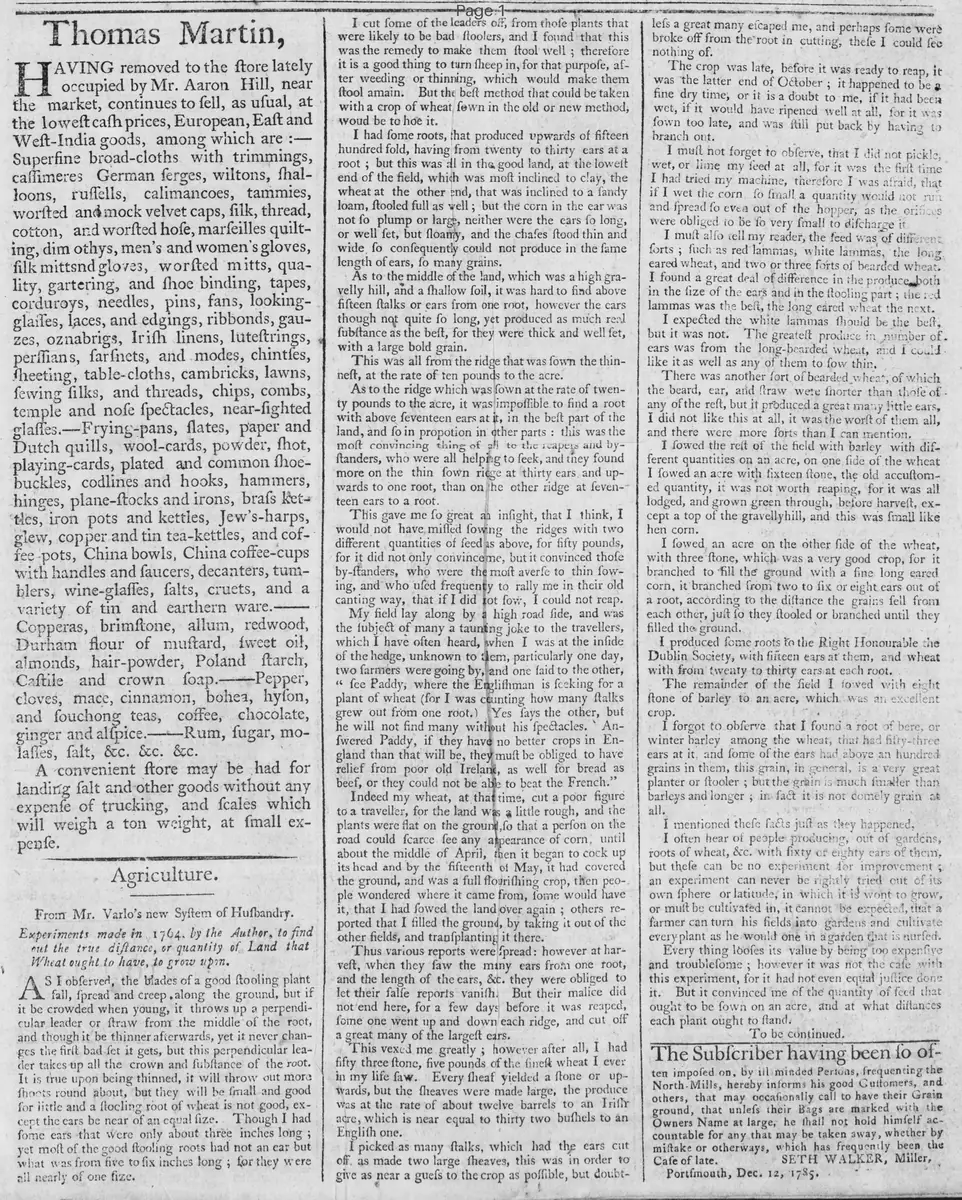
Agriculture.
From Mr. Varlo's new System of Husbandry.
Experiments made in 1764. by the Author, to find
out the true distance, or quantity of Land that
Wheat ought to have, to grow upon.
I observed. the blades of a good stooling plant
fall, spread and creep along the ground, but if
it be crowded when young, it throws up a perpendi-
cular leader or straw from the middle of the root,
and though it be thinner afterwards, yet it never chan-
ges the first bad set it gets, but this perpendicular lea-
der takes up all the crown and substance of the root.
It is true upon being thinned, it will throw out more
shoots round about, but they will be small and good
for little and a stooling root of wheat is not good, ex-
cept the ears be near of an equal size. Though I had
some ears that were only about three inches long ;
yet most of the good stooling roots had not an ear but
what was from five to six inches long ; for they were
all nearly of one size.
I cut some of the leaders off, from those plants that
were likely to be bad stoolers, and I found that this
was the remedy to make them stool well : therefore
it is a good thing to turn sheep in, for that purpose, af-
ter weeding or thinning, which would make them
stool amain. But the best method that could be taken
with a crop of wheat sown in the old or new method,
would be to hoe it.
I had some roots, that produced upwards of fifteen
hundred fold, having from twenty to thirty ears at a
root ; but this was all in the good land. at the lowest
end of the field, which was most inclined to clay, the
wheat at the other end, that was inclined to a sandy
loam. stooled full as well ; but the corn in the ear was
not so plump or large, neither were the ears so long,
or well set, but floamy, and the chaff stood thin and
wide so consequently could not produce in the same
length of ears, so many grains.
As to the middle of the land, which was a high gra-
velly hill, and a shallow soil, it was hard to find above
fifteen stalks or ears from one root, however the ears
though not quite so long, yet produced as much real
substance as the best, for they were thick and well set,
with a large bold grain.
This was all from the ridge that was sown the thin-
net, at the rate of ten pounds to the acre.
As to the ridge which was sown at the rate of twen-
ty pounds to the acre, it was impossible to find a root
with above seventeen ears at it. in the best part of the
land, and so in proportion in other parts : this was the
most convincing thing of all to the reapers and by-
standers, who were all helping to seek, and they found
more on the thin sown ridge at thirty ears and up-
wards to one root, than on the other ridge at seven-
teen ears to a root.
This gave me so great an insight, that I think, I
would not have missed sowing the ridges with two
different quantities of seed as above, for fifty pounds,
for it did not only convince me. but it convinced those
by-standers, who were the most averse to thin sow-
ing, and who used frequently to rally me in their old
canting way, that if I did not sow, I could not reap.
My field lay along by a high road side, and was
the subject of many a taunting joke to the travellers,
which I have often heard, when I was at the inside
of the hedge, unknown to them, particularly one day,
two farmers were going by, and one said to the other,
"see Paddy, where the Englishman is seeking for a
plant of wheat (for I was counting how many stalks
grew out from one root.) Yes says the other, but
he will not find many without his spectacles. An-
swered Paddy, if they have no better crops in En-
gland than that will be, they must be obliged to have
relief from poor old Ireland. as well for bread as
beef, or they could not be able to beat the French."
Indeed my wheat, at that time, cut a poor figure
to a traveller, for the land was a little rough, and the
plants were flat on the ground,so that a person on the
road could scarce see any appearance of corn. until
about the middle of April, then it began to cock up
its head and by the fifteenth of May, it had covered
the ground, and was a full flourishing crop, then peo-
ple wondered where it came from. some would have
it, that I had sowed the land over again : others re-
ported that I filled the ground, by taking it out of the
other fields, and transplanting it there.
Thus various reports were spread: however at har-
vest, when they saw the many ears from one root,
and the length of the ears, &c. they were obliged to
let their false reports vanish. But their malice did
not end here, for a few days before it was reaped,
some one went up and down each ridge, and cut off
a great many of the largest ears.
This vexed me greatly : however after all, I had
fifty three stone, five pounds of the finest wheat I ever
in my life saw. Every sheaf yielded a stone or up-
wards, but the sheaves were made large, the produce
was at the rate of about twelve barrels to an Irish
acre, which is near equal to thirty two bushels to an
English one.
I picked as many stalks. which had the ears cut
off, as made two large sheaves, this was in order to
less a great many escaped me, and perhaps some were
broke off from the root in cutting, these I could see
nothing of.
The crop was late, before it was ready to reap, it
was the latter end of October ; it happened to be a
fine dry time, or it is a doubt to me, if it had been
wet, if it would have ripened well at all, for it was
sown too late, and was still put back by having to
branch out.
I must not forget to observe, that I did not pickle,
wet, or lime my seed at all, for it was the first time
I had tried my machine, therefore I was afraid, that
if I wet the corn so small a quantity would not run
and spread so even out of the hopper, as the orifices
were obliged to be so very small to discharge it
I must also tell my reader, the seed was of different
sorts ; such as red lammas, white lammas, the long.
eared wheat, and two or three sorts of bearded wheat.
I found a great deal of difference in the produce both
in the size of the ears and in the stooling part ; the red
lammas was the best, the long eared wheat the next.
I expected the white lammas should be the best,
but it was not. The greatest produce in number of.
ears was from the long-bearded wheat, and I could
like it as well as any of them to sow thin.
There was another sort of bearded wheat, of which
the beard, ear, and straw were shorter than those of.
any of the rest, but it produced a great many little ears,
I did not like this at all, it was the worst of them all,
and there were more sorts than I can mention.
I sowed the rest of the field with barley with dif-
ferent quantities on an acre, on one side of the wheat
I sowed an acre with sixteen stone, the old accust-
omed quantity, it was not worth reaping, for it was all
lodged, and grown green through, before harvest, ex-
cept a top of the gravelly hill, and this was small like
hen corn.
I sowed an acre on the other side of the wheat,
with three stone, which was a very good crop, for it
branched to fill the ground with a fine long eared
corn, it branched from two to six or eight ears out of
a root, according to the distance the grains fell from
each other, just so they stooled or branched until they
filled the ground.
I produced some roots to the Right Honourable the
Dublin Society, with fifteen ears at them, and wheat
with from twenty to thirty ears at each root.
The remainder of the field I sowed with eight
stone of barley to an acre, which was an excellent
crop.
I forgot to observe that I found a root of bere, or
winter barley among the wheat, that had fifty-three
ears at it. and some of the ears had above an hundred
grains in them, this grain, in general, is a very great
planter or stooler ; but the grain is much smaller than
barleys and longer ; in fact it is not comely grain at
all.
I mentioned these facts just as they happened,
I often hear of people producing, out of gardens,
roots of wheat, &c. with sixty of eighty ears of them,
but these can be no experiment for improvement ;
an experiment can never be rightly tried out of its
own sphere or latitude, in which it is wont to grow,
or must be cultivated in, it cannot be expected, that a
farmer can turn his fields into gardens and cultivate
every plant as he would one in a garden that is nursed.
Every thing looses its value by being too expensive
and troublesome ; however it was not the case with
this experiment, for it had not even equal justice done
it. But it convinced me of the quantity of seed that
ought to be sown on an acre, and at what distances
each plant ought to stand.
To be continued.
From Mr. Varlo's new System of Husbandry.
Experiments made in 1764. by the Author, to find
out the true distance, or quantity of Land that
Wheat ought to have, to grow upon.
I observed. the blades of a good stooling plant
fall, spread and creep along the ground, but if
it be crowded when young, it throws up a perpendi-
cular leader or straw from the middle of the root,
and though it be thinner afterwards, yet it never chan-
ges the first bad set it gets, but this perpendicular lea-
der takes up all the crown and substance of the root.
It is true upon being thinned, it will throw out more
shoots round about, but they will be small and good
for little and a stooling root of wheat is not good, ex-
cept the ears be near of an equal size. Though I had
some ears that were only about three inches long ;
yet most of the good stooling roots had not an ear but
what was from five to six inches long ; for they were
all nearly of one size.
I cut some of the leaders off, from those plants that
were likely to be bad stoolers, and I found that this
was the remedy to make them stool well : therefore
it is a good thing to turn sheep in, for that purpose, af-
ter weeding or thinning, which would make them
stool amain. But the best method that could be taken
with a crop of wheat sown in the old or new method,
would be to hoe it.
I had some roots, that produced upwards of fifteen
hundred fold, having from twenty to thirty ears at a
root ; but this was all in the good land. at the lowest
end of the field, which was most inclined to clay, the
wheat at the other end, that was inclined to a sandy
loam. stooled full as well ; but the corn in the ear was
not so plump or large, neither were the ears so long,
or well set, but floamy, and the chaff stood thin and
wide so consequently could not produce in the same
length of ears, so many grains.
As to the middle of the land, which was a high gra-
velly hill, and a shallow soil, it was hard to find above
fifteen stalks or ears from one root, however the ears
though not quite so long, yet produced as much real
substance as the best, for they were thick and well set,
with a large bold grain.
This was all from the ridge that was sown the thin-
net, at the rate of ten pounds to the acre.
As to the ridge which was sown at the rate of twen-
ty pounds to the acre, it was impossible to find a root
with above seventeen ears at it. in the best part of the
land, and so in proportion in other parts : this was the
most convincing thing of all to the reapers and by-
standers, who were all helping to seek, and they found
more on the thin sown ridge at thirty ears and up-
wards to one root, than on the other ridge at seven-
teen ears to a root.
This gave me so great an insight, that I think, I
would not have missed sowing the ridges with two
different quantities of seed as above, for fifty pounds,
for it did not only convince me. but it convinced those
by-standers, who were the most averse to thin sow-
ing, and who used frequently to rally me in their old
canting way, that if I did not sow, I could not reap.
My field lay along by a high road side, and was
the subject of many a taunting joke to the travellers,
which I have often heard, when I was at the inside
of the hedge, unknown to them, particularly one day,
two farmers were going by, and one said to the other,
"see Paddy, where the Englishman is seeking for a
plant of wheat (for I was counting how many stalks
grew out from one root.) Yes says the other, but
he will not find many without his spectacles. An-
swered Paddy, if they have no better crops in En-
gland than that will be, they must be obliged to have
relief from poor old Ireland. as well for bread as
beef, or they could not be able to beat the French."
Indeed my wheat, at that time, cut a poor figure
to a traveller, for the land was a little rough, and the
plants were flat on the ground,so that a person on the
road could scarce see any appearance of corn. until
about the middle of April, then it began to cock up
its head and by the fifteenth of May, it had covered
the ground, and was a full flourishing crop, then peo-
ple wondered where it came from. some would have
it, that I had sowed the land over again : others re-
ported that I filled the ground, by taking it out of the
other fields, and transplanting it there.
Thus various reports were spread: however at har-
vest, when they saw the many ears from one root,
and the length of the ears, &c. they were obliged to
let their false reports vanish. But their malice did
not end here, for a few days before it was reaped,
some one went up and down each ridge, and cut off
a great many of the largest ears.
This vexed me greatly : however after all, I had
fifty three stone, five pounds of the finest wheat I ever
in my life saw. Every sheaf yielded a stone or up-
wards, but the sheaves were made large, the produce
was at the rate of about twelve barrels to an Irish
acre, which is near equal to thirty two bushels to an
English one.
I picked as many stalks. which had the ears cut
off, as made two large sheaves, this was in order to
less a great many escaped me, and perhaps some were
broke off from the root in cutting, these I could see
nothing of.
The crop was late, before it was ready to reap, it
was the latter end of October ; it happened to be a
fine dry time, or it is a doubt to me, if it had been
wet, if it would have ripened well at all, for it was
sown too late, and was still put back by having to
branch out.
I must not forget to observe, that I did not pickle,
wet, or lime my seed at all, for it was the first time
I had tried my machine, therefore I was afraid, that
if I wet the corn so small a quantity would not run
and spread so even out of the hopper, as the orifices
were obliged to be so very small to discharge it
I must also tell my reader, the seed was of different
sorts ; such as red lammas, white lammas, the long.
eared wheat, and two or three sorts of bearded wheat.
I found a great deal of difference in the produce both
in the size of the ears and in the stooling part ; the red
lammas was the best, the long eared wheat the next.
I expected the white lammas should be the best,
but it was not. The greatest produce in number of.
ears was from the long-bearded wheat, and I could
like it as well as any of them to sow thin.
There was another sort of bearded wheat, of which
the beard, ear, and straw were shorter than those of.
any of the rest, but it produced a great many little ears,
I did not like this at all, it was the worst of them all,
and there were more sorts than I can mention.
I sowed the rest of the field with barley with dif-
ferent quantities on an acre, on one side of the wheat
I sowed an acre with sixteen stone, the old accust-
omed quantity, it was not worth reaping, for it was all
lodged, and grown green through, before harvest, ex-
cept a top of the gravelly hill, and this was small like
hen corn.
I sowed an acre on the other side of the wheat,
with three stone, which was a very good crop, for it
branched to fill the ground with a fine long eared
corn, it branched from two to six or eight ears out of
a root, according to the distance the grains fell from
each other, just so they stooled or branched until they
filled the ground.
I produced some roots to the Right Honourable the
Dublin Society, with fifteen ears at them, and wheat
with from twenty to thirty ears at each root.
The remainder of the field I sowed with eight
stone of barley to an acre, which was an excellent
crop.
I forgot to observe that I found a root of bere, or
winter barley among the wheat, that had fifty-three
ears at it. and some of the ears had above an hundred
grains in them, this grain, in general, is a very great
planter or stooler ; but the grain is much smaller than
barleys and longer ; in fact it is not comely grain at
all.
I mentioned these facts just as they happened,
I often hear of people producing, out of gardens,
roots of wheat, &c. with sixty of eighty ears of them,
but these can be no experiment for improvement ;
an experiment can never be rightly tried out of its
own sphere or latitude, in which it is wont to grow,
or must be cultivated in, it cannot be expected, that a
farmer can turn his fields into gardens and cultivate
every plant as he would one in a garden that is nursed.
Every thing looses its value by being too expensive
and troublesome ; however it was not the case with
this experiment, for it had not even equal justice done
it. But it convinced me of the quantity of seed that
ought to be sown on an acre, and at what distances
each plant ought to stand.
To be continued.
What sub-type of article is it?
Essay
What themes does it cover?
Agriculture Rural
What keywords are associated?
Wheat Experiments
Thin Sowing
Stooling Roots
Agricultural Husbandry
1764 Trials
Barley Cultivation
Soil Variations
What entities or persons were involved?
Mr. Varlo
Literary Details
Title
Experiments Made In 1764. By The Author, To Find Out The True Distance, Or Quantity Of Land That Wheat Ought To Have, To Grow Upon.
Author
Mr. Varlo
Subject
On Wheat Sowing Experiments And Optimal Density
Key Lines
I Had Some Roots, That Produced Upwards Of Fifteen Hundred Fold, Having From Twenty To Thirty Ears At A Root ; But This Was All In The Good Land.
This Gave Me So Great An Insight, That I Think, I Would Not Have Missed Sowing The Ridges With Two Different Quantities Of Seed As Above, For Fifty Pounds,