Thank you for visiting SNEWPapers!
Sign up free
Story
February 9, 1888
The Cheyenne Daily Leader
Cheyenne, Laramie County, Wyoming
What is this article about?
Account of 'ravageurs,' Parisian scavengers who collect floating debris and dead animals from the Seine River using skiffs and harpoons, selling parts for leather, fat, soap, candles, and maggots to fishermen.
Clipping
OCR Quality
98%
Excellent
Full Text
"Ravageurs" of the Seine.
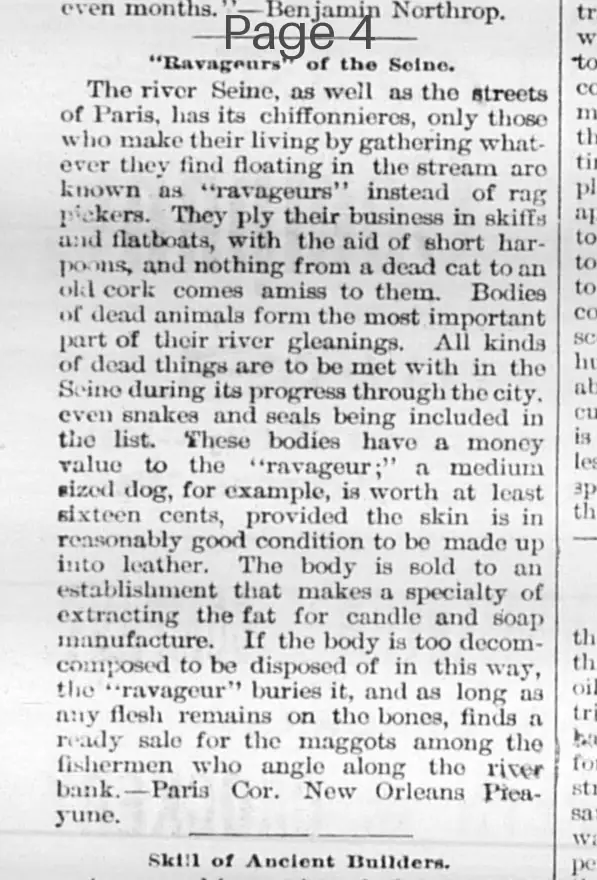
The river Seine, as well as the streets of Paris, has its chiffonnières, only those who make their living by gathering whatever they find floating in the stream are known as "ravageurs" instead of rag pickers. They ply their business in skiffs and flatboats, with the aid of short harpoons, and nothing from a dead cat to an old cork comes amiss to them. Bodies of dead animals form the most important part of their river gleanings. All kinds of dead things are to be met with in the Seine during its progress through the city, even snakes and seals being included in the list. These bodies have a money value to the "ravageur;" a medium sized dog, for example, is worth at least sixteen cents, provided the skin is in reasonably good condition to be made up into leather. The body is sold to an establishment that makes a specialty of extracting the fat for candle and soap manufacture. If the body is too decomposed to be disposed of in this way, the "ravageur" buries it, and as long as any flesh remains on the bones, finds a ready sale for the maggots among the fishermen who angle along the river bank.—Paris Cor. New Orleans Picayune.
The river Seine, as well as the streets of Paris, has its chiffonnières, only those who make their living by gathering whatever they find floating in the stream are known as "ravageurs" instead of rag pickers. They ply their business in skiffs and flatboats, with the aid of short harpoons, and nothing from a dead cat to an old cork comes amiss to them. Bodies of dead animals form the most important part of their river gleanings. All kinds of dead things are to be met with in the Seine during its progress through the city, even snakes and seals being included in the list. These bodies have a money value to the "ravageur;" a medium sized dog, for example, is worth at least sixteen cents, provided the skin is in reasonably good condition to be made up into leather. The body is sold to an establishment that makes a specialty of extracting the fat for candle and soap manufacture. If the body is too decomposed to be disposed of in this way, the "ravageur" buries it, and as long as any flesh remains on the bones, finds a ready sale for the maggots among the fishermen who angle along the river bank.—Paris Cor. New Orleans Picayune.
What sub-type of article is it?
Curiosity
What themes does it cover?
Misfortune
Survival
What keywords are associated?
Ravageurs
Seine River
Scavengers
Dead Animals
Paris
Chiffonnières
Harpoons
What entities or persons were involved?
Ravageurs
Where did it happen?
Seine River, Paris
Story Details
Key Persons
Ravageurs
Location
Seine River, Paris
Story Details
Ravageurs collect floating debris and dead animals from the Seine using skiffs, flatboats, and harpoons. They sell animal skins for leather, bodies for fat used in candles and soap, and maggots from decomposed remains to fishermen.