Thank you for visiting SNEWPapers!
Sign up free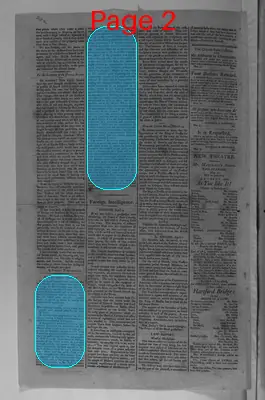
Editorial
May 30, 1794
Gazette Of The United States & Evening Advertiser
Philadelphia, Philadelphia County, Pennsylvania
What is this article about?
Editorial announces James Monroe's nomination as U.S. minister to France, succeeding Gouverneur Morris. Commentary criticizes Democratic party's hypocrisy in opposing John Jay's appointment on constitutional grounds while praising Monroe's, attributing it to partisan motives rather than principle.
Clipping
OCR Quality
95%
Excellent
Full Text
From the General Advertiser.
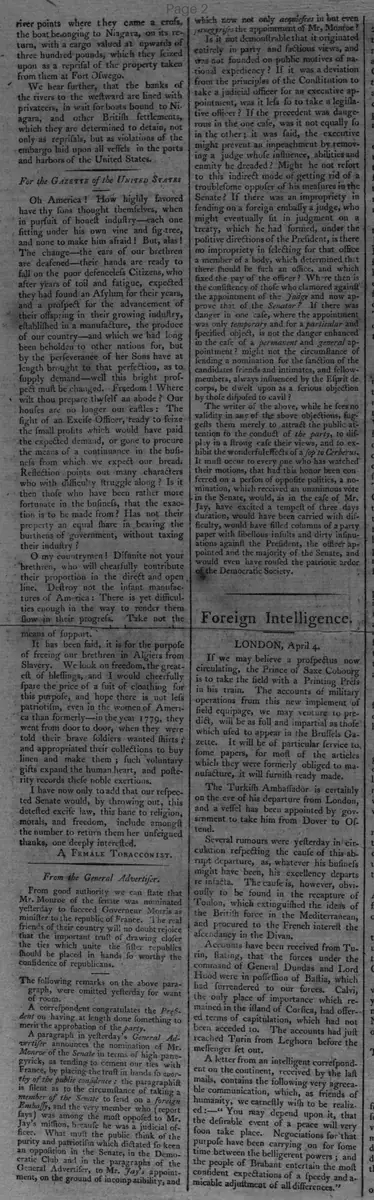
From good authority we can state that Mr. Monroe of the Senate was nominated yesterday to succeed Gouverneur Morris as minister to the republic of France. The real friends of their country will no doubt rejoice that the important trust of drawing closer the ties which unite the sister republics should be placed in hands so worthy the confidence of republicans.
The following remarks on the above paragraph, were omitted yesterday for want of room.
A correspondent congratulates the President on having at length done something to merit the approbation of the party.
A paragraph in yesterday's General Advertiser announces the nomination of Mr. Monroe of the Senate in terms of high panegyric, as tending to cement our ties with France, by placing the trust in hands so worthy of the public confidence: the paragraphist is silent as to the circumstance of taking a member of the Senate to send on a foreign Embassy, and the very member who (report says) was among the most opposed to Mr. Jay's mission, because he was a judicial officer. What must the public think of the purity and patriotism which dictated so keen an opposition in the Senate, in the Democratic Club and in the paragraphs of the General Advertiser, to Mr. Jay's appointment, on the ground of incompatibility, and which not only acquiesces in but even eulogizes the appointment of Mr. Monroe?
Is it not demonstrable that it originated entirely in party and factious views, and was not founded on public motives of national expediency? If it was a deviation from the principles of the Constitution to take a judicial officer for an executive appointment, was it less so to take a legislative officer? If the precedent was dangerous in the one case, was it not equally so in the other; it was said, the executive might prevent an impeachment by removing a judge whose influence, abilities and enmity he dreaded? Might he not resort to this indirect mode of getting rid of a troublesome opposer of his measures in the Senate? If there was an impropriety in sending on a foreign embassy a judge, who might eventually sit in judgment on a treaty, which he had formed, under the positive directions of the President, is there no impropriety in selecting for that office a member of a body, which determined that there should be such an office, and which fixed the pay of the officer? Where then is the consistency of those who clamored against the appointment of the Judge and now approve that of the Senator? If there was danger in one case, where the appointment was only temporary and for a particular and specified object, is not the danger enhanced in the case of a permanent and general appointment? might not the circumstance of sending a nomination for the sanction of the candidate's friends and intimates, and fellow-members, always influenced by the Esprit de corps, be dwelt upon as a serious objection by those disposed to cavil?
The writer of the above, while he sees no validity in any of the above objections, suggests them merely to attract the public attention to the conduct of the party, to display in a strong case their views, and to exhibit the wonderful effects of a sop to Cerberus.
It must occur to every one who has watched their motions, that had this honor been conferred on a person of opposite politics, a nomination, which received an unanimous vote in the Senate, would, as in the case of Mr. Jay, have excited a tempest of three days duration, would have been carried with difficulty, would have filled columns of a party paper with libellous insults and dirty insinuations against the President, the officer appointed and the majority of the Senate, and would even have roused the patriotic ardor of the Democratic Society.
From good authority we can state that Mr. Monroe of the Senate was nominated yesterday to succeed Gouverneur Morris as minister to the republic of France. The real friends of their country will no doubt rejoice that the important trust of drawing closer the ties which unite the sister republics should be placed in hands so worthy the confidence of republicans.
The following remarks on the above paragraph, were omitted yesterday for want of room.
A correspondent congratulates the President on having at length done something to merit the approbation of the party.
A paragraph in yesterday's General Advertiser announces the nomination of Mr. Monroe of the Senate in terms of high panegyric, as tending to cement our ties with France, by placing the trust in hands so worthy of the public confidence: the paragraphist is silent as to the circumstance of taking a member of the Senate to send on a foreign Embassy, and the very member who (report says) was among the most opposed to Mr. Jay's mission, because he was a judicial officer. What must the public think of the purity and patriotism which dictated so keen an opposition in the Senate, in the Democratic Club and in the paragraphs of the General Advertiser, to Mr. Jay's appointment, on the ground of incompatibility, and which not only acquiesces in but even eulogizes the appointment of Mr. Monroe?
Is it not demonstrable that it originated entirely in party and factious views, and was not founded on public motives of national expediency? If it was a deviation from the principles of the Constitution to take a judicial officer for an executive appointment, was it less so to take a legislative officer? If the precedent was dangerous in the one case, was it not equally so in the other; it was said, the executive might prevent an impeachment by removing a judge whose influence, abilities and enmity he dreaded? Might he not resort to this indirect mode of getting rid of a troublesome opposer of his measures in the Senate? If there was an impropriety in sending on a foreign embassy a judge, who might eventually sit in judgment on a treaty, which he had formed, under the positive directions of the President, is there no impropriety in selecting for that office a member of a body, which determined that there should be such an office, and which fixed the pay of the officer? Where then is the consistency of those who clamored against the appointment of the Judge and now approve that of the Senator? If there was danger in one case, where the appointment was only temporary and for a particular and specified object, is not the danger enhanced in the case of a permanent and general appointment? might not the circumstance of sending a nomination for the sanction of the candidate's friends and intimates, and fellow-members, always influenced by the Esprit de corps, be dwelt upon as a serious objection by those disposed to cavil?
The writer of the above, while he sees no validity in any of the above objections, suggests them merely to attract the public attention to the conduct of the party, to display in a strong case their views, and to exhibit the wonderful effects of a sop to Cerberus.
It must occur to every one who has watched their motions, that had this honor been conferred on a person of opposite politics, a nomination, which received an unanimous vote in the Senate, would, as in the case of Mr. Jay, have excited a tempest of three days duration, would have been carried with difficulty, would have filled columns of a party paper with libellous insults and dirty insinuations against the President, the officer appointed and the majority of the Senate, and would even have roused the patriotic ardor of the Democratic Society.
What sub-type of article is it?
Partisan Politics
Foreign Affairs
Constitutional
What keywords are associated?
Monroe Nomination
Jay Appointment
Partisan Hypocrisy
Diplomatic Mission
Senate Member
Constitutional Inconsistency
France Relations
What entities or persons were involved?
Mr. Monroe
Gouverneur Morris
Mr. Jay
President
Senate
Democratic Club
General Advertiser
Democratic Society
Editorial Details
Primary Topic
Critique Of Democratic Party's Inconsistency On Diplomatic Appointments
Stance / Tone
Critical Of Partisan Hypocrisy
Key Figures
Mr. Monroe
Gouverneur Morris
Mr. Jay
President
Senate
Democratic Club
General Advertiser
Democratic Society
Key Arguments
Opposition To Jay's Appointment As Judicial Officer Was Hypocritical Given Support For Monroe As Senator
Arguments Against Jay Stemmed From Party Views, Not Constitutional Principles
Appointing Legislative Officer Poses Similar Or Greater Risks As Judicial One
Party Would Have Opposed Monroe's Nomination Vehemently If He Held Opposite Politics