Thank you for visiting SNEWPapers!
Sign up free
The Mississippi Enterprise
Jackson, Hinds County, Mississippi
What is this article about?
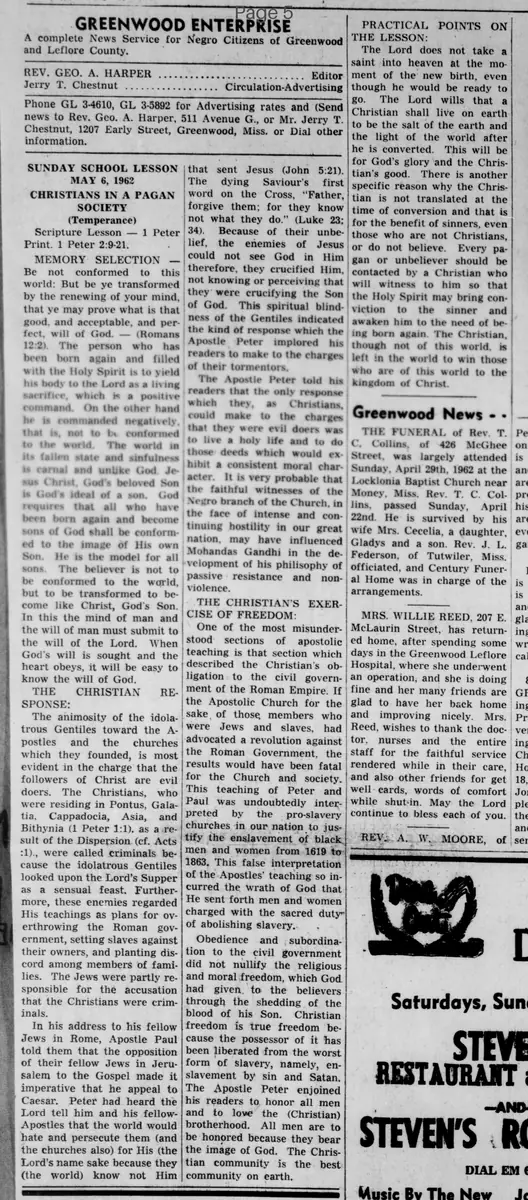
Sunday school lesson from May 6, 1962, on 1 Peter, urging Christians to live transformed lives in a sinful world, respond to persecution with holiness, honor civil authority without compromising faith, and witness to unbelievers. References biblical history, Roman persecution, American slavery, and Gandhi's non-violence.
Clipping
OCR Quality
Full Text
CHRISTIANS IN A PAGAN SOCIETY
(Temperance)
Scripture Lesson - 1 Peter
Print. 1 Peter 2:9-21.
MEMORY SELECTION
Be not conformed to this world: But be ye transformed by the renewing of your mind, that ye may prove what is that good, and acceptable, and perfect, will of God. - (Romans 12:2).
The person who has been born again and filled with the Holy Spirit is to yield his body to the Lord as a living sacrifice, which is a positive command.
On the other hand he is commanded negatively. that is, not to be conformed to the world.
The world in its fallen state and sinfulness is carnal and unlike God.
Jesus Christ God's beloved Son is God's ideal of son.
God requires that all who have been born again and become sons of God shall be conformed to the image of His own Son. He is the model for all sons.
The believer is not to be conformed to the world, but to be transformed to become like Christ, God's Son.
In this the mind of man and the will of man must submit to the will of the Lord. When God's will is sought and the heart obeys, it will be easy to know the will of God.
THE CHRISTIAN RESPONSE:
The animosity of the idolatrous Gentiles toward the Apostles and the churches which they founded, is most evident in the charge that the followers of Christ are evil doers. The Christians, who were residing in Pontus, Galatia, Cappadocia, Asia, and Bithynia (1 Peter 1:1). as a result of the Dispersion (cf. Acts 2:1)., were called criminals because the idolatrous Gentiles looked upon the Lord's Supper as a sensual feast. Furthermore, these enemies regarded His teachings as plans for overthrowing the Roman government, setting slaves against their owners, and planting discord among members of families. The Jews were partly responsible for the accusation that the Christians were criminals.
In his address to his fellow Jews in Rome, Apostle Paul told them that the opposition of their fellow Jews in Jerusalem to the Gospel made it imperative that he appeal to Caesar. Peter had heard the Lord tell him and his fellow Apostles that the world would hate and persecute them (and the churches also) for His (the Lord's) name sake because they (the world) know not Him that sent Jesus (John 15:21).
The dying Saviour's first word on the Cross, "Father, forgive them; for they know not what they do." (Luke 23:34).
Because of their unbelief, the enemies of Jesus could not see God in Him therefore, they crucified Him, not knowing or perceiving that they were crucifying the Son of God.
This spiritual blindness of the Gentiles indicated the kind of response which the Apostle Peter implored his readers to make to the charges of their tormentors.
The Apostle Peter told his readers that the only response which they, as Christians, could make to the charges that they were evil doers was to live a holy life and to do those deeds which would exhibit a consistent moral character.
It is very probable that the faithful witnesses of the Negro branch of the Church, in the face of intense and continuing hostility in our great nation, may have influenced Mohandas Gandhi in the development of his philosophy of passive resistance and non-violence.
THE CHRISTIAN'S EXERCISE OF FREEDOM:
One of the most misunderstood sections of apostolic teaching is that section which described the Christian's obligation to the civil government of the Roman Empire. If the Apostolic Church for the sake of those members who were Jews and slaves, had advocated a revolution against the Roman Government, the results would have been fatal for the Church and society.
This teaching of Peter and Paul was undoubtedly interpreted by the pro-slavery churches in our nation to justify the enslavement of black men and women from 1619 to 1863. This false interpretation of the Apostles' teaching so incurred the wrath of God that He sent forth men and women charged with the sacred duty of abolishing slavery.
Obedience and subordination to the civil government did not nullify the religious and moral freedom, which God had given, to the believers through the shedding of the blood of his Son. Christian freedom is true freedom because the possessor of it has been liberated from the worst form of slavery, namely, enslavement by sin and Satan.
The Apostle Peter enjoined his readers to honor all men and to love the (Christian) brotherhood. All men are to be honored because they bear the image of God. The Christian community is the best community on earth.
PRACTICAL POINTS ON THE LESSON:
The Lord does not take a saint into heaven at the moment of the new birth, even though he would be ready to go.
The Lord wills that a Christian shall live on earth to be the salt of the earth and the light of the world after he is converted. This will be for God's glory and the Christian's good. There is another specific reason why the Christian is not translated at the time of conversion and that is for the benefit of sinners, even those who are not Christians, or do not believe.
Every pagan or unbeliever should be contacted by a Christian who will witness to him so that the Holy Spirit may bring conviction to the sinner and awaken him to the need of being born again. The Christian, though not of this world, is left in the world to win those who are of this world to the kingdom of Christ.
What sub-type of article is it?
What themes does it cover?
What keywords are associated?
What entities or persons were involved?
Where did it happen?
Story Details
Key Persons
Location
Pontus, Galatia, Cappadocia, Asia, Bithynia; Rome; Jerusalem
Event Date
May 6, 1962
Story Details
A Sunday school lesson on 1 Peter 2:9-21, teaching Christians to live holy lives in a pagan society, not conforming to the world but transforming to be like Christ. It discusses responses to persecution, freedom under civil government, and the Christian's role to witness to unbelievers, referencing historical contexts like Roman Empire, slavery in America, and Gandhi's philosophy.