Thank you for visiting SNEWPapers!
Sign up free
Alexandria Daily Advertiser
Alexandria, Virginia
What is this article about?
Depositions from Philip Norborne Nicholas and George Hay criticize Judge Samuel Chase's rude and biased conduct during the 1800 trial of James T. Callender in Richmond, Virginia. Interrogatories and responses from William S. Biddle detail the court's opinion in John Fries' 1800 treason trial in Pennsylvania. Part of a congressional inquiry into Chase and Peters' official conduct, dated February 7, 1804.
Clipping
OCR Quality
Full Text
(Continued.)
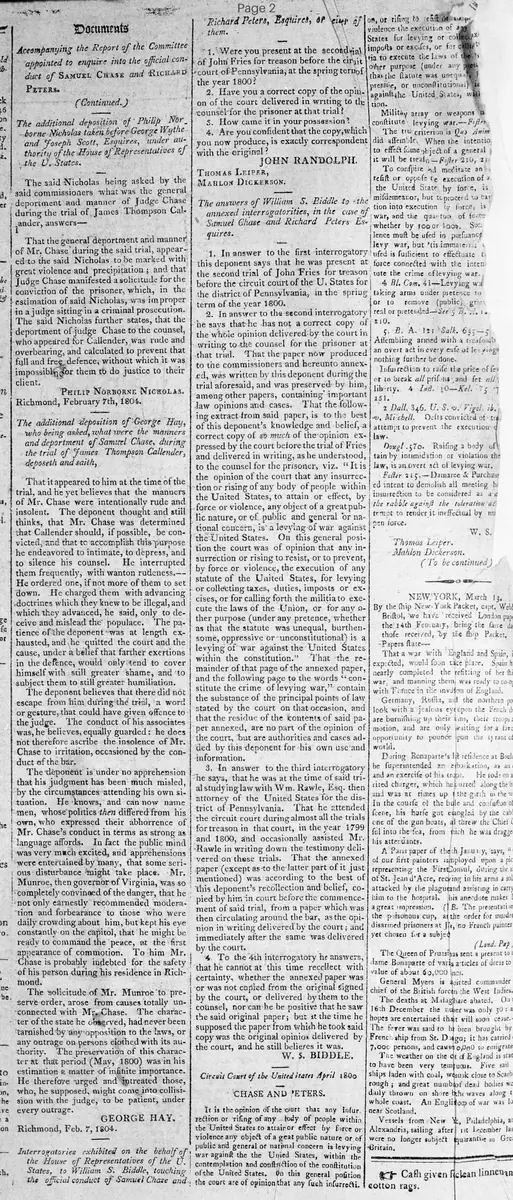
The additional deposition of Philip Norborne Nicholas taken before George Wythe and Joseph Scott, Esquires, under authority of the House of Representatives of the U. States.
The said Nicholas being asked by the said commissioners what was the general deportment and manner of Judge Chase during the trial of James Thompson Callender, answers--
That the general deportment and manner of Mr. Chase during the said trial, appeared to the said Nicholas to be marked with great violence and precipitation; and that Judge Chase manifested a solicitude for the conviction of the prisoner, which, in the estimation of said Nicholas, was improper in a judge sitting in a criminal prosecution.
The said Nicholas further states, that the deportment of judge Chase to the counsel, who appeared for Callender, was rude and overbearing, and calculated to prevent that full and free defence; without which it was impossible for them to do justice to their client.
Philip Norborne Nicholas.
Richmond, February 7th, 1804.
The additional deposition of George Hay, who being asked, what were the manners and deportment of Samuel Chase, during the trial of James Thompson Callender, deposeth and saith,
That it appeared to him at the time of the trial, and he yet believes that the manners of Mr. Chase were intentionally rude and insolent. The deponent thought and still thinks, that Mr. Chase was determined that Callender should, if possible, be convicted, and that to accomplish this purpose he endeavored to intimate, to depress, and to silence his counsel. He interrupted them frequently, with wanton rudeness.-- He ordered one, if not more of them to sit down. He charged them with advancing doctrines which they knew to be illegal, and which they advanced, he said, only to deceive and mislead the populace. The patience of the deponent was at length exhausted, and he quitted the court and the cause, under a belief that farther exertions in the defence, would only tend to cover himself with still greater shame, and to subject them to still greater humiliation.
The deponent believes that there did not escape from him during the trial, a word or gesture, that could have given offence to the judge. The conduct of his associates was, he believes, equally guarded: he does not therefore ascribe the insolence of Mr. Chase to irritation, occasioned by the conduct of the bar.
The deponent is under no apprehension that his judgment has been much misled, by the circumstances attending his own situation. He knows, and can now name men, whose politics then differed from his own, who expressed their abhorrence of Mr. Chase's conduct in terms as strong as language affords. In fact the public mind was very much excited, and apprehensions were entertained by many, that some serious disturbance might take place. Mr. Munroe, then governor of Virginia, was so completely convinced of the danger, that he not only earnestly recommended moderation and forbearance to those who were daily crowding about him, but kept his eye constantly on the capitol, that he might be ready to command the peace, at the first appearance of commotion. To him Mr. Chase is probably indebted for the safety of his person during his residence in Richmond.
The solicitude of Mr. Munroe to preserve order, arose from causes totally unconnected with Mr Chase. The character of the state he observed, had never been tarnished by any opposition to the laws, or any outrage on persons clothed with its authority. The preservation of this character at that period (May, 1800) was in his estimation a matter of infinite importance. He therefore urged and intreated those, who, he supposed, might come into collision with the judge, to be patient, under every outrage.
GEORGE HAY.
Richmond, Feb. 7, 1804.
Interrogatories exhibited on the behalf of the House of Representatives of the U. States, to William S. Biddle, touching the official conduct of Samuel Chase and Richard Peters, Esquires, or either of them.
1. Were you present at the second trial of John Fries for treason before the circuit court of Pennsylvania, at the spring term of the year 1800?
2. Have you a correct copy of the opinion of the court delivered in writing to the counsel for the prisoner at that trial?
3. How came it in your possession?
4. Are you confident that the copy, which you now produce, is exactly correspondent with the original?
JOHN RANDOLPH.
Thomas Leiper,
Mahlon Dickerson.
The answers of William S. Biddle to the annexed interrogatories, in the case of Samuel Chase and Richard Peters Esquires.
1. In answer to the first interrogatory this deponent says that he was present at the second trial of John Fries for treason before the circuit court of the U. States for the district of Pennsylvania, in the spring term of the year 1800.
2. In answer to the second interrogatory he says that he has not a correct copy of the whole opinion delivered by the court in writing to the counsel for the prisoner at that trial. That the paper now produced to the commissioners and hereunto annexed, was written by this deponent during the trial aforesaid, and was preserved by him, among other papers, containing important law opinions and cases. That the following extract from said paper, is to the best of this deponent's knowledge and belief, a correct copy of so much of the opinion expressed by the court before the trial of Fries and delivered in writing, as he understood, to the counsel for the prisoner, viz. "It is the opinion of the court that any insurrection or rising of any body of people within the United States, to attain or effect, by force or violence, any object of a great public nature, or of public and general or national concern, is a levying of war against the United States. On this general position the court was of opinion that any insurrection or rising to resist, or to prevent, by force or violence, the execution of any statute of the United States, for levying or collecting taxes, duties, imposts or excises, or for calling forth the militia to execute the laws of the Union, or for any other purpose (under any pretence, whether as that the statute was unequal, burthensome, oppressive or unconstitutional) is a levying of war against the United States within the constitution." That the remainder of that page of the annexed paper, and the following page to the words "constitute the crime of levying war," contain the substance of the principal points of law stated by the court on that occasion, and that the residue of the contents of said paper annexed, are no part of the opinion of the court, but are authorities and cases added by this deponent for his own use and information.
3. In answer to the third interrogatory he says, that he was at the time of said trial studying law with Wm. Rawle, Esq. then attorney of the United States for the district of Pennsylvania. That he attended the circuit court during almost all the trials for treason in that court, in the year 1799 and 1800, and occasionally assisted Mr. Rawle in writing down the testimony delivered on those trials. That the annexed paper (except as to the latter part of it just mentioned) was according to the best of this deponent's recollection and belief, copied by him in court before the commencement of said trial, from a paper which was then circulating around the bar, as the opinion in writing delivered by the court: and immediately after the same was delivered by the court.
4. To the 4th interrogatory he answers, that he cannot at this time recollect with certainty, whether the annexed paper was or was not copied from the original signed by the court, or delivered by them to the counsel, nor can he be positive that he saw the said original paper; but at the time he supposed the paper from which he took said copy was the original opinion delivered by the court, and he still believes it was.
W. S. BIDDLE.
Circuit Court of the United States April 1800 CHASE AND PETERS.
It is the opinion of the court that any insurrection or rising of any body of people within the United States to attain or effect by force or violence any object of a great public nature or of public and general or national concern is levying war against the United States, within the contemplation and construction of the constitution of the United States. On this general position the court are of opinion that any such insurrection, or rising to resist or to prevent by force or violence the execution of any statute of the United States for levying or collecting taxes, duties, imposts or excises, or for calling forth the militia to execute the laws of the Union, or for any other purpose (under any pretence, whether as that the statute was unequal, burthensome, oppressive or unconstitutional) is a levying of war against the United States within the constitution.
Military array or weapons do not constitute levying war.--Foster
The true criterion is Quo Animimo they did assemble. When the intention is to effect some object of a general nature, it will be treason--Foster 210, 21
To conspire and meditate an insurrection to resist or oppose the execution of a law of the United States by force, is a misdemeanor, but to proceed to carry the insurrection into execution by force, is levying war, and the quantum of force necessary must be used in pursuance of the original intent--whether by 100 or 1000. Some violence must be used in pursuance of an intent to levy war, but 'tis immaterial whether the force used is sufficient to effectuate it. Any force connected with the intent will constitute the crime of levying war.
4 Bl. Com. 41--Levying war is taking arms under pretence to redress or to remove (public) grievances real or pretended.--See 5 B. l. 210.
5 B. l. 121 Salk. 635--Assembling armed with a treasonable intent is an overt act in every case of levying war, although nothing further be done.
Insurrection to raise the price of every commodity, or to break all prisons and set all at liberty. 4 Inst. 10--Kely. 75, 251.
2 Dall. 346. U. S. v. Vigol. ib. v. Mitchell. Defts convicted of treasonable attempt to prevent the execution of a law
Doug. 570. Raising a body of men to intimidate or violate the law, is an overt act of levying war.
Foster 215.--Damaree & Purchase had intent to demolish all meeting houses--insurrection to be considered as a design of the rabble against the toleration act--attempt to render it ineffectual by open force.
(To be continued)
What sub-type of article is it?
What keywords are associated?
What entities or persons were involved?
Where did it happen?
Domestic News Details
Primary Location
Richmond
Event Date
February 7th, 1804
Key Persons
Outcome
depositions allege improper judicial conduct by chase during callender's trial; biddle provides copy of court opinion on fries' treason trial defining insurrection as levying war.
Event Details
Depositions by Nicholas and Hay describe Chase's violent, rude, and biased behavior toward defense counsel in Callender's 1800 trial, leading to public excitement and gubernatorial intervention for order. Biddle's responses confirm presence at Fries' 1800 treason trial and provide a partial copy of the court's written opinion on levying war, along with legal notes.