Thank you for visiting SNEWPapers!
Sign up free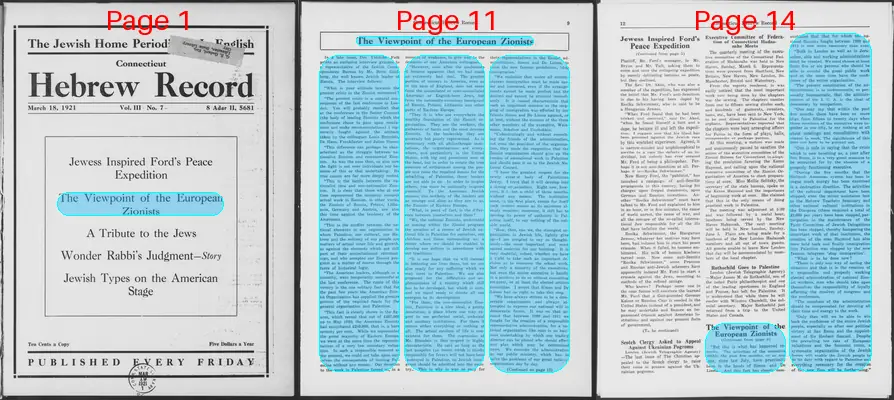
Connecticut Hebrew Record
Hartford, Hartford County, Connecticut
What is this article about?
Interview with Boris Goldberg on the crisis in the Zionist movement, highlighting conflicts between nationalist European Zionists and American commercial Zionists over Palestine development, immigration, and organizational leadership following the London conference and San Remo decisions.
Merged-components note: Merged title on page 1 with article on page 11 and continuation on page 14 for 'The Viewpoint of the European Zionists'; changed label from story to foreign_news for the main article.
Clippings

1 of 3
OCR Quality
Full Text
In a late issue, Dos Yiddishe Folk prints an exclusive interview granted to a representative of the Jewish Correspondence Bureau by Mr. Boris Goldberg, the well known Jewish leader of Russia. The interview follows:
"What is your attitude towards the present crisis in the Zionist movement?"
"The present crisis is a natural consequence of the last conference in London. You will probably recollect that at the conference in the Senior Convent (the body of leading Zionists which the conference chose to pass upon resolutions and make recommendations) I vigorously fought against the attitude taken by the colleagues Louis Brandeis, De Haas, Frankfurter and Julius Simon."
"This difference can perhaps be characterized as the struggle between nationalist Zionism and commercial Zionism. As was the case then, so also now the fight is not over individuals nor because of this or that undertaking. Its true causes are far more deeply rooted."
"This is the battle between the nationalist idea and non-nationalist Zionism. It is clear that those who at one time represented the tendency towards actual work in Zionism, in other words, the Zionists of Russia, Poland, Lithuania, Germany and Austria, are also this time against the tendency of the Americans."
"This is the conflict between the national elements in our organization to whom Palestine, our cultural, our Hebrew and the entirety of our people are matters of actual inner life and growth, as against the elements which are still part of their assimilationist surroundings, and who accepted our Zionist program as a matter of course through the force of historical logic."
"The American leaders, although in a minority, were temporarily successful at the last conference. The cause of this victory is the one solitary fact that for the past few years the American Zionist Organization has supplied the greater portion of the required funds for the general organization and Palestine."
"This fact is clearly shown in the figures, which reveal that out of £407,000 up to May 1920, the American Zionists had contributed £250,000, that is, a bare seventy per cent. While we represented the great majority of Eastern Europe, we were at the same time the representatives of a very low monetary valuation. In such a responsible moment as the present, we could not take upon ourselves the consequences of leaving Palestine without any means. Our devotion to the work in Palestine forced us, in a moment of weakness, to give way to the demands of our American colleagues."
"However, soon after the conference it became apparent that we had made an extremely bad deal. The greater portion of moneys in America, even as in the case of England, does not come from the assimilated or semi-assimilated American or English-born Jews, but from the nationally-conscious immigrant of Russia, Poland, Lithuania and other parts of Eastern Europe."
"They it is who are everywhere the wealthy foundation of the Zionist organization. They are the workers, the gatherers of funds and the most devoted Zionists. In the leadership they are generally but poorly represented. As is customary with all philanthropic institutions, the organizations are everywhere, and particularly in the United States, with big and prominent men at the head, but in order to create the true measure of enthusiasm among the people and raise the required means for the rebuilding of Palestine, these leaders are not able to do. In order to inspire others, you must be nationally inspired yourself. To the American Jewish masses, the methods of the leaders are as strange and alien as they are to us, the Zionists of Eastern Europe."
"What, in point of fact, is the difference between yourselves and them?"
"We, the national Zionists, understand as coming within the Zionist program the creation of a center of Jewish national life in Palestine for ourselves, our children and those surrounding us; a center where we should be enabled to develop our culture in accordance with our traditions."
"It is our hope that we will succeed in bettering our lives there, but we are also ready for any suffering which we may meet in Palestine. We are also prepared for the difficulties and unpleasantness of a country which still has to be developed, but which is ours, and we stand ready to devote all our energies to its development."
"For them, the non-nationalist Zionists, Palestine is a nice ideal, a pretty decoration, a place where one may expect to see perfected social, technical and sanitary institutions. For them it means either everything or nothing at all. The actual medium of life is non-existent for them. The expression of Mr. Brandeis in this respect is highly characteristic. He said as long as the last anopheles (an insect which is chiefly responsible for fever) will not have been destroyed in Palestine, no Jewish immigrant should be admitted into the country. This is why it was so easy for their representatives in the Zionist administration, Simon and De Liema, to issue the now famous prohibition, 'stop immigration.'"
"We maintain that under all circumstances immigration must be made easier and increased, even if the arrangements cannot be made perfect and the desired end cannot be attained immediately. It is indeed characteristic that such an important decision as the stopping of immigration was effected by our friends Simon and De Liema against, or at best, without the consent of the three other members of the executive, Weizmann, Sokolow and Ussishkin."
"Unhesitatingly and without consulting the friends of the administration, not even the president of the organization, they made the suggestion that the Zionist organization should give up the burden of educational work in Palestine and should pass it on to the Jewish National Council."
"I have the greatest respect for the newly created body of Palestinian Jewry. I trust that it will develop into a strong organization. Right now, however, it is but a child of three months, without any means. The institution must, in the first place, create for itself such modern means as its existence already requires; moreover, it still has to develop its power of authority in Palestine itself, to say nothing of the outside world."
"How, then, can we, the strongest organization in Jewish life, lightly give up--I am tempted to say so thoughtlessly--the most important and most sacred material for our building. It is very doubtful, indeed, whether we have a right to take such an important decision as to renounce the school work. Not only a minority of the executives, but even the entire executive is hardly in a position to do so without consulting congress, or at least the elected actions committee. I assert that Simon and De Liema had no right to take this step."
"We have always striven to be a democratic organization and always attempted to express our national will in democratic forms. It was on that account that between 1909 and 1911 we fought for the creation of a responsible representative administration, for a national organization like ours is no business undertaking by which one leading director can be placed who should effect any plan which may be determined upon. We consider the administration as our public ministry, which has to solve the problems of our great national organization day by day."
(Continued on page 12)
The Viewpoint of the European Zionists
(Continued from page 9)
"But this is what has happened recently. The activities of the executive within the past five months, or at any rate, since last July, have practically been in the hands of Simon and De Liema. And this fact has clearly demonstrated that that for which the national Zionists fought between 1909 and 1911 is now more necessary than ever.
"Both in London as well as in Jerusalem, able and working administrations must be created. We must choose at least from five or six persons who should be able to control the great public work and at the same time have the confidence of the entire organization.
"The present constitution of the administration is so undemocratic, so personally bureaucratic, that the administration of the I. C. A. is the ideal of democracy by comparison.
"One may say that within the past five months there have been no more than from fifteen to twenty days when three members of the executive were together in one city, to say nothing at all about meetings and consultations with regard to work. The significance of this does not have to be pointed out.
"One is safe in saying that the crisis which is now besetting us, a year after San Remo, is to a very great measure to be accounted for by the absence of a properly functioning executive.
"During the five months that the Holland-American system has been in vogue much energy has been exercised in a destructive direction. The activities of the cultural department have been stopped, even the minor assistance lent to the Hebrew Teachers Seminary and other national cultural institutions in the Diaspora (these required a total of £3,000 per year) have been stopped, participation in the maintenance of the Paris Committee of Jewish Delegations has been stopped, thereby hampering the important work of that institution, the creation of the Keren Hayesod has also been held back and finally immigration into Palestine was stopped by the now famous telegram 'stop immigration'.
"What is to be done now?
"There is only one way of saving the situation and that is in the creation of a responsible and properly working elected administration of national Zionist workers, men who should take upon themselves the responsibility of loyally effecting the resolves of congress and the conference.
"The members of the administration should be compensated for devoting all their time and energy to the work.
"Only then will we be able to win back the confidence of the entire Jewish people, especially so after our political victory at San Remo and the appointment of Sir Herbert Samuel. Despite the prevailing low rate of European valuations and the financial crisis, a systematic organization of the Jewish forces will enable the Jewish people to do its duty with regard to Palestine and everything necessary for the creation of the new Zion will be forthcoming."
What sub-type of article is it?
What keywords are associated?
What entities or persons were involved?
Where did it happen?
Foreign News Details
Primary Location
Palestine
Event Date
1920
Key Persons
Outcome
crisis in zionist movement; immigration to palestine stopped; cultural and educational activities halted; calls for democratic administration reform.
Event Details
Boris Goldberg criticizes the influence of American Zionist leaders like Brandeis and Simon for prioritizing commercial aspects over nationalist goals, leading to decisions like halting immigration and educational work in Palestine without proper consultation, following the London conference and San Remo.