Thank you for visiting SNEWPapers!
Sign up free
The Abbeville Banner
Abbeville, Abbeville County, South Carolina
What is this article about?
Detailed account of the Battle of Cerro Gordo (April 16-18), where U.S. forces under Gen. Scott outmaneuvered and stormed Mexican positions, capturing key forts, 6,000 prisoners including four generals, artillery, and Santa Anna's funds, with Twiggs' division leading the assault.
Merged-components note: Merged the initial parsing of the 'Battle of Cerro Gordo' article across multiple components, including the accompanying image which overlaps spatially with the main text.
Clipping
OCR Quality
Full Text
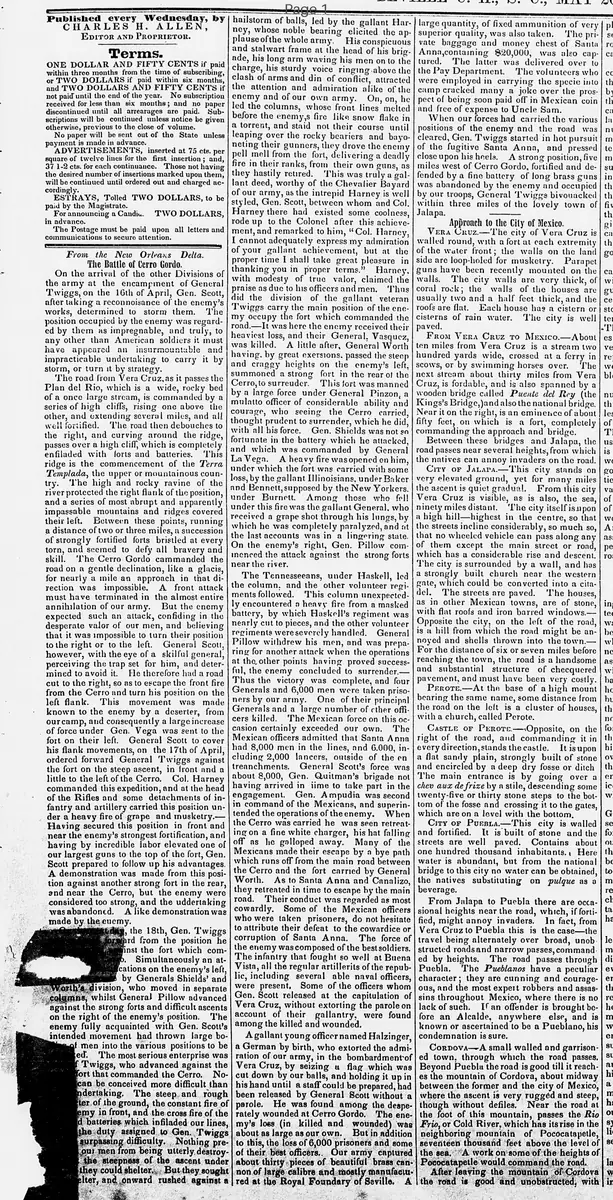
The Battle of Cerro Gordo.
On the arrival of the other Divisions of the army at the encampment of General Twiggs, on the 16th of April, Gen. Scott, after taking a reconnoisance of the enemy's works, determined to storm them. The position occupied by the enemy was regarded by them as impregnable, and truly, to any other than American soldiers it must have appeared an insurmountable and impracticable undertaking to carry it by storm, or turn it by strategy.
The road from Vera Cruz, as it passes the Plan del Rio, which is a wide, rocky bed of a once large stream, is commanded by a series of high cliffs, rising one above the other, and extending several miles, and all well fortified. The road then debouches to the right, and curving around the ridge, passes over a high cliff, which is completely enfiladed with forts and batteries. This ridge is the commencement of the Terra Templada, the upper or mountainous country. The high and rocky ravine of the river protected the right flank of the position, and a series of most abrupt and apparently impassable mountains and ridges covered their left. Between these points, running a distance of two or three miles, a succession of strongly fortified forts bristled at every turn, and seemed to defy all bravery and skill. The Cerro Gordo commanded the road on a gentle declination, like a glacis, for nearly a mile an approach in that direction was impossible. A front attack must have terminated in the almost entire annihilation of our army. But the enemy expected such an attack, confiding in the desperate valor of our men, and believing that it was impossible to turn their position to the right or to the left. General Scott, however, with the eye of a skilful general, perceiving the trap set for him, and determined to avoid it. He therefore had a road cut to the right, so as to escape the front fire from the Cerro and turn his position on the left flank. This movement was made known to the enemy by a deserter, from our camp, and consequently a large increase of force under Gen. Vega was sent to the fort on their left. General Scott to cover his flank movements, on the 17th of April, ordered forward General Twiggs against the fort on the steep ascent, in front and a little to the left of the Cerro. Col. Harney commanded this expedition, and at the head of the Rifles and some detachments of infantry and artillery carried this position under a heavy fire of grape and musketry. Having secured this position in front and near the enemy's strongest fortification, and having by incredible labor elevated one of our largest guns to the top of the fort, Gen. Scott prepared to follow up his advantages. A demonstration was made from this position against another strong fort in the rear, and near the Cerro, but the enemy were considered too strong, and the undertaking was abandoned. A like demonstration was made by the enemy.
On the 18th, Gen. Twiggs advanced from the position he against the fort which com- Simultaneously an attack nations on the enemy's left. by Generals Shields' and Worth's division, who moved in separate columns, whilst General Pillow advanced against the strong forts and difficult ascents on the right of the enemy's position. The enemy fully acquainted with Gen. Scott's intended movement had thrown large bo- of men into the various positions to be attacked. The most serious enterprise was of Twiggs, who advanced against the fort that commanded the Cerro. No- thing can be conceived more difficult than this under- taking. The steep and rough character of the ground, the constant fire of the enemy in front, and the cross fire of the enemy's batteries which enfiladed our lines. The duty assigned to Gen. Twiggs was of surpassing difficulty. Nothing pre- vented our men from being utterly destroyed by the steepness of the ascent under which they could shelter. But they sought no shel- ter, and onward rushed against a hailstorm of balls, led by the gallant Har- ney, whose noble bearing elicited the ap- plause of the whole army. His conspicuous and stalwart frame at the head of his brig- ade, his long arm waving his men on to the charge, his sturdy voice ringing above the clash of arms and din of conflict, attracted the attention and admiration alike of the enemy and of our own army. On, on, he led the columns, whose front lines melted before the enemy's fire like snow flake in a torrent, and staid not their course until leaping over the rocky barriers and bayo- neting their gunners, they drove the enemy pell mell from the fort, delivering a deadly fire in their ranks, from their own guns, as they hastily retired. This was truly a gal- lant deed, worthy of the Chevalier Bayard of our army, as the intrepid Harney is well styled, Gen. Scott, between whom and Col. Harney there had existed some coolness, rode up to the Colonel after this achieve- ment, and remarked to him, "Col. Harney. I cannot adequately express my admiration of your gallant achievement, but at the proper time I shall take great pleasure in thanking you in proper terms." Harney, with modesty of true valor, claimed the praise as due to his officers and men. Thus did the division of the gallant veteran Twiggs carry the main position of the ene- my occupy the fort which commanded the road. It was here the enemy received their heaviest loss, and their General, Vasquez, was killed. A little after, General Worth having, by great exertions, passed the steep and craggy heights on the enemy's left, summoned a strong fort in the rear of the Cerro, to surrender. This fort was manned by a large force under General Pinzon, a mulatto officer of considerable ability and courage, who seeing the Cerro carried, thought prudent to surrender, which he did, with all his force. Gen. Shields was not so fortunate in the battery which he attacked. and which was commanded by General La Vega. A heavy fire was opened on him, under which the fort was carried with some loss, by the gallant Illinoisians, under Baker and Bennett, supposed by the New Yorkers. under Burnett. Among those who fell under this fire was the gallant General, who received a grape shot through his lungs, by which he was completely paralyzed, and at the last accounts was in a lingering state.
On the enemy's right, Gen. Pillow com- menced the attack against the strong forts near the river. The Tennesseeans, under Haskell, led the column, and the other volunteer regi- ments followed. This column unexpected- ly encountered a heavy fire from a masked battery, by which Haskell's regiment was nearly cut to pieces, and the other volunteer regiments were severely handled. General Pillow withdrew his men, and was prepa- ring for another attack when the operations at the other points having proved success- ful, the enemy concluded to surrender.
Thus the victory was complete, and four Generals and 6,000 men were taken pri- soners by our army. One of their principal Generals and a large number of other offi- cers killed. The Mexican force on this oc- casion certainly exceeded our own. The Mexican officers admitted that Santa Anna had 8,000 men in the lines, and 6,000, in- cluding 2,000 lancers, outside of the en- trenchments. General Scott's force was about 8,000, Gen. Quitman's brigade not having arrived in time to take part in the engagement. Gen. Ampudia was second in command of the Mexicans, and superin- tended the operations of the enemy. When the Cerro was carried he was seen retreat- ing on a fine white charger, his hat falling off as he galloped away. Many of the Mexicans made their escape by a bye path which runs off from the main road between the Cerro and the fort carried by General Worth. As to Santa Anna and Canalizo, they retreated in time to escape by the main road. Their conduct was regarded as most cowardly. Some of the Mexican officers who were taken prisoners, do not hesitate to attribute their defeat to the cowardice or corruption of Santa Anna. The force of the enemy was composed of the best soldiers. The infantry that fought so well at Buena Vista, all the regular artillerists of the repub- lic, including several able naval officers, were present. Some of the officers whom Gen. Scott released at the capitulation of Vera Cruz, without exacting the parole on account of their gallantry, were found among the killed and wounded.
A gallant young officer named Halzinger, a German by birth, who extorted the admi- ration of our army, in the bombardment of Vera Cruz, by seizing a flag which was cut down by our balls, and holding it up in his hand until a staff could be prepared, had been released by General Scott without a parole. He was found among the despe- rately wounded at Cerro Gordo. The ene- my's loss (in killed and wounded) was about as large as our own. But in addition to this, the loss of 6,000 prisoners and some of their best officers. Our army captured about thirty pieces of beautiful brass can- non of large calibre and mostly manufac- tured at the Royal Foundry of Seville. A large quantity of fixed ammunition of very superior quality, was also taken. The pri- vate baggage and money chest of Santa Anna, containing $20,000, was also cap- tured. The latter was delivered over to the Pay Department. The volunteers who were employed in carrying the specie into camp cracked many a joke over the pros- pect of being soon paid off in Mexican coin and free of expense to Uncle Sam.
When our forces had carried the various positions of the enemy and the road was cleared, Gen. Twiggs started in hot pursuit of the fugitive Santa Anna, and pressed close upon his heels. A strong position, five miles west of Cerro Gordo, fortified and de- fended by a fine battery of long brass guns was abandoned by the enemy and occupied by our troops, General Twiggs bivouacked within three miles of the lovely town of Jalapa.
What sub-type of article is it?
What keywords are associated?
What entities or persons were involved?
Where did it happen?
Foreign News Details
Primary Location
Cerro Gordo
Event Date
April 16 18
Key Persons
Outcome
complete u.s. victory; mexican losses: general vasquez killed, ~equal killed/wounded to u.s., 6,000 prisoners including 4 generals; u.s. captured 30 brass cannons, large ammunition stores, santa anna's $20,000 money chest; mexicans outnumbered but position turned; pursuit led to abandonment of further positions near jalapa.
Event Details
U.S. Army under Gen. Scott arrived at Cerro Gordo pass on April 16 and planned to storm the seemingly impregnable Mexican fortifications held by Santa Anna's forces. Scott ordered a flanking road cut to the right to avoid frontal assault. On April 17, Twiggs' division under Col. Harney seized an advanced fort under heavy fire. On April 18, coordinated attacks: Twiggs stormed the main Cerro fort in a gallant charge led by Harney, capturing it and killing Vasquez; Worth summoned and took a rear fort from Pinzon; Shields' forces captured a battery from La Vega despite losses, including a general wounded; Pillow's volunteers attacked right flank forts but withdrew after heavy casualties from masked battery. Mexicans surrendered after these successes, with Santa Anna and Ampudia fleeing cowardly. U.S. forces ~8,500; Mexicans ~14,000 total.