Thank you for visiting SNEWPapers!
Sign up free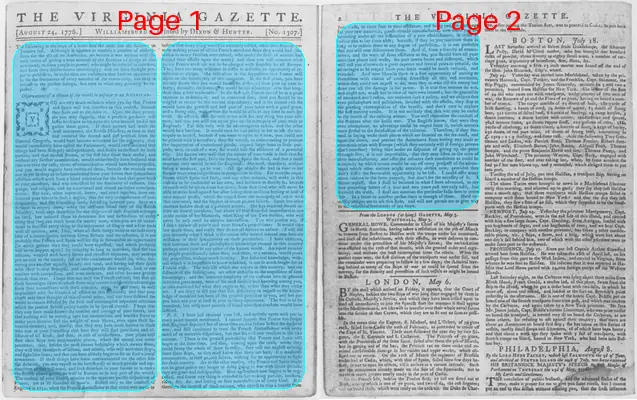
The Virginia Gazette
Richmond, Williamsburg, Richmond County, Virginia
What is this article about?
A published letter from a 'citizen of the world' (likely European) responds to an American, arguing that France and Spain will soon intervene against Britain in the colonial war due to strategic trade and revenge interests. It urges the colonies to publicize their situation to secure foreign aid in ammunition and naval support.
Merged-components note: The image overlaps spatially with the letter text on page 1 and is in sequential reading order; the text on page 2 is a direct continuation of the letter from page 1; relabeled the page 2 portion from editorial to letter_to_editor as it is part of the same letter.
Clippings
1 of 2
OCR Quality
Full Text
Observations of a citizen of the world in answer to an American.
You are very much mistaken when you say that France and Spain will not interfere in this contest, because they have not as yet done it. Upon the same principle you may suppose, that a prudent gardener will suffer his fruits to rot upon the trees because he did not gather them green. If those powers had made the least movement, the British Ministry, as soon as they had received the second and last petition from the General Congress, would have become advocates for the colonies; they would immediately have called the Parliament, would have declared that things had been strangely misrepresented, and badly understood by both parties; and that modest Senate, at the first hint from their master, and without any further examination, would undoubtedly have declared that this was even the case; terms of reconciliation would have been proposed, and you would eagerly have embraced them, because the wounds were not as yet so deep as to have eradicated from your hearts that sympathetic affection which arose from a blind veneration for the land that gave birth to your ancestors, and was nourished by the similarity of customs, language, and religion, and by a continual and almost exclusive correspondence. But now, when repeated, heavy, and cruel injuries, have embittered your hearts to such a degree, that the very remembrance of consanguinity, and the friendship lately subsisting between you, serve as a ferment to anger; now, when the obstinate blind fury of the British Ministry, to revenge themselves for the disgrace of their fruitless attempts on land, has induced them to denounce fire and destruction to every thing that they can reach from the water; now, when you are all unanimous to sacrifice every thing to the enjoyment of liberty and a free trade with all nations; now, I say, when all these things unite to exclude every idea of a reconciliation between Great Britain and the colonies, it is not probable that France and Spain will let slip so favourable an opportunity (so much greater than they could have expected, and which probably will never happen again) by delaying so long to interfere, that the two nations, wearied with heavy blows and excessive expenses, may perhaps put an end to the contest; just as two combatants would do, who, surveying one another equally bloody and tired, and having lost their spirit with their bodily strength, and consequently their anger, look at one another with compassion, and even embrace, and often become greater friends than ever. I hope that not only the French cabinet, but that all those Sovereigns likewise whose states may receive considerable advantages from their connections with these colonies, may, by this time, be well acquainted with the situation of affairs on this continent, and that your chiefs may have thought of this essential point, and not have suffered the world to remain deluded by the false and unexampled impudent relations which the present British policy causes to be spread abroad. I hope that they may have made known the number and courage of your forces, and that nothing will be wanting here but ammunition and warlike stores to make your enemies feel the weight of your blows, even upon their favourite element; and, finally, that they may have made known to those who aim at your friendship that here they will find provisions and assistance of all kind; and that, in case of misfortunes, your pilots will steer their ships into innumerable places, where the enemy can never penetrate; that, besides the most sincere hospitality which awaits them, they will find thousands of sailors, and others, who will man their ships, and fight like lions; and that you have already began to set on foot a naval armament. If these things have been communicated on the other side the Atlantic, you may expect to see here shortly as much powder and ammunition as you will want, and such diversion in your favour as to make the British power totter, as well in Europe as in any part of the world.
The reasons of your friend, relative to the apparent pacific disposition of France, are as ill founded as yours. Reflect only to the conduct of England in 1733, when the French Ambassador at that court was made to believe that every thing would be amicably settled, while their ships of war were making prizes of all the French merchant ships they could find (for which so many families were ruined, who under the faith of nations had trusted their effects upon the water) and then you will conceive what policy France must use not to be charged with stupidity by all Europe. They have too many wise men to suffer so desirable an opportunity of retaliation to escape. As ridiculous is the supposition that France will aspire to the sovereignty of this continent. In the first place, you have already shown that you would sooner be destroyed than give up your liberty; secondly, the sovereignty would be less advantageous to that kingdom than a free trade only. In the first case France would be at a great expense to maintain it, and in continual fear, lest you should be inveigled to return to the ancient dependency; and in the second case she would have the greatest and best part of your trade with a good grace, and a strong ally, with whom she would be able at any time to curb her rival. Be assured, that she will never wish for any thing but your alliance, and that you will not again give up the monopoly of your trade to England: For this only will be advantageous to her, and the other would be a burthen. It would even be bad policy in her to ask the monopoly to herself, because if you were to agree to it now, you could not be pleased with it hereafter; then she would, in endeavouring to prevent the importation of contraband goods, expend large sums to little purpose; and, in case of a war, she would lose the assistance of a powerful ally. She knows very well that the nature of your trade is such that she must have the first part, Italy the second, Spain the third, and that a small remnant only would be left for England. She must, therefore, without losing a moment, go to war. All the objects she had in view in her former wars were insignificant in comparison to this. For even the acquisitions which Spain and Italy, and any other nations, will make in this case are to be considered as her own, and her own as doubly so, because so much will be taken from her rival; from that rival who will never be able to make head against her after losing three millions sterling at least of neat annual profit, which she reaped from the monopoly of trade with this continent, and the support of about 40,000 sailors. Spain has other motives besides those of a political nature. She has received several insults on several occasions, but above all that shameful unpardonable one in the person of her Monarch, when King of the Two Sicilies, who will never be easy until he obtains satisfaction. You will pardon me, if I don't answer all yours and your friend's propositions: It would take too much time, and really they do not all deserve an answer. I will tell you sincerely what I think is the reason why several learned men here are mistaken in their speculations on these particulars. I have observed, that common sense and philosophical knowledge abound in this country perhaps more than in any other of the known world. An equal number of people promiscuously taken here, and there, at a venture, would prove my proposition without much scrutiny. But historical knowledge, without which it is impossible to know mankind, is not so much sought for as I could wish. The easy life which one enjoys in this country, and the distance of the habitations, are other obstacles to the acquisition of such knowledge; and the innocent simplicity of the customs here in general induces a great many, even of the most sensible and knowing among you to take mankind for what they ought to be, rather than what they really are. I am sorry to tell you that this deficiency in respect to the knowledge of mankind has been of the greatest prejudice to you, and has put you back one year at least in your military operations. The evil is to be remedied, but with more pounds of blood now than drachms would have sufficed.
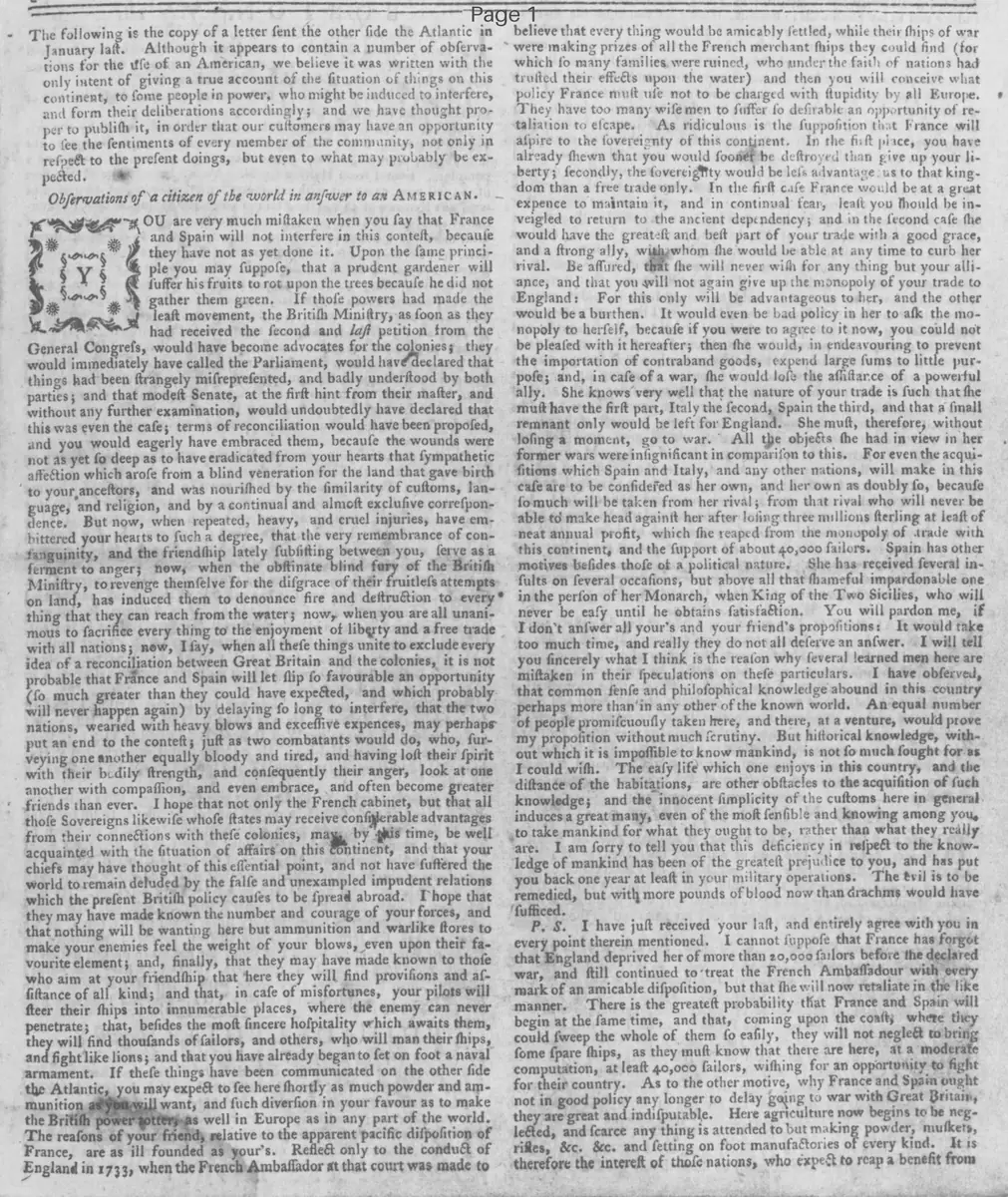
P. S. I have just received your last, and entirely agree with you in every point therein mentioned. I cannot suppose that France has forgot that England deprived her of more than 20,000 sailors before the declared war, and still continued to treat the French Ambassador with every mark of an amicable disposition, but that he will now retaliate in the like manner. There is the greatest probability that France and Spain will begin at the same time, and that, coming upon the coast; where they could sweep the whole of them so easily, they will not neglect to bring some spare ships, as they must know that there are here, at a moderate computation, at least 40,000 sailors, wishing for an opportunity to fight for their country. As to the other motive, why France and Spain ought not in good policy any longer to delay going to war with Great Britain, they are great and indisputable. Here agriculture now begins to be neglected, and scarce any thing is attended to but making powder, muskets, rifles, &c. &c. and setting on foot manufactories of every kind. It is therefore the interest of those nations, who expect to reap a benefit from
Your trade, to come soon to your assistance, and bring you, in exchange for your raw materials, goods already manufactured, now while you are labouring under all the difficulties of a new establishment, in order to induce you to lay them aside; because, if they let you continue them so long as to reduce them to any degree of perfection, it is not probable that you will ever discontinue them. And if, from a scarcity of ammunition, and the want of some assistance at sea, you should have all your maritime places laid waste, sea-port towns burnt and destroyed, which will cost you afterwards a great expense and several years to rebuild, the advantages to be reaped from your trade would be much reduced, and retarded. And now likewise there is a fine opportunity of uniting to themselves with chains of cordial friendship all this vast continent, which they could not expect to do, were they to wait till the enemy had done you all the damage in his power. It is true that nations do not, and ought not, to act but in view of their own interest; but the generality of mankind don't refine, nor conceive such a policy, and we observe that even philosophers and politicians, satisfied with the effects, they stop at the pleasing contemplation of the benefit, and don't care to explore the first moving causes. It is not unlikely that this war may be ended in the course of the ensuing winter. You well remember the conduct of the Romans after the Italic war. The English know, that were they even triumphant, no advantage could be reaped from it, unless matters were settled to the satisfaction of the colonies. Therefore, if they succeed in laying waste those places which are situated on the sea-coast, and upon the rivers, and prevent the Americans from having any trade or communication with Europe (which they certainly will if foreign powers don't interfere) being then under no suspicion of giving up the point through fear, it is not improbable, that they may listen to the cries of their manufacturers, and offer the colonies such conditions as could be accepted; by which means would be cut off every prospect of the advantages which other nations might certainly obtain now, provided they don't suffer the favourable opportunity to be lost. I could offer many more reasons to the same purpose, but don't see the necessity of it. I flatter myself, that I shall be believed in what I have advanced, as my two preceding letters of a year and two years past not only told, but foretold the truth. I shall not mention the particular facts here to prove this. In a letter to another person there is enough of them. Hard necessity obliges me to use this style, and will not permit me to give way to the respectful sentiments of my heart.
What sub-type of article is it?
What themes does it cover?
What keywords are associated?
What entities or persons were involved?
Letter to Editor Details
Author
A Citizen Of The World
Recipient
An American
Main Argument
france and spain will intervene in the american-british conflict due to strategic advantages in trade and revenge against britain, and the colonies should communicate their needs to secure timely aid in ammunition, naval support, and alliances to prevent reconciliation and ensure victory.
Notable Details