Thank you for visiting SNEWPapers!
Sign up free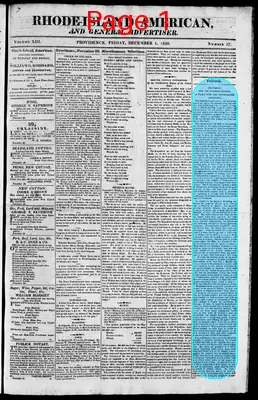
Editorial
December 1, 1820
The Rhode Island American, And General Advertiser
Providence, Providence County, Rhode Island
What is this article about?
An editorial pleads for extending religious tolerance to conscientious objectors against military training, arguing that Massachusetts' constitution supports diverse worship and that peace principles are as valid for defense as arms, without compelling minorities.
Clipping

OCR Quality
95%
Excellent
Full Text
Political.
[By Request.]
FROM THE COLUMBIAN CENTINEL.
A PLEA FOR THE OPPRESSED.
[Continued.]
The stability of government, the preservation of our origins, the publick safety and welfare, have been supposed to require the support of Divine worship, religious institutions and schools for the instruction of youth; and the same objects have been thought to require military institutions, as means of guard, defence. Such it is presumed were the views of the worthy men who framed the Constitution of this State.
That means should be used for the security and defence of our rights and privileges, will be granted by people of every denomination.
All Christians will admit, that the safety and welfare of a community are promoted by the worship of God, by religious and moral instructions and by the establishment of schools for the instruction of children and young people. They will also agree, that means of national defence should be employed. But the people of each denomination regard their own forms of worship, their own religious and moral instructions, and their own modes of educating children, as preferable to those which are adopted by other sects. It is not, however, hence inferred, that the most numerous sect have a right to establish their own tenets, views and forms, and compel the minor sects to adopt them, or even to aid in supporting them. There is a vast majority of Protestants in this State, and they all suppose that their principles and forms of worship are more adapted to the benefit of society, than those of the Catholick Communion; but this is not urged as a reason for requiring the Catholicks to conform to the religion of Protestants, to attend their Worship, or to support their institutions. The Catholicks are allowed to meet by themselves, to worship and do all the good they can, in their own way—and to enact laws which would expose them to penalties for neglecting to worship with Protestants, would justly be deemed a cruel invasion of the rights of conscience.
In respect to the means of defending our liberty, our property and our lives, there is also a diversity of opinion. The majority perhaps sincerely believe, that preparing weapons of death, and training men for the purposes of war, are the best means of defence. But others believe, that these are not the means which God approves; that they tend to promote hostilities rather than prevent them, and that disseminating the principles and cultivating the spirit of justice, kindness, and peace, are much better adapted to avert the evils of war, and secure our rights and privileges. From the history of nations they think it is clear, that no ground of difference is so trivial, that the spirit of war cannot work it up into a cause for publick hostilities; and that none is so great, that the spirit of peace cannot adjust the affair, in a manner far better for each party than an appeal to arms.—They observe that duellists, as means of self-defence, adopt the war policy; they arm and train themselves for private combat—and what are the consequences? Does this policy operate to save them from harm? Far from it. Probably ten duellists perish by the hand of violence to one man of pacifick sentiments.
How seldom do we hear that a Quaker has fallen a victim to his principles of peace: and how frequently is our country disgraced by the mortal combats of duellists! From such results it is very natural for peaceable men to infer, that the prevalence of their own views would conduce to the safety of nations, as well as of individuals; and that kind and pacifick men are a better defence to a State than warriors—especially when raised to power.—Why then should not the Constitution and laws of Massachusetts be as tolerant and liberal in respect to the means of defence, as they are in regard to religious worship? Life, liberty, and property are as dear to men of peace as they are to other people; and such men love their country as well as others, and have as good a right to judge of the means of safety most adapted to ensure the protection of Heaven. If, then, it should be deemed necessary to devote certain days in every year, to learn the art and means of defence, why should not those whose consciences forbid them to bear arms, be allowed to meet by themselves, and employ their time in cultivating the art of preserving peace, teaching its principles, and diffusing its spirit? Have they not as good a right to do this, as others have to learn the art of war and to cherish the spirit of violence? Why should not every citizen be allowed, on such days, to attend on those instructions which in his opinion are the most honourable to God, and most conducive to the safety and welfare of his country?
It is admitted that there are many questions of policy or political expediency, in respect to which the voice of the majority must govern the whole, and the minority should acquiesce. But there are questions of a moral nature, respecting which every accountable being must decide and act for himself, however great the majority may be against him.—Of this class are many questions which relate to the proper expressions of love to God; and many others which relate to the proper expressions of love to men. In respect to these, the will or commands of God should be consulted by individuals, rather than the will or commands of fallible rulers. No human authority can bind any man to do what he believes to be inconsistent with loving God supremely, and loving his neighbour as himself.
[By Request.]
FROM THE COLUMBIAN CENTINEL.
A PLEA FOR THE OPPRESSED.
[Continued.]
The stability of government, the preservation of our origins, the publick safety and welfare, have been supposed to require the support of Divine worship, religious institutions and schools for the instruction of youth; and the same objects have been thought to require military institutions, as means of guard, defence. Such it is presumed were the views of the worthy men who framed the Constitution of this State.
That means should be used for the security and defence of our rights and privileges, will be granted by people of every denomination.
All Christians will admit, that the safety and welfare of a community are promoted by the worship of God, by religious and moral instructions and by the establishment of schools for the instruction of children and young people. They will also agree, that means of national defence should be employed. But the people of each denomination regard their own forms of worship, their own religious and moral instructions, and their own modes of educating children, as preferable to those which are adopted by other sects. It is not, however, hence inferred, that the most numerous sect have a right to establish their own tenets, views and forms, and compel the minor sects to adopt them, or even to aid in supporting them. There is a vast majority of Protestants in this State, and they all suppose that their principles and forms of worship are more adapted to the benefit of society, than those of the Catholick Communion; but this is not urged as a reason for requiring the Catholicks to conform to the religion of Protestants, to attend their Worship, or to support their institutions. The Catholicks are allowed to meet by themselves, to worship and do all the good they can, in their own way—and to enact laws which would expose them to penalties for neglecting to worship with Protestants, would justly be deemed a cruel invasion of the rights of conscience.
In respect to the means of defending our liberty, our property and our lives, there is also a diversity of opinion. The majority perhaps sincerely believe, that preparing weapons of death, and training men for the purposes of war, are the best means of defence. But others believe, that these are not the means which God approves; that they tend to promote hostilities rather than prevent them, and that disseminating the principles and cultivating the spirit of justice, kindness, and peace, are much better adapted to avert the evils of war, and secure our rights and privileges. From the history of nations they think it is clear, that no ground of difference is so trivial, that the spirit of war cannot work it up into a cause for publick hostilities; and that none is so great, that the spirit of peace cannot adjust the affair, in a manner far better for each party than an appeal to arms.—They observe that duellists, as means of self-defence, adopt the war policy; they arm and train themselves for private combat—and what are the consequences? Does this policy operate to save them from harm? Far from it. Probably ten duellists perish by the hand of violence to one man of pacifick sentiments.
How seldom do we hear that a Quaker has fallen a victim to his principles of peace: and how frequently is our country disgraced by the mortal combats of duellists! From such results it is very natural for peaceable men to infer, that the prevalence of their own views would conduce to the safety of nations, as well as of individuals; and that kind and pacifick men are a better defence to a State than warriors—especially when raised to power.—Why then should not the Constitution and laws of Massachusetts be as tolerant and liberal in respect to the means of defence, as they are in regard to religious worship? Life, liberty, and property are as dear to men of peace as they are to other people; and such men love their country as well as others, and have as good a right to judge of the means of safety most adapted to ensure the protection of Heaven. If, then, it should be deemed necessary to devote certain days in every year, to learn the art and means of defence, why should not those whose consciences forbid them to bear arms, be allowed to meet by themselves, and employ their time in cultivating the art of preserving peace, teaching its principles, and diffusing its spirit? Have they not as good a right to do this, as others have to learn the art of war and to cherish the spirit of violence? Why should not every citizen be allowed, on such days, to attend on those instructions which in his opinion are the most honourable to God, and most conducive to the safety and welfare of his country?
It is admitted that there are many questions of policy or political expediency, in respect to which the voice of the majority must govern the whole, and the minority should acquiesce. But there are questions of a moral nature, respecting which every accountable being must decide and act for himself, however great the majority may be against him.—Of this class are many questions which relate to the proper expressions of love to God; and many others which relate to the proper expressions of love to men. In respect to these, the will or commands of God should be consulted by individuals, rather than the will or commands of fallible rulers. No human authority can bind any man to do what he believes to be inconsistent with loving God supremely, and loving his neighbour as himself.
What sub-type of article is it?
Moral Or Religious
Constitutional
Military Affairs
What keywords are associated?
Religious Tolerance
Conscientious Objection
Military Training Exemption
Pacifism
Massachusetts Constitution
Peace Principles
Rights Of Conscience
What entities or persons were involved?
Framers Of The Constitution Of This State
Protestants
Catholics
Quakers
Editorial Details
Primary Topic
Plea For Tolerance In Religious Worship And Conscientious Objection To Military Training
Stance / Tone
Advocating For Religious And Conscientious Freedom
Key Figures
Framers Of The Constitution Of This State
Protestants
Catholics
Quakers
Key Arguments
Stability Of Government Requires Support For Divine Worship, Religious Institutions, Schools, And Military Institutions As Per State Constitution Framers.
All Agree On Need For Security, Defense, Religious And Moral Instructions, And Schools.
People Of Each Denomination Prefer Their Own Forms Of Worship And Education; Majority Cannot Compel Minorities To Adopt Them.
Protestants Do Not Require Catholics To Conform Or Support Protestant Institutions; Catholics Worship In Their Own Way Without Penalties.
Diversity In Opinions On Defense: Majority Favor Weapons And Training, But Others Believe Peace Principles Better Prevent War.
History Shows War Spirit Escalates Trivial Differences; Peace Spirit Resolves Great Ones Better Than Arms.
Duellists' War Policy Leads To More Deaths Than Pacifists Like Quakers.
Peaceable Views Promote National Safety; Kind Men Better Defense Than Warriors.
Massachusetts Laws Tolerant On Religious Worship Should Extend To Means Of Defense.
Conscientious Objectors To Bearing Arms Should Meet Separately To Cultivate Peace Principles On Training Days.
Every Citizen Should Attend Instructions They Deem Most Honorable To God And Beneficial To Country.
On Moral Questions Like Love To God And Men, Individuals Must Follow Conscience Over Majority Or Rulers' Commands.