Thank you for visiting SNEWPapers!
Sign up free
The Richmond Palladium
Richmond, Wayne County, Indiana
What is this article about?
In a 1875 speech at Urbana, Ohio, Sen. O.P. Morton critiques the Democratic Party's adherence to state sovereignty and secession ideas, resistance to Southern reconstruction and equal rights for freed slaves, and inflationary financial proposals. He champions Republican national unity, justice, and stable currency policies.
Merged-components note: These components contain the continuation of Hon. O. P. Morton's speech on Republicanism, spanning multiple columns and pages; the second was mislabeled as advertisement due to OCR mixing in ad rates, and the third as editorial, but overall it is a single narrative story reprinting the speech.
Clippings
1 of 2
OCR Quality
Full Text
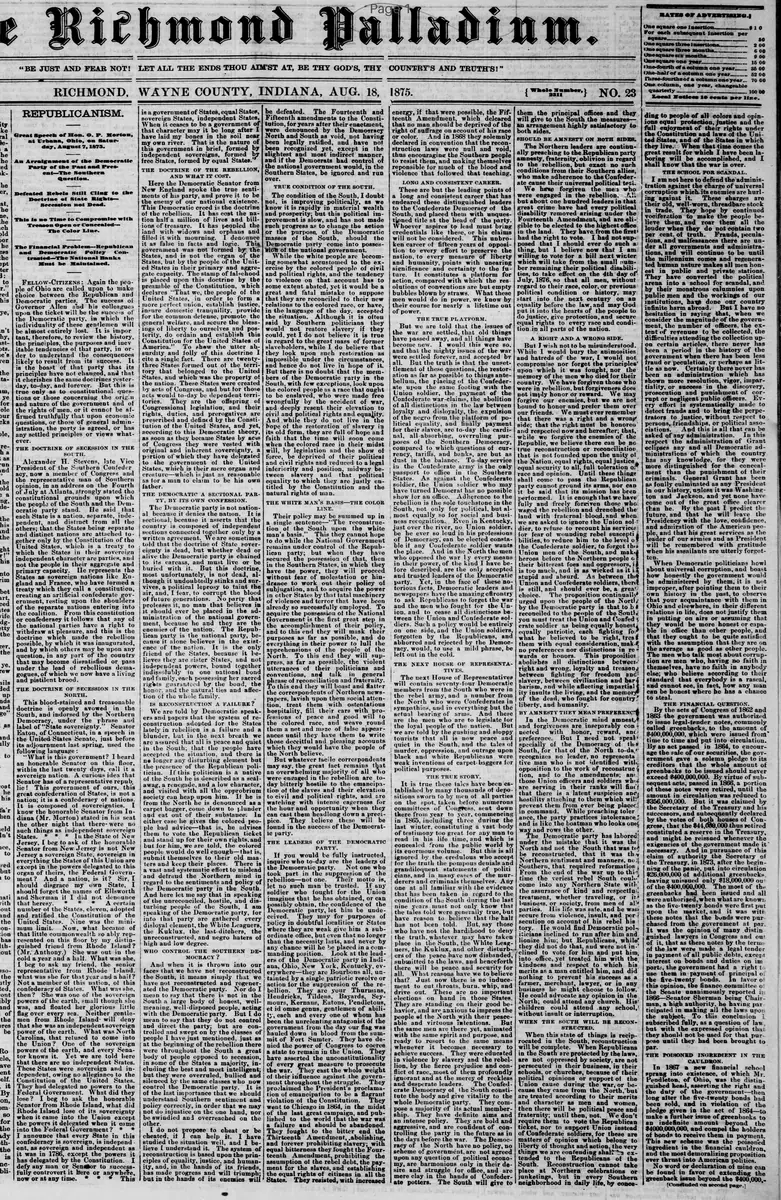
Great Speech of Hon. O. P. Morton, at Urbana, Ohio, on Saturday, August 7, 1875.
An Arraignment of the Democratic Party of the Past and Present—The Southern Question.
Defeated Rebels Still Cling to the Doctrine of State Rights—Secession not Dead.
This is no Time to Compromise with Treason Open or Concealed—'The Color Line.'
The Financial Problem—Republican and Democratic Policy Contrasted—The National Banks Must be Maintained.
Fellow-Citizens: Again the people of Ohio are called upon to make choice between the Republican and Democratic parties. The success of Governor Allen and his colleagues upon the ticket will be the success of the Democratic party, in which the individuality of these gentlemen will be almost entirely lost. It is important, therefore, to review the history, the principles, the purposes and inevitable tendencies of that party, in order to understand the consequences likely to result from its success. It is the boast of that party that its principles have not changed, and that it cherishes the same doctrines yesterday, to-day, and forever. But this is true only as to constitutional questions or those concerning the origin and nature of the government and of the rights of men, or it cannot be affirmed truthfully that upon economic questions, or those of general administration, the party is agreed, or has any settled principles or views whatever.
THE DOCTRINE OF SECESSION IN THE SOUTH.
Alexander H. Stephens, late Vice President of the Southern Confederacy, now a member of Congress and the representative man of Southern opinion, in an address on the Fourth of July at Atlanta, strongly stated the constitutional grounds upon which the people of the South and the Democratic party stand. He said that each State is a nation, separate, independent, and distinct from all the others; that the States being separate and distinct nations are attached together only by the Constitution of the United States, which is a treaty to which the States in their sovereign independent character are parties, and not the people in their aggregate and primary capacity. He represents the States as sovereign nations like England and France, who have formed a treaty which they call a constitution, creating an artificial confederate government, resting upon the shoulders of the separate nations entering into the coalition. From this constitution or confederacy it follows that any of the national parties have a right to withdraw at pleasure, and this is the doctrine which made the rebellion possible, by which it was inaugurated, and by which others may be upon any question, in any part of the country that may become dissatisfied or pass under the lead of rebellious demagogues, of which we now have a living and pestilent brood.
THE DOCTRINE OF SECESSION IN THE NORTH.
This blood-stained and treasonable doctrine is openly avowed in the South, and indorsed by the Northern Democracy, under the phrase and label of "State sovereignty." Senator Eaton, of Connecticut, in a speech in the United States Senate, just before its adjournment last spring, used the following language:
"What is this government? I heard an honorable Senator on this floor, within the last twenty days, call it a sovereign nation. A curious idea that Senator has of a representative republic! This government of ours, this great confederation of States, is not a nation; it is a confederacy of nations. It is composed of sovereignties. I know the honorable Senator from Indiana (Mr. Morton) stated in his seat the other night that there were no such things as independent sovereign States.
*** In the State of New Jersey, I beg to ask of the honorable Senator from New Jersey is not New Jersey a sovereign State, sovereign in everything the States of this Union are except in the powers delegated to this organ of theirs, the Federal Government? And a nation, is it? Sir, I should disgrace my own State, I should forget the names of Ellsworth and Sherman if I did not denounce that heresy.
A certain number of the States, eleven, adopted and ratified the Constitution of the United States. Nine was the minimum limit. Now, what became of that little commonwealth so ably represented on this floor by my distinguished friend from Rhode Island? (Mr. Anthony.) She was out in the cold a year and a half. What was she, I beg to ask my friend, the senior representative from Rhode Island, what was she for that year and a half? Not a member of this nation, of this confederacy of States. What was she, then? She was one of the sovereign powers of the earth, small though she was, and floated her glorious little flag over every sea. Neither gentlemen from Rhode Island will deny that she was an independent sovereign power of the earth. What was North Carolina, that refused to come into the Union? One of the sovereign powers of the earth, and every Senator knows it. Yet we are told here that there are no independent States. These States were sovereign and independent, owing no allegiance to the Constitution of the United States. They had delegated no powers to the Federal Government. What did they lose? I beg to ask the honorable Senator from Rhode Island, what did Rhode Island lose of its sovereignty when it came into the Union except the powers it delegated when it came into the Federal Government? * *
I announce that every State in this confederacy is sovereign, is independent, as sovereign and independent as it was in 1786, except the powers it has delegated by the Constitution. I defy any man or Senator to successfully controvert it here or anywhere, now or at any time.
This is a government of States, equal States, sovereign States, independent States. When it ceases to be a government of that character may it be long after I have laid my bones in the soil near my own river. That is the nature of this government in brief, formed by independent sovereigns, formed by free States, formed by equal States.
THE DOCTRINE OF THE REBELLION, AND WHAT IT COST.
Here the Democratic Senator from New England spoke the true sentiments of his party, and prove it to be the enemy of our national existence. This Democratic creed is the doctrine of the rebellion. It has cost the nation half a million of lives and billions of treasure. It has peopled the land with widows and orphans and filled it with mourning. I denounce it as false in facts and logic. This government was not formed by the States, and is not the organ of the States, but by the people of the United States in their primary and aggregate capacity. The stamp of falsehood is placed upon this doctrine by the preamble of the Constitution, which declares "That we, the people of the United States, in order to form a more perfect union, establish justice, insure domestic tranquility, provide for the common defense, promote the general welfare, and secure the blessings of liberty to ourselves and posterity, do ordain and establish this Constitution for the United States of America." To show the utter absurdity and folly of this doctrine I cite a single fact. There are twenty-three States formed out of the territory that belonged to the United States, and which was the property of the nation. These States were created by acts of Congress, and but for those acts would to-day be dependent territories. They are the offspring of Congressional legislation, and their rights, duties, and prerogatives are prescribed and defined by the Constitution of the United States, and yet, according to this Democratic theory, as soon as they became States by acts of Congress they were vested with original and inherent sovereignty, a portion of which they have delegated to the government of the United States, which is their mere organ and creature—which is just as reasonable as for a man to claim to be his own father.
THE DEMOCRATIC A SECTIONAL PARTY, BY ITS OWN CONFESSION.
The Democratic party is not national because it denies the nation. It is sectional, because it asserts that the country is composed of independent sections connected together only by a written agreement. We are sometimes told that the doctrine of State sovereignty is dead, but whether dead or alive the Democratic party is chained to its carcass, and must live or be buried with it. But this doctrine, most unfortunately, is not dead, although it undoubtedly stinks and survives, a political leprosy to taint the air, and, I fear, to corrupt the blood of future generations. No party that professes it, no man that believes in it should ever be placed in the administration of the national government, because he and they are the enemies of the nation. The Republican party is the national party, because it alone believes in the existence of the nation. It is the only friend of the States, because it believes they are sister States, and not independent powers, bound together indissolubly in one national bond and family, each possessing her sacred rights guaranteed by the bond, the honor, and the natural ties and affections of the whole family.
IS RECONSTRUCTION A FAILURE?
We are told by Democratic speakers and papers that the system of reconstruction adopted for the States lately in rebellion is a failure and a blunder, but in the next breath we are assured that all is peace and quiet in the South; that the people have accepted the situation, and there is no longer any disturbing element but the presence of the Republican politician. If this politician is a native of the South he is described as a scalawag, a renegade, and a low character, and visited with all the opprobrium society can heap upon him. If he is from the North he is denounced as a carpet-bagger, come down to plunder and eat out of their substance. In either case he gives the colored people bad advice—that is, he advises them to vote the Republican ticket and stand up for their own rights, and but for him, we are told, the colored people would do well enough—that is, submit themselves to their old masters and keep their places. There is a vast and systematic effort to mislead and defraud the Northern mind in regard to the sentiments and policy of the Democratic party in the South. And here let me say that in speaking of the unreconciled, hostile, and disturbing people of the South, I am speaking of the Democratic party, for into that party are gathered every disloyal element, the White Leaguers, the Kuklux, the last-ditchers, the unreconstructed, and negro-haters of high and low degree.
WHO CONTROL THE SOUTHERN DEMOCRACY?
And when it is thrown into our faces that we have not reconstructed the South, it means simply that we have not reconstructed and regenerated the Democratic party. Nor do I mean to say that there is not in the South a large body of honest, well-meaning, well-disposed people, acting with the Democratic party. But I do mean to say that they do not control and direct the party; but are controlled and swept on by the classes of people I have just mentioned, just as at the beginning of the rebellion there were throughout the South a great body of people opposed to secession, in some of the States a majority, including the best and most intelligent; but they were overruled, bullied and silenced by the same classes who now control the Democratic party. It is of the last importance that we should understand Southern sentiment and policy correctly, in order that we may not do injustice on the one hand, nor be swindled and overreached on the other.
I do not propose to cheat or be cheated, if I can help it. I have studied the situation well, and I believe I understand it. The system of reconstruction is based upon the principles of equality, justice, and humanity, and, in the hands of its friends has made progress and will triumph; but in the hands of its enemies will be defeated. The Fourteenth and Fifteenth amendments to the Constitution, for years after their enactment were denounced by the Democracy North and South as void, not having been legally ratified, and have not been recognized yet, except in the slightest and most indirect manner, and if the Democrats had control of the national government would, in the Southern States, be ignored and run over.
TRUE CONDITION OF THE SOUTH.
The condition of the South, I doubt not, is improving politically, as we know it is rapidly in material wealth and prosperity; but this political improvement is slow, and has not made such progress as to change the action or the purpose, of the Democratic masses of the South, should the Democratic party come into possession of the national government. While the white people are becoming somewhat accustomed to the exercise by the colored people of civil and political rights, and the tendency to violence on that account has to some extent abated, yet it would be a great and fatal mistake to suppose that they are reconciled to their new relations to the colored race, or have, in the language of the day, accepted the situation. Although it is often said by Southern politicians they would not restore slavery if they could, yet I do not believe it is true in regard to the great mass of former slaveholders, while I do believe that they look upon such restoration as impossible under the circumstances, and hence do not live in hope of it. But there is no doubt that the members of the Democratic party in the South, with few exceptions, look upon the colored people as a race that ought to be enslaved, who were made free wrongfully by the accident of war, and deeply resent their elevation to civil and political rights and equality. And while they do not live in the hope of the restoration of slavery in its old form, they are full of hope and faith that the time will soon come when the colored race in their midst will, by legislation and the show of force, be deprived of their political and civil rights and reduced to a legal inferiority and position, midway between slavery and that political equality to which they are justly entitled by the Constitution and the natural rights of man.
THE WHITE MAN'S BASIS—THE COLOR LINE.
Their policy may be summed up in a single sentence—"The reconstruction of the South upon the white man's basis." This they cannot hope to do while the National Government remains under control of the Republican party; but when they have secured the possession of that, then in the Southern States, in which they have the power, they will proceed without fear of molestation or hindrance to work out their policy of subjugation, and to acquire the power in other States by that fatal machinery of violence and terror that have been already so successfully employed. To acquire the possession of the National Government is the first great step in the accomplishment of their policy, and to this end they will mask their purposes as far as possible, and do everything in their power to lull the apprehensions of the people of the North. To this end they will suppress, as far as possible, the violent utterances of their politicians and conventions, and talk in general phrase of reconciliation and fraternity. To this end they will boast and flatter the correspondents of Northern newspapers, lavish upon them social attention, treat them with ostentatious hospitality, fill their ears with professions of peace and good will to the colored race, and weave round them a net and maze of false appearances until they have them to write those deceitful and pleasing accounts which they would have the people of the North believe. But whatever facile correspondents may say, the great fact remains that an overwhelming majority of all who were engaged in the rebellion are to-day bitterly hostile to the emancipation of the slaves and their elevation to civil and political rights, and are watching with intense eagerness for the hour and opportunity when they can cast them headlong down a precipice. They believe these will be found in the success of the Democratic party.
THE LEADERS OF THE DEMOCRATIC PARTY.
If you would be fully instructed, inquire who to-day are the leaders of the Democratic party. Not one who took part in the suppression of the rebellion—not one. Their motto is, let no such man be trusted. If any soldier who fought for the Union imagines that he has obtained, or can possibly obtain, the confidence of the Democratic party, let him be undeceived. They may for purposes of policy in doubtful localities or States where they are weak give him a subordinate office, but even that no longer than the necessity lasts, and never by any chance will he be placed in a commanding position. Look at the leaders of the Democratic party in Indiana, Ohio, New York, Kentucky, everywhere—they are Bourbons all, untainted by a single patriotic resolve or action for the suppression of the rebellion. They are your Thurmans, Hendricks, Tildens, Bayards, Seymours, Kernans, Eatons, Pendletons, et id omne genus, gentlemen of ability, each and every one of whom has been the unrelenting antagonist of the government from the day our flag was hauled down in blood from the summit of Fort Sumter. They have denied the power of Congress to coerce a state to remain in the Union. They have asserted the unconstitutionality of every great measure to prosecute the war. They cast the whole weight of their influence against the government throughout the struggle. They proclaimed the President's proclamation of emancipation to be a flagrant violation of the Constitution. They went to Chicago in 1864, in the midst of the last great campaign, and published to the world that the war was a failure and should be abandoned. They fought to the bitter end the Thirteenth Amendment, abolishing, and forever prohibiting slavery; with equal bitterness they fought the Fourteenth Amendment, prohibiting the assumption of the rebel debt, the payment for the slaves, and establishing the equal rights of citizens in all the States. They resisted, with increased energy, if that were possible, the Fifteenth Amendment, which declared that no man should be deprived of the right of suffrage on account of his race or color. And in 1868 they solemnly declared in convention that the reconstruction laws were null and void, thus encouraging the Southern people to resist them, and making themselves responsible for much of the blood and violence that followed that teaching.
LONG AND CONSISTENT CAREER
These are but the leading points of a long and consistent career that has endeared these distinguished leaders to the Confederate Democracy of the South, and placed them with unquestioned title at the head of the party. Whoever aspires to lead must bring credentials like these, or his claims will not be considered. This unbroken career of fifteen years of opposition to every effort to preserve the nation, to every measure of liberty and humanity, points with unerring significance and certainty to the future. It constitutes a platform for action, compared with which the resolutions of conventions are but empty bubbles blown by straws. What these men would do in power, we know by their course for nearly a lifetime out of power.
THE TRUE PLATFORM.
But we are told that the issues of the war are settled, that old things have passed away, and all things have become new. I would this were so, and that the mighty issues of the war were settled forever, and accepted by all. But the truth is that the unsettlement of these questions, the restoration as far as possible to things ante-bellum, the placing of the Confederate upon the same footing with the Union soldier, the payment of the Confederate war-claims, the abolition of all distinctions in the law between loyalty and disloyalty, the expulsion of the negro from the platform of political equality, and finally payment for their slaves, are to-day the cardinal, all-absorbing, overruling purposes of the Southern Democracy, compared to which questions of currency, tariffs, and banks, are but as dust in the balance. To-day service in the Confederate army is the only passport to office in the Southern States. As against the Confederate soldier, the Union soldier who may have turned Democrat has no possible show for an office. Adherence to the rebellion is the sole touchstone in the South, not only for political, but almost equally so for social and business recognition. Even in Kentucky, just over the river, no Union soldier, be he ever so loud in his professions of Democracy, can be elected constable if any Confederate soldier wants the place. And in the North the men who opposed the war by every means in their power, of the kind I have before described, are the only accepted and trusted leaders of the Democratic party. Yet, in the face of these notorious facts, Democratic leaders and newspapers have the amazing effrontery to ask Republicans to forget the war and the men who fought for the Union, and to cease all distinctions between the Union and Confederate soldiers. Such a policy would be entirely on one side, and the Union soldiers, forgotten by the Republicans, and abhorred and rejected by the Democracy, would, to use a mild phrase, be left out in the cold.
THE NEXT HOUSE OF REPRESENTATIVES.
The next House of Representatives will contain seventy-four Democratic members from the South who were in the rebel army, and a number from the North who were Confederates in sympathies, and in everything but the actual bearing of arms. And these are the men who are to legislate for the loyal people of the nation. But we are told by the gushing and sloppy tourists that all is now peace and quiet in the South, and the tales of murder, oppression, and outrage upon black and white Republicans were weak inventions of carpet-baggers for political purposes.
THE TRUE STORY
It is true these tales have been established by many thousands of depositions sworn to by men of all parties on the spot, taken before numerous committees of Congress, sent down there from year to year, commencing in 1865, including three during the last winter, constituting a vast body of testimony too great for any man to read in his life time, and which is concealed from the public world by its enormous volume. But this is all ignored by the credulous who accept for the truth the pompous denials and grandiloquent statements of politicians, and in many cases of the murderers and criminals themselves. Any one at all familiar with the evidence that has been taken in regard to the condition of the South during the last nine years must not only know that the tales told were generally true, but have reason to believe that the half has not been told. But, say those who have not the hardihood to deny the truth, whatever may have taken place in the South, the White Leaguers, the Kuklux, and other disturbers of the peace have now disbanded, submitted to the laws, and henceforth there will be peace and security for all. What reasons have we to believe that? Just now there is no inducement to cut throats, burn, whip, and drive out. There are no important elections on hand in those States. They are standing on their good behavior, and are anxious to impress the people of the North with their peaceable and virtuous intentions. But the same men are there yet, animated with the same spirit and purpose, and ready to resort to the same means whenever it becomes necessary to achieve success. They were educated in violence by slavery and the rebellion, by the fierce prejudice and conflict of race, most of them profoundly ignorant and at the mercy of reckless and desperate leaders. The Confederate Democracy of the South constitute the body and give vitality to the whole Democratic party. They compose a majority of its actual membership. They have definite aims and an intense policy. They are bold and aggressive, and are confident of controlling the party in the future as in the days before the war. The Democracy of the North have no policy, no scheme of government, are not agreed upon any question of political economy, are harmonious only in their desire and struggle for office, and are mere clay in the hands of Confederate potters. The South will give to them the principal offices and they will give to the South the measures—an arrangement highly satisfactory to both sides.
SHOULD BE AMNESTY ON BOTH SIDES.
The Northern leaders are continually preaching to the Republican party amnesty, fraternity, oblivion in regard to the rebellion, but exact no such conditions from their Southern allies, who make adherence to the Confederate cause their universal political test. We have forgiven the men who were engaged in the rebellion. All but about one hundred leaders in that great crime have had every political disability removed arising under the Fourteenth Amendment, and are eligible to be elected to the highest office in the land. They have from the first had the right to vote. I had not supposed that I should ever do such a thing, but I believe now that I am willing to vote for a bill next winter which will take from the small number remaining their political disabilities, to take effect on the 4th day of July, 1876, so that all men, without regard to their race, color, or previous political condition or history, may start into the next century on an equality before the law, and may God put it into the hearts of the people to do justice, give protection, and secure equal rights to every race and condition in all parts of the nation.
A RIGHT AND A WRONG SIDE.
But I wish not to be misunderstood. While I would bury the animosities and hatreds of the war, I would not compromise nor forget the principles upon which it was fought, nor the memory of the men who died for their country. We have forgiven those who were in rebellion, but forgiveness does not imply honor or reward. We may forgive our enemies, but we are not bound to honor and prefer them over our friends. We must ever remember that there was a right and a wrong side; that the right must be honored and respected now and hereafter; that, while we forgive the enemies of the Republic, we believe there can be no true reconstruction or reconciliation that is not founded upon the unity of the Nation, equal rights, equal justice, equal security to all, full toleration of race and opinion. Until these things shall come to pass the Republican party cannot ground its arms, nor can it be said that its mission has been performed. It is enough that we have fully and freely forgiven those who waged the rebellion and drenched the land with fraternal blood, and when we are asked to ignore the Union soldier, to refuse to recount his services for fear of wounding rebel susceptibilities, to reduce him to the level of the Confederate soldier, to forget the Union men of the South, and make heroes before the Northern people of their bitterest foes and oppressors, it is too much, and is as wicked as it is stupid and absurd. As between the Union and Confederate soldiers, there is still, and should ever be, a great choice. The proposition continually urged upon the people of the North by the Democratic party is that to be reconciled to the people of the South, you must treat the Union and Confederate soldier as being equally honest, equally patriotic, each fighting on what he believed to be right, treat them with equal consideration, make no preferences nor distinctions in rewards or honors. This proposition abolishes all distinctions between right and wrong, loyalty and treason, between fighting for freedom and slavery, between civilization and barbarism, and while affecting impartiality insults the living, and the memory of the dead, who fought for country, liberty, and humanity.
BY AMNESTY THEY MEAN PREFERENCE
In the Democratic mind amnesty, and forgiveness are inseparably connected with honor, reward, and preference. But I need not speak specially of the Democracy of the South, for that of the North to-day recognizes no leader, no representative man who is not identified with opposition to the work of reconstruction, and to the amendments; and those Union officers and soldiers who are serving in their ranks will find that there is a latent suspicion and hostility attaching to them which will prevent them from ever being placed in command. While preaching tolerance, the party practices intolerance and is like the boatman who looks one way and rows the other.
The Democratic party has labored under the mistake that it was the North and not the South that was to be reconstructed, that it was the Northern sentiment and manners, not Southern, that required reformation. From the end of the war up to this time the veriest rebel South could come into any Northern State with the assurance of kind and respectful treatment, whether traveling, or in business, or society, from men of all parties. His life was safe, and he was secure from violence, insult, and persecution on account of his rebel history. He would find Democratic politicians inclined to run after him and lionize him; but Republicans, while they did not do that, and were not inclined to vote for him and put him into office, yet treated him with the kindness and respect to which his merits as a man entitled him, and did nothing to prevent his success as a farmer, merchant, lawyer, or in any business he might choose to follow. He could advocate any opinion in the North; could attend any church. His children could attend any school, without insult or interruption.
WHEN THE SOUTH WILL BE RECONSTRUCTED.
When this state of things is reciprocated in the South, reconstruction will be complete. When Republicans in the South are protected by the laws, are not oppressed by society, are not persecuted in their business, in their schools, or churches, because of their political opinions or support of the Union cause during the war, or because they came from the North, but are treated according to their merits and character as men and women, then there will be political peace and fraternity; until then, not. We don't require them to vote the Republican ticket, nor to support Union instead of Confederate soldiers, for these are matters of opinion which belong to liberty of thought and action, the very things we are contending shall be extended to the Republicans of the South. Reconstruction cannot take place at Northern celebrations or junketings, but in every Southern neighborhood in daily life, by conce
The Richmond Palladium is the organ of no party or clique, but the fearless advocate of Republican principles, and pledges itself to the people of all colors and opinions equal protection, justice and the full enjoyment of their rights under the Constitution and laws of the United States, and of the States in which they live. When that time comes the great result for which I have been laboring will be accomplished, and I shall know that the war is over.
THE SCHOOL FOR SCANDAL.
I am not here to defend the administration against the charge of universal corruption which its enemies are hurling against it. These charges are their old, well-worn, threadbare stock in trade. They hope by continued vociferation to make the people believe them, and roar them all the louder when they do not contain two per cent. of truth. Frauds, peculations, and malfeasances there are under all governments and administrations, and will continue to be until the millennium comes and regenerated human nature makes all men honest in public and private stations. They have converted the political arena into a school for scandal, and by their monstrous calumnies upon public men and the workings of our institutions, have done our country infinite harm abroad. But I have no hesitation in saying that, when we consider the magnitude of the government, the number of officers, the extent of revenue to be collected, the difficulties attending the collection upon certain articles, there never has been a period in the history of the government when there has been less fraud or peculation, or perhaps as little as now. Certainly there never has been an administration which has shown more resolution, vigor, impartiality, or success in the discovery, prosecution and punishment of corrupt or negligent public officers. Every effort is systematically made to detect frauds and to bring the perpetrators to justice, without respect to persons, friendships, or political associations. And this is all that can be asked of any administration. In this respect the administration of Grant eclipses any and all Democratic administrations of which the country has any knowledge, for they were more distinguished for the concealment than the punishment of their criminals. General Grant has been as foully calumniated as any President in our history, unless it was Washington and Jackson, and yet none have come out of the great office clearer than he. By the past I predict the future, and that he will leave the Presidency with the love, confidence, and admiration of the American people, and that his great services as the leader of our armies and as President will be remembered with gratitude when his assailants are utterly forgotten.
When Democratic politicians howl about universal corruption, and boast how honestly the government would be administered by them, it is not improper, after pointing them to their own history in the past, to observe that your acquaintance with them in Ohio and elsewhere, in their different relations in life, does not justify them in putting on airs or assuming that they would be more honest or capable in office than other people, and that they ought to be quite satisfied with the assumption that they are on the average as good as other people. The men who talk most about corruption are men who, having no faith in themselves, have no faith in anybody else; who believe according to their standard that everybody is a rascal, and cannot see, in fact, how any man can be honest where he has a chance to steal.
THE FINANCIAL QUESTION.
By the acts of Congress of 1862 and 1863 the government was authorized to issue legal-tender notes, commonly called greenbacks, to the amount of $400,000,000, which were issued from time to time and put into circulation. By an act passed in 1864, to encourage the sale of our securities, the government gave a solemn pledge to its creditors that the whole amount of greenbacks to be issued should never exceed $400,000,000. By virtue of subsequent acts, passed in 1866, a portion of these notes were retired, until the amount in circulation was reduced to $356,000,000. But it was claimed by the Secretary of the Treasury and his successors, and subsequently declared by the votes of both houses of Congress, that the $44,000,000 thus retired constituted a reserve in the Treasury, and might be reissued whenever the exigencies of the government made it necessary. And in pursuance of this claim of authority the Secretary of the Treasury, in 1873, after the beginning of the panic, put into circulation $26,000,000 of additional greenbacks, leaving unissued only $18,000,000 out of the $44,000,000. The most of the greenbacks had been issued and all were authorized, when what are known as the five-twenty bonds were first put upon the market, and it was with these notes that the bonds were purchased from the government at par. It was the opinion of many distinguished lawyers in Congress and out of it, that as these notes by the terms of the law were made a legal tender in payment of all public debts, except interest on bonds and duties on imports, the government had a right to use them in payment of principal of the five-twenty bonds. In favor of this opinion, the finance committee of the Senate unanimously reported in 1866—Senator Sherman being Chairman, a high authority, he having participated in making all the laws upon the subject. To this conclusion I subscribed fully, as a question of law but with the expressed opinion that they should not be used for that purpose until they had been brought to par.
THE POISONED INGREDIENT IN THE CAULDRON.
In 1867 a new financial school sprang into existence, of which Mr. Pendleton, of Ohio, was the distinguished head, asserting the right and the duty of the government—then long after the five-twenty bonds had been sold, and in violation of the pledge given in the act of 1864—to make a further issue of greenbacks to an indefinite amount beyond the $400,000,000, and compel the holders of bonds to receive them in payment. This new scheme was the poisoned ingredient in the financial cauldron, and the most demoralizing proposition ever thrust into American politics. No word or declaration of mine can be found in favor of extending the greenback issue beyond the $400,000—
Concluded
In his speech in the Senate in 1874, just before the passage of the bill which the President vetoed, I said: "We must take the greenback as we find it. Its character cannot now be changed, and the promise to pay it in coin is an unanswerable reason why it cannot be substituted for the national bank notes. Another reason why it cannot be substituted for the national bank notes is that in the act of June 30 it was declared that for all the total amount of United States notes issued, or to be issued, ever exceed $100,000,000, and such additional sum, not exceeding $50,000,000, and may be temporarily required for the redemption of a temporary loan. This was in the nature of a contract with the purchasers of our bonds, that the amount of $400,000,000 cannot be exceeded without breach of faith."
THE ACT OF 1869.
This new doctrine created great excitement throughout the country, and alarm among the national creditors, and was justly regarded as flagrant repudiation, and I myself, at the first opportunity, denounced it as such. This scheme was by its advocates blended with the right asserted by others, to use the original legal-tender notes authorized and issued before the bonds were sold, and with which they had been purchased in payment of the principal of the bonds, and led Congress, in 1869, to pass a bill known as an act to strengthen the public credit, declaring that the five-twenty bonds were payable only in coin. The passage of that act settled the question. It was brought about by Mr. Pendleton's proposition, but settled the question equally with regard to the original legal-tender notes. Since that time the bonds have been bought and sold on the faith of the express declaration that they were to be paid in coin; and the attempt to pay them in anything else now would be repudiation and national dishonor. The question, therefore, of the mode of paying the five-twenty bonds must be considered as settled, if anything can be considered settled where the Democratic party is concerned. If Democrats now complain of the act of 1869, let them console themselves with the reflection it was the work of Mr. Pendleton and his disciples, and was brought about by the shock and alarm which his proposition gave to the moral sense of the nation.
THE BILL VETOED BY THE PRESIDENT.
I come now to the question of the redemption of legal tender notes and the resumption of specie payment. No one has ever denied that these notes are a promise to pay the amount in coin, and constitute a part of the public debt. In April, 1874, a bill passed both houses of Congress, which was vetoed by the President, and in regard to which I wish to say a word. This bill declared the maximum amount of greenbacks to be $400,000,000, of which all but $18,000,000 were then in circulation. It did not require the government to put the remaining eighteen millions into circulation, but simply declared the law to be what President Grant and the Treasury Department, since 1868, had assumed it to be, that under the acts of 1862 and 1863, the greenback circulation might be kept at $400,000,000, about which, however, there was much doubt and discussion, and both the President and Secretary of the Treasury had asked Congress to settle the doubt. The bill further authorized the increase of the national bank circulation, in States having less than their proportion, to the amount of fifty-four millions. It was not expected this circulation would be issued rapidly by the establishment of new banks, and this has since been justified by experience. But the bill contained another provision, requiring national banks to keep their greenback reserves in their own vaults, and not deposit them in New York, where they were loaned to stock jobbers and passed into circulation, and undoubtedly gave rise to bitter opposition to the bill. The bill was framed with a view to the condition of the country, then suffering from the panic, and did not claim to be a full settlement of financial questions, and left the question of return to specie payments to be provided for afterward.
THE FINANCIAL ACT OF LAST SESSION.
When Congress assembled last December there was a general conviction among its members that some financial measure should be passed to remove the doubts and uncertainties prevailing in the country, and that it was the duty of all to abate something of their opinions, if a common ground could be arrived at, upon the most material questions. A great diversity of views prevailed among the members of both parties. A very few were in favor of repealing the legal tender act and thus forcing resumption at an early day. Some were in favor of contracting the volume of currency until that remaining in circulation was brought to par. Others were in favor of fixing a day for resumption so far in the future that business could prepare for it, and the transition be gradual and easy. Others again were in favor of such a measure as would enable the currency to be expanded if the business or condition of the country required it, but the action of the President, and his known opinions precluded the possibility of any such measure. A bill was prepared which received the votes of every Republican Senator save one, and of all the Republican members of the House, except a few from the Eastern States.
THE BILL A COMPROMISE.
The bill was in its nature a compromise and middle ground. It recognized the greenbacks as a part of the public debt, and the obligation of the government to pay them in coin, and fixed the 1st of January, 1879, for the period, four years from the time of its passage. It was provided in the bill that when the time arrived the Secretary of the Treasury might employ the surplus gold in the Treasury for the redemption of greenbacks, and if that was not sufficient, might procure enough, by the sale of bonds at par, the bonds not to bear a greater rate of interest than 5 per cent. It was thought with four years' notice the business of the country could be prepared without shock or injury, for resumption, and that, as the time approached, say to within two years, the value of greenbacks would gradually appreciate, and be at par when the time arrived, and that then there would not be a large demand to exchange them for coin. The bill provided that the greenbacks should not be retired so as to leave less than $300,000,000 in circulation, and it contemplated that they should continue to be a part of the circulation, and the main purpose was to improve their quality and bring them to a par value; and with them the bank notes, which were redeemable in greenbacks. When the panic took place I believed that the period of resumption was necessarily postponed for a considerable time, and that the true remedy and relief from the panic was that which had been successfully employed in England for more than a hundred years when financial panics came—that is, a moderate increase of the currency; and I advised the President to put into circulation the forty-four millions reserve of greenbacks then in the Treasury. The increase in the currency which I sought by legislation was by the extension of the national banking system, and not by a further issue of greenbacks. In a speech in the Senate on the 17th of January, 1874, I said: "I am not speaking of increasing the greenbacks beyond the four hundred millions of reserve, but I am speaking of increasing the national bank circulation forty-four or fifty millions, so as to make the States equal, and requiring it to be redeemed in greenbacks. That would not cheapen the greenbacks; it would not affect the value of our currency at all. The national bank notes would still have to be redeemed in greenbacks, and the number of greenbacks would not be increased. I submit, therefore, that increasing the national bank currency to the amount I speak of, which is little enough, would not cheapen the value of greenbacks, and would not increase the premium on gold, would not interfere with the gradual return to specie payment, that I hope for." That the period has gone by when any increase of the currency would do good in checking the panic, I am free to say, and believe it must run its course until the times are relieved by economy, industry, and the operation of general causes.
NEITHER CONTRACTION NOR EXPANSION.
The theory of the bill in another respect was that there should be neither contraction nor expansion of the currency, that the volume should be maintained as nearly as possible at what it then was. Banking was made free, that is, the restriction as to the amount of bank notes that might be issued in the aggregate, or in any of the States, was repealed, and the people left free to organize new banks in any of the States or Territories upon compliance with the terms and conditions of the law. To prevent the expansion of the currency from this source, it was provided that for every $100,000 bank notes issued the Secretary of the Treasury should retire $80,000 in greenbacks, which, added to the greenback reserve the new banks would be required to keep in their vaults, would maintain the volume of currency in circulation about the same. I had something to do with the preparation of this bill, voted for it in good faith, and intend to stand by it until experience has demonstrated that it is impracticable or needs amendment. Its main feature, fixing a day for resumption and providing for it, I had proposed to the Senate six years before, and whether the time fixed is a proper one or not, and I should have preferred it a year or two later, it is the method by which I believe specie payments can and will be reached. It establishes the policy of free banking, the slow, gradual, but certain return to specie payments, and no contraction nor expansion of the currency until that time.
DEMOCRATIC PLATFORM.
The Columbus Democratic platform demands immediate abolition of the national banking system, and the substitution for national bank notes of a new issue of greenbacks. A change so great and vital would be attended by the most disastrous consequences, the extent of which no man can now foresee. It would require the banks at once to withdraw from the people $350,000,000 in loans now outstanding, which would undoubtedly result in the greatest distress and the almost total suspension of business. The greenback circulation would be suddenly increased from $375,000,000 to $730,000,000, and would inevitably greatly depreciate. The value of greenbacks now is maintained by the ability of the government to pay them, and by the prospect of such payment at no remote time, and if the amount was so increased that the government could not pay them, and the prospect of payment passed entirely away, they would at once lose the principal part of their value. If, when there are but $375,000,000 in circulation, and we are within three years and a half of the time fixed for redemption, they are worth but eighty-eight cents on the dollar, what would be their value if the amount was increased to $800,000,000 or $1,000,000,000, with no hope, prospect, or pretense that they would ever be redeemed? Let any man of common sense answer. But it is said that the legal tender quality, the fact that the debtor can compel the creditor to take them in payment of debts, will preserve their value even if they are never to be redeemed or paid. The simple answer to this is that when the volume of greenbacks is largely increased, and all prospect or pretense of payment is abandoned, people will refuse to sell their property or labor upon a credit, knowing that they can be compelled to receive in payment depreciated paper never to be redeemed.
AN UNAVAILABLE SECURITY
But we are told that any amount of this paper will float, because the faith, resources, and credit of the country are pledged for it. If there be no way to convert the resources or credit of the government to the payment of the notes, what does the security amount to? If all the real estate in the Union were mortgaged for the payment of these notes, but there is no way to foreclose, to collect, to convert, what does the mortgage amount to? Stripped of all disguises and pretenses, the substitution of greenbacks for National Bank notes will be understood by the country as a declaration that these notes will never be redeemed.
THE DEMOCRATIC PARTY THE ENEMY OF GREENBACKS.
But I here unmask this whole fraud and imposture. The advocates of more greenbacks in the place of national bank notes are the enemies of the greenbacks, as they have ever been. They are utterly opposed to a national currency in every form. When the greenback currency was first proposed in 1862, and was indispensable to the suppression of the rebellion and the preservation of the Union, the Democratic leaders everywhere denounced it as unconstitutional, did everything in their power to make it worthless, and to bring it into dishonor. This warfare against the constitutionality of greenbacks has never been relinquished to this hour. When Chief Justice Chase, with the majority of the Supreme Court, decided that the issue of greenbacks during the war, under a military necessity to preserve the life of the nation, was unconstitutional, the decision was heralded everywhere by the Democratic party as the grandest triumph of constitutional principles known in our history, and when, afterward, during the administration of General Grant, the membership of that court having somewhat changed, the court decided by a majority of one that the issue of greenbacks during the war, under pressure of national military necessity, was constitutional, the Democratic party, with one accord throughout the United States, declared that the decision was corrupt, and that the court had been packed by President Grant for that purpose. And you will remember that, during the canvass of 1872, the charge of having packed the Supreme Court to procure a decision sustaining greenbacks, in flagrant violation of the Constitution, was the most persistent and clamorous made against General Grant and the Republican party. Democratic leaders have not changed their opinions upon that subject. Only the other day, at Gallipolis, Mr. Pendleton asserted in the strongest terms that as a member of Congress he had opposed the issue of greenbacks in 1862, because they were unconstitutional, that he had never changed his opinion, and believed that Congress had no such power. Mr. Thurman, Mr. Bayard, and, I believe, every Democratic member of the Senate, have from time to time denied the power of Congress to make greenbacks a legal tender, charged that the Supreme Court, by which the decision was made, was packed, although the decision went no further than holding that Congress had the power to pass such a law in time of war. If the Democratic leaders now believe that greenbacks are unconstitutional, how can we sufficiently condemn the hypocrisy of the demand for a new issue of hundreds of millions to take the place of national bank notes? If they believe them to be constitutional, no condemnation can be severe enough for their conduct during the war, when they denied their constitutionality and did all in their power to dishonor them, at a time when they were necessary to preserve the life of the nation. The question as to whether a Treasury note can be made a legal tender in payment of debts is purely a question of law, to be decided finally by the Supreme Court of the United States, and there is not a respectable Democratic lawyer now in the State of Ohio who does not believe that a new law creating a further issue of greenbacks as a substitute for national bank notes, or for any other purpose, would be declared by that court unconstitutional and void.
RESTORATION OF STATE BANKS THE ULTIMATUM.
This whole scheme of a further issue of greenbacks, in lieu of national bank notes, I arraign here to-day as hypocritical and treacherous, designed in the first place to effect the destruction of national banks, and then, by their volume, and by the decision of the courts, to destroy the greenbacks themselves, and pave the way for the restoration of the old State bank system. The State sovereignty party will never stop short of State banks. A national currency, whether of greenbacks or bank notes, is hateful to that party which abhors the national idea and declares that there is not one nation, but thirty-seven independent and sovereign powers. The party which clamors constantly about centralization and Federal assumption can never be the friend of the greenback, which represents the highest form of national sovereignty. Every year the proposition has been brought forward in Congress to repeal the law taxing the notes of State banks, which drove those banks out of existence, and the repeal of which would again open up the flood-gates for public and private robbery by the establishment of innumerable kiting and worthless banks in all the States. Only last year Mr. Thurman and every Democratic Senator voted for a proposition to repeal that law which was offered as an amendment to a finance bill. The restoration of the State bank system means as many systems of banking as there are States, violent expansions and contractions, hundreds of broken banks, and millions of bank note trash dying in the hands of the people. It means the Western and Southern States shall again pay millions of tribute to the Eastern States in the form of exchange. It means that the citizen of Ohio cannot pay his hotel bills in New York or Boston with Ohio money, without suffering a shave or buying Eastern funds. It means that no man can receive the price of a horse without examining a counterfeit detector to see that the money is good or that the bank is not broken. The old State bank system is necessary to the State-rights Democracy. The party that denies the nation and hates everything national turns with aversion from a national currency. State sovereignty and State banks are twin relics of the times that we fondly hope have passed away forever.
THE CENTENNIAL
The celebration of the centenary of the Declaration of Independence on the Fourth of July, 1876, will be peculiarly grateful to the members of the Republican party. That party had its origin and development in the immortal principles of that instrument, and to its hands, under divine providence, was committed their final accomplishment. The declaration that all men are created equal; that they are endowed by their creator with certain inalienable rights; that among these are life, liberty, and the pursuit of happiness: that to secure these rights governments are instituted among men, deriving their just powers from the consent of the governed, is the corner-stone of the Republican party. It is the grand platform upon which we stand to-day, upon which the Union has been preserved and slavery abolished, and the political and civil equality of all men before the law established. It embodies the principles of civil and religious liberty upon which our government, after nearly one hundred years, now stands triumphant, and which have been impressed to a greater or less degree upon all the civilized governments in the world, by whatever name called. In its first sentence it proclaims the grand fact of the national unity, by describing the inhabitants of the thirteen colonies as one people about to dissolve the political bands which have connected them with another, and to assume among the powers of the earth the separate and equal station to which the laws of nature and of nature's God entitle them. The existence of the nation thus asserted in the beginning is a grand fundamental fact in the creed of the Republican party, denied for a long time in some of the States, crushed to earth by the rebellion, resurrected in blood to live forever, we trust, in the hearts of the people. The Declaration is the rock upon which our political church is built, and the gates of hell shall not prevail against it. It is the gospel of human liberty; the grand platform upon which all others should be built. While one party claims descent from Hamilton, and another from Jackson, it is the proud privilege of the Republican party to claim for its ancestry the fathers of the revolution, and their first declaration of principles for its platform.
What sub-type of article is it?
What themes does it cover?
What keywords are associated?
What entities or persons were involved?
Where did it happen?
Story Details
Key Persons
Location
Urbana, Ohio
Event Date
August 7, 1875
Story Details
Hon. O. P. Morton delivers a speech arraigning the Democratic Party for clinging to secession doctrines, opposing reconstruction, and proposing harmful financial policies like expanding greenbacks and abolishing national banks. He defends Republican principles of national unity, equal rights, and sound finance, contrasting party histories and urging support for Republicans.