Thank you for visiting SNEWPapers!
Sign up free
Literary
October 8, 1874
Independent Statesman
Concord, Merrimack County, New Hampshire
What is this article about?
Struggling writer Tom Ford pines for Helen Deno during her visit to a farmhouse. Jealous of her suitor Mr. Hastings, Tom plans to leave but falls from a precipice. Helen, sensing trouble, rescues him, realizing her love for Tom and rejecting Hastings.
Clipping
OCR Quality
98%
Excellent
Full Text
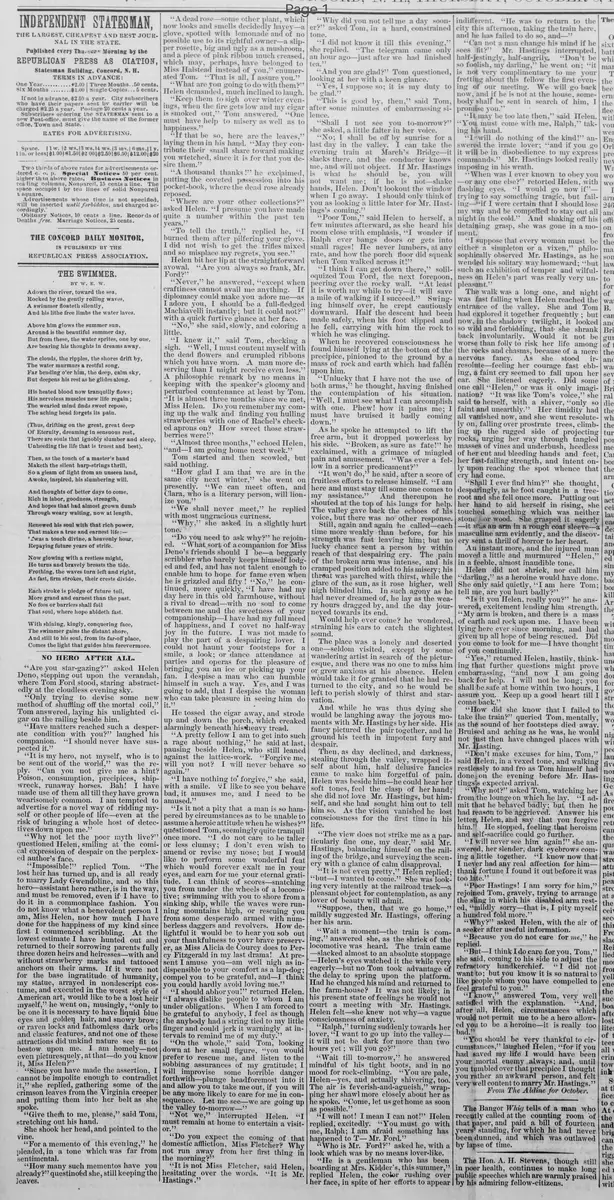
NO HERO AFTER ALL.
"Are you star-gazing?" asked Helen Deno, stepping out upon the verandah where Tom Ford stood, staring abstractedly at the cloudless evening sky.
"Only trying to devise some new method of shuffling off the mortal coil," Tom answered, laying his unlighted cigar on the railing beside him.
"Have matters reached such a desperate condition with you?" laughed his companion. "I should never have suspected it."
"It is my hero, not myself, who is to be sent out of the world," was the reply. "Can you not give me a hint? Poison, consumption, precipices, shipwreck, runaway horses. Bah! I have made use of them all till they have grown wearisomely common. I am tempted to advertise for a novel way of ridding myself or other people of life—even at the risk of bringing a whole host of detectives down upon me."
"Why not let the poor myth live?" questioned Helen, smiling at the comical expression of despair on the perplexed author's face.
"Impossible!" replied Tom. "The lost heir has turned up, and is all ready to marry Lady Gwendoline, and so this hero—assistant hero rather, is in the way, and must be removed, even if I have to do it in a commonplace fashion. You do not know what a benevolent person I am, Miss Helen, nor how much I have done for the happiness of my kind since first I commenced scribbling. At the lowest estimate I have hunted out and returned to their sorrowing parents fully three dozen heirs and heiresses—with and without strawberry marks and tattooed anchors on their arms. If it were not for the base ingratitude of humanity, my statue, arrayed in nondescript costume, and executed in the worst style of American art, would like to be a lost heir myself," he went on, musingly, "only to be one it is necessary to have liquid blue eyes and golden hair, and snowy brow; or raven locks and fathomless dark orbs and classic features, and not one of these attractions did unkind nature see fit to bestow upon me. I am homely—not even picturesquely, at that—do you know it, Miss Helen?"
"Since you have made the assertion, I cannot be impolite enough to contradict it," she replied, gathering some of the crimson leaves from the Virginia creeper and putting them into her belt as she spoke.
"Give them to me, please," said Tom, stretching out his hand.
She shook her head, and pointed to the vine.
"For a memento of this evening," he pleaded, in a tone which was far from sentimental.
"How many such mementos have you already?" questioned she, still keeping the leaves.
"A dead rose—some other plant, which now looks and smells decidedly hayey—a glove, spotted with lemonade and of no possible use to its rightful owner—a slipper rosette, big and ugly as a mushroom, and a piece of pink ribbon much creased, which may, perhaps, have belonged to Miss Halstead instead of you," enumerated Tom. "That is all, I assure you."
"What are you going to do with them?" Helen demanded, much inclined to laugh.
"Keep them to sigh over winter evenings, when the fire gets low and my cigar is smoked out," Tom answered. "One must have help to misery as well as to happiness."
"If that be so, here are the leaves," laying them in his hand. "May they contribute their small share toward making you wretched, since it is for that you desire them."
"A thousand thanks!" he exclaimed, putting the coveted possession into his pocket-book, where the dead rose already reposed.
"Where are your other collections?" asked Helen. "I presume you have made quite a number within the past ten years."
"To tell the truth," replied he, "I burned them after pilfering your glove. I did not wish to get the trifles mixed and so misplace my regrets, you see."
Helen bit her lip at the straightforward avowal. "Are you always so frank, Mr. Ford?"
"Never," he answered, "except when craftiness cannot avail me anything. If diplomacy could make you adore me—as I adore you, I should be a full-fledged Machiavelli instantly; but it could not?" with a quick furtive glance at her face.
"No," she said, slowly, and coloring a little.
"I knew it," said Tom, checking a sigh. "Well, I must content myself with the dead flowers and crumpled ribbons which you have worn. A man more deserving than I might receive even less."
A philosophic remark by no means in keeping with the speaker's gloomy and perturbed countenance at least by Tom.
"It is almost three months since we met, Miss Helen. Do you remember my coming up the walk and finding you hulling strawberries with one of Rachel's checked aprons on? How sweet those strawberries were!"
"Almost three months," echoed Helen, "and—I am going home next week."
Tom started and then scowled, but said nothing.
"How glad I am that we are in the same city next winter," she went on presently. "We can meet often, and Clara, who is a literary person, will lionize you."
"We shall never meet," he replied with most ungracious curtness.
"Why," she asked in a slightly hurt tone.
"Do you need to ask why?" he rejoined. "What sort of a companion for Miss Deno's friends should I be—a beggarly scribbler who barely keeps himself lodged and fed, and has not talent enough to enable him to hope for fame even when he is grizzled and fifty! "No," he continued, more quickly, "I have had my day here in this old farmhouse, without a rival to dread—with no soul to come between me and the sweetness of your companionship—I have had my full meed of happiness, and I covet no half-way joy in the future. I was not made to play the part of a despairing lover. I could not haunt your footsteps for a smile, a look; or dance attendance at parties and operas for the pleasure of bringing you an ice or picking up your fan. I despise a man who can humble himself in such a way. Yes, and I was going to add, that I despise the woman who can take pleasure in seeing him do it."
He tossed the cigar away, and strode up and down the porch, which creaked alarmingly beneath his heavy tread.
"A pretty fellow I am to get into such a rage about nothing," he said at last, pausing beside Helen, who still leaned against the lattice-work. "Forgive me, will you not? I will never behave so again."
"I have nothing to forgive," she said with a smile. "I like to see you behave bad, it amuses me, and I need to be amused."
"Is it not a pity that a man is so hampered by circumstances as to be unable to assume a heroic attitude when he wishes?" questioned Tom, seemingly quite tranquil once more. "I do not care to be taller or less clumsy; I don't even wish to amend or revise my nose; but I would like to perform some wonderful feat which would forever exalt me in your eyes, and earn for me your eternal gratitude. I can think of scores—snatching you from under the wheels of a locomotive; swimming with you to shore from a sinking ship, while the waves were running mountains high, or rescuing you from some desperado armed with numberless daggers and revolvers. How delightful it would be to hear you sob out your thankfulness to your brave preserver, as Miss Alicia de Courcy does to Percy Fitzgerald in my last drama! At present I amuse you—am well nigh as indispensable to your comfort as a lap-dog; compel you to be grateful, and—I think you could hardly avoid loving me."
"I should abhor you!" returned Helen. "I always dislike people to whom I am under obligations." When I am forced to be grateful to anybody, I feel as though the anybody had a string tied to my little finger and could jerk it warningly at intervals to remind me of my duty.
"On the whole," said Tom, looking down at her small figure, "you would prefer to rescue me, and listen to the sobbing assurances of my gratitude; I will improvise some horrible danger forthwith—plunge headforemost into it and allow you to take me out, if you will be any more likely to care for me in consequence. Let me see—we are going up the valley to-morrow—"
"Not we," interrupted Helen. "I must remain at home to entertain a visitor."
"Do you expect the coming of that domestic affliction, Miss Fletcher? Why not run away from her first thing in the morning?"
"It is not Miss Fletcher," said Helen, hesitating over the words. "It is Mr. Hastings."
"Why did you not tell me a day sooner?" asked Tom, in a hard, constrained tone.
"I did not know it till this evening," she replied. "The telegram came only an hour ago—just after we had finished tea."
"And you are glad?" Tom questioned looking at her with a keen glance.
"Yes, I suppose so; it is my duty to be glad."
"This is good-by, then," said Tom, after some minutes of embarrassing silence.
"Shall I not see you to-morrow?" she asked, a little falter in her voice.
"No; I shall be off by sunrise for a last day in the valley. I can take the evening train at March's Bridge—it slacks there, and the conductor knows me, and will not object. If Mr. Hastings is what he should be, you will not want me; if he is not—shake hands, Helen. Don't look out the window when I go away. I should only think of you as looking a little later for Mr. Hastings's coming."
"Poor Tom," said Helen to herself, a few minutes afterward, as she heard his room close with emphasis, "I wonder if Ralph ever bangs doors or gets into small rages! He never lumbers, at any rate, and how the porch floor did squeak when Tom walked across it!"
"I think I can get down there," soliloquized Tom Ford, the next forenoon, peering over the rocky wall. "At least it is worth my while to try—it will save a mile of walking if I succeed." Swinging himself over, he crept cautiously downward. Half the descent had been made safely, when his foot slipped and he fell, carrying with him the rock to which he was clinging.
When he recovered consciousness he found himself lying at the bottom of the precipice, pinioned to the ground by a mass of rock and earth which had fallen upon him.
"Unlucky that I have not the use of both arms," he thought, having finished the contemplation of his situation. "Well, I must see what I can accomplish with one. Phew! how it pains me; I must have bruised it badly coming down."
As he spoke he attempted to lift the free arm, but it dropped powerless by his side. "Broken, as sure as fate!" he exclaimed, with a grimace of mingled pain and amusement. "Was ever a fellow in a sorrier predicament?"
"It won't do," he said, after a score of fruitless efforts to release himself. "I am here and must stay till some one comes to my assistance." And thereupon he shouted at the top of his lungs for help.
The valley gave back the echoes of his voice, but there was no other response. Still, again and again he called—each time more weakly than before, for his strength was fast leaving him; but no lucky chance sent a person by within reach of that despairing cry. The pain of the broken arm was intense, and his cramped position added to his misery; his throat was parched with thirst, while the glare of the sun, as it rose higher, well nigh blinded him. In such agony as he had never dreamed of, he lay as the weary hours dragged by, and the day journeyed towards its end.
Would help ever come? he wondered straining his ears to catch the slightest sound.
The place was a lonely and deserted one—seldom visited, except by some wandering artist in search of the picturesque, and there was no one to miss him or grow anxious at his absence. Helen would take it for granted that he had returned to the city, and so he would be left to perish slowly of thirst and starvation.
And while he was thus dying she would be laughing away the joyous moments with Mr. Hastings by her side. His fancy pictured the pair together, and he ground his teeth in impotent fury and despair.
Then, as day declined, and darkness, stealing through the valley, wrapped itself about him, half delusive fancies came to make him forgetful of pain. Helen was beside him—he could hear her soft tones, feel the clasp of her hand; she did not love Mr. Hastings, but himself, and she had sought him out to tell him so. As the vision vanished he lost consciousness for the first time in his life.
"The view does not strike me as a particularly fine one, my dear," said Mr. Hastings, balancing himself on the railing of the bridge, and surveying the scenery with a glance of calm disapproval.
"It is not even pretty," Helen replied; "but—I wanted to come." She was looking very intently at the railroad track—a pleasant object for contemplation, as any lover of beauty will admit.
"Suppose, then, that we go home," mildly suggested Mr. Hastings, offering her his arm.
"Wait a moment—the train is coming," answered she, as the shriek of the locomotive was heard. The train came—slacked almost to an absolute stoppage—Helen's eyes watched it the while very eagerly—but no Tom took advantage of the delay to spring upon the platform.
Had he changed his mind and returned to the farm-house? It was not likely; in his present state of feelings he would not court a meeting with Mr. Hastings.
Helen felt—she knew not why—a vague consciousness of anxiety.
"Ralph," turning suddenly towards her lover, "I want to go up into the valley—it will not be dark for more than two hours yet; will you go?"
"Wait till to-morrow," he answered mindful of his tight boots, and in no mood for rock-climbing. "You are pale, Helen—yes, and actually shivering, too. The air is feverish-and-agueish," wrapping her shawl more closely about her as he spoke. "Come, let us get home as soon as possible."
"I will not! I mean I can not!" Helen replied, excitedly. "You must go with me, Ralph; I am afraid something has happened to Mr. Ford."
"Who is Mr. Ford?" asked he, with a look which was by no means lover-like.
"He is a gentleman who has been boarding at Mrs. Kidder's, this summer," replied Helen, the color rushing over her face, in spite of her efforts to appear indifferent. "He was to return to the city this afternoon, taking the train here, and he has failed to do so, and—"
"Can not a man change his mind if he sees fit?" Mr. Hastings interrupted, half-jestingly, half-angrily "Don't be so foolish, my darling," he went on; "it is not very complimentary to me your fretting about this fellow the first evening of our meeting. We will go back now, and if he is not at the house, somebody shall be sent in search of him, I promise you."
"It may be too late then," said Helen. "You must come with me, Ralph," taking his hand.
"I—will do nothing of the kind!" answered the irate lover; "and if you go it will be in disobedience to my express commands." Mr. Hastings looked really imposing in his wrath.
"When was I ever known to obey you—or any one else?" retorted Helen, with flashing eyes. "I would go now if" trying to say something tragic, but failing—if I were certain that I should lose my way and be compelled to stay out all night in the cold." And shaking off his detaining grasp, she was gone in a moment.
"I suppose that every woman must be either a simpleton or a vixen," philosophically observed Mr. Hastings, as he wended his solitary way homeward; "but such an exhibition of temper and wilfulness on Helen's part was really very unpleasant."
The walk was a long one, and night was fast falling when Helen reached the entrance of the valley. She and Tom had explored it together frequently; but now, in the shadowy twilight, it looked so wild and forbidding, that she shrank back involuntarily. Would it not be worse than folly to risk her life among the rocks and chasms, because of a mere nervous fancy. As she stood irresolute—feeling her courage fast ebbing, a faint cry seemed to fall upon her ear. She listened eagerly. Did some one call "Helen," or was it only imagination? "It was like Tom's voice," she said to herself, with a shiver, "only so faint and unearthly." Her timidity had all vanished now, and she went resolutely on, falling over prostrate trees, climbing up the rugged side of projecting rocks, urging her way through tangled masses of vines and underbush, heedless of her cut and bleeding hands and feet, her fast-failing strength, and intent only upon reaching the spot whence that cry had come.
"Shall I ever find him?" she thought despairingly, as her foot caught in a tree-root and she fell once more. Putting out her hand to aid herself in rising, she touched something which was neither stone or wood. She grasped it eagerly—it was an arm in a rough coat sleeve—a masculine arm evidently, and the discovery sent a thrill of horror to her heart.
An instant more, and the injured man moved a little and murmured "Helen," in a feeble, almost inaudible tone.
Helen did not shriek, nor call him "darling," as a heroine would have done. She only said quietly, "I am here Tom: tell me, are you hurt badly?"
"Is it you Helen, really you?" he answered, excitement lending him strength. "My arm is broken, and there is a mass of earth and rock upon me. I have been lying here ever since morning, and had given up all hope of being rescued. Did you come to look for me—I have thought of you continually."
"Yes," returned Helen, hastily, thinking that further questions might prove embarrassing, "and now I am going back for help. I will not be long; you shall be safe at home within two hours. I assure you. Keep up a good heart till I come back."
"How did she know that I failed to take the train?" queried Tom, mentally, as the sound of her footsteps died away.
Bruised and aching as he was, he would not just then have changed places with Mr. Hastings.
"Don't make excuses for him, Tom," said Helen, in a vexed tone, and walking restlessly to and fro as Tom himself had done on the evening before Mr. Hastings's expected arrival.
"Why not?" asked Tom, watching her from the lounge on which he lay. "I admit that he behaved badly; but then he had reason to be aggrieved. Answer his letter, Helen, and say that you forgive him." He stopped, feeling that heroism and self-sacrifice could go further.
"I will never see him again!" she answered, her slender, dark eyebrows coming a little together. "I know now that I never had any real affection for him—thank fortune I found it out before it was too late."
"Poor Hastings! I am sorry for him," rejoined Tom, gravely, trying to arrange the sling in which his disabled arm rested, "mildly sorry—that is, I pity myself a hundred fold more."
"Why?" asked Helen, with the air of a seeker after useful information.
"Because you do not care for me," he replied.
"But—I think I do care for you, Tom," she said, coming to his side to adjust the refractory handkerchief. "I did not want to; but you know it is so natural to like people whom you have compelled to feel grateful to you."
"I know," answered Tom, very well satisfied with the explanation.
"And, after all, Helen, circumstances which would not permit me to be a hero allowed you to be a heroine—it is really too bad."
"You should be very thankful to circumstances," laughed Helen, "for if you had saved my life I would have been your mortal enemy always; and, until you tumbled over that precipice I thought you rather an awkward person, and felt very well content to marry Mr. Hastings."
"Are you star-gazing?" asked Helen Deno, stepping out upon the verandah where Tom Ford stood, staring abstractedly at the cloudless evening sky.
"Only trying to devise some new method of shuffling off the mortal coil," Tom answered, laying his unlighted cigar on the railing beside him.
"Have matters reached such a desperate condition with you?" laughed his companion. "I should never have suspected it."
"It is my hero, not myself, who is to be sent out of the world," was the reply. "Can you not give me a hint? Poison, consumption, precipices, shipwreck, runaway horses. Bah! I have made use of them all till they have grown wearisomely common. I am tempted to advertise for a novel way of ridding myself or other people of life—even at the risk of bringing a whole host of detectives down upon me."
"Why not let the poor myth live?" questioned Helen, smiling at the comical expression of despair on the perplexed author's face.
"Impossible!" replied Tom. "The lost heir has turned up, and is all ready to marry Lady Gwendoline, and so this hero—assistant hero rather, is in the way, and must be removed, even if I have to do it in a commonplace fashion. You do not know what a benevolent person I am, Miss Helen, nor how much I have done for the happiness of my kind since first I commenced scribbling. At the lowest estimate I have hunted out and returned to their sorrowing parents fully three dozen heirs and heiresses—with and without strawberry marks and tattooed anchors on their arms. If it were not for the base ingratitude of humanity, my statue, arrayed in nondescript costume, and executed in the worst style of American art, would like to be a lost heir myself," he went on, musingly, "only to be one it is necessary to have liquid blue eyes and golden hair, and snowy brow; or raven locks and fathomless dark orbs and classic features, and not one of these attractions did unkind nature see fit to bestow upon me. I am homely—not even picturesquely, at that—do you know it, Miss Helen?"
"Since you have made the assertion, I cannot be impolite enough to contradict it," she replied, gathering some of the crimson leaves from the Virginia creeper and putting them into her belt as she spoke.
"Give them to me, please," said Tom, stretching out his hand.
She shook her head, and pointed to the vine.
"For a memento of this evening," he pleaded, in a tone which was far from sentimental.
"How many such mementos have you already?" questioned she, still keeping the leaves.
"A dead rose—some other plant, which now looks and smells decidedly hayey—a glove, spotted with lemonade and of no possible use to its rightful owner—a slipper rosette, big and ugly as a mushroom, and a piece of pink ribbon much creased, which may, perhaps, have belonged to Miss Halstead instead of you," enumerated Tom. "That is all, I assure you."
"What are you going to do with them?" Helen demanded, much inclined to laugh.
"Keep them to sigh over winter evenings, when the fire gets low and my cigar is smoked out," Tom answered. "One must have help to misery as well as to happiness."
"If that be so, here are the leaves," laying them in his hand. "May they contribute their small share toward making you wretched, since it is for that you desire them."
"A thousand thanks!" he exclaimed, putting the coveted possession into his pocket-book, where the dead rose already reposed.
"Where are your other collections?" asked Helen. "I presume you have made quite a number within the past ten years."
"To tell the truth," replied he, "I burned them after pilfering your glove. I did not wish to get the trifles mixed and so misplace my regrets, you see."
Helen bit her lip at the straightforward avowal. "Are you always so frank, Mr. Ford?"
"Never," he answered, "except when craftiness cannot avail me anything. If diplomacy could make you adore me—as I adore you, I should be a full-fledged Machiavelli instantly; but it could not?" with a quick furtive glance at her face.
"No," she said, slowly, and coloring a little.
"I knew it," said Tom, checking a sigh. "Well, I must content myself with the dead flowers and crumpled ribbons which you have worn. A man more deserving than I might receive even less."
A philosophic remark by no means in keeping with the speaker's gloomy and perturbed countenance at least by Tom.
"It is almost three months since we met, Miss Helen. Do you remember my coming up the walk and finding you hulling strawberries with one of Rachel's checked aprons on? How sweet those strawberries were!"
"Almost three months," echoed Helen, "and—I am going home next week."
Tom started and then scowled, but said nothing.
"How glad I am that we are in the same city next winter," she went on presently. "We can meet often, and Clara, who is a literary person, will lionize you."
"We shall never meet," he replied with most ungracious curtness.
"Why," she asked in a slightly hurt tone.
"Do you need to ask why?" he rejoined. "What sort of a companion for Miss Deno's friends should I be—a beggarly scribbler who barely keeps himself lodged and fed, and has not talent enough to enable him to hope for fame even when he is grizzled and fifty! "No," he continued, more quickly, "I have had my day here in this old farmhouse, without a rival to dread—with no soul to come between me and the sweetness of your companionship—I have had my full meed of happiness, and I covet no half-way joy in the future. I was not made to play the part of a despairing lover. I could not haunt your footsteps for a smile, a look; or dance attendance at parties and operas for the pleasure of bringing you an ice or picking up your fan. I despise a man who can humble himself in such a way. Yes, and I was going to add, that I despise the woman who can take pleasure in seeing him do it."
He tossed the cigar away, and strode up and down the porch, which creaked alarmingly beneath his heavy tread.
"A pretty fellow I am to get into such a rage about nothing," he said at last, pausing beside Helen, who still leaned against the lattice-work. "Forgive me, will you not? I will never behave so again."
"I have nothing to forgive," she said with a smile. "I like to see you behave bad, it amuses me, and I need to be amused."
"Is it not a pity that a man is so hampered by circumstances as to be unable to assume a heroic attitude when he wishes?" questioned Tom, seemingly quite tranquil once more. "I do not care to be taller or less clumsy; I don't even wish to amend or revise my nose; but I would like to perform some wonderful feat which would forever exalt me in your eyes, and earn for me your eternal gratitude. I can think of scores—snatching you from under the wheels of a locomotive; swimming with you to shore from a sinking ship, while the waves were running mountains high, or rescuing you from some desperado armed with numberless daggers and revolvers. How delightful it would be to hear you sob out your thankfulness to your brave preserver, as Miss Alicia de Courcy does to Percy Fitzgerald in my last drama! At present I amuse you—am well nigh as indispensable to your comfort as a lap-dog; compel you to be grateful, and—I think you could hardly avoid loving me."
"I should abhor you!" returned Helen. "I always dislike people to whom I am under obligations." When I am forced to be grateful to anybody, I feel as though the anybody had a string tied to my little finger and could jerk it warningly at intervals to remind me of my duty.
"On the whole," said Tom, looking down at her small figure, "you would prefer to rescue me, and listen to the sobbing assurances of my gratitude; I will improvise some horrible danger forthwith—plunge headforemost into it and allow you to take me out, if you will be any more likely to care for me in consequence. Let me see—we are going up the valley to-morrow—"
"Not we," interrupted Helen. "I must remain at home to entertain a visitor."
"Do you expect the coming of that domestic affliction, Miss Fletcher? Why not run away from her first thing in the morning?"
"It is not Miss Fletcher," said Helen, hesitating over the words. "It is Mr. Hastings."
"Why did you not tell me a day sooner?" asked Tom, in a hard, constrained tone.
"I did not know it till this evening," she replied. "The telegram came only an hour ago—just after we had finished tea."
"And you are glad?" Tom questioned looking at her with a keen glance.
"Yes, I suppose so; it is my duty to be glad."
"This is good-by, then," said Tom, after some minutes of embarrassing silence.
"Shall I not see you to-morrow?" she asked, a little falter in her voice.
"No; I shall be off by sunrise for a last day in the valley. I can take the evening train at March's Bridge—it slacks there, and the conductor knows me, and will not object. If Mr. Hastings is what he should be, you will not want me; if he is not—shake hands, Helen. Don't look out the window when I go away. I should only think of you as looking a little later for Mr. Hastings's coming."
"Poor Tom," said Helen to herself, a few minutes afterward, as she heard his room close with emphasis, "I wonder if Ralph ever bangs doors or gets into small rages! He never lumbers, at any rate, and how the porch floor did squeak when Tom walked across it!"
"I think I can get down there," soliloquized Tom Ford, the next forenoon, peering over the rocky wall. "At least it is worth my while to try—it will save a mile of walking if I succeed." Swinging himself over, he crept cautiously downward. Half the descent had been made safely, when his foot slipped and he fell, carrying with him the rock to which he was clinging.
When he recovered consciousness he found himself lying at the bottom of the precipice, pinioned to the ground by a mass of rock and earth which had fallen upon him.
"Unlucky that I have not the use of both arms," he thought, having finished the contemplation of his situation. "Well, I must see what I can accomplish with one. Phew! how it pains me; I must have bruised it badly coming down."
As he spoke he attempted to lift the free arm, but it dropped powerless by his side. "Broken, as sure as fate!" he exclaimed, with a grimace of mingled pain and amusement. "Was ever a fellow in a sorrier predicament?"
"It won't do," he said, after a score of fruitless efforts to release himself. "I am here and must stay till some one comes to my assistance." And thereupon he shouted at the top of his lungs for help.
The valley gave back the echoes of his voice, but there was no other response. Still, again and again he called—each time more weakly than before, for his strength was fast leaving him; but no lucky chance sent a person by within reach of that despairing cry. The pain of the broken arm was intense, and his cramped position added to his misery; his throat was parched with thirst, while the glare of the sun, as it rose higher, well nigh blinded him. In such agony as he had never dreamed of, he lay as the weary hours dragged by, and the day journeyed towards its end.
Would help ever come? he wondered straining his ears to catch the slightest sound.
The place was a lonely and deserted one—seldom visited, except by some wandering artist in search of the picturesque, and there was no one to miss him or grow anxious at his absence. Helen would take it for granted that he had returned to the city, and so he would be left to perish slowly of thirst and starvation.
And while he was thus dying she would be laughing away the joyous moments with Mr. Hastings by her side. His fancy pictured the pair together, and he ground his teeth in impotent fury and despair.
Then, as day declined, and darkness, stealing through the valley, wrapped itself about him, half delusive fancies came to make him forgetful of pain. Helen was beside him—he could hear her soft tones, feel the clasp of her hand; she did not love Mr. Hastings, but himself, and she had sought him out to tell him so. As the vision vanished he lost consciousness for the first time in his life.
"The view does not strike me as a particularly fine one, my dear," said Mr. Hastings, balancing himself on the railing of the bridge, and surveying the scenery with a glance of calm disapproval.
"It is not even pretty," Helen replied; "but—I wanted to come." She was looking very intently at the railroad track—a pleasant object for contemplation, as any lover of beauty will admit.
"Suppose, then, that we go home," mildly suggested Mr. Hastings, offering her his arm.
"Wait a moment—the train is coming," answered she, as the shriek of the locomotive was heard. The train came—slacked almost to an absolute stoppage—Helen's eyes watched it the while very eagerly—but no Tom took advantage of the delay to spring upon the platform.
Had he changed his mind and returned to the farm-house? It was not likely; in his present state of feelings he would not court a meeting with Mr. Hastings.
Helen felt—she knew not why—a vague consciousness of anxiety.
"Ralph," turning suddenly towards her lover, "I want to go up into the valley—it will not be dark for more than two hours yet; will you go?"
"Wait till to-morrow," he answered mindful of his tight boots, and in no mood for rock-climbing. "You are pale, Helen—yes, and actually shivering, too. The air is feverish-and-agueish," wrapping her shawl more closely about her as he spoke. "Come, let us get home as soon as possible."
"I will not! I mean I can not!" Helen replied, excitedly. "You must go with me, Ralph; I am afraid something has happened to Mr. Ford."
"Who is Mr. Ford?" asked he, with a look which was by no means lover-like.
"He is a gentleman who has been boarding at Mrs. Kidder's, this summer," replied Helen, the color rushing over her face, in spite of her efforts to appear indifferent. "He was to return to the city this afternoon, taking the train here, and he has failed to do so, and—"
"Can not a man change his mind if he sees fit?" Mr. Hastings interrupted, half-jestingly, half-angrily "Don't be so foolish, my darling," he went on; "it is not very complimentary to me your fretting about this fellow the first evening of our meeting. We will go back now, and if he is not at the house, somebody shall be sent in search of him, I promise you."
"It may be too late then," said Helen. "You must come with me, Ralph," taking his hand.
"I—will do nothing of the kind!" answered the irate lover; "and if you go it will be in disobedience to my express commands." Mr. Hastings looked really imposing in his wrath.
"When was I ever known to obey you—or any one else?" retorted Helen, with flashing eyes. "I would go now if" trying to say something tragic, but failing—if I were certain that I should lose my way and be compelled to stay out all night in the cold." And shaking off his detaining grasp, she was gone in a moment.
"I suppose that every woman must be either a simpleton or a vixen," philosophically observed Mr. Hastings, as he wended his solitary way homeward; "but such an exhibition of temper and wilfulness on Helen's part was really very unpleasant."
The walk was a long one, and night was fast falling when Helen reached the entrance of the valley. She and Tom had explored it together frequently; but now, in the shadowy twilight, it looked so wild and forbidding, that she shrank back involuntarily. Would it not be worse than folly to risk her life among the rocks and chasms, because of a mere nervous fancy. As she stood irresolute—feeling her courage fast ebbing, a faint cry seemed to fall upon her ear. She listened eagerly. Did some one call "Helen," or was it only imagination? "It was like Tom's voice," she said to herself, with a shiver, "only so faint and unearthly." Her timidity had all vanished now, and she went resolutely on, falling over prostrate trees, climbing up the rugged side of projecting rocks, urging her way through tangled masses of vines and underbush, heedless of her cut and bleeding hands and feet, her fast-failing strength, and intent only upon reaching the spot whence that cry had come.
"Shall I ever find him?" she thought despairingly, as her foot caught in a tree-root and she fell once more. Putting out her hand to aid herself in rising, she touched something which was neither stone or wood. She grasped it eagerly—it was an arm in a rough coat sleeve—a masculine arm evidently, and the discovery sent a thrill of horror to her heart.
An instant more, and the injured man moved a little and murmured "Helen," in a feeble, almost inaudible tone.
Helen did not shriek, nor call him "darling," as a heroine would have done. She only said quietly, "I am here Tom: tell me, are you hurt badly?"
"Is it you Helen, really you?" he answered, excitement lending him strength. "My arm is broken, and there is a mass of earth and rock upon me. I have been lying here ever since morning, and had given up all hope of being rescued. Did you come to look for me—I have thought of you continually."
"Yes," returned Helen, hastily, thinking that further questions might prove embarrassing, "and now I am going back for help. I will not be long; you shall be safe at home within two hours. I assure you. Keep up a good heart till I come back."
"How did she know that I failed to take the train?" queried Tom, mentally, as the sound of her footsteps died away.
Bruised and aching as he was, he would not just then have changed places with Mr. Hastings.
"Don't make excuses for him, Tom," said Helen, in a vexed tone, and walking restlessly to and fro as Tom himself had done on the evening before Mr. Hastings's expected arrival.
"Why not?" asked Tom, watching her from the lounge on which he lay. "I admit that he behaved badly; but then he had reason to be aggrieved. Answer his letter, Helen, and say that you forgive him." He stopped, feeling that heroism and self-sacrifice could go further.
"I will never see him again!" she answered, her slender, dark eyebrows coming a little together. "I know now that I never had any real affection for him—thank fortune I found it out before it was too late."
"Poor Hastings! I am sorry for him," rejoined Tom, gravely, trying to arrange the sling in which his disabled arm rested, "mildly sorry—that is, I pity myself a hundred fold more."
"Why?" asked Helen, with the air of a seeker after useful information.
"Because you do not care for me," he replied.
"But—I think I do care for you, Tom," she said, coming to his side to adjust the refractory handkerchief. "I did not want to; but you know it is so natural to like people whom you have compelled to feel grateful to you."
"I know," answered Tom, very well satisfied with the explanation.
"And, after all, Helen, circumstances which would not permit me to be a hero allowed you to be a heroine—it is really too bad."
"You should be very thankful to circumstances," laughed Helen, "for if you had saved my life I would have been your mortal enemy always; and, until you tumbled over that precipice I thought you rather an awkward person, and felt very well content to marry Mr. Hastings."
What sub-type of article is it?
Prose Fiction
What themes does it cover?
Love Romance
Social Manners
What keywords are associated?
Romance
Rescue
Jealousy
Heroism
Short Story
Unrequited Love
Social Class
Literary Details
Title
No Hero After All.
Key Lines
"I Should Abhor You!" Returned Helen. "I Always Dislike People To Whom I Am Under Obligations."
"But—I Think I Do Care For You, Tom," She Said, Coming To His Side To Adjust The Refractory Handkerchief.
"And, After All, Helen, Circumstances Which Would Not Permit Me To Be A Hero Allowed You To Be A Heroine—It Is Really Too Bad."