Thank you for visiting SNEWPapers!
Sign up free
Literary
July 16, 1899
Wheeling Sunday Register
Wheeling, Ohio County, West Virginia
What is this article about?
In 1846 Rome, a young revolutionary named Luigi Torreani escapes custody by boarding a balloon during a festival. Captain Guardiola pursues across the Campagna but loses him in a wooded hill near the sea. Meanwhile, in Val di Orno, Luigi's family anxiously awaits his return, suspecting his political involvement with the Liberatori society.
Clipping
OCR Quality
98%
Excellent
Full Text
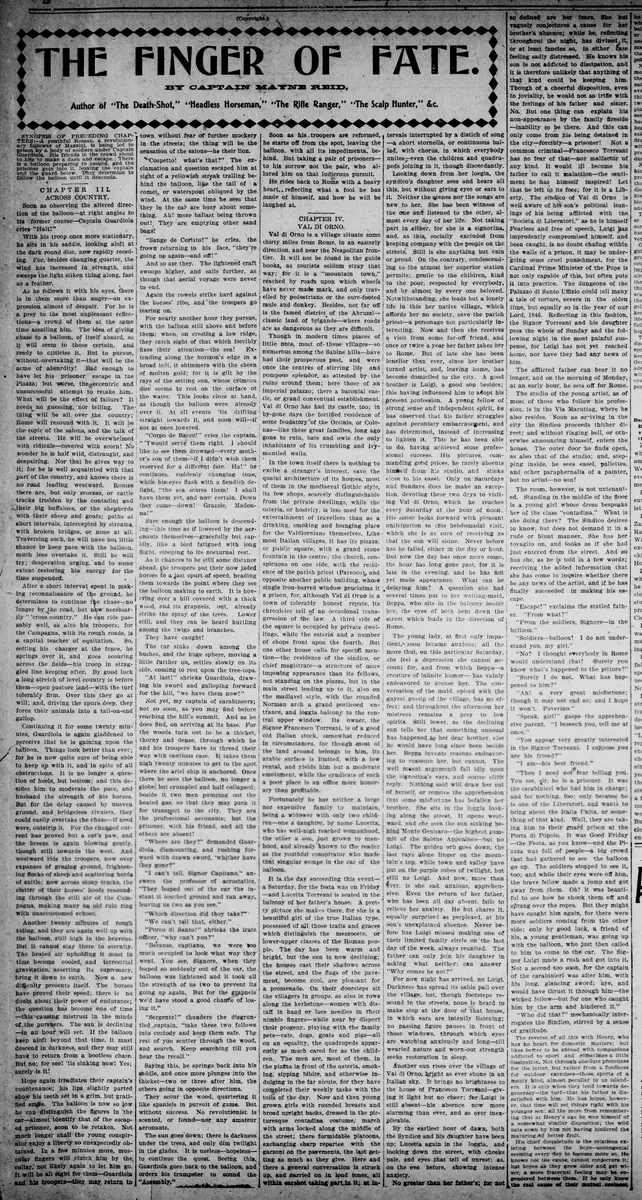
THE FINGER OF FATE
By Captain Mayne Reid,
Author of "The Death-Shot," "Headless Horseman,"
"The Rifle Rangers," "The Scalp Hunters," &c.
SYNOPSIS OF PRECEDING CHAPTERS:--A youthful Roman, a revolutionary follower of Mazzini, is being led to prison by a body of soldiers under Captain Guardiola. His friends in the crowd shout to him to make a dash and escape. There is a balloon preparing to ascend, and the prisoner gets into it, leaving the captain and the guard below. They determine to follow the balloon until it descends.
CHAPTER III.
ACROSS COUNTRY.
Soon as observing the altered direction of the balloon--at right angles to its former course--Captain Guardiola cries "Halt!"
With his troop once more stationary, he sits in his saddle, looking aloft at the dark round disc, now rapidly receding. For, besides changing quarter, the wind has increased in strength, and sweeps the light silken thing along, fast as a feather.
As he follows it with his eyes, there is in them more than anger--an expression almost of despair. For he is a prey to the most unpleasant reflections--a crowd of them at the same time assailing him. The idea of giving chase to a balloon, of itself absurd, as it will seem to those certain, and ready to criticise it. But to pursue, without overtaking it--that will be the acme of absurdity! Bad enough to have let his prisoner escape in the Piazza; but worse, the eccentric and unsuccessful attempt to retake him.
What will be the effect of failure? It needs no guessing, nor telling. The thing will be all over the country; Rome will resound with it. It will be the topic of the salons, and the talk of the streets. He will be overwhelmed with ridicule--covered with scorn! No wonder he is half wild, distraught, and despairing. Nor that he gives way to it; for he is well acquainted with that part of the country, and knows there is no road leading westward. Routes there are, but only scorza, or cattle tracks trodden by the contadini and their big buffaloes, or the shepherds with their sheep and goats; paths at short intervals, intercepted by streams, with broken bridges, or none at all.
Traversing such, he will have but little chance to keep pace with the balloon, much less overtake it. Still he will try; desperation urging, and to some extent restoring his energy for the time suspended.
After a short interval spent in making reconnaissance of the ground, he determines to continue the chase--no longer by the road, but now necessarily "cross country." He can ride passably well, as also his troopers; for the Campagna, with its rough roads, is a capital teacher of equitation. So, setting his charger at the fence, he springs over it, and goes scouring across the fields--his troop in straggled line keeping after. By good luck a long stretch of level country is before them--open pasture land--with the turf tolerably firm. Over this they go at will; and, driving the spurs deep, they force their animals into a tail-on-end gallop.
Continuing it for some twenty minutes, Guardiola is again gladdened to perceive that he is gaining upon the balloon. Things look better than ever; for he is now quite sure of being able to keep up with it, and in spite of all obstructions. It is no longer a question of heels, but bottom; and this decides him to moderate the pace, and husband the strength of his horses.
But for the delay caused by uneven ground, and bridgeless rivulets, they could easily overtake the chase--if need were, outstrip it. For the changed current has proved but a cat's paw, and the breeze is again blowing gently, though still towards the west. And westward ride the troopers, now over expanses of grazing ground, frightening flocks of sheep and scattering herds of cattle; now across stony tracks, the clatter of their horses' hoofs resounding through the still air of the Campagna, making many an old ruin ring with unaccustomed echoes.
Another twenty minutes of rough riding, and they are again well up with the balloon, still high in the heavens. But it cannot stay there to eternity. The heated air upholding it must in time become cooled, and terrestrial gravitation, asserting its supremacy, bring it down to earth. Now a new difficulty presents itself. The horses have proved their speed; there is no doubt about their power of endurance; the question has become one of time this causing mistrust in the minds of the pursuers. The sun is declining--in an hour will set. If the balloon keep aloft beyond that time, it must descend in darkness, and they may still have to return from a bootless chase.
But no; for see! 'tis sinking now! Yes; surely is it!
Hope again irradiates their captain's countenance; his lips slightly parted show his teeth set in a grim, but gratified smile. The balloon is now so low he can distinguish the figures in the car--almost identify that of the escaped prisoner, soon to be retaken. Not much longer shall the young conspirator enjoy a liberty so unexpectedly obtained. In a few minutes more, muscular fingers will clutch him by the collar, not likely again to let him go.
It will be all right for them--Guardiola and his troopers--they may return to town without fear of further mockery in the streets: the thing will be the sensation of the salons--he their lion.
"Cospetto! what's that?" The exclamation and question escaped him at sight of a yellowish streak trailing behind the balloon, like the tail of a comet, or waterspout obliqued by the wind. At the same time he sees that they in the car are busy about something. Ah! more ballast being thrown out! They are emptying other sand bags!
"Sanguo de Cristo!" he cries, the frown returning to his face, "they're going up again--and off!"
And so are they. The lightened craft swoops higher, and sails further, as though that aerial voyage were never to end.
Again the rowels strike hard against the horses' ribs, and the troopers go tearing on.
For nearly another hour they pursue with the balloon still above and before them; when, on cresting a low ridge, they catch sight of that which forcibly fixes their attention--the sea! Extending along the horizon's edge in a broad belt, it shimmers with the sheen of molten gold; for it is gilt by the rays of the setting sun, whose crimson disc seems to rest on the surface of the water. This looks close at hand as though the balloon were already over it. At all events 'tis drifting straight towards it, and soon will--if not at once lowered.
"Corpo de Bacco!" cries the captain " 'Twould serve them right. I should like to see them drowned--every mother's son of them--if I didn't wish them reserved for a different fate. Ha!" he continues, suddenly changing tone, while his eyes flash with a fiendish delight, "the sea scares them! I shall have them yet, and now certain. Down they come--down! Grazie, Madonna!"
Sure enough the balloon is descending--this time as if lowered by the aeronauts themselves--gracefully but rapidly, like a bird fatigued with long flight, stooping to its nocturnal rest.
As it chances to be still some distance ahead, the troopers put their now jaded horses to a last spurt of speed, heading them towards the point where they see the balloon making to earth. It is hovering over a hill covered with a thick wood, and its grapnels, out, already strike the spray of the trees.
Lower still, and they can be heard hurtling among the twigs and branches.
They have caught!
The car sinks down among the bushes, and the huge sphere, moving a little further on, settles slowly on its side, coming to rest upon the tree-tops.
"At last!" shrieks Guardiola, drawing his sword and galloping forward for the hill, "we have them now!"
Not yet, my captain of carabineers; not so soon, as you may find before reaching the hill's summit. And as he does find, on arriving at its base. For the woods turn out to be a thicket, thorny and dense, through which he and his troopers have to thread their way with cautious care. It takes them nigh twenty minutes to get to the spot where the aerial ship is anchored. Once there he sees the balloon, no longer a globe! but crumpled and half collapsed; beside it two men pumping out the heated gas, so that they may pack it for transport to the city. They are the professional aeronauts; but the prisoner, with his friend, and all the others are absent
"Where are they?" demanded Guardiola, dismounting, and rushing forward with drawn sword, "whither have they gone?"
"I can't tell, Signor Capitano," answers the professor of aerostatics.
"They leaped out of the car the instant it touched ground and ran away, leaving us two as you see."
"Which direction did they take?"
"We can't tell that, either."
"Porco di Santo!" shrieks the irate officer, "why can't you?"
"Because, capitano, we were both much occupied to look what way they went. You see, Signore, when they leaped so suddenly out of the car, the balloon was lightened and it took all the strength of us two to prevent its going up again. But for the grapnels we'd have stood a good chance of losing it."
"Sergente!" thunders the disgruntled captain, "take these two fellows into custody and keep them safe. The rest of you scatter through the wood, and search. Keep searching till you hear the recall."
Saying this, he springs back into his saddle, and once more plunges into the thicket--two or three after him, the others going in opposite directions.
They scour the wood, quartering it like spaniels in pursuit of game. But without success. No revolutionist is scented, or found--nor any amateur aeronauts.
The sun goes down; there is darkness under the trees, and only dim twilight in the glades. It is useless--hopeless--to continue the quest. Seeing this, Guardiola goes back to the balloon, and orders his trumpeter to sound the "Assembly."
Soon as his troopers are reformed he starts off from the spot, leaving the balloon, with all its impedimenta, behind. But taking a pair of prisoners--to his sorrow not the pair, who allured him on that ludicrous pursuit.
He rides back to Rome with a heavy heart, reflecting what a fool he has made of himself, and how he will be laughed at.
CHAPTER IV.
VAL DI ORNO.
Val di Orno is a village situate some thirty miles from Rome, in an easterly direction, and near the Neapolitan frontier. It will not be found in the guide books, as tourists seldom stray that way; for it is a mountain town, reached by roads upon which wheels have never made mark, and only travelled by pedestrians or the sure-footed mule and donkey. Besides, not far off is the famed district of the Abruzzi--classic land of brigands--where roads are as dangerous as they are difficult.
Though in modern times places of little note, most of these villages--so numerous among the Sabine hills--have had their prosperous past, and were once the centres of stirring life and pompous splendor, as attested by the ruins around them; here those of an imperial palazzo; there a baronial castle, or grand conventual establishment
Val di Orno has had its castle, too: in by-gone days the fortified residence of some feudatory of the Orsinis, or Colonnas--like these great families, long ago gone to ruin, bats and owls the only inhabitants of its crumbling and ivy-mantled walls.
In the town itself there is nothing to excite a stranger's interest, save the quaint architecture of its houses, most of them in the mediaeval Gothic style, its few shops, scarcely distinguishable from the private dwellings, while the osteria, or hostelry, is less used for the entertainment of travellers than as a drinking, smoking and lounging place for the Valdiornians themselves. Like most Italian villages, it has its piazza, or public square, with a grand stone fountain in the centre: the church, conspicuous on one side, with the residence of the parish priest (Parroco), and opposite another public building, whose single iron-barred window proclaims it a prison. For, although Val di Orno is a town of tolerably honest repute, its chronicles tell of an occasional transgression of the law. A third side of the square is occupied by private dwellings, while the osteria and a number of shops front upon the fourth. But one other house calls for special mention--the residence of the sindico, or chief magistrate--a structure of more imposing appearance than its fellows, not standing on the piazza, but in the main street leading up to it, also on the mediaeval style, with the rounded Norman arch a grand porticoed entrance, and loggia balcony to the central upper window. Its owner, the Signor Francesco Torreani, is of a good old Italian stock, somewhat reduced in circumstances, for though most of the land around belongs to him, its arable surface is limited, with a low rental, and yields him but a moderate emolument, while the syndicate of such a poor place is an office more honorary than profitable.
Fortunately he has neither a large nor expensive family to maintain, being a widower with only two children--one a daughter, by name Lucetta, who has well-nigh reached womanhood, the other a son, just grown to manhood, and already known to the reader as the youthful conspirator who made that singular escape in the car of the balloon.
It is the day succeeding this event--a Saturday, for the festa was on Friday--and Lucetta Torreani is seated in the balcony of her father's house. A pretty picture she makes there, for she is a beautiful girl of the true Italian type, possessed of all those traits and graces which distinguish the mezzoceto, or lower-upper classes of the Roman people. The day has been warm and bright, but the sun is now declining: the houses cast their shadows across the street, and the flags of the pavement, become cool, are pleasant for a promenade. On their doorsteps sit the villagers in groups, as also in rows along the kerbstone--women with distaff in hand or lace needles in their nimble fingers--while near by disport their progeny, playing with the family pets--cats, dogs, goats and pigs--all on an equality, the quadrupeds apparently as much cared for as the children. The men are, most of them, in the piazza in front of the osteria, smoking, sipping bibite, and otherwise indulging in the far niente, for they have completed their weekly tasks with the toils of the day. Now and then young grown girls with rounded breasts and broad upright backs, dressed in the picturesque contadina costume, march with arms locked along the middle of the street; there formidable platoons, exchanging sharp repartee with the garzoni on the pavements, the last getting as much as they give. Here and there a general conversation is struck up, and carried on in loud tones, all within earshot taking part in it; at intervals interrupted by a distich of song--a short stornella, or continuous ballad, with chorus, in which everybody unites even the children and quadrupeds joining in it, though discordantly.
Looking down from her loggia, the syndico's daughter sees and hears all this, but without giving eyes or ears to it. Neither the scenes nor the songs are new to her. She has been witness of the one and listened to the other, almost every day of her life. Not taking part in either, for she is a signorina, and, as this, socially excluded from keeping company with the people on the streets. Still is she anything but vain or proud. On the contrary, condescending to the utmost her superior station permits; gentle to the children, kind to the poor, respected by everybody, and by almost every one beloved.
Notwithstanding, she leads but a lonely life in this her native village, which affords her no society, save the parish priest--a personage not particularly interesting. Now and then she receives a visit from some far-off friend, and once or twice a year her father takes her to Rome. But of late she has been lonelier than ever, since her brother turned artist, and, leaving home, has become domiciled to the city. A good brother is Luigi, a good son besides; this having influenced him to adopt his present profession. A young fellow of strong sense and independent spirit, he has observed that his father struggles against pecuniary embarrassment, and has determined, instead of increasing to lighten it. This he has been able to do, having achieved some professional success. His pictures, commanding good prices, he rarely absents himself from his studio, and sticks close to his easel. Only on Saturdays and Sundays does he make an exception, devoting these two days to visiting Val di Orno, which he reaches every Saturday at the hour of noon.
His sister looks forward with pleasant anticipation to this hebdomadal visit, which she is as sure of receiving as that the sun will shine. Never before has he failed, either in the day or hour. But now the day has once more come, the hour has long gone past, for it is late in the evening, and he has not yet made appearance. What can be delaying him? A question she had several times put to her waiting-maid, Beppa, who sits in the balcony beside her, the eyes of both bent down the street which leads in the direction of Rome.
The young lady, at first only impatient, soon became anxious: all the more that, on this particular Saturday, she feels a depression she cannot account for, and from which Beppa--a creature of infinite humor--has vainly endeavored to arouse her. The conversation of the maid, spiced with the gayest gossip of the village, has no effect: and throughout the afternoon her mistress remains a prey to low spirits. Still lower, as the declining sun tells her that something unusual has happened to her dear brother, else he would have long since been beside her. Beppa invents reasons endeavoring to reassure her, but cannot. The well meant arguments fall idly upon the signorina's ears, and scarce elicit reply. Nothing said will draw her out of herself, or remove the apprehension that some misfortune has befallen her brother. She sits in the loggia looking along the street. It opens westward, and she sees the sun sinking behind Monte Gennaro--the highest summit of the Sabine Apennines--but no Luigi. The golden orb goes down, the last rays alone linger on the mountain's top, while town and valley have put on the purple robes of twilight, but still no Luigi. And now, more than ever, is she sad, anxious, apprehensive. Even the return of her father who has been all day absent, fails to relieve her anxiety. He but shares it, equally surprised as perplexed, at his son's unexplained absence. Never before has Luigi missed making one of their limited family circle on the last day of the week, always reunited. The father can only join his daughter in asking what neither can answer "Why comes he not?"
For now night has arrived, no Luigi Darkness has spread its sable pall over the village, but, though footsteps resound in the streets, none is heard to make stop at the door of that house, in which ears are intently listening; no passing figure pauses in front of those windows, through which eyes are watching anxiously and long--till wearied nature and worn-out strength seeks restoration in sleep.
Another sun rises over the village of Val di Orno, bright as ever shone in an Italian sky. It brings no brightness to the house of Francesco Torreani--giving it light but no cheer: for Luigi is still absent--his absence now more alarming than ever, and as ever inexplicable.
By the earliest hour of dawn, both the Syndico and his daughter have been up; Lucetta again in the loggia, and looking down the street, with cheeks pale, and eyes that tell of unrest; as, on the eve before, showing intense anxiety.
No greater than her father's; for not so defined are her fears. She but vaguely conjectures a cause for her brother's absence; while he, reflecting throughout the night, has divined it or at least fancies so, in either case feeling sadly distressed. He knows his son is not addicted to dissipation, and it is therefore unlikely that anything of that kind could be keeping him. Though of a cheerful disposition, even to joviality, he would not so trifle with the feelings of his father and sister.
No. But one thing can explain his non-appearance by the family fireside--inability to be there. And this can only come from his being detained in the city--forcibly--a prisoner! Not a common criminal--Francesco Torreani has no fear of that--nor malefactor of any kind. It would ill become his father to call it malaction--the sentiment he has himself inspired! Let that be left to its foes: for it is a Liberty. The sindico of Val di Orno is well aware of his son's political leanings of his being affiliated with the "Societa di Liberatori," as he is himself
Fearless and free of speech, Luigi has imprudently compromised himself, and been caught, is no doubt chafing within the walls of a prison. it may be undergoing some cruel punishment. for the Cardinal Prime Minister of the Pope is not only capable of this, but often puts it into practice. The dungeons of the Palazzo di Santo Uffizio could tell many a tale of torture, severe in the olden time. but equally so in the year of our Lord, 1846. Reflecting in this fashion, the Signor Torreani and his daughter pass the whole of Sunday and the following night in the most painful suspense, for Luigi has not yet reached home, nor have they had any news of him.
The afflicted father can bear it no longer, and on the morning of Monday, at an early hour, he sets off for Rome
The studio of the young artist, as of most of those who follow his profession, is in the Via Marutta, where he also resides. Soon as arriving in the city the Sindico proceeds thither direct; and without ringing bell, or otherwise announcing himself, enters the house. The outer door he finds open, as also that of the studio: and, stepping inside, he sees easel, pallettes, and other paraphernalia of a painter, but no artist--no son!
The room, however, is not untenanted. Standing in the middle of the floor is a young girl whose dress bespeaks her of the class "contadina." What is she doing there? The Sindico desires to know. but does not demand it in a rude or blunt manner. She has her tovaglio on, and looks as if she had just entered from the street. And so has she, as he is told in a few words; receiving the added information that she has come to inquire whether there be any news of the artist. and if he has finally succeeded in making his escape.
"Escape!" exclaims the startled father. "From what?"
"From the soldiers, Signore--in the balloon."
"Soldiers--balloon! I do not understand you, my girl."
"No? I thought everybody in Rome would understand that! Surely you know what's happened to the pittore?"
"Surely I do not. What has happened to him?"
"Ah! a very great misfortune: though it may not end so; and I hope it won't. Poverino."
"Speak, girl!" gasps the apprehensive parent. "I beseech you, tell me at once."
"You appear very greatly interested in the Signor Torreani. I suppose you are his friend?"
"I am--his best friend."
"Then I need not fear telling you. You see, sir, he is a prisoner. It was the carabinieri who had him in charge: and for nothing, too: only because he is one of the Liberatori, and wants to bring about the Italia Unita, or something of that kind. Well, they are taking him to their guard prison at the Porta di Popolo. It was Good Friday--the Festa, as you know--and the Piazza was full of people--a big crowd that had gathered to see the balloon go up. The soldiers stopped to see it, too: and while their eyes were off him, the brave fellow made a jump and got away from them. Oh! it was beautiful to see how he shook them off and sprang over the ropes. But they might have caught him again, for there were more soldiers coming from the other side: only by good luck, a friend of his, a young gentleman, was going up with the balloon, who just then called to him to come to the car. The Signor Luigi made a rush and got into it. Not a second too soon, for the captain of the carabinieri was after him, with his long, glancing sword; aye, and would have thrust it through him--the wicked fellow--but for one who caught him by the arm and hindered it."
"Who did that?" mechanically interrogates the Sindico, stirred by a sense of gratitude.
By Captain Mayne Reid,
Author of "The Death-Shot," "Headless Horseman,"
"The Rifle Rangers," "The Scalp Hunters," &c.
SYNOPSIS OF PRECEDING CHAPTERS:--A youthful Roman, a revolutionary follower of Mazzini, is being led to prison by a body of soldiers under Captain Guardiola. His friends in the crowd shout to him to make a dash and escape. There is a balloon preparing to ascend, and the prisoner gets into it, leaving the captain and the guard below. They determine to follow the balloon until it descends.
CHAPTER III.
ACROSS COUNTRY.
Soon as observing the altered direction of the balloon--at right angles to its former course--Captain Guardiola cries "Halt!"
With his troop once more stationary, he sits in his saddle, looking aloft at the dark round disc, now rapidly receding. For, besides changing quarter, the wind has increased in strength, and sweeps the light silken thing along, fast as a feather.
As he follows it with his eyes, there is in them more than anger--an expression almost of despair. For he is a prey to the most unpleasant reflections--a crowd of them at the same time assailing him. The idea of giving chase to a balloon, of itself absurd, as it will seem to those certain, and ready to criticise it. But to pursue, without overtaking it--that will be the acme of absurdity! Bad enough to have let his prisoner escape in the Piazza; but worse, the eccentric and unsuccessful attempt to retake him.
What will be the effect of failure? It needs no guessing, nor telling. The thing will be all over the country; Rome will resound with it. It will be the topic of the salons, and the talk of the streets. He will be overwhelmed with ridicule--covered with scorn! No wonder he is half wild, distraught, and despairing. Nor that he gives way to it; for he is well acquainted with that part of the country, and knows there is no road leading westward. Routes there are, but only scorza, or cattle tracks trodden by the contadini and their big buffaloes, or the shepherds with their sheep and goats; paths at short intervals, intercepted by streams, with broken bridges, or none at all.
Traversing such, he will have but little chance to keep pace with the balloon, much less overtake it. Still he will try; desperation urging, and to some extent restoring his energy for the time suspended.
After a short interval spent in making reconnaissance of the ground, he determines to continue the chase--no longer by the road, but now necessarily "cross country." He can ride passably well, as also his troopers; for the Campagna, with its rough roads, is a capital teacher of equitation. So, setting his charger at the fence, he springs over it, and goes scouring across the fields--his troop in straggled line keeping after. By good luck a long stretch of level country is before them--open pasture land--with the turf tolerably firm. Over this they go at will; and, driving the spurs deep, they force their animals into a tail-on-end gallop.
Continuing it for some twenty minutes, Guardiola is again gladdened to perceive that he is gaining upon the balloon. Things look better than ever; for he is now quite sure of being able to keep up with it, and in spite of all obstructions. It is no longer a question of heels, but bottom; and this decides him to moderate the pace, and husband the strength of his horses.
But for the delay caused by uneven ground, and bridgeless rivulets, they could easily overtake the chase--if need were, outstrip it. For the changed current has proved but a cat's paw, and the breeze is again blowing gently, though still towards the west. And westward ride the troopers, now over expanses of grazing ground, frightening flocks of sheep and scattering herds of cattle; now across stony tracks, the clatter of their horses' hoofs resounding through the still air of the Campagna, making many an old ruin ring with unaccustomed echoes.
Another twenty minutes of rough riding, and they are again well up with the balloon, still high in the heavens. But it cannot stay there to eternity. The heated air upholding it must in time become cooled, and terrestrial gravitation, asserting its supremacy, bring it down to earth. Now a new difficulty presents itself. The horses have proved their speed; there is no doubt about their power of endurance; the question has become one of time this causing mistrust in the minds of the pursuers. The sun is declining--in an hour will set. If the balloon keep aloft beyond that time, it must descend in darkness, and they may still have to return from a bootless chase.
But no; for see! 'tis sinking now! Yes; surely is it!
Hope again irradiates their captain's countenance; his lips slightly parted show his teeth set in a grim, but gratified smile. The balloon is now so low he can distinguish the figures in the car--almost identify that of the escaped prisoner, soon to be retaken. Not much longer shall the young conspirator enjoy a liberty so unexpectedly obtained. In a few minutes more, muscular fingers will clutch him by the collar, not likely again to let him go.
It will be all right for them--Guardiola and his troopers--they may return to town without fear of further mockery in the streets: the thing will be the sensation of the salons--he their lion.
"Cospetto! what's that?" The exclamation and question escaped him at sight of a yellowish streak trailing behind the balloon, like the tail of a comet, or waterspout obliqued by the wind. At the same time he sees that they in the car are busy about something. Ah! more ballast being thrown out! They are emptying other sand bags!
"Sanguo de Cristo!" he cries, the frown returning to his face, "they're going up again--and off!"
And so are they. The lightened craft swoops higher, and sails further, as though that aerial voyage were never to end.
Again the rowels strike hard against the horses' ribs, and the troopers go tearing on.
For nearly another hour they pursue with the balloon still above and before them; when, on cresting a low ridge, they catch sight of that which forcibly fixes their attention--the sea! Extending along the horizon's edge in a broad belt, it shimmers with the sheen of molten gold; for it is gilt by the rays of the setting sun, whose crimson disc seems to rest on the surface of the water. This looks close at hand as though the balloon were already over it. At all events 'tis drifting straight towards it, and soon will--if not at once lowered.
"Corpo de Bacco!" cries the captain " 'Twould serve them right. I should like to see them drowned--every mother's son of them--if I didn't wish them reserved for a different fate. Ha!" he continues, suddenly changing tone, while his eyes flash with a fiendish delight, "the sea scares them! I shall have them yet, and now certain. Down they come--down! Grazie, Madonna!"
Sure enough the balloon is descending--this time as if lowered by the aeronauts themselves--gracefully but rapidly, like a bird fatigued with long flight, stooping to its nocturnal rest.
As it chances to be still some distance ahead, the troopers put their now jaded horses to a last spurt of speed, heading them towards the point where they see the balloon making to earth. It is hovering over a hill covered with a thick wood, and its grapnels, out, already strike the spray of the trees.
Lower still, and they can be heard hurtling among the twigs and branches.
They have caught!
The car sinks down among the bushes, and the huge sphere, moving a little further on, settles slowly on its side, coming to rest upon the tree-tops.
"At last!" shrieks Guardiola, drawing his sword and galloping forward for the hill, "we have them now!"
Not yet, my captain of carabineers; not so soon, as you may find before reaching the hill's summit. And as he does find, on arriving at its base. For the woods turn out to be a thicket, thorny and dense, through which he and his troopers have to thread their way with cautious care. It takes them nigh twenty minutes to get to the spot where the aerial ship is anchored. Once there he sees the balloon, no longer a globe! but crumpled and half collapsed; beside it two men pumping out the heated gas, so that they may pack it for transport to the city. They are the professional aeronauts; but the prisoner, with his friend, and all the others are absent
"Where are they?" demanded Guardiola, dismounting, and rushing forward with drawn sword, "whither have they gone?"
"I can't tell, Signor Capitano," answers the professor of aerostatics.
"They leaped out of the car the instant it touched ground and ran away, leaving us two as you see."
"Which direction did they take?"
"We can't tell that, either."
"Porco di Santo!" shrieks the irate officer, "why can't you?"
"Because, capitano, we were both much occupied to look what way they went. You see, Signore, when they leaped so suddenly out of the car, the balloon was lightened and it took all the strength of us two to prevent its going up again. But for the grapnels we'd have stood a good chance of losing it."
"Sergente!" thunders the disgruntled captain, "take these two fellows into custody and keep them safe. The rest of you scatter through the wood, and search. Keep searching till you hear the recall."
Saying this, he springs back into his saddle, and once more plunges into the thicket--two or three after him, the others going in opposite directions.
They scour the wood, quartering it like spaniels in pursuit of game. But without success. No revolutionist is scented, or found--nor any amateur aeronauts.
The sun goes down; there is darkness under the trees, and only dim twilight in the glades. It is useless--hopeless--to continue the quest. Seeing this, Guardiola goes back to the balloon, and orders his trumpeter to sound the "Assembly."
Soon as his troopers are reformed he starts off from the spot, leaving the balloon, with all its impedimenta, behind. But taking a pair of prisoners--to his sorrow not the pair, who allured him on that ludicrous pursuit.
He rides back to Rome with a heavy heart, reflecting what a fool he has made of himself, and how he will be laughed at.
CHAPTER IV.
VAL DI ORNO.
Val di Orno is a village situate some thirty miles from Rome, in an easterly direction, and near the Neapolitan frontier. It will not be found in the guide books, as tourists seldom stray that way; for it is a mountain town, reached by roads upon which wheels have never made mark, and only travelled by pedestrians or the sure-footed mule and donkey. Besides, not far off is the famed district of the Abruzzi--classic land of brigands--where roads are as dangerous as they are difficult.
Though in modern times places of little note, most of these villages--so numerous among the Sabine hills--have had their prosperous past, and were once the centres of stirring life and pompous splendor, as attested by the ruins around them; here those of an imperial palazzo; there a baronial castle, or grand conventual establishment
Val di Orno has had its castle, too: in by-gone days the fortified residence of some feudatory of the Orsinis, or Colonnas--like these great families, long ago gone to ruin, bats and owls the only inhabitants of its crumbling and ivy-mantled walls.
In the town itself there is nothing to excite a stranger's interest, save the quaint architecture of its houses, most of them in the mediaeval Gothic style, its few shops, scarcely distinguishable from the private dwellings, while the osteria, or hostelry, is less used for the entertainment of travellers than as a drinking, smoking and lounging place for the Valdiornians themselves. Like most Italian villages, it has its piazza, or public square, with a grand stone fountain in the centre: the church, conspicuous on one side, with the residence of the parish priest (Parroco), and opposite another public building, whose single iron-barred window proclaims it a prison. For, although Val di Orno is a town of tolerably honest repute, its chronicles tell of an occasional transgression of the law. A third side of the square is occupied by private dwellings, while the osteria and a number of shops front upon the fourth. But one other house calls for special mention--the residence of the sindico, or chief magistrate--a structure of more imposing appearance than its fellows, not standing on the piazza, but in the main street leading up to it, also on the mediaeval style, with the rounded Norman arch a grand porticoed entrance, and loggia balcony to the central upper window. Its owner, the Signor Francesco Torreani, is of a good old Italian stock, somewhat reduced in circumstances, for though most of the land around belongs to him, its arable surface is limited, with a low rental, and yields him but a moderate emolument, while the syndicate of such a poor place is an office more honorary than profitable.
Fortunately he has neither a large nor expensive family to maintain, being a widower with only two children--one a daughter, by name Lucetta, who has well-nigh reached womanhood, the other a son, just grown to manhood, and already known to the reader as the youthful conspirator who made that singular escape in the car of the balloon.
It is the day succeeding this event--a Saturday, for the festa was on Friday--and Lucetta Torreani is seated in the balcony of her father's house. A pretty picture she makes there, for she is a beautiful girl of the true Italian type, possessed of all those traits and graces which distinguish the mezzoceto, or lower-upper classes of the Roman people. The day has been warm and bright, but the sun is now declining: the houses cast their shadows across the street, and the flags of the pavement, become cool, are pleasant for a promenade. On their doorsteps sit the villagers in groups, as also in rows along the kerbstone--women with distaff in hand or lace needles in their nimble fingers--while near by disport their progeny, playing with the family pets--cats, dogs, goats and pigs--all on an equality, the quadrupeds apparently as much cared for as the children. The men are, most of them, in the piazza in front of the osteria, smoking, sipping bibite, and otherwise indulging in the far niente, for they have completed their weekly tasks with the toils of the day. Now and then young grown girls with rounded breasts and broad upright backs, dressed in the picturesque contadina costume, march with arms locked along the middle of the street; there formidable platoons, exchanging sharp repartee with the garzoni on the pavements, the last getting as much as they give. Here and there a general conversation is struck up, and carried on in loud tones, all within earshot taking part in it; at intervals interrupted by a distich of song--a short stornella, or continuous ballad, with chorus, in which everybody unites even the children and quadrupeds joining in it, though discordantly.
Looking down from her loggia, the syndico's daughter sees and hears all this, but without giving eyes or ears to it. Neither the scenes nor the songs are new to her. She has been witness of the one and listened to the other, almost every day of her life. Not taking part in either, for she is a signorina, and, as this, socially excluded from keeping company with the people on the streets. Still is she anything but vain or proud. On the contrary, condescending to the utmost her superior station permits; gentle to the children, kind to the poor, respected by everybody, and by almost every one beloved.
Notwithstanding, she leads but a lonely life in this her native village, which affords her no society, save the parish priest--a personage not particularly interesting. Now and then she receives a visit from some far-off friend, and once or twice a year her father takes her to Rome. But of late she has been lonelier than ever, since her brother turned artist, and, leaving home, has become domiciled to the city. A good brother is Luigi, a good son besides; this having influenced him to adopt his present profession. A young fellow of strong sense and independent spirit, he has observed that his father struggles against pecuniary embarrassment, and has determined, instead of increasing to lighten it. This he has been able to do, having achieved some professional success. His pictures, commanding good prices, he rarely absents himself from his studio, and sticks close to his easel. Only on Saturdays and Sundays does he make an exception, devoting these two days to visiting Val di Orno, which he reaches every Saturday at the hour of noon.
His sister looks forward with pleasant anticipation to this hebdomadal visit, which she is as sure of receiving as that the sun will shine. Never before has he failed, either in the day or hour. But now the day has once more come, the hour has long gone past, for it is late in the evening, and he has not yet made appearance. What can be delaying him? A question she had several times put to her waiting-maid, Beppa, who sits in the balcony beside her, the eyes of both bent down the street which leads in the direction of Rome.
The young lady, at first only impatient, soon became anxious: all the more that, on this particular Saturday, she feels a depression she cannot account for, and from which Beppa--a creature of infinite humor--has vainly endeavored to arouse her. The conversation of the maid, spiced with the gayest gossip of the village, has no effect: and throughout the afternoon her mistress remains a prey to low spirits. Still lower, as the declining sun tells her that something unusual has happened to her dear brother, else he would have long since been beside her. Beppa invents reasons endeavoring to reassure her, but cannot. The well meant arguments fall idly upon the signorina's ears, and scarce elicit reply. Nothing said will draw her out of herself, or remove the apprehension that some misfortune has befallen her brother. She sits in the loggia looking along the street. It opens westward, and she sees the sun sinking behind Monte Gennaro--the highest summit of the Sabine Apennines--but no Luigi. The golden orb goes down, the last rays alone linger on the mountain's top, while town and valley have put on the purple robes of twilight, but still no Luigi. And now, more than ever, is she sad, anxious, apprehensive. Even the return of her father who has been all day absent, fails to relieve her anxiety. He but shares it, equally surprised as perplexed, at his son's unexplained absence. Never before has Luigi missed making one of their limited family circle on the last day of the week, always reunited. The father can only join his daughter in asking what neither can answer "Why comes he not?"
For now night has arrived, no Luigi Darkness has spread its sable pall over the village, but, though footsteps resound in the streets, none is heard to make stop at the door of that house, in which ears are intently listening; no passing figure pauses in front of those windows, through which eyes are watching anxiously and long--till wearied nature and worn-out strength seeks restoration in sleep.
Another sun rises over the village of Val di Orno, bright as ever shone in an Italian sky. It brings no brightness to the house of Francesco Torreani--giving it light but no cheer: for Luigi is still absent--his absence now more alarming than ever, and as ever inexplicable.
By the earliest hour of dawn, both the Syndico and his daughter have been up; Lucetta again in the loggia, and looking down the street, with cheeks pale, and eyes that tell of unrest; as, on the eve before, showing intense anxiety.
No greater than her father's; for not so defined are her fears. She but vaguely conjectures a cause for her brother's absence; while he, reflecting throughout the night, has divined it or at least fancies so, in either case feeling sadly distressed. He knows his son is not addicted to dissipation, and it is therefore unlikely that anything of that kind could be keeping him. Though of a cheerful disposition, even to joviality, he would not so trifle with the feelings of his father and sister.
No. But one thing can explain his non-appearance by the family fireside--inability to be there. And this can only come from his being detained in the city--forcibly--a prisoner! Not a common criminal--Francesco Torreani has no fear of that--nor malefactor of any kind. It would ill become his father to call it malaction--the sentiment he has himself inspired! Let that be left to its foes: for it is a Liberty. The sindico of Val di Orno is well aware of his son's political leanings of his being affiliated with the "Societa di Liberatori," as he is himself
Fearless and free of speech, Luigi has imprudently compromised himself, and been caught, is no doubt chafing within the walls of a prison. it may be undergoing some cruel punishment. for the Cardinal Prime Minister of the Pope is not only capable of this, but often puts it into practice. The dungeons of the Palazzo di Santo Uffizio could tell many a tale of torture, severe in the olden time. but equally so in the year of our Lord, 1846. Reflecting in this fashion, the Signor Torreani and his daughter pass the whole of Sunday and the following night in the most painful suspense, for Luigi has not yet reached home, nor have they had any news of him.
The afflicted father can bear it no longer, and on the morning of Monday, at an early hour, he sets off for Rome
The studio of the young artist, as of most of those who follow his profession, is in the Via Marutta, where he also resides. Soon as arriving in the city the Sindico proceeds thither direct; and without ringing bell, or otherwise announcing himself, enters the house. The outer door he finds open, as also that of the studio: and, stepping inside, he sees easel, pallettes, and other paraphernalia of a painter, but no artist--no son!
The room, however, is not untenanted. Standing in the middle of the floor is a young girl whose dress bespeaks her of the class "contadina." What is she doing there? The Sindico desires to know. but does not demand it in a rude or blunt manner. She has her tovaglio on, and looks as if she had just entered from the street. And so has she, as he is told in a few words; receiving the added information that she has come to inquire whether there be any news of the artist. and if he has finally succeeded in making his escape.
"Escape!" exclaims the startled father. "From what?"
"From the soldiers, Signore--in the balloon."
"Soldiers--balloon! I do not understand you, my girl."
"No? I thought everybody in Rome would understand that! Surely you know what's happened to the pittore?"
"Surely I do not. What has happened to him?"
"Ah! a very great misfortune: though it may not end so; and I hope it won't. Poverino."
"Speak, girl!" gasps the apprehensive parent. "I beseech you, tell me at once."
"You appear very greatly interested in the Signor Torreani. I suppose you are his friend?"
"I am--his best friend."
"Then I need not fear telling you. You see, sir, he is a prisoner. It was the carabinieri who had him in charge: and for nothing, too: only because he is one of the Liberatori, and wants to bring about the Italia Unita, or something of that kind. Well, they are taking him to their guard prison at the Porta di Popolo. It was Good Friday--the Festa, as you know--and the Piazza was full of people--a big crowd that had gathered to see the balloon go up. The soldiers stopped to see it, too: and while their eyes were off him, the brave fellow made a jump and got away from them. Oh! it was beautiful to see how he shook them off and sprang over the ropes. But they might have caught him again, for there were more soldiers coming from the other side: only by good luck, a friend of his, a young gentleman, was going up with the balloon, who just then called to him to come to the car. The Signor Luigi made a rush and got into it. Not a second too soon, for the captain of the carabinieri was after him, with his long, glancing sword; aye, and would have thrust it through him--the wicked fellow--but for one who caught him by the arm and hindered it."
"Who did that?" mechanically interrogates the Sindico, stirred by a sense of gratitude.
What sub-type of article is it?
Prose Fiction
What themes does it cover?
Liberty Freedom
Political
What keywords are associated?
Balloon Escape
Revolutionary Prisoner
Captain Guardiola
Luigi Torreani
Val Di Orno
Italian Revolution
1846 Rome
What entities or persons were involved?
By Captain Mayne Reid, Author Of "The Death Shot," "Headless Horseman," "The Rifle Rangers," "The Scalp Hunters," &C.
Literary Details
Title
The Finger Of Fate
Author
By Captain Mayne Reid, Author Of "The Death Shot," "Headless Horseman," "The Rifle Rangers," "The Scalp Hunters," &C.