Thank you for visiting SNEWPapers!
Sign up free
The New Hampshire Gazette
Portsmouth, Rockingham County, New Hampshire
What is this article about?
Extract of a 1806 letter from a gentleman in New Orleans describing his six-week barge journey down the low-water Ohio and Mississippi rivers, facing navigation hazards like planters and sawyers, observing wildlife, Native American tribes, fertile lands, and river geography from March 30 to May 14.
Clipping
OCR Quality
Full Text
BALTIMORE, June 21.
Extract of a letter from a gentleman in New Orleans, to his friend in this City, dated, May 14, 1806.
"Dear Sir,
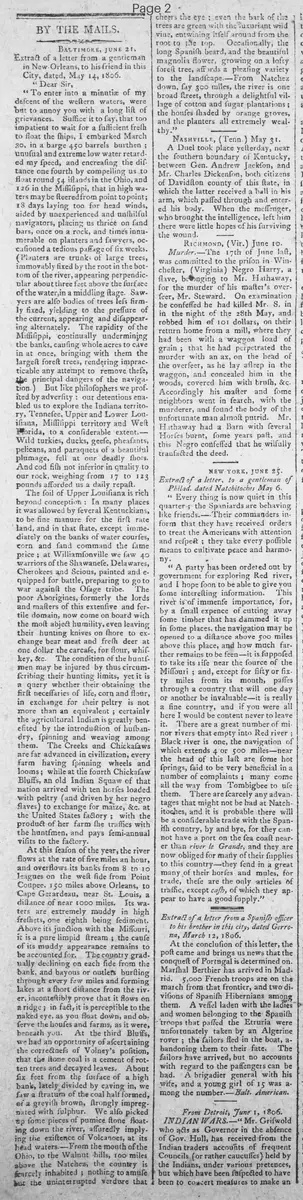
To enter into a minutiae of my descent of the western waters, were but to annoy you with a long list of grievances. Suffice it to say, that too impatient to wait for a sufficient fresh to float the ships. I embarked March 30, in a barge 450 barrels burthen; unusual and extreme low water retarded my speed, and increasing the distance one fourth by compelling us to float round 54 islands in the Ohio, and 126 in the Mississippi, that in high waters may be steered from point to point; 18 days laying too for head winds, aided by unexperienced and unskilful navigators, placing us thrice on sands and bars, once on a rock, and times innumerable on planters and sawyers, occasioned a tedious passage of six weeks.
(Planters are trunks of large trees, immovably fixed by the root in the bottom of the river, appearing perpendicular about three feet above the surface of the water in a middling stage. Sawyers are also bodies of trees less firmly fixed, yielding to the pressure of the current, appearing and disappearing alternately. The rapidity of the Mississippi, continually undermining the banks, causing whole acres to cave in at once, bringing with them the largest forest trees, rendering impracticable any attempt to remove these, the principal dangers of the navigation.) But like philosophers we profited by adversity: our detentions enabled us to explore the Indiana territory, Tennessee, Upper and Lower Louisiana, Mississippi territory and West Florida, to a considerable extent.-- Wild turkies, ducks, geese, pheasants, pelicans, and paraquets of a beautiful plumage, fell at our deadly shots. And cod fish not inferior in quality to our rock, weighing from 17 to 123 pounds afforded us a daily repast. The soil of Upper Louisiana is rich beyond conception: In many places it was allowed by several Kentuckians, to be fine manure for the first rate land, and in that state, except immediately on the banks of water courses, corn and [illegible] command the same price; at Williamsonville we saw 40 warriors of the Shawanese, Delawares, Cherokees and Sioux, painted and equipped for battle, preparing to go to war against the Osage tribe. The poor Aborigines, formerly the lords and masters of this extensive and fertile domain, now come on board with the most abject humility, even leaving their hunting knives on shore to exchange bear meat and fresh deer at one dollar the carcass, for flour, whiskey, &c. The condition of the huntsmen may be injured by thus circumscribing their hunting limits, yet it is a query whether their obtaining the first necessaries of life, corn and flour, in exchange for their peltry is not more than an equivalent; certainly the agricultural Indian is greatly benefited by the introduction of husbandry, spinning and weaving among them. The Creeks and Chickasaws are far advanced in civilization, every farm having spinning wheels and looms: while at the fourth Chickasaw Bluffs, an old Indian Squaw of that nation arrived with ten horses loaded with peltry (and driven by her negro slaves) to exchange for maize, &c. at the United States factory: with the product of her farm she traffics with the huntsmen, and pays semi-annual visits to the factory. At this season of the year, the river flows at the rate of five miles an hour, and overflows its banks from 8 to 10 leagues on the west side from Point Coupee, 150 miles above Orleans, to Cape Gerardeau, near St. Louis, a distance of near 1000 miles. Its waters are extremely muddy in high freshets, one eighth being sediment. Above its junction with the Missouri, it is a pure limpid stream; the cause of its muddy appearance remains to be accounted for. The country gradually declining on each side from the bank, and bayous or outlets bursting through every few miles and forming lakes at a short distance from the river, incontestibly prove that it flows on a ridge; in fact, it is perceptible to the naked eye, as you float down, and observe the houses and farms, as it were, beneath you. At the third Bluffs, we had an opportunity of ascertaining the correctness of Volney's position, that the stone coal is a cement of rotten trees and decayed leaves. About six feet from the surface of a high bank, lately divided by caving in, we saw a stratum of the coal half formed, of a greyish brown, strongly impregnated with sulphur. We also picked up some pieces of pumice stone floating down the river, assuredly implying the existence of Volcanoes, at its head waters.-From the mouth of the Ohio, to the Walnut hills, 100 miles above the Natchez, the country is scarcely inhabited; nothing to amuse but the uninterrupted verdure that cheers the eye; even the bark of the trees are green with the luxuriant wild vine, entwining itself around from the root to the top. Occasionally, the long Spanish beard, and the beautiful magnolia flower, growing on a lofty forest tree, affords a pleasing variety to the landscape. From Natchez down, say 300 miles, the river is one broad street, through a delightful village of cotton and sugar plantations; the houses shaded by orange groves, and the planters all extremely wealthy."
What sub-type of article is it?
What themes does it cover?
What keywords are associated?
Where did it happen?
Story Details
Location
Ohio River, Mississippi River, Indiana Territory, Tennessee, Upper And Lower Louisiana, Mississippi Territory, West Florida
Event Date
March 30 To May 14, 1806
Story Details
A gentleman's impatient embarkation on March 30, 1806, in a barge down the low-water Ohio and Mississippi rivers leads to a six-week journey hampered by winds, unskilled navigators, and hazards like planters and sawyers; detentions allow exploration of territories, hunting wildlife, observing rich soils, Native American interactions, and river phenomena.