Thank you for visiting SNEWPapers!
Sign up free
The Enquirer
Richmond, Henrico County, Virginia
What is this article about?
Judge Toulmin addresses the Grand Jury in Washington County, Mississippi Territory, warning against rumored settler plans to attack Mobile in Spanish West Florida. He argues such unauthorized expeditions violate U.S. law, Constitution, and international principles, citing Vattel and federal statutes prohibiting private wars.
Clipping
OCR Quality
Full Text
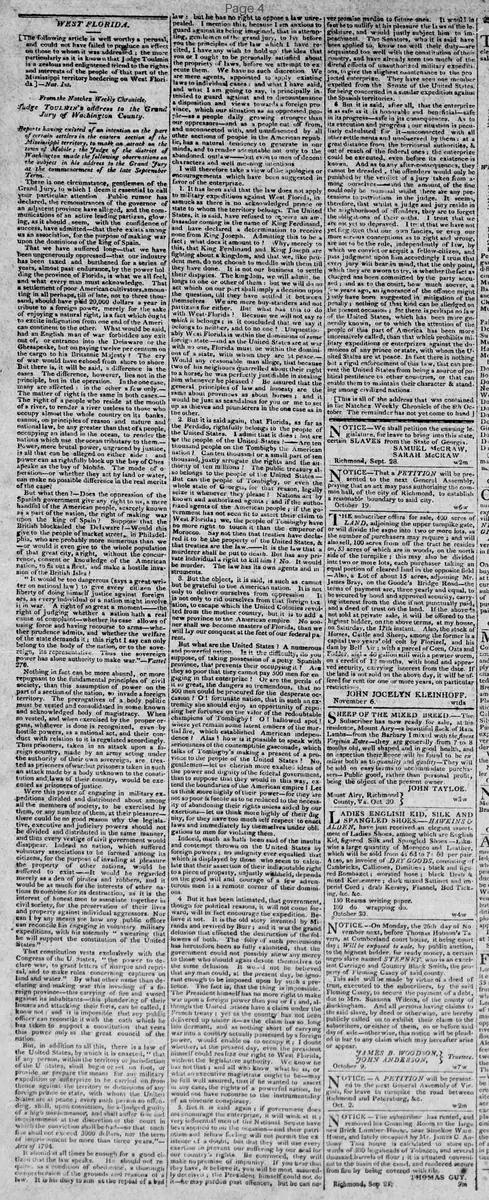
The following article is well worthy a perusal, and could not have failed to produce an effect on those to whom it was addressed; the more particularly as it is known that Judge Toulmin is a zealous and enlightened friend to the rights and interests of the people of that part of the Mississippi territory bordering on West Florida—Nat. Int.
From the Natchez Weekly Chronicle.
Judge Toulmin's address to the Grand Jury of Washington County.
Reports having existed of an intention on the part of certain settlers in the eastern section of the Mississippi territory, to make an attack on the town of Mobile; the Judge of the district of Washington made the following observations on the subject in his address to the Grand Jury at the commencement of the late September Term.
There is one circumstance, gentlemen of the Grand Jury, to which I deem it essential to call your particular attention. Public rumor has declared, the remonstrances of the governor of an adjacent province have alleged, and the communications of an active leading partizan, glowing, as it should seem, with the confidence of success, have admitted—that there exists among us an association, for the purpose of making war upon the dominions of the king of Spain.
That we have suffered long—that we have been ungenerously oppressed—that our industry has been taxed and burthened for a series of years, almost past endurance, by the power holding the province of Florida, is what we all feel, and what every man must acknowledge. That a settlement of poor American cultivators, amounting in all perhaps, till of late, not to three thousand, should have paid 20,000 dollars a year in tribute to a foreign power, merely for the sake of enjoying a natural right, is a fact which ought to excite indignation from one end of the American continent to the other. What would be said, had an English man of war forbidden any exit out of, or entrance into the Delaware or the Chesapeake, but on paying twelve per centum on the cargo to his Britannic Majesty? The cry of war would have echoed from shore to shore.
But there is, it will be said, a difference in the cases. The difference, however, lies not in the principle, but in the operation. In the one case, many are affected: in the other a few only. The matter of right is the same in both cases. The right of a people who reside at the mouth of a river, to render a river useless to those who occupy almost the whole country on its banks, cannot, on principles of reason and nature and national law, be any greater than that of a people, occupying an island in the ocean, to render the nations which use the ocean tributary to them. Power, mere brutal power, ungraced by justice, is all that can be alleged on either side: and power can as rightfully block up the bay of Chesapeake as the bay of Mobile. The mode of operation—or whether they act by land or water, can make no possible difference in the real merits of the case!
But what then?—Does the oppression of the Spanish government give any right to us, a mere handful of the American people, scarcely known as a part of the nation, the right of making war upon the king of Spain? Suppose that the British blockaded the Delaware? Would this give to the people of Market Street, in Philadelphia, who are probably more numerous than we—or would it even give to the whole population of that great city, a right, without the concurrence, consent or knowledge of the American nation, to fit out a fleet, and make a hostile invasion of the British Isles?
'It would be too dangerous (says a great writer on national law) to give every citizen the liberty of doing himself justice against foreigners, as every individual of a nation might involve it in war. A right of so great a moment—the right of judging whether a nation hath a real cause of complaint—whether its case allows of using force and having recourse to arms—whether prudence admits, and whether the welfare of the state demands it; this right I say can only belong to the body of the nation, or to the sovereign, its representative. Thus the sovereign power has alone authority to make war.'—Vattel, 270.
Nothing in fact can be more absurd, or more repugnant to the fundamental principles of civil society, than this assumption of power on the part of a section of the nation, to invade a foreign territory. The prerogatives of a body politic must be vested and consolidated in some known and acknowledged body of magistracy. When so vested, and when exercised by the proper organs, whatever is done is recognized, even by hostile powers, as a national act, and their conduct with relation to it is regulated accordingly. Thus prisoners, taken in an attack upon a foreign country, made by an army acting under the authority of their own sovereign, are treated as prisoners of war: but prisoners taken in such an attack made by a body unknown to the constitution and laws of their country, would be executed as prisoners of justice.
Were this power of engaging in military expeditions divided and distributed about among all the members of society, to be exercised by them, or any number of them, at their pleasure—there could be no good reason why the legislative, executive and judiciary powers should not be divided and distributed in the same manner, and thus every vestige of civil government would disappear. Indeed no nation, which suffered voluntary associations to be formed among its citizens, for the purpose of invading at pleasure the property of other nations, would be suffered to exist—It would be regarded merely as a den of pirates and robbers, and it would be as much for the interests of other nations to combine for its destruction, as it is the interest of honest men to associate together in civil society, for the preservation of their lives and property against individual aggressors. Nor can I by any means see how any public officer can reconcile his engaging in voluntary military expeditions, with his solemnly 'swearing that he will support the constitution of the United States.'
That constitution vests exclusively with the Congress of the U. States, 'the power to declare war, to grant letters of marque and reprisal, and to make rules concerning captures on land and water.' By what other name than declaring and making war this invading of a foreign province—this carrying of fire and sword against its inhabitants—this plundering of their houses and attacking their forts, can be called, I know not: and it is impossible that any public officer can reconcile it with the oath which he has taken to support a constitution that vests this power only in the great council of the nation.
But, in addition to all this, there is a law of the United States, by which it is enacted, 'that if any person, within the territory or jurisdiction of the U. States, shall begin or set on foot, or provide or prepare the means for any military expedition or enterprise to be carried on from thence against the territory or dominions of any foreign prince or state, with whom the United States are at peace; every such person so offending, shall, upon conviction, be adjudged guilty of a high misdemeanor, and shall suffer fine and imprisonment at the discretion of the court in which the conviction shall be had—so that such fine shall not exceed 3000 dollars, nor the term of imprisonment be more than three years.'—Acts of 1794.
It should at all times be enough for a good citizen that the law speaks. He should not require, as a condition of obedience, a thorough comprehension of the grounds and reasons of a law. It is his duty to aim at the repeal of a bad law: but he has no right to oppose a law unrepealed. I mention this, because I am anxious to guard against its being imagined, that in attempting, gentlemen of the grand jury, to lay before you the principles of the law which I have recited, I have any wish to hold up the idea that you or I ought to be personally satisfied about the propriety of laws, before we attempt to execute them. We have no such discretion. We are mere agents, appointed to apply existing laws to individual cases: and what I have said, and what I am going to say, is principally intended to guard against and to discountenance a disposition and views towards a foreign province, which our situation as an oppressed people—as a people daily growing stronger than our oppressors—and as a people cut off from, and unconnected with, and uninfluenced by all other sections of people in the American republic, has a natural tendency to generate in our minds, and to render acceptable not only to the abandoned outlaw—but even to men of decent characters and well meaning intentions.
I will therefore take a view of the apologies or encouragements which have been suggested in favor of the enterprize.
1. It has been said that the law does not apply to military expeditions against West Florida, inasmuch as there is no acknowledged prince or state to whom the territory belongs. The United States, it is said, have refused to receive an ambassador coming in the name of King Ferdinand, and have declared a determination to receive none from King Joseph. Admitting this to be a fact; what does it amount to? Why, merely to this, that King Ferdinand and King Joseph are fighting about a kingdom, and that we, like prudent men, do not choose to meddle with them till they have done. It is not our business to settle their disputes. The kingdom, we will admit, belongs to one or other of them: but we will do no act which on our part shall imply a decision upon the question, till they have settled it between themselves. We are mere by-standers and not partizans for either. But what has this to do with West-Florida? Because we will not say to which it belongs; is it concluded that we say it belongs to neither, and to no one? Unquestionably West Florida is within the dominions of some foreign state—and as the United States are at war with no one, Florida must be within the dominions of a state, with whom they are at peace. Would any reasonable man allege, that because two of his neighbors quarrelled about their right to a horse, he was perfectly justifiable in stealing him whenever he pleased? Be assured that the general principles of law and honesty are the same about provinces as about horses; and it would be just as scandalous for you or me to set up as thieves and plunderers in the one case as in the other.
2. But it is said again, that Florida, as far as the Perdido, rightfully belongs to the people of the United States. I admit that it does; but are we the people of the United States?—Are ten thousand people on the Tombigby the American nation? Can ten thousand or a small part of ten thousand, justly arrogate the rights and the authority of ten millions? The public treasury also belongs to the people of the United States. But can the people of Tombigby, or even the whole state of Georgia, for that reason, legally seize it whenever they please? Nations act by known and authorized agents; and if the authorized agents of the American people; if the government has not seen fit to assert their claim to West Florida; we, the people of Tombigby have no more right to touch it than the emperor of Morocco. Say not then that treaties have declared it to be the property of the United States, & that treaties are the law. It is the law that a murderer shall be put to death. But has any private individual a right to kill him? No. It would be murder. The law has its own agents and instruments.
3. But the object, it is said, is such as cannot but be grateful to the American nation. It is not only to deliver ourselves from oppression. It is not only to rid ourselves from that foreign taxation, to escape which the United Colonies revolted from the mother country, but it is to add a new province to the American empire. No sooner shall we become masters of Florida, than we will lay our conquest at the feet of our federal parent.
But what are the United States? A numerous and powerful nation. Is it the difficulty, do you suppose, of taking possession of a petty Spanish province, that prevents their occupying it? Are they so poor that they cannot pay 500 men for engaging in that enterprize! Or are the perils of it so great, the dangers so tremendous, that no 500 men could be procured for the desperate occasion? O! fortunate nation, that in such an extremity she should enjoy an opportunity of reposing her fortunes on the valor of the redoubtable champions of Tombigby! O! hallowed spot! where yet remain some latent embers of the martial fire, which established American independence! Alas! how is it possible to speak with seriousness of the contemptible gasconade, which talks of Tombigby's making a present of a province to the people of the United States! No, gentlemen—let us cherish more exalted ideas of the power and dignity of the federal government, than to suppose that they would in this way, extend the boundaries of the American empire! Let us think more highly of their power—for they are not so poor & feeble as to be reduced to the necessity of abandoning their rights unless aided by our exertions—let us think more highly of their dignity, for they have too much self respect to enact laws and immediately lay themselves under obligations to men for violating them.
Indeed, much as hath been said of the insults and contempt thrown on the United States by foreign powers; no indignity ever equalled that which is displayed by those who seem to calculate that their assertion of their indisputable right to a piece of property, unjustly withheld, depends on the good will and courage of a few adventurous men in a remote corner of their dominions.
4. But it has been intimated, that government, though for political reasons, it will not come forward, will in fact encourage the expedition. Believe it not. It is the old story invented by Miranda and revived by Burr; and it was the grand delusion that effected the destruction of the followers of both. The folly of such pretensions has heretofore been so fully exhibited, that the government could not possibly shew any mercy to those who should again devote themselves to the same delusion. It would not be believed that any man could, at the present day, be ignorant enough to be imposed upon by such a pretence. The fact is, that the thing is impossible. The President himself has no more right to make war upon a foreign power than you or I; and, although the United States have a claim under the French treaty; yet as the country has not been delivered up under it—as the claim has so long lain dormant, and as nothing short of carrying war into a country actually possessed by a foreign power, would enable us to occupy it; I doubt whether, at the present day, even the president himself could realize our right to West Florida, without the legislative authority. We know he has not that; and all who know what he is, or what an executive magistrate ought to be—may be full well assured, that if he wanted to assert in any case, the rights of a powerful nation, he would not have recourse to the instrumentality of an obscure conspiracy.
5. But it is said again; if government does not encourage the enterprize, it will wink at it; very influential men of the National Senate have been applied to on the occasion—and their patriotism and fellow feeling will not permit the existence of a doubt, but that they will use every exertion to prevent our suffering by our zeal for our country's rights. Be convinced, they will make no promise of impunity. If you hear that they have, & believe it, you will be most assuredly deceived; the President himself could not do it—he may pardon past offences, but he can never promise pardon to future ones. It would in fact be to nullify at his pleasure the laws of the legislature, and would justly subject him to impeachment. The Senators, who it is said have been applied to, know too well their duty—are acquainted too well with the constitution of their country, and have already seen too much of the dreadful effects of unauthorized military expeditions, to give the slightest countenance to the projected enterprize. They have seen one member expelled from the Senate of the United States, for being concerned in a similar expedition against the Spanish territories.
6. But it is said, after all, that the enterprize is as safe as it is honorable and beneficial—safe in its progress—safe in its consequences. As to its execution and progress; our situation is peculiarly calculated for it—unconnected with all other settlements and unobserved by them: at a great distance from the territorial authorities, & out of reach of the federal ones; the enterprize could be executed, even before its existence is known. And as to any after-consequences, they cannot be dreaded, the offenders would only be punished by the verdict of a jury taken from among ourselves—and the amount of the fine could only be nominal whilst there are any pretensions to patriotism in the judge. It seems, therefore, that whilst a judge and jury reside in the neighborhood of offenders, they are to forget the obligations of their oaths. I trust that we are not yet so depraved. I trust that we have not yet forgotten that our own fancies, or even our more serious conceptions as to right and wrong, are not to be the rule, independently of law, by which we convict or acquit a fellow-citizen, and pass judgment upon him accordingly. I trust that every jury will bear in mind, that the only point, which they are sworn to try, is whether the fact as charged has been committed by the party accused; and as to the court, how much soever, a few years ago, an ignorance of the offence might justly have been suggested in mitigation of the penalty: nothing of that kind can be alledged on the present occasion; for there is perhaps no law of the United States, which has been more generally known, or to which the attention of the people of this part of America has been more impressively called, than that which prohibits military expeditions or enterprizes against the dominions of any prince or state, with whom the U. nited States are at peace. In fact there is nothing but a rigid enforcement of this law, that can prevent the United States from being a source of political pestilence to other countries, or that can enable them to maintain their character & standing among civilized nations.
[This is all of the address that was contained in the Natchez Weekly Chronicle of the 8th October. The remainder has not yet come to hand.]
What sub-type of article is it?
What themes does it cover?
What keywords are associated?
What entities or persons were involved?
Where did it happen?
Story Details
Key Persons
Location
Washington County, Mississippi Territory; Mobile, West Florida
Event Date
Late September Term; 8th October
Story Details
Judge Toulmin delivers an address to the Grand Jury warning against unauthorized military expeditions by settlers against Spanish West Florida, citing constitutional limits, federal laws like the 1794 Neutrality Act, and international law from Vattel, refuting justifications and emphasizing legal obedience.