Thank you for visiting SNEWPapers!
Sign up free
The Conservative
Mcconnelsville, Morgan County, Ohio
What is this article about?
Detailed description of Russian America's geography, climate, natural resources, fur trade, and mineral potential, highlighting its vast size, forests, rivers, and advantages over Asian coasts, based on 1855 Quebec publication and earlier accounts.
Clipping
OCR Quality
Full Text
Russian America
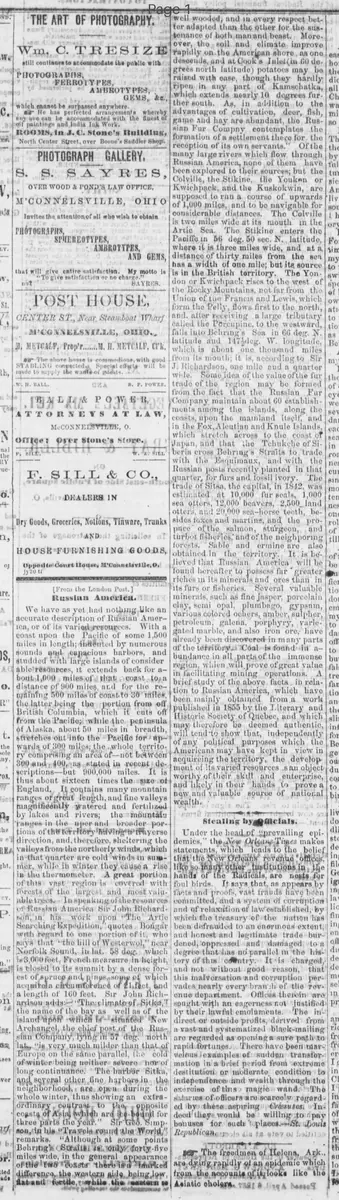
We have as yet had nothing like an accurate description of Russian America, or of its varied resources. With a coast upon the Pacific of some 1,500 miles in length; indented by numerous sounds and capacious harbors, and studded with large islands of considerable resources, it extends back for about 1,000 miles of that coast to a distance of 900 miles, and for the remaining 500 miles of coast to 30 miles. the latter being the portion from off British Columbia, which it cuts off from the Pacific; while the peninsula of Alaska, about 50 miles in breadth, stretches out into the Pacific for upwards of 300 miles; the whole territory comprising an area of not between 300 and 400, as stated in recent descriptions—but 900,000 square miles. It is thus about sixteen times the size of England. It contains many mountain ranges of great length, and fine valleys magnificently watered and fertilized by lakes and rivers; the mountain ranges in the upper and broader portions of the territory running in a transverse direction, and therefore sheltering the valleys from the northerly winds, which in that quarter are cold winds in summer, while in winter they cause a rise in the thermometer. A great portion of this vast region is covered with forests of the largest and most valuable trees. In speaking of the resources of Russian America Sir John Richardson, in his work upon "The Arctic Searching Expedition," quotes Bongar with regard to one portion of it, who says that "the hill of Westerwol," near Norfolk Sound, in lat. 58 deg. which is 3,000 feet, French measure in height, is clothed to its summit by a dense forest of spruce and pines, some of which acquire a circumference of 21 feet, and a length of 160 feet. Sir John Richardson adds: The climate of Sitka, the name of the bay as well as of the island upon which is situated New Archangel, the chief post of the Russian Company, lying in 57 deg. north lat, "is very much milder than that of Europe on the same parallel, the cold of winter being neither severe nor of long continuance. The harbor Sitka and several other fine harbors in the neighborhood, are open during the whole winter, thus showing an extraordinary contrast to the opposite coasts of Asia which are ice-bound for three parts of the year." Sir Geo. Simpson, in his "Travels round the World," remarks. "Although at some points Behring's Straits is only forty-five miles wide, in the general appearance of the two coasts there is a marked difference, the western side being low, flat and barren, while the eastern is well wooded, and in every respect better adapted than the other for the sustenance of both man and beast. Moreover, the soil and climate improve rapidly on the American shore as one descends, and at Cook's Inlet (in 60 degrees north latitude) potatoes may be raised with ease, though they hardly ripen in any part of Kamschatka, which extends nearly 10 degrees further south. As, in addition to the advantages of cultivation, deer, fish game and hay are abundant, the Russian Fur Company contemplates the formation of a settlement there for the reception of its own servants." Of the many large rivers which flow through Russian America, none of them have been explored to their sources; but the Colville, the Stikine, the Youkon or Kwichpack, and the Kuskokwin, are supposed to run a course of upwards of 1,000 miles, and to be navigable for considerable distances. The Colville is two miles wide at its mouth in the Arctic Sea. The Stikine enters the Pacific in 56 deg. 50 sec. N. latitude, where it is three miles wide, and at a distance of thirty miles from the sea has a width of one mile; but its source is in the British territory. The Youkon or Kwichpack rises to the west of the Rocky Mountains, not far from the Union of the Francis and Lewis, which form the Pelly, flows first to the north, and after receiving a large tributary called the Porcupine, to the westward. falls into Behring's Sea in 66 deg. N. latitude and 147 deg. W. longitude, which is about one thousand miles from its mouth; it is, according to Sir J. Richardson, one mile and a quarter wide. "Some idea of the value of the fur trade of the region may be formed from the fact that the Russian Fur Company maintain about 60 establishments among the islands, along the coasts, upon the mainland itself, and in the Fox, Aleutian and Knule Islands, which stretch across to the coast of Japan, and that the Tchukche of Siberia cross Behring's Straits to trade with the Esquimaux, and with the Russian posts recently planted in that quarter, for furs and fossil ivory. The trade of Sitka, the capital, in 1842, was estimated at 10,000 fur seals, 1,000 sea otters, 12,000 beavers, 2,500 land otters, and 20,000 sea-horse teeth, besides foxes and martins, and the produce of the salmon, sturgeon, and turbot fisheries, and of the neighboring forests. Sable and ermine are also obtained in the territory. It is believed that Russian America will be found hereafter to possess far greater riches in its minerals and ores than in its furs or fisheries. Several valuable minerals, such as fine jasper, porcelain clay, semi opal, plumbago, gypsum, various colored ochers, amber, sulphur, petroleum, galena, porphyry, variegated marble, and also iron ore, have already been discovered in many parts of the territory. Coal is found in abundance in all parts of the immense region, which will prove of great value in facilitating mining operations. A brief study of the above facts in relation to Russian America, which have been mainly obtained from a work published in 1855 by the Literary and Historic Society of Quebec, and which may therefore be deemed authentic, will tend to show that, independently of any political purposes which the Americans may have kept in view in acquiring the territory, the development of its varied resources is an object worthy of their skill and enterprise, and likely in their hands to prove a new and valuable source of national wealth.
What sub-type of article is it?
What keywords are associated?
What entities or persons were involved?
Where did it happen?
Foreign News Details
Primary Location
Russian America
Event Date
1842 1855
Key Persons
Event Details
Description of Russian America's extensive Pacific coast, vast territory of 900,000 square miles, mountain ranges, valleys, forests, milder climate at Sitka, abundant rivers like Colville, Stikine, Youkon, fur trade via Russian Fur Company with 60 establishments and 1842 Sitka trade estimates, potential minerals including coal, jasper, and ores, sourced from 1855 Quebec publication.