Thank you for visiting SNEWPapers!
Sign up free
Editorial
November 19, 1864
The Council Bluffs Nonpareil
Council Bluffs, Pottawattamie County, Iowa
What is this article about?
This editorial asserts that the Union possesses the will (affirmed by recent election majorities in most states), sufficient manpower (from population growth and immigration to sustain a million-man army), and financial resources (via domestic loans and surplus capital) to suppress the rebellion, re-establish federal authority, and preserve the Union indefinitely if needed.
Clipping
OCR Quality
90%
Excellent
Full Text
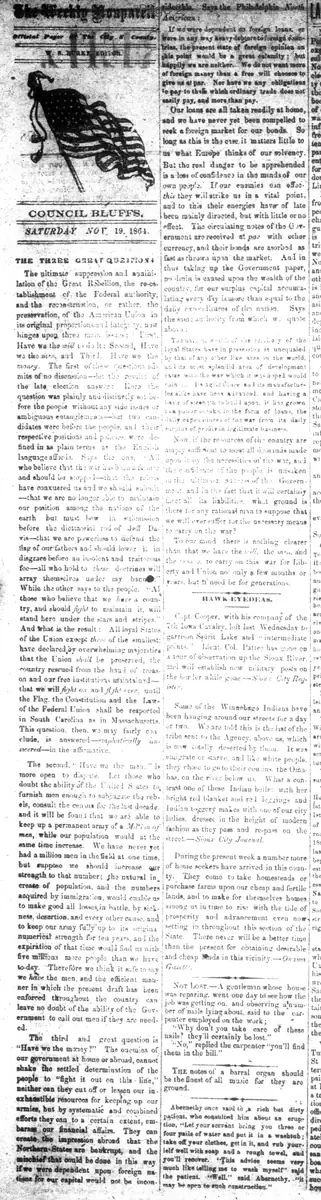
THE THREE GREAT QUESTIONS
The ultimate suppression and annihilation of the Great Rebellion, the re-establishment of the Federal authority and the reconstruction, or rather, the preservation, of the American Union in its original proportions and integrity, now hinges upon three main issues: First. Have we the will to do it? Second. Have we the men, and Third. Have we the money. The first of these questions admits of no discussion--the result of the late election answers it. The question was plainly and distinctly put before the people without any side issues or ambiguous entanglements--two candidates were before the people, and their respective positions and policies were defined in as plain terms as the English language affords. Says the one, "All who believe that the rebels have conquered us and we should submit--that we are no longer able to maintain our position among the nations of the earth but must bow in submission before the dictatorial rod of Jeff. Davis--that we are powerless to defend the flag of our fathers and should lower it in disgrace before an insolent and traitorous foe--all who hold to these doctrines will array themselves under my banner."
While the other says to the people, "All those who believe that we have a country, and should fight to maintain it, will stand here under the stars and stripes."
And what is the result? All loyal States of the Union except three of the smallest have declared by overwhelming majorities that the Union shall be preserved, the country rescued from the hands of traitors, and our free institutions maintained--that we will fight on and fight ever, until the Flag, the Constitution and the Laws of the Federal Union shall be respected in South Carolina as in Massachusetts.
This question, then, we may fairly conclude, is answered emphatically in the affirmative.
The second, "Have we the men?" is more open to discussion. Let those who doubt the ability of the United States to furnish men enough to subjugate the rebels, consult the census for the last decade, and it will be found that we are able to keep up a permanent army of a million men, while our population would at the same time increase. We have never yet had a million men in the field at one time, but suppose we should increase our strength to that number; the natural increase of population, and the numbers acquired by immigration, would enable us to make good all losses in battle, by sickness, desertion, and every other cause, and to keep our army fully up to its original numerical strength for ten years, and the expiration of that time would find us with five millions more people than we have to-day. Therefore we think it safe to say we have the men, and the efficient manner in which the present draft has been enforced throughout the country can leave no doubt of the ability of the Government to call out men if they are needed.
The third and great question is "Have we the money?" The enemies of our government at home or abroad, cannot shake the settled determination of the people to "fight it out on this line," neither can they cut off or lessen our inexhaustible resources for keeping up our armies, but by systematic and combined efforts they can to a certain extent, embarrass our financial affairs. They can create the impression abroad that the Northern States are bankrupt, and the mischief that could be done in this way if we were dependent upon foreign nations for our capital would not be inconsiderable.
American
If we were dependent on foreign loans, or were in any way heavy debtors to foreign countries, the present state of foreign opinion on this point would be a great calamity; but happily we are neither. We do not want more of foreign money than a free will chooses to give us at par. Nor have we any obligations to pay to them which ordinary trade does not easily pay, and more than pay.
Our loans are all taken readily at home, and we have never yet been compelled to seek a foreign market for our bonds. So long as this is the case, it matters little to us what Europe thinks of our solvency.
But the real danger to be apprehended is a loss of confidence in the minds of our own people. If our enemies can effect this they will strike us in a vital point, and to this their energies have of late been mainly directed, but with little or no effect. The circulating notes of the Government are received at par with other currency, and their bonds are absorbed as fast as thrown upon the market. And in thus taking up the Government paper no drain is caused upon the wealth of the country, for our surplus capital accumulating every day is more than equal to the daily expenditures of the nation. Says the New York Journal of Commerce, from which we quote above:
The vast wealth of the loyal States have in possession an unequaled by that of any other like area in the world, and its immense splendid array of development came with the war which it was hoped would ruin it. In agriculture and its manufactures alike have been advanced, and having a basis overseas to build upon, it has grown ten today in the form of loans, the daily expenditures of the war from its daily surplus of profits in legitimate business.
Now, if the resources of the country are amply sufficient to meet all demands made upon it in the necessity of the war, and the confidence of the people is unshaken in the ultimate success of the Government, and in the fact that it will certainly meet all its liabilities, what ground is there for any rational man to suppose that we will ever suffer for the necessary means to carry on the war?
To our mind there is nothing clearer than that we have the will, the men, and the money, to carry on this war for Liberty and Union not only a few months or years, but if need be for generations.
The ultimate suppression and annihilation of the Great Rebellion, the re-establishment of the Federal authority and the reconstruction, or rather, the preservation, of the American Union in its original proportions and integrity, now hinges upon three main issues: First. Have we the will to do it? Second. Have we the men, and Third. Have we the money. The first of these questions admits of no discussion--the result of the late election answers it. The question was plainly and distinctly put before the people without any side issues or ambiguous entanglements--two candidates were before the people, and their respective positions and policies were defined in as plain terms as the English language affords. Says the one, "All who believe that the rebels have conquered us and we should submit--that we are no longer able to maintain our position among the nations of the earth but must bow in submission before the dictatorial rod of Jeff. Davis--that we are powerless to defend the flag of our fathers and should lower it in disgrace before an insolent and traitorous foe--all who hold to these doctrines will array themselves under my banner."
While the other says to the people, "All those who believe that we have a country, and should fight to maintain it, will stand here under the stars and stripes."
And what is the result? All loyal States of the Union except three of the smallest have declared by overwhelming majorities that the Union shall be preserved, the country rescued from the hands of traitors, and our free institutions maintained--that we will fight on and fight ever, until the Flag, the Constitution and the Laws of the Federal Union shall be respected in South Carolina as in Massachusetts.
This question, then, we may fairly conclude, is answered emphatically in the affirmative.
The second, "Have we the men?" is more open to discussion. Let those who doubt the ability of the United States to furnish men enough to subjugate the rebels, consult the census for the last decade, and it will be found that we are able to keep up a permanent army of a million men, while our population would at the same time increase. We have never yet had a million men in the field at one time, but suppose we should increase our strength to that number; the natural increase of population, and the numbers acquired by immigration, would enable us to make good all losses in battle, by sickness, desertion, and every other cause, and to keep our army fully up to its original numerical strength for ten years, and the expiration of that time would find us with five millions more people than we have to-day. Therefore we think it safe to say we have the men, and the efficient manner in which the present draft has been enforced throughout the country can leave no doubt of the ability of the Government to call out men if they are needed.
The third and great question is "Have we the money?" The enemies of our government at home or abroad, cannot shake the settled determination of the people to "fight it out on this line," neither can they cut off or lessen our inexhaustible resources for keeping up our armies, but by systematic and combined efforts they can to a certain extent, embarrass our financial affairs. They can create the impression abroad that the Northern States are bankrupt, and the mischief that could be done in this way if we were dependent upon foreign nations for our capital would not be inconsiderable.
American
If we were dependent on foreign loans, or were in any way heavy debtors to foreign countries, the present state of foreign opinion on this point would be a great calamity; but happily we are neither. We do not want more of foreign money than a free will chooses to give us at par. Nor have we any obligations to pay to them which ordinary trade does not easily pay, and more than pay.
Our loans are all taken readily at home, and we have never yet been compelled to seek a foreign market for our bonds. So long as this is the case, it matters little to us what Europe thinks of our solvency.
But the real danger to be apprehended is a loss of confidence in the minds of our own people. If our enemies can effect this they will strike us in a vital point, and to this their energies have of late been mainly directed, but with little or no effect. The circulating notes of the Government are received at par with other currency, and their bonds are absorbed as fast as thrown upon the market. And in thus taking up the Government paper no drain is caused upon the wealth of the country, for our surplus capital accumulating every day is more than equal to the daily expenditures of the nation. Says the New York Journal of Commerce, from which we quote above:
The vast wealth of the loyal States have in possession an unequaled by that of any other like area in the world, and its immense splendid array of development came with the war which it was hoped would ruin it. In agriculture and its manufactures alike have been advanced, and having a basis overseas to build upon, it has grown ten today in the form of loans, the daily expenditures of the war from its daily surplus of profits in legitimate business.
Now, if the resources of the country are amply sufficient to meet all demands made upon it in the necessity of the war, and the confidence of the people is unshaken in the ultimate success of the Government, and in the fact that it will certainly meet all its liabilities, what ground is there for any rational man to suppose that we will ever suffer for the necessary means to carry on the war?
To our mind there is nothing clearer than that we have the will, the men, and the money, to carry on this war for Liberty and Union not only a few months or years, but if need be for generations.
What sub-type of article is it?
War Or Peace
Economic Policy
Partisan Politics
What keywords are associated?
Civil War
Union Preservation
Military Manpower
War Financing
Loyal States
Rebellion Suppression
What entities or persons were involved?
Union
Rebels
Jeff. Davis
Loyal States
Government
New York Journal Of Commerce
Editorial Details
Primary Topic
Resources To Suppress Rebellion And Preserve Union
Stance / Tone
Confident Affirmation Of Union's Capability To Continue War
Key Figures
Union
Rebels
Jeff. Davis
Loyal States
Government
New York Journal Of Commerce
Key Arguments
Election Demonstrates National Will To Preserve Union And Fight On
Population And Immigration Allow Sustaining Million Man Army Indefinitely
Domestic Loans And Surplus Capital Ensure Financial Stability Without Foreign Dependence
Enemies Cannot Undermine Resources But May Try To Erode Public Confidence
War Expenditures Met By Daily Business Profits