Thank you for visiting SNEWPapers!
Sign up free
Orleans Independent Standard
Irasburg, Barton, Orleans County, Vermont
What is this article about?
Bishop O. C. Baker describes the degraded conditions, customs, burial practices, and beliefs of Pacific Coast Indians, including Digger Indians in California and Oregon tribes. He discusses their food, mourning rituals, missionary influences from various denominations, and Catholic impact on indigenous communities.
Clipping
OCR Quality
Full Text
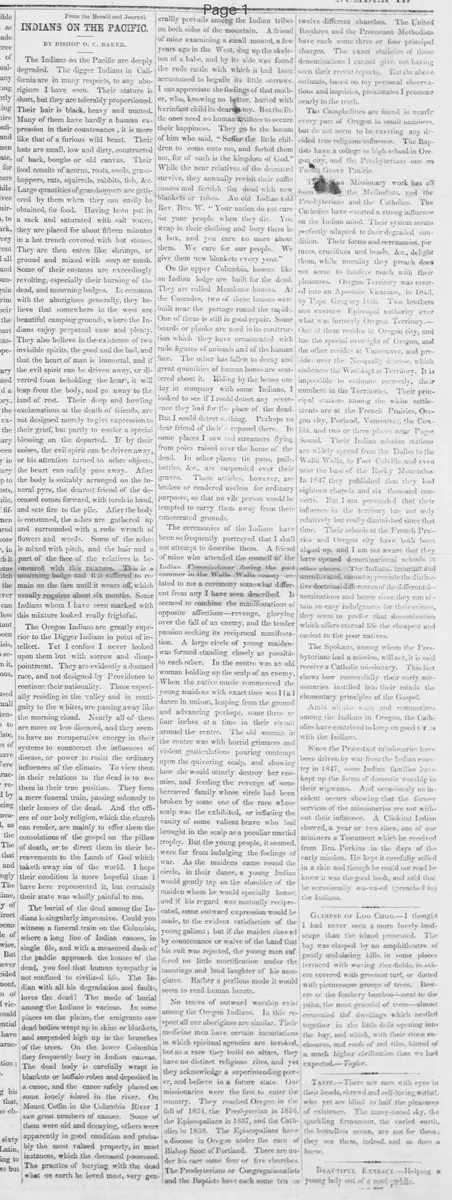
INDIANS ON THE PACIFIC.
BY BISHOP O. C. BAKER.
The Indians on the Pacific are deeply degraded. The digger Indians in California are in many respects, to any aborigines I have seen. Their stature is short, but they are tolerably proportioned. Their hair is black, heavy and matted. Many of them have hardly a human expression in their countenance, it is more like that of a furious wild beast. Their huts are small, low and dirty, constructed of bark, boughs or old canvas. Their food consists of acorns, roots, seeds, grasshoppers, rats, squirrels, rabbits, fish, &c. Large quantities of grasshoppers are gathered by them when they can easily be obtained, for food. Having been put in a sack and saturated with salt water, they are placed for about fifteen minutes in a hot trench covered with hot stones. They are then eaten like shrimps, or ground and mixed with soup or mush. Some of their customs are exceedingly revolting, especially their burning of the dead, and mourning badges. In common with the aborigines generally, they believe that somewhere in the west are beautiful camping grounds, where the Indians enjoy perpetual ease and plenty. They also believe in the existence of two invisible spirits, the good and the bad, and that the heart of man is immortal, and if the evil spirit can be driven away, or diverted from beholding the heart, it will leap from the body, and go away to the land of rest. Their deep and howling exclamations at the death of friends, are not designed merely to give expression to their grief, but partly to confer a special blessing on the departed. If by their noises, the evil spirit can be driven away, or his attention turned to other objects, the heart can safely pass away. After the body is suitably arranged on the funeral pyre, the dearest friend of the deceased comes forward, with torch in hand, and sets fire to the pile. After the body is consumed, the ashes are gathered up and surrounded with a rude wreath of flowers and weeds. Some of the ashes is mixed with pitch, and the hair and a part of the face of the relatives is besmeared with this mixture. This is a mourning badge and it is suffered to remain on the face until it wears off, which usually requires about six months. Some Indians whom I have seen marked with this mixture looked really frightful.
The Oregon Indians are greatly superior to the Digger Indians in point of intellect. Yet I confess I never looked upon them but with sorrow and disappointment. They are evidently a doomed race, and not designed by Providence to continue their nationality. Those especially residing in the valley and in contiguity to the whites, are passing away like the morning cloud. Nearly all of them are more or less diseased, and they seem to have no recuperative energy in their systems to counteract the influences of disease, or power to resist the ordinary influences of the climate. To view them in their relations to the dead is to see them in their true position. They form a mere funeral train, passing solemnly to their houses of the dead. And the offices of our holy religion, which the church can render, are mainly to offer them the consolations of the gospel on the pillow of death, or to direct them in their bereavements to the Lamb of God which taketh away sin of the world. I hope their condition is more hopeful than I have here represented it, but certainly their state was wholly painful to me.
The burial of the dead among the Indians is singularly impressive. Could you witness a funeral train on the Columbia, where a long line of Indian canoes, in single file, and with a measured dash of the paddle approach the houses of the dead, you feel that human sympathy is not confined to civilized life. The Indian with all his degradation and faults, loves the dead! The mode of burial among the Indians is various. In some places on the plains, the emigrants saw dead bodies wrapt up in skins or blankets, and suspended high up in the branches of the trees. On the lower Columbia they frequently bury in Indian canvas. The dead body is carefully wrapt in blankets or buffalo robes and deposited in a canoe, and the canoe safely placed on some lonely island in the river. On Mount Coffin in the Columbia River I saw great numbers of canoes. Some of them were old and decaying, others were apparently in good condition and probably the most valued property, in most instances, which the deceased possessed.
The practice of burying with the dead what on earth he loved most, very generally prevails among the Indian tribes on both sides of the mountain. A friend of mine examining a small mound, a few years ago in the West, dug up the skeleton of a babe, and by its side was found the rude rattle with which it had been accustomed to beguile its little sorrows. I can appreciate the feelings of that mother, who, knowing no better, buried with her infant child its dearest toy. But the little ones need no human artifices to secure their happiness. They go to the bosom of him who said, "Suffer the little children to come unto me, and forbid them not, for of such is the kingdom of God."
While the near relatives of the deceased survive, they annually revisit their coffin canoes and furnish the dead with new blankets or robes. An old Indian told Rev. Bro. W., "Your nation do not care for your people when they die. You wrap in their clothing and bury them in a box, and you care no more about them. We care for our people. We give them new blankets every year."
On the upper Columbia, houses like an Indian lodge are built for the dead. They are called Memlouse houses. At the Cascades, two of these houses were built near the portage round the rapid— One of them is still in good repair. Some boards or planks are used in its construction which they have ornamented with rude figures of animals and of the human face. The other has fallen to decay and great quantities of human bones are scattered about it. Riding by the bones one day in company with some Indians, I looked to see if I could detect any reverence they had for the place of the dead. But I could detect nothing. Perhaps no dear friend of theirs reposed there. In some places I saw red streamers flying from poles raised over the home of the dead. In other places tin pans, pails, kettles, &c., are suspended over their graves. These articles, however, are broken or rendered useless for ordinary purposes, so that no vile person would be tempted to carry them away from their consecrated grounds.
The ceremonies of the Indians have been so frequently portrayed that I shall not attempt to describe them. A friend of mine who attended the council of the Indian Commissioner during the past Summer in the Walla Walla county related to me a ceremony somewhat different from any I have seen described. It seemed to combine the manifestations of opposite affections-revenge, glorying over the fall of an enemy, and the tender passion seeking its reciprocal manifestation. A large circle of young maidens was formed standing closely as possible to each other. In the centre was an old woman holding up the scalp of an enemy. When the native music commenced the young maidens with exact time would dance in unison, leaping from the ground and advancing perhaps, some three or four inches at a time in their circuit around the centre. The old woman in the centre was with horrid grimaces and violent gesticulations pouring contempt upon the quivering scalp, and showing how she would utterly destroy her enemies, and feeding the revenge of some bereaved family whose circle had been broken by some one of the race whose scalp was the exhibited, or inflating the vanity of some valiant brave who had brought in the scalp as a peculiar martial trophy. But the young people, it seemed, were far from indulging the feelings of war. As the maidens came round the circle, in their dance, a young Indian would gently tap on the shoulder of the maiden whom he would specially honor, and if his regard was mutually reciprocated, some outward expression would be made, to the evident satisfaction of the young gallant; but if the maiden showed by countenance or waive of the hand that his suit was rejected, the young man suffered no little mortification under the tauntings and loud laughter of his associates. Rather a perilous mode it would seem to read human hearts.
No traces of outward worship exist among the Oregon Indians. In this respect all our aborigines are similar. Their medicine men have certain incantations in which spiritual agencies are invoked, but as a race they build no altars, they have no distinct religious rites, and yet they acknowledge a superintending power, and believe in a future state. Our missionaries were the first to enter the country. They reached Oregon in the fall of 1834, the Presbyterians in 1836, the Episcopalians in 1837, and the Catholics in 1838. The Episcopalians have a diocese in Oregon under the care of Bishop Scott of Portland. There are under his care some four or five churches. The Presbyterians or Congregationalists and the Baptists have each some ten or twelve different churches. The United Brethren and the Protestant Methodists have each some three or four principal charges. The exact statistics of these denominations I cannot give, not having seen their recent reports. But the above estimate, based on my personal observations and inquiries, approximates I presume nearly to the truth.
The Campbellites are found in nearly every part of Oregon in small numbers, but do not seem to be exerting any decided true religious influence. The Baptists have a college or high school in Oregon city, and the Presbyterians one on Forest Grove Prairie.
The Missionary work has all been by the Methodists, and the Presbyterians and the Catholics. The Catholics have exerted a strong influence on the Indian mind. Their system seems perfectly adapted to their degraded condition. Their forms and ceremonies, pictures, crucifixes and beads, &c., delight them, while morality they preach does not seem to interfere much with their pleasures. Oregon Territory was erected into an Apostolic Vicariate, in 1843, by Pope Gregory 16th. Two Brothers now exercise Episcopal authority over what was formerly Oregon Territory.- One of them resides in Oregon city, and has the special oversight of Oregon, and the other resides at Vancouver, and presides over the Nesqually diocese, which embraces the Washington Territory. It is impossible to estimate correctly, their numbers in the Territories. Their principal stations among the white settlements are at the French Prairies, Oregon city, Portland, Vancouver, the Cowlitz, and two or three places near Puget Sound. Their Indian mission stations are widely spread from the Dalles to the Wallawalla, to Fort Colville, and even near the base of the Rocky Mountains. In 1847 they published that they had eighteen chapels and six thousand converts. But I am persuaded that their influence in the territory has not only relatively but really diminished since that time. Their schools at the French Prairies and Oregon city have both been closed up, and I am not aware that they have opened denominational schools in other places. The Indians, ignorant and uncultivated, cannot appreciate the distinctive doctrinal differences of the different denominations and hence since they can obtain so easy indulgences for their crimes, they seem to prefer that denomination which offers eternal life the cheapest and easiest to the poor natives.
The Spokans, among whom the Presbyterians had a mission, will not, it is said receive a Catholic missionary. This fact shows how successfully their early missionaries instilled into their minds the elementary principles of the Gospel.
Amid all the wars and commotions among the Indians in Oregon, the Catholics have contrived to keep on good terms with the Indians.
Since the Protestant missionaries have been driven by war from the Indian country in 1847, some Indian families have kept up the forms of domestic worship in their wigwams. And occasionally an incident occurs showing that the former services of the missionaries are not without their influence. A Clickitat Indian showed, a year or two since, one of our ministers a Testament which he received from Bro. Perkins in the days of the early mission. He kept it carefully rolled in a skin and though he could not read he knew it was the good book, and said that he occasionally wa-wa-ed (preached to) the Indians.
What sub-type of article is it?
What keywords are associated?
What entities or persons were involved?
Where did it happen?
Domestic News Details
Primary Location
Oregon Territory And California
Key Persons
Outcome
indians described as diseased and passing away; missionary influences varying by denomination, with catholics maintaining good terms amid wars.
Event Details
Bishop Baker provides observations on the customs, beliefs, burial practices, food sources, and declining conditions of Pacific Coast Indians, including Digger Indians in California and Oregon tribes. He details mourning rituals, funeral processions, and missionary efforts by Methodists, Presbyterians, Episcopalians, Baptists, and Catholics since 1834, noting Catholic adaptations and Protestant impacts.