Thank you for visiting SNEWPapers!
Sign up free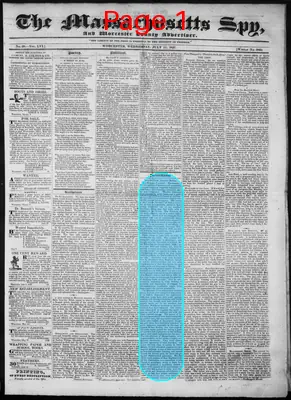
Story
July 11, 1827
The Massachusetts Spy, And Worcester County Advertiser
Worcester, Worcester County, Massachusetts
What is this article about?
Article from North American Review on early Boston settlers' simple houses contrasting with valuable English furniture; abundant food despite lacks; failed attempts to curb luxury, drinking, and profiteering; overall respectable community with some adventurers.
Clipping
OCR Quality
95%
Excellent
Full Text
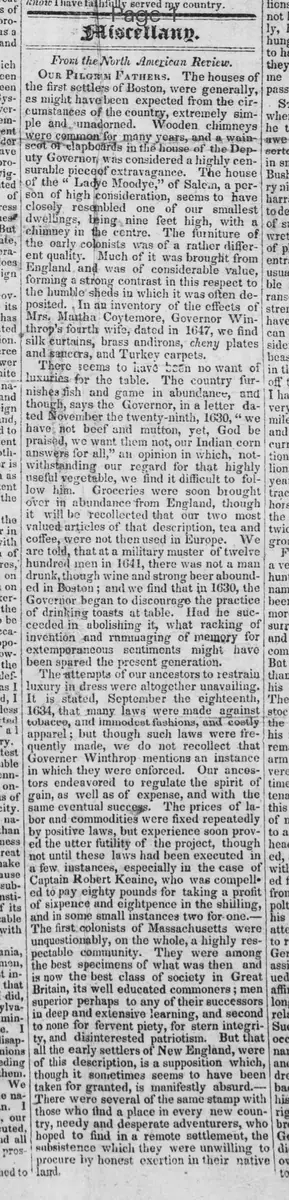
MISCELLANY.
From the North American Review.
OUR PILGRIM FATHERS. The houses of
the first settlers of Boston, were generally,
as might have been expected from the circumstances of the country, extremely simple and unadorned. Wooden chimneys
were common for many years, and a wainscot of clapboards in the house of the Deputy Governor, was considered a highly censurable piece of extravagance. The house
of the "Ladye Moodye," of Salem, a person of high consideration, seems to have
closely resembled one of our smallest
dwellings, being nine feet high, with a
chimney in the centre. The furniture of
the early colonists was of a rather different quality. Much of it was brought from
England and was of considerable value,
forming a strong contrast in this respect to
the humble sheds in which it was often deposited. In an inventory of the effects of
Mrs. Martha Coytemore, Governor Winthrop's fourth wife, dated in 1647, we find
silk curtains, brass andirons, cheny plates
and saucers, and Turkey carpets.
There seems to have been no want of
luxuries for the table. The country furnishes fish and game in abundance, and
though, says the Governor, in a letter dated November the twenty-ninth, 1630, "we
have not beef and mutton yet, God be
praised, we want them not, our Indian corn
answers for all," an opinion in which, notwithstanding our regard for that highly
useful vegetable, we find it difficult to follow him. Groceries were soon brought
over in abundance from England, though
it will be recollected that our two most
valued articles of that description, tea and
coffee, were not then used in Europe. We
are told, that at a military muster of twelve
hundred men in 1641, there was not a man
drunk, though wine and strong beer abounded in Boston; and we find that in 1630, the
Governor began to discourage the practice
of drinking toasts at table. Had he succeeded in abolishing it, what racking of
invention and rummaging of memory for
extemporaneous sentiments might have
been spared the present generation.
The attempts of our ancestors to restrain
luxury in dress were altogether unavailing.
It is stated, September the eighteenth,
1634. that many laws were made against
tobacco, and immodest fashions, and costly
apparel; but though such laws were frequently made, we do not recollect that
Governor Winthrop mentions an instance
in which they were enforced. Our ancestors endeavored to regulate the spirit of
gain, as well as of expense, and with the
same eventual success. The prices of labor and commodities were fixed repeatedly
by positive laws, but experience soon proved the utter futility of the project, though
not until these laws had been executed in
a few instances, especially in the case of
Captain Robert Keayne, who was compelled to pay eighty pounds for taking a profit
of sixpence and eightpence in the shilling,
and in some small instances two for one.
The first colonists of Massachusetts were
unquestionably, on the whole, a highly respectable community. They were among
the best specimens of what was then and
is now the best class of society in Great
Britain, its well educated commoners; men
superior perhaps to any of their successors
in deep and extensive learning, and second
to none for fervent piety, for stern integrity, and disinterested patriotism. But that
all the early settlers of New England, were
of this description, is a supposition which,
though it sometimes seems to have been
taken for granted, is manifestly absurd.—
There were several of the same stamp with
those who find a place in every new country, needy and desperate adventurers, who
hoped to find in a remote settlement, the
subsistence which they were unwilling to
procure by honest exertion in their native
land.
From the North American Review.
OUR PILGRIM FATHERS. The houses of
the first settlers of Boston, were generally,
as might have been expected from the circumstances of the country, extremely simple and unadorned. Wooden chimneys
were common for many years, and a wainscot of clapboards in the house of the Deputy Governor, was considered a highly censurable piece of extravagance. The house
of the "Ladye Moodye," of Salem, a person of high consideration, seems to have
closely resembled one of our smallest
dwellings, being nine feet high, with a
chimney in the centre. The furniture of
the early colonists was of a rather different quality. Much of it was brought from
England and was of considerable value,
forming a strong contrast in this respect to
the humble sheds in which it was often deposited. In an inventory of the effects of
Mrs. Martha Coytemore, Governor Winthrop's fourth wife, dated in 1647, we find
silk curtains, brass andirons, cheny plates
and saucers, and Turkey carpets.
There seems to have been no want of
luxuries for the table. The country furnishes fish and game in abundance, and
though, says the Governor, in a letter dated November the twenty-ninth, 1630, "we
have not beef and mutton yet, God be
praised, we want them not, our Indian corn
answers for all," an opinion in which, notwithstanding our regard for that highly
useful vegetable, we find it difficult to follow him. Groceries were soon brought
over in abundance from England, though
it will be recollected that our two most
valued articles of that description, tea and
coffee, were not then used in Europe. We
are told, that at a military muster of twelve
hundred men in 1641, there was not a man
drunk, though wine and strong beer abounded in Boston; and we find that in 1630, the
Governor began to discourage the practice
of drinking toasts at table. Had he succeeded in abolishing it, what racking of
invention and rummaging of memory for
extemporaneous sentiments might have
been spared the present generation.
The attempts of our ancestors to restrain
luxury in dress were altogether unavailing.
It is stated, September the eighteenth,
1634. that many laws were made against
tobacco, and immodest fashions, and costly
apparel; but though such laws were frequently made, we do not recollect that
Governor Winthrop mentions an instance
in which they were enforced. Our ancestors endeavored to regulate the spirit of
gain, as well as of expense, and with the
same eventual success. The prices of labor and commodities were fixed repeatedly
by positive laws, but experience soon proved the utter futility of the project, though
not until these laws had been executed in
a few instances, especially in the case of
Captain Robert Keayne, who was compelled to pay eighty pounds for taking a profit
of sixpence and eightpence in the shilling,
and in some small instances two for one.
The first colonists of Massachusetts were
unquestionably, on the whole, a highly respectable community. They were among
the best specimens of what was then and
is now the best class of society in Great
Britain, its well educated commoners; men
superior perhaps to any of their successors
in deep and extensive learning, and second
to none for fervent piety, for stern integrity, and disinterested patriotism. But that
all the early settlers of New England, were
of this description, is a supposition which,
though it sometimes seems to have been
taken for granted, is manifestly absurd.—
There were several of the same stamp with
those who find a place in every new country, needy and desperate adventurers, who
hoped to find in a remote settlement, the
subsistence which they were unwilling to
procure by honest exertion in their native
land.
What sub-type of article is it?
Historical Event
Curiosity
Biography
What themes does it cover?
Social Manners
Moral Virtue
Providence Divine
What keywords are associated?
Pilgrim Fathers
Early Settlers
Colonial Life
Boston History
Governor Winthrop
Luxury Laws
Colonists Character
What entities or persons were involved?
Governor Winthrop
Mrs. Martha Coytemore
Ladye Moodye
Captain Robert Keayne
Where did it happen?
Boston, Salem, Massachusetts, New England
Story Details
Key Persons
Governor Winthrop
Mrs. Martha Coytemore
Ladye Moodye
Captain Robert Keayne
Location
Boston, Salem, Massachusetts, New England
Event Date
1630 1647
Story Details
Early Boston settlers lived in simple houses but owned valuable English furniture; enjoyed abundant food like fish, game, and Indian corn; failed to enforce laws against luxury, tobacco, and profiteering; community was mostly respectable but included adventurers.