Thank you for visiting SNEWPapers!
Sign up free
Richmond Enquirer
Richmond, Richmond County, Virginia
What is this article about?
South Carolina newspaper items: Report on a Union dinner in Sumter District honoring candidates, with toasts and letters supporting the cause; note on Col. Thomas Taylor heading the Union ticket; full letter from Alfred Huger rejecting Nullification in response to parish resolutions, favoring a deliberative convention to address Tariff grievances.
Clipping
OCR Quality
Full Text
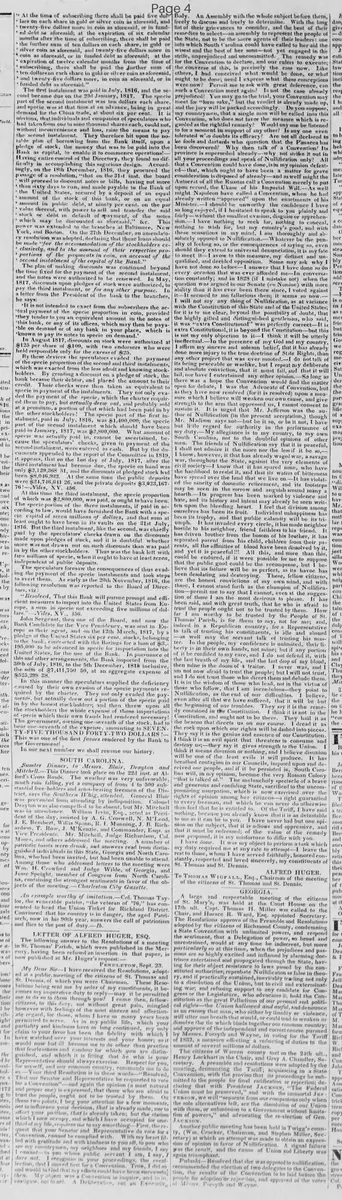
Sumter Dinner, to Messrs. Blair, Drayton and Mitchell.—This Dinner took place on the 22d inst. at Alford's Cross Roads. The weather was very unfavorable, much rain falling, yet a company of from 400 to 500 substantial free-holders and arms-bearing freemen of the District, says the Southern Whig, attended. General Blair was prevented from attending by indisposition. Colonel Drayton was also compelled to be absent, but Mr. Mitchell was in attendance.
William Irvin, Esq., acted as President of the day, assisted by A. G. Croswell, N. M'Leod, J. E. Rembert, Willis Spann, R. I. Manning, J. B. Richardson, T. Rose, J. M'Kenzie, and Commander, Esqs. as Vice Presidents. Mr. Mitchell, Judge Richardson, Col. Moses, and others addressed the meeting. A number of patriotic toasts were drunk, and answers read from distinguished individuals in this State, Georgia and North Carolina, who had been invited, but had been unable to attend.
Among those who addressed letters to the meeting were Wm. H. Crawford and Judge Wilde, of Georgia, and Jesse Speight, member of Congress from North Carolina, containing the strongest sentiments in favor of the objects of the meeting.—Charleston City Gazette.
An example worthy of imitation.—Col. Thomas Taylor, the venerable patriot, "the veteran of '76," has consented to head the Union Ticket for Richland District. Convinced that his country is in danger, the aged Patriarch, now in his 90th year, answers the call of patriotism and flies to the post of duty.—Ib.
LETTER OF ALFRED HUGER, ESQ.
The following answer to the Resolutions of a meeting in St. Thomas' Parish, which were published in the Mercury, having been refused an insertion in that paper, is now published at Mr. Huger's request:
PENDLETON, Sept. 23.
My Dear Sir—I have received the Resolutions, adopted at a public meeting of the citizens of St. Thomas and St. Dennis, of which you were Chairman. These Resolutions being sent me by order of my constituents, it becomes my imperative duty to reply—may it be permitted me to do so to them through you? I come then, fellow-citizens, to this duty, not without great pain, mingled however with feelings of the most sincere and affectionate regard, for those, whom I have so many years been permitted to serve. As in my public life, which your partiality and kindness have so long continued, my only claim to your favor has been the fidelity with which I have watched over your interests and your honor; so it would now but ill become me to do other than practice that fearlessness and candour for which you are distinguished. and which it is fitting that he who is your Representative should always exercise. Respect for you, for myself, and our common country, commands me to do so—Your third Resolution is in these words—"Resolved, That our Senator and Representative be requested to vote for a Convention"—and again the opinion (a most natural and proper one) is expressed, that those who are afraid to trust the people, ought not to be trusted by them. On these two points, I beg your attention for a few moments. not to influence your decision, that is already made, nor to affect your position, that is already taken; but the station which I now occupy, and which I have occupied for one-third of my life, requires me to say something—First, the request that your Senator and Representative do vote for a Convention, cannot be complied with. With my heart filled with gratitude and with kindness to you all, to you who are my countrymen, my neighbors and my friends, I say I cannot to you whose public servant I am, I say, I dare not. I recognize in your proceedings, the recollection, that I moved first for a Convention. True, I did so and would to God that my efforts could have been successful then. My object was a Convention to inquire, and to investigate, not to act. A Deliberative, not an Executive,
An Assembly with the whole subject before them, freely to discuss and freely to determine. With the long list of their grievances to consider, and the best of their remedies to select—an assembly to represent the people of the State, not to be the mere agents of their leaders: one into which South Carolina could have called to her aid the wisest and the best of her sons—not yet engaged in the strife, unprejudiced and uncommitted. The remedy was for the Convention to declare, and our rulers to execute; the converse of this, is precisely the case now. Like others, I had conceived what would be done, or what ought to be done; need I express what these conceptions were now? Permit me to ask with great deference, can such a Convention meet again? Is not the case already prejudiced? You may go to the trial, your Convention may meet for "form's sake," but the verdict is already made up, and the jury will be packed accordingly. Do you suppose, my countrymen, that a single man will be called into this Convention, who does not favor the measure which is regarded as the rightful remedy? Would any one be listened to for a moment in support of any other? Is any one even tolerated who doubts its efficacy? Are not all declared to be fools and dastards who question that the Panacea has been discovered? Why then talk of a Convention? Its province is superseded already—why not strike it out in all your proceedings and speak of Nullification only? All that a Convention could have done, is in my opinion defeated—that, which ought to have been a matter for grave consideration is disposed of already—and as well might the Autocrat of all the Russias call a Convention merely to put upon record, the Ukase of his Imperial Will.—As well might Napoleon have called a Convention, when he had already written "approved" upon the enactments of his Minister.—I should be unworthy the confidence I have so long enjoyed, if I hesitated to speak to you plainly and fairly—without the smallest evasion, disguise or apprehension.—I have nothing to seek for, nothing to conceal, nothing to wish for, but my country's good, and with these sensations in my mind, I am thoroughly and absolutely opposed to Nullification.—Whatever be the penalty of feeling so, or the consequences of saying so, even should they extend to universal denunciation, it is my fate to meet it—I avow to this measure, my distinct and unqualified, and decided opposition. Some may ask why I have not done so before—I answer that I have done so on every occasion that was ever afforded me—In conversation constantly; and in 1828 (if I mistake not) when the question was argued in our Senate (eo nomine) with more ability than it has ever been there since, I voted against it It seemed to me fallacious then; it seems so now.—
I will not say any thing of Nullification, as at variance with the Constitution of this State and of the United States; for it is to me clear, beyond the possibility of doubt, that the highly gifted and distinguished gentleman, who said, it was "extra Constitutional" was perfectly correct—It is extra Constitutional, it is beyond the Constitution—but this is not my only objection to it—I think it will be utterly ineffectual.—In the presence of my God and my country, I affirm my sincere and solemn belief, that it has already done more injury to the true doctrine of State Rights, than any other project that was ever mooted.—I do not talk of its being peaceable or warlike, but I repeat my deliberate and absolute conviction, that it must fail, and that it will fail, nor have I entertained any other opinion.—So long as there was a hope the Convention would find the matter open for debate, I was the Advocate of Convention, but as they have now resolved (for it is resolved) upon a measure which I believe will weaken our own cause, and give strength to the arm that oppressed us, I cannot consent to sustain it. It is urged that Mr. Jefferson was the author of Nullification (in the present acceptation,) though Mr. Madison says not but be it so, or be it not, I have but little regard for authority in the performance of my duty.—My allegiance is to my country, to my own South Carolina, not to the doubtful opinions of other men. The friends of Nullification say that it is peaceful, I shall not admire it the more nor the less if it be so,— I know, however, it that has already waged war, a savage war, throughout the State, against the very elements of civil society—I know that it has spared none, who have the hardihood to resist it, and that its waters of bitterness have spread over the land that we live on.—It has violated the sanctity of domestic retirement, and its footsteps may be seen in the sorrow and anguish around many a hearth.—Its progress has been marked by violence and hate, and its history and intent may already be seen written upon the bleeding heart. I feel that division among ourselves has been its fruit. Individual unhappiness has been its trophy, and that public calamity will be its triumph. It has invaded every circle, it has made neighbor hostile to his neighbor, friend faithless to his friend. It has driven brother from the bosom of his brother, it has separated parent from his child, children from their parents, all the affinities of blood have been dissolved by it, and yet it is peaceful!!! All this, and more than this, could be endured, if it were possible for me to suppose that the public good could be the recompense, but I believe that its failure will be as perfect, as its havoc has been desolating and destroying. These, fellow citizens, are the honest convictions of my own mind, and with these, I cannot stand forth as the champion of Nullification—permit me to say that I cannot, even at the suggestion of those I am the most desirous to please. It has been said, and with great truth, that he who is afraid to trust the people ought not to be trusted by them. How far I am worthy to be trusted by the People of St. Thomas' Parish, is for them to say, not for me; and, indeed in a Republican country, for a Representative to talk of trusting his constituents, is idle and absurd—as well may the servant talk of trusting his master. In the people, my confidence is unlimited, their liberty is in their own hands, not mine; but if any portion of it be confided to my care, and I do not defend it, with the last breath of my life, and the last drop of my blood, then mine is the doom of a traitor. I never was, and I am not now afraid to trust the people; but I will not trust, and I do not trust those who direct them and delude them. It is in the wisdom of those who lead, not in the virtue of those who follow, that I am incredulous—they point to Nullification, as the end of our difficulties. I believe, even after all that we have suffered, that it will be but the beginning of our troubles. They say it is the remedy contained in the Constitution. I think it is not in the Constitution, and ought not to be there. They hail it as the beacon that directs us on our course. I dread it as the rock upon which our rights will be dashed into pieces. They say it is the genius and essence of our Constitution. I think it is an evil spirit that threatens to consume and destroy us;—they say it gives strength to the Union. I think it means disunion or nothing, and I believe disunion will be one of the least evils it will produce. It has breathed contagion in our Councils, imposed upon and deceived our people, and if it be persisted in, South Carolina will, in my opinion, become the very Roman Colony "that is talked of." The melancholy spectacle of a brave and generous and confiding State, sacrificed to the uncom promising usurpation, which is now exercised over the rights of opinion among her citizens—a right guaranteed to every freeman, and which he can never do otherwise than feel that he is entitled to. Of the Tariff, I have said nothing, because you already know that it is as detestable to me as it can be to you. I have never had but one opinion on the subject, that it is odious and oppressive, and that it must be redressed; of the value of the remedy now proposed, it is my misfortune to differ with you.
I have done. It was my object to perform a task which my duty required me at any rate to attempt—I leave the rest to those, whom I have served faithfully, honored constantly, respected and loved sincerely, my constituents of St. Thomas and St. Dennis.
ALFRED HUGER.
To Thomas Wigrall, Esq., Chairman of the meeting of the citizens of St. Thomas and St. Dennis.
What sub-type of article is it?
What themes does it cover?
What keywords are associated?
What entities or persons were involved?
Letter to Editor Details
Author
Alfred Huger
Recipient
Thomas Wigrall, Esq., Chairman Of The Meeting Of The Citizens Of St. Thomas And St. Dennis
Main Argument
alfred huger opposes nullification as extra-constitutional, ineffectual, and divisive, arguing it will harm state rights and lead to failure; he advocates for a deliberative convention to investigate grievances like the tariff rather than directly acting on nullification.
Notable Details