Thank you for visiting SNEWPapers!
Sign up free
New York Dispatch
New York, New York County, New York
What is this article about?
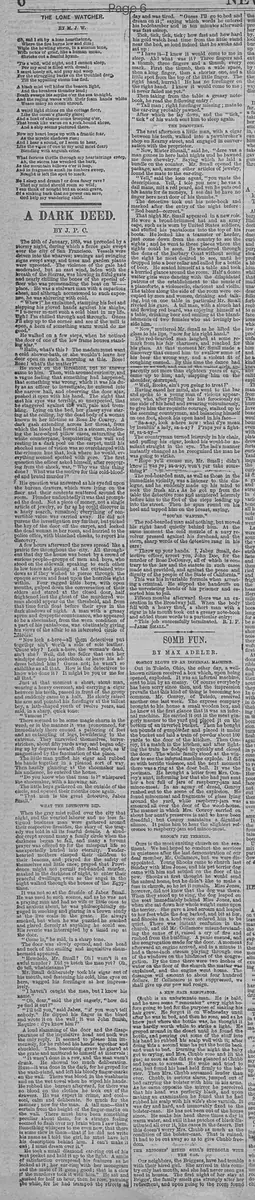
On January 29, 1858, in San Francisco, a woman named Rose De Courcy is found murdered and robbed. Detective Jabez Small solves the case using fingerprints and a pawned earring to arrest a one-fingered, red-bearded man, who is executed 15 months later.
Clipping
OCR Quality
Full Text
BY J. P. C.
The 29th of January, 1858, was preceded by a stormy night, during which a fierce gale swept over the city of San Francisco. Vessels were driven into the wharves: awnings and swinging signs swept away, and trees and garden plants were uprooted. The violence of the gale had moderated, but an east wind, laden with the breath of the Sierras, was blowing in fitful gusts and nearly chilling the bones of the special officer who was promenading the beat on W. place. He was a stalwart man with a capacious chest, and although accustomed to such exposure, he was shivering with cold.
"Whew!" he exclaimed, stamping his feet and lapping his gloved hands against his thighs. "I n-never m-met such a cold blast in my life. Ugh! I'm chilled through and through. Guess I'll step up to the corner and see if the mill is open; a horn of something warm would do me good."
He walked on a few steps, when he noticed the door of one of the low frame houses standing ajar.
"Hallo, what's this? The madam must want a cold shower-bath, or she wouldn't leave her door open on such a morning as this. Rosel Rose! what's the matter?"
He stood on the threshold, but no answer came to him. Then, with aroused curiosity, and a vague feeling that something had happened that something was wrong, which it was his duty as an officer to investigate, he entered into the narrow hall, and observing the door ajar, pushed it open with his hand. The sight that met his eyes was terrible, so unexpected, that he staggered against the wall, pale and trembling. Lying on the bed, her glassy eyes staring at the ceiling, lay the dead body of a woman known in her lifetime as Rose De Courcy. A dark gash extending across her throat, from which the blood had flowed in a stream, reddening the lace-edged pillow cases, saturating the white counterpane, bespattering the wall and resting in a dark pool on the carpet, until his shocked sense of vision was so overcharged with the crimson hue that, look where he would, everything seemed spotted with gore. The first question the officer asked himself, after recovering from the shock, was, "Why was this thing done? What was the motive for this cold-blooded and brutal murder?"
His question was answered as his eye fell upon the bureau drawers, which were lying on the floor and their contents scattered around the room. Plunder undoubtedly it was that prompted the deed. Not a piece of money, not a single article of jewelry, so far as he could discover in a hasty search, remained; everything of convertible value was carried away. He did not pursue the investigation any further, but picked the key of the door off the carpet, and locked the dead woman in her room, and hurried to the police office, with blanched cheeks, to report his discovery.
A few hours afterward the news spread like a prairie fire throughout the city. All throughout that day the house was beset by a crowd of curious people—groups of men and boys, who stood on the sidewalk speaking to each other in low tones and gazing at the curtained windows as if they wished to pierce through the opaque screen and feast upon the horrible sight within. Four ragged little boys, with open mouths, gulped down the conversation of their elders and stared at the closed door, half frightened lest the ghost of the murdered woman should appear on the threshold, and from that time forth float before their eyes in the dark shadows of night. A man with a greasy apron and dyspeptic countenance, who appeared to be a shoemaker, from the worn condition of a part of his pantaloons, was obstinately giving his views of the affair to an interested circle of hearers!
"Now look a-here—all them detectives put together ain't worth a side of sole leather. Cause why? Look a-here, the woman's dead, ain't she? Well, did the feller that cut her windpipe drop his pocketbook or leave his address behind him? Guess not; he wasn't so childlike as all that. How is the detectives to know who done it? It might be you or me for all that."
Just at that moment a short, stout man, wearing a heavy overcoat, and carrying a cigar between his teeth, passed in front of the group and suddenly came to a halt. He slowly raised his arm and pointed his forefinger at the tallest boy, a lath-shaped youth of twelve years, and said, in a sharp, quick tone:
"Vamose!"
There seemed to be some magic charm in the word, or in the manner it was pronounced, for immediately there ensued a pattering of feet and an entangling of legs, bewildering in the extreme. They unraveled themselves, terror stricken, about fifty yards away, and began edging up by degrees toward the fatal spot, as if magnetized by the fascination of the place. The little man puffed his cigar and rubbed his hands together in a pleased sort of way. Then hastily glancing at the shoemaker and his audience, he entered the house.
"Do you know who that man is?" whispered the shoemaker, with a knowing air.
The little boys gathered on the outside of the circle, and opened their mouths once again.
"That man is the great detective, Jabez Small."
WHAT THE DETECTIVE DID.
When the gray mist rolled over the city that night, and the wearied laborer and no less fatigued business man were gathered around their respective firesides, the story of the tragedy was told in all its fearful details. A shudder crept around many a family circle when the darkness began to fall, and many a fervent prayer was offered up for the misspent life so unexpectedly hurled into eternity. Tender-hearted mothers clasped their children to their bosoms, and prayed for the safety of themselves and little ones; prayed that Providence might not permit red-handed murder, masked in the darkness of night, to enter their peaceful dwellings, even as the angel in the night walked through the houses of the Egyptians.
It was not so at the fireside of Jabez Small. He was used to such scenes, and as he was not a praying man and had no wife or little ones to feel anxious about, he was philosophically engaged in smoking and glaring in a brown study at the live coals in the grate. He always smoked, but when he was puzzled he smoked and glared fiercely at anything he could see. His reverie was interrupted by a timid rap at the door.
"Come in," he said, in a sharp tone.
The door was slowly opened, and the head and neck of the smiling and inquisitive chambermaid appeared.
"Howdedo, Mr. Small? Oh! wasn't it an awful murder? Did ye ketch the man yet? Oh, do tell, whatsisname?"
Mr. Small deliberately took his cigar out of his mouth, and fastening his cold, blue eyes on hers, wagged his forefinger at her impressively.
"I haven't caught the man, but I know his name."
"Oh, dear," said the girl eagerly, "how did ye find it out?"
"I'll tell you," said Jabez, "if you won't tell nobody." He dipped his finger in the blood and wrote it on the wall; it was John Smith, Esquire: d'ye know him?"
A loud slamming of the door and the disappearance of the inquisitive head and neck was the only reply. It seemed to please him immensely, for he rubbed his hands together and chuckled. Then becoming grave he glared at the grate and muttered to himself at intervals:
"It wasn't done in a row, and the man wasn't drunk. He showed too much deliberation. Hum—it was done in the dark, for he groped for the wash-stand, and left his bloody finger-marks on the wall. There was blood in the washbasin and on the wet towel when he wiped his hands. He robbed the bureau afterward, for there was no blood on the clothes he took out of the drawers. He was expert in crime, and cool—cool, calm and deliberate. So much for the manner; now for the man. A tall man—that's certain from the height of the finger-marks on the wall. There must have been something peculiar about them, for a strange feeling seemed to flash over my brain when I saw them. Something whispers to me even now, that there is some clew in them—that if he did not write his name as I told the girl, he must have left his description behind him. I can't make it out; I must dream over it."
He took a small diamond ear-ring out of his vest pocket and held it up to the light. A smile of satisfaction overspread his features as he looked at it; her ear-ring with her monogram and the mate of it gone; good; that is a clew if the murderer took it with him." He sat and smoked for half an hour, then he rose, yawning the while, for he had tramped the streets all day and was tired. "Guess I'll go to bed and dream on it;" saying which words he entered his bedchamber and in ten minutes afterward was fast asleep.
Tick, tick, tick, tick; how fast and how hard his gold watch beat time from the little stand near the bed, so loud indeed that he awoke and sat up:
"I have it! I knew it would come to me in sleep. Ah! what was it? Three fingers and a thumb, three fingers and a thumb, every mark. First the thumb, then a wide space, then a long finger, then a shorter one, and a little spot from the top of the little finger. The right hand. hurrah! He has no forefinger on the right hand. I knew it would come to me; it never failed me yet."
Then taking from the table a greasy note-book, he read the following entry:
"Tall man; right forefinger missing; mate to the ear-ring probably pawned."
After which he lay down, and the "tick," "tick" of his watch sent him to sleep again.
THE DISCOVERY.
The next afternoon a little man, with a cigar between his teeth, walked into a pawnbroker's shop on Kearny street, and engaged in conversation with the proprietor.
"Now, Mister Shmall," said he, "dere vas a man gomes in here lasht nights und he bawned me dose chewelry." Saying which he laid a bundle on the counter. Mr. Small opened the package, and, among other articles of jewelry, found the mate to the ear-ring.
"Vell," said the loan agent, "you vants the descriptions. Vell, I tole you now; he vas a dall mans, mit a red peard, and ven he puts oud his hants for de moneys, I see dat he have no finger here next door of his thumbs."
The detective took out his note-book and marked after the entry of the night before:
"Red beard—correct."
That night Mr. Small appeared in a new role. He wore a broad-brimmed hat and an army cape, such as is worn by United States soldiers, and stuffed his pantaloons into the top of his boots. He looked like a teamster or herder just come down from the country to see the sights; and he went to those places where the sights could be seen. He wandered through the dens of the Barbary Coast without seeing the sight he most desired to see, until he dropped into a beer cellar and called for a bottle of beer. He seated himself at a table and took a hurried glance around the room. Half a dozen waiter girls were dancing with the dilapidated patrons of the establishment to the music of a pianoforte, a violoncello, clarionet and violin. The tables along the side of the room were occupied by men and women, drinking and talking, but on one table in particular Mr. Small riveted his gaze. A tall man, with a slouch hat and flowing red beard, was enjoying himself at a table, drinking beer and smiling at the blandishments of two females who sat lovingly beside him.
"Now," muttered Mr. Small as he lifted the glass to his lips, "now for his right hand."
The red-bearded man laughed at some remark from his fair charmers, and reached for his glass. At that moment Mr. Small made a discovery that caused him to swallow some of his beer the wrong way, and a violent fit of coughing ensued. By this time the dance had come to an end, and one of the waiter girls, apparently not more than eighteen years of age, came up to him, and, slapping him on the shoulder, chirruped
"Well, Rooks, ain't you geing to treat?"
Having eased her mind, she went to the bar and spoke to a young man of vicious appearance, who, after pulling his hat ferociously on one side of his head and swearing voluminously, to give him the requisite courage, stalked up to the seeming countryman, and balancing himself on one foot, shook his open hand in his face
"Sa-a-ay, look a-here now: what d'ye mean by insultin' a lady, sa-a-ay? P'raps yer a fight er, sa-a-ay"
The countryman turned leisurely in his chair, and puffing his cigar, looked his would-be assailant straight in the eye. The lad's manner instantly changed as he recognized the man he was going to strike.
"Ope ve'll excuse me, Mr. Small; didn't know i was ye; sa-a-ay, won't yer take some- thing?"
The red-bearded man, as well as those in the immediate vicinity, was a listener to this dialogue, and he suddenly made up his mind to seek the fresh air. As he got up from the table the detective rose and sauntered leisurely before him to the foot of the steps leading up into the street. Then he spun round on his heel and tapped him on the breast, saying,
"YOU'RE WANTED."
The red-bearded man said nothing, but moved his right hand quietly behind him. At the same moment the cold muzzle of a navy revolver pressed against his forehead, and the stern, sharp words of the detective rang in his ears:
"Throw up your hands. I, Jabez Small, detective officer, arrest you, John Doe, for the murder of Rose DeCourcy, all of which is contrary to the law and the statute in such cases made and provided, and against the peace and dignity of the people of the State of California."
This was his invariable formula when arresting a criminal. He slipped the handcuffs on the unresisting hands of his prisoner and escorted him to jail.
Fifteen months afterward there was an execution in the Broadway jail. When the body fell with a heavy thud, a short man with a cigar in his mouth took out a greasy note-book and added these words to a particular entry:
"This job successfully terminated. R. I. P. -JABEZ SMALL."
What sub-type of article is it?
What themes does it cover?
What keywords are associated?
What entities or persons were involved?
Where did it happen?
Story Details
Key Persons
Location
San Francisco
Event Date
29th Of January, 1858
Story Details
A police officer discovers the murdered body of Rose De Courcy in her San Francisco home, throat slashed and robbed of valuables. Detective Jabez Small examines clues including bloody fingerprints indicating a tall man missing his right forefinger, and a pawned earring, leading him to identify and arrest a red-bearded man in a Barbary Coast beer cellar. The culprit is executed fifteen months later.